Enclomiphene Peptide: What Men Need to Know About This SERM

The following blog post is for entertainment and informational purposes only. It is not intended to provide medical advice or diagnosis. Please consult your doctor before making any health-related decisions.
The term "enclomiphene peptide" is widely used in integrative hormone circles, but the compound is not a peptide. Enclomiphene is a selective estrogen receptor modulator (SERM) that acts on the brain's hormonal feedback loop to encourage the body's own testosterone production rather than replacing it with an external source. For men evaluating options for fatigue, reduced libido, or other symptoms linked to below-range testosterone, knowing the accurate classification matters before starting any protocol. If a secondary hypogonadism pattern is confirmed on labs, that is typically where provider conversations about enclomiphene begin.
Is enclomiphene a peptide?
No. Enclomiphene is not a peptide. Peptides are short chains of amino acids; enclomiphene is a small-molecule, non-steroidal compound derived from triphenylethylene chemistry. The phrase "enclomiphene peptide" became common because enclomiphene is frequently included in integrative hormone protocols alongside true peptide compounds, which led practitioners and patients to group it under a "peptide therapy" label as a convenience shorthand.
That grouping reflects clinical practice, not pharmacology. Peptides work through receptors on cell surfaces or through intracellular pathways unique to their amino acid sequences. Enclomiphene works differently: as an enclomiphene estrogen modulator, it binds to estrogen receptors in the hypothalamus and pituitary and blocks the negative feedback that would otherwise suppress gonadotropin-releasing hormone (GnRH) and luteinizing hormone (LH). The downstream result is an increase in the body's own testosterone production.
The "selective" in SERM is doing specific pharmacological work. Enclomiphene acts at certain tissue types, not all of them. This distinguishes it from a global estrogen blocker and separates it entirely from the amino acid-chain mechanism of actual peptides. "Enclomiphene SERM" is the more precise classification, even if "enclomiphene peptide" is what patients encounter most often in wellness contexts.
Understanding this distinction helps set accurate expectations. A peptide protocol and an enclomiphene peptide protocol share shelf space in hormone optimization conversations, but the mechanisms, monitoring requirements, and regulatory frameworks differ meaningfully.
How does enclomiphene affect testosterone levels?
Enclomiphene affects testosterone by restoring the signaling that makes endogenous production possible. In men with secondary hypogonadism, the testes retain their capacity. The problem sits higher up. The hypothalamus-pituitary-gonadal (HPG) axis loses output, LH drops, and testosterone falls below the range where most men function well.
As a SERM, enclomiphene occupies estrogen receptors in the hypothalamus without activating them. The brain reads this as low estrogen. It responds by releasing more GnRH, which drives LH and follicle-stimulating hormone (FSH) upward. Higher LH reaches the Leydig cells in the testes. Those cells receive the signal and produce more testosterone.
That is the enclomiphene testosterone boost mechanism. Not direct supplementation. A restoration of the axis's natural output. This is the defining feature of an enclomiphene peptide approach: the body does the producing while the SERM removes the brake on signaling.
A 2016 expert review in Expert Opinion on Pharmacotherapy described enclomiphene as an option for restoring endogenous testosterone in men with secondary hypogonadism, noting its advantage of acting at the top of the signaling axis rather than bypassing it (Rodriguez et al., 2016). A 2025 systematic review and meta-analysis in Archives of Endocrinology and Metabolism examined RCT data and found that both enclomiphene and clomiphene produced clinically significant improvements in testosterone concentrations in men with hypogonadism (Hohl et al., 2025).
One practical consequence stands out. Because enclomiphene preserves the HPG axis rather than suppressing it, fertility remains intact. That separates it from testosterone replacement therapy (TRT), which suppresses LH and FSH and typically reduces sperm production for the duration of treatment. For men where fertility is still an active consideration, this distinction shapes which therapy a provider recommends.
What is the difference between enclomiphene and clomiphene?
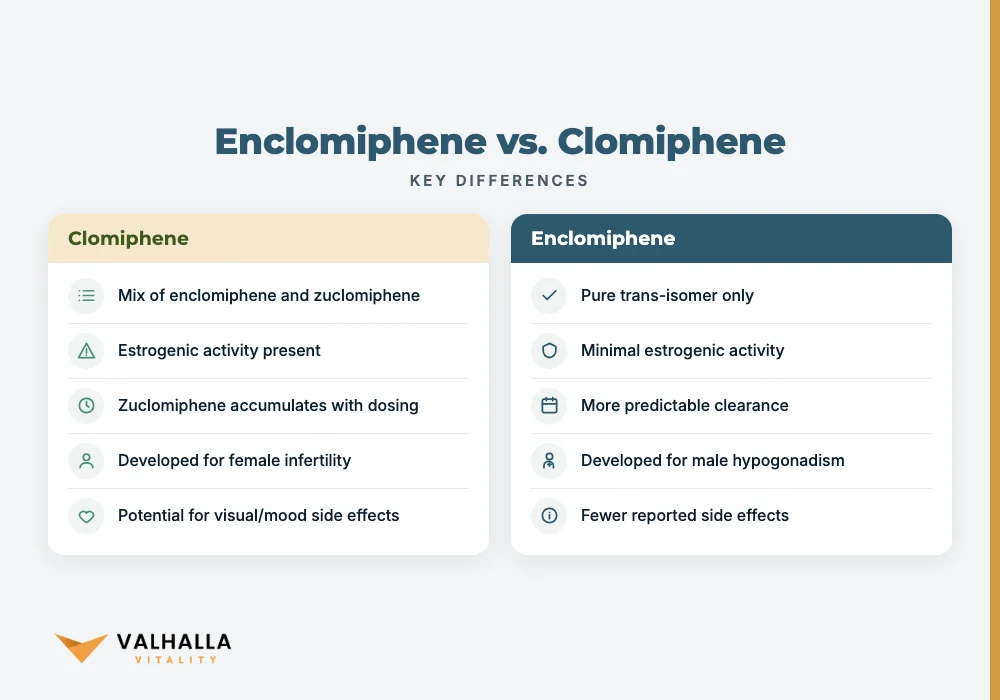
Clomiphene citrate is a racemic mixture. It contains two geometric isomers: zuclomiphene (the cis-isomer) and enclomiphene (the trans-isomer) in roughly equal proportion. Enclomiphene citrate is the purified trans-isomer alone. That structural difference changes the clinical profile in ways that matter for men using it for hormone support.
The enclomiphene vs clomiphene comparison across key dimensions:
| Property | Clomiphene citrate | Enclomiphene citrate |
|---|---|---|
| Composition | Roughly equal mix of enclomiphene and zuclomiphene | Pure trans-isomer only |
| Estrogenic activity | Present via zuclomiphene component | Minimal |
| Clearance pattern | Zuclomiphene accumulates with repeated dosing | More predictable clearance |
| Development history | Developed for female infertility; off-label for men | Developed specifically for male hypogonadism |
Zuclomiphene carries weak estrogenic activity. In a compound intended to block estrogen receptors in the hypothalamus, having a component with its own estrogenic activity partially counteracts the mechanism. Zuclomiphene also accumulates with repeated dosing, extending its presence beyond the intended therapeutic window. These properties are associated with side effects, including visual disturbances and mood changes, that some men experience on clomiphene but less often on enclomiphene.
A 2022 systematic review in Andrology confirmed that clomiphene increases testosterone and gonadotropins in men with hypogonadism while noting that the adverse-effect profile of the racemic mixture warrants monitoring (Huijben et al., 2022). Enclomiphene was developed to isolate the mechanistically useful isomer and remove the pharmacological noise introduced by zuclomiphene.
For a detailed look at what enclomiphene citrate does in the body, a comprehensive review of enclomiphene citrate's pharmacology and clinical use covers the mechanism in more depth.
What are the main uses of enclomiphene for men?
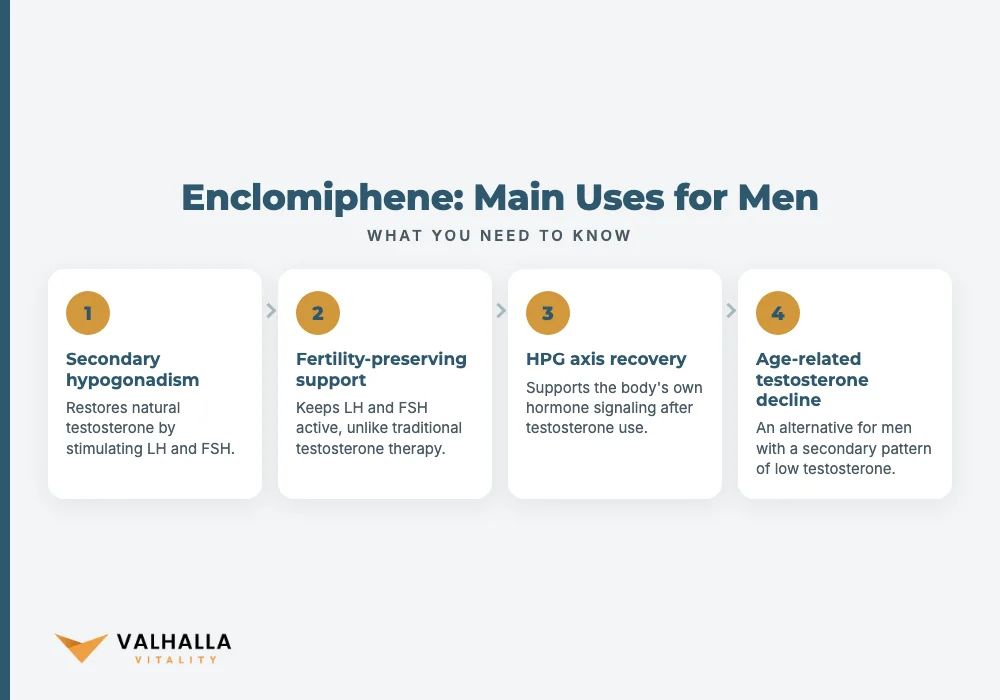
The primary clinical application is secondary hypogonadism. In this condition, the testes are functionally intact but are not receiving adequate hormonal instruction from the hypothalamus and pituitary. Enclomiphene addresses that specific deficit at its source.
Enclomiphene reproductive health applications for men include several distinct clinical contexts:
- Secondary hypogonadism with intact testicular function: Stimulating LH and FSH output through the SERM mechanism to restore endogenous testosterone. This is the most extensively studied use of enclomiphene peptide protocols in men.
- Fertility-preserving testosterone support: Unlike TRT, which suppresses gonadotropins and typically causes sperm production to decline significantly, enclomiphene keeps LH and FSH active. A 2023 meta-analysis in Andrology found that clomiphene improved sperm concentration and total motile sperm count in men with infertility (Huijben et al., 2023). Men who are currently trying to conceive benefit from keeping the reproductive axis intact during treatment.
- HPG axis recovery after exogenous testosterone use: After a period of TRT, the HPG axis needs time and often support to restart its own signaling. Providers may include enclomiphene in medically supervised restart protocols, monitoring gonadotropin and testosterone levels throughout.
- Age-related testosterone decline with a secondary pattern: Testosterone decreases with age, and some men develop a secondary pattern where LH is inappropriately normal or low relative to their testosterone level. When labs confirm this pattern, a provider may evaluate enclomiphene as an alternative to exogenous supplementation.
A 2016 expert review noted that the advantage of enclomiphene over TRT for men who wish to preserve fertility centers on the preservation of gonadotropin output, which TRT consistently suppresses (Rodriguez et al., 2016). That practical difference shapes treatment decisions for men whose reproductive goals remain active.
Can enclomiphene be combined with peptide therapy?
Yes. Providers do combine enclomiphene and peptide therapy in practice, though whether and how depends entirely on the individual's labs, symptoms, and clinical goals.
Enclomiphene acts at the HPG axis. It blocks estrogen receptors in the hypothalamus and pituitary to increase GnRH, LH, and FSH output, which in turn stimulates testicular testosterone production. Peptide compounds, such as growth hormone secretagogues, operate through different receptor systems entirely. There is no direct pharmacological overlap between a SERM and a growth-hormone-releasing peptide. The two do not cancel each other out, which is why an enclomiphene peptide component can coexist with a separate peptide in a single protocol.
The rationale for combining them is that hormonal optimization often involves more than one physiological axis. The HPG axis governs testosterone and reproductive hormones. Other systems govern sleep quality, body composition, and metabolic function. A provider may address the testosterone component with enclomiphene and a different aspect of the patient's clinical picture with a separate peptide, each working through its own pathway without interference.
What does not change: neither compound should be self-administered, informally stacked, or sourced outside a licensed prescribing relationship. A provider determines which components fit, sets the protocol, and monitors response with regular labs. For background on how the estrogen side of this picture fits into the broader hormonal system, enclomiphene's role in the hormone regulation pathway provides useful context.
Enclomiphene peptide as an estrogen modulator: why selectivity matters
The "selective" in SERM is not marketing language. It describes a real pharmacological property: enclomiphene blocks estrogen receptors in some tissues and not others. Its primary action is at the hypothalamus and pituitary. Estrogen receptors elsewhere, including in bone and the cardiovascular system, function largely independently.
This selectivity matters because estrogen is not the enemy in men's hormone health at appropriate concentrations. Bone mineral density, cardiovascular markers, and mood regulation all depend partly on adequate estrogen signaling. An agent that blocked estrogen across all tissue types would damage the very systems that testosterone optimization aims to support. That is a known limitation of aromatase inhibitors, which do reduce systemic estrogen and require more careful management for that reason.
The enclomiphene estrogen modulator approach allows it to lift GnRH and LH output without stripping estrogen activity elsewhere. That is the central clinical advantage over indiscriminate estrogen suppression.
One follow-on consideration: as testosterone rises with enclomiphene treatment, aromatase activity increases and estrogen production rises as well. Estradiol can climb above the reference range if the testosterone response is substantial. Providers monitor estradiol alongside testosterone throughout therapy. Regular lab draws are not optional for this reason. The interconnected hormone system requires data to manage well.
The broader benefits of enclomiphene for men's hormonal health examines the full hormonal picture in more detail.
Who may be evaluated for enclomiphene peptide therapy?
Not every man with low testosterone is a candidate for enclomiphene peptide protocols. The compound targets secondary hypogonadism specifically, and identifying that pattern requires blood work. Symptoms guide the conversation. Labs determine eligibility.
Providers typically look for a specific pattern before considering enclomiphene:
- Low or low-normal serum testosterone alongside LH and FSH values that are inappropriately normal or low. If LH and FSH are already elevated, the testes are failing to respond to adequate stimulation. That is primary hypogonadism, and enclomiphene will not resolve it.
- An intact hypothalamic-pituitary axis, without tumors or adenomas that would disrupt signaling independent of estrogen feedback.
- No active conditions requiring direct testosterone replacement, such as confirmed testicular failure.
- Absence of chronic HPG-suppressant medications, such as long-term opioid use, or a clear plan to address them before beginning therapy.
Men who are trying to conceive represent a group where enclomiphene is often preferred over TRT on clinical grounds: it raises testosterone while keeping the reproductive axis intact, whereas TRT does the opposite. Men who prefer endogenous hormone restoration over exogenous supplementation may also be evaluated, provided labs support that path.
Symptom overlap is common and insufficient for diagnosis on its own. Fatigue, reduced drive, and body composition changes can arise from thyroid dysfunction, sleep apnea, mood disorders, or other conditions that require entirely different interventions. Lab work separates a secondary hypogonadism pattern from those contributors.
Availability varies by state.
What providers assess before prescribing enclomiphene peptide
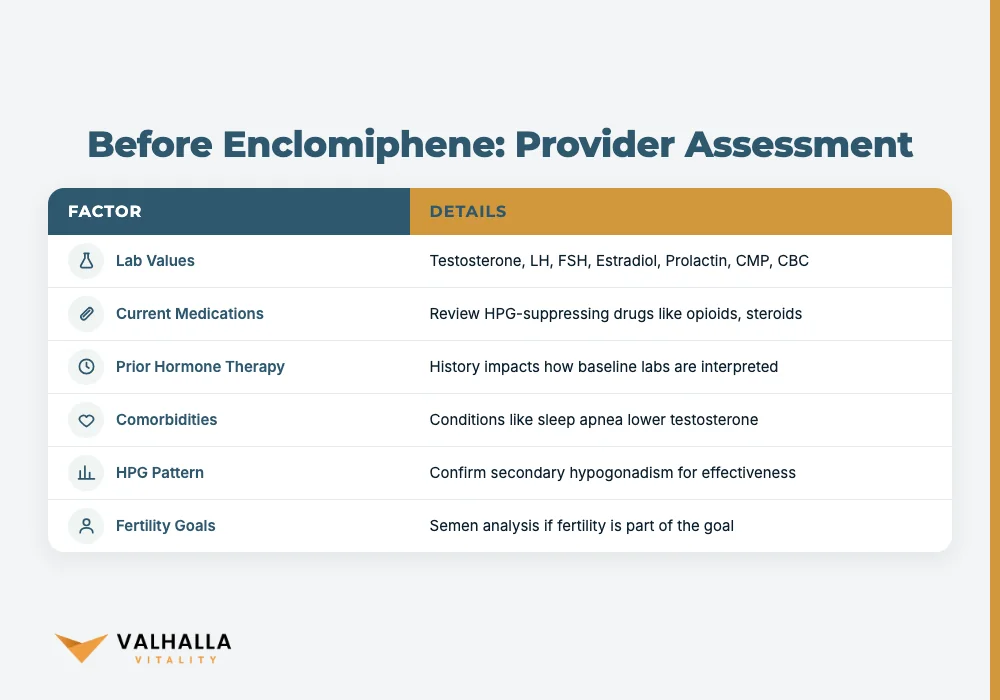
Most coverage of enclomiphene explains what it does but skips the equally relevant question of what providers check before prescribing it. The clinical assessment process matters because the same symptom list does not produce the same treatment in every patient.
Lab values a provider typically reviews
- Total and free testosterone, typically a fasting morning draw to capture peak levels
- LH and FSH, to confirm the HPG pattern is secondary rather than primary
- Estradiol (E2), to understand baseline aromatization and guide monitoring decisions
- Prolactin: elevated prolactin is an independent cause of secondary hypogonadism and requires separate investigation before any HPG-axis treatment begins
- Complete metabolic panel and complete blood count
- Semen analysis, when fertility is part of the clinical goal
Clinical context that shapes the decision
The provider also reviews current medications known to suppress the HPG axis, including opioids, glucocorticoids, and anabolic steroids. Prior hormone therapy history affects how baseline labs are interpreted. Relevant comorbidities, including obstructive sleep apnea, independently lower testosterone and influence the overall clinical picture.
The critical HPG pattern distinction
If LH and FSH are already elevated alongside low testosterone, the testes are not responding to adequate stimulation. That is a primary hypogonadism pattern. Giving enclomiphene in that case increases GnRH and gonadotropins further, but without testes capable of responding, testosterone will not rise. Enclomiphene is only effective when the signaling deficit, not testicular capacity, is the limiting factor.
A licensed provider determines whether a therapy is appropriate after reviewing your intake. Interpreting the HPG axis pattern accurately requires clinical training and lab context that no symptom checklist can replicate.
Regulatory status and off-label use
Enclomiphene citrate does not currently hold a formally approved indication for male hypogonadism in the United States. Its use in men is off-label, a recognized and legally established category in clinical medicine. Off-label prescribing allows providers to apply compounds supported by clinical evidence to indications where formal regulatory approval has not been completed.
The evidence base for enclomiphene peptide use in male hypogonadism has grown through multiple randomized controlled trials. The 2025 meta-analysis by Hohl et al. synthesized that trial data and found meaningful testosterone improvements across studies, supporting clinical use even in the absence of a male-specific approved indication (Hohl et al., 2025). The regulatory pathway for this indication remains in development.
Off-label does not mean unsupported by evidence. It means the manufacturer has not submitted or completed the regulatory process for that specific indication. Providers who prescribe off-label accept responsibility for reviewing the available evidence and matching it to the individual patient. That review is part of the consultation and intake process.
Enclomiphene supplied through telehealth providers comes from partner compounding pharmacies operating under 503A or 503B regulatory frameworks. A provider licensed in your state reviews your intake and, if appropriate, routes the prescription to a partner pharmacy. Availability varies by state.
Book your consultation
A licensed provider can review your lab results and symptoms to determine whether enclomiphene therapy fits your clinical picture. Book Your Consultation to start the intake process.
FAQ
Is enclomiphene the same as a peptide?
No. Enclomiphene is a selective estrogen receptor modulator (SERM), not a peptide. Peptides are chains of amino acids; enclomiphene is a small-molecule compound derived from triphenylethylene chemistry. The phrase "enclomiphene peptide" is informal shorthand from wellness contexts, not a pharmacological classification.
How does enclomiphene raise testosterone without replacing it?
Enclomiphene blocks estrogen receptors in the hypothalamus, which prevents the negative feedback that would suppress GnRH and LH production. More LH signals the Leydig cells in the testes to produce more testosterone. The process uses the body's existing production pathway rather than bypassing it with an external hormone source.
Can enclomiphene be used while trying to have children?
Yes. This is one clinical reason providers may choose enclomiphene over TRT for men with secondary hypogonadism who want to preserve fertility. TRT suppresses LH and FSH, which causes sperm production to decline significantly. Enclomiphene preserves gonadotropin output and may support spermatogenesis throughout treatment.
What makes enclomiphene different from clomiphene for men?
Enclomiphene is the purified trans-isomer of clomiphene. Clomiphene is a racemic mixture containing both enclomiphene and zuclomiphene. Zuclomiphene has weak estrogenic activity and accumulates with repeated dosing, contributing to more side effects. Enclomiphene isolates the anti-estrogenic, gonadotropin-stimulating mechanism without that complication.
Who is not a candidate for enclomiphene?
Men with primary hypogonadism, where the testes cannot produce testosterone regardless of the hormonal signal they receive, do not benefit from enclomiphene. Men whose low testosterone stems from a cause outside the HPG axis, such as a prolactin-secreting pituitary tumor, also require a different treatment approach. Lab results, not symptoms alone, determine eligibility.
Sources
- Hohl A et al. (2025). Clomiphene or enclomiphene citrate for the treatment of male hypogonadism: a systematic review and meta-analysis of randomized controlled trials. Archives of Endocrinology and Metabolism. PubMed
- Rodriguez KM et al. (2016). Enclomiphene citrate for the treatment of secondary male hypogonadism. Expert Opinion on Pharmacotherapy. PubMed
- Huijben M et al. (2023). Clomiphene citrate for male infertility: A systematic review and meta-analysis. Andrology. PubMed
- Huijben M et al. (2022). Clomiphene citrate for men with hypogonadism: a systematic review and meta-analysis. Andrology. PubMed
You May Also Like
 Enclomiphene
Enclomiphene Hair Loss: DHT, Follicles, and the Evidence
Enclomiphene hair loss is not a listed side effect, but testosterone raises DHT, which can affect follicles. Here is what clinical research shows.
October 12, 2026 ETRead more → Enclomiphene
Enclomiphene for Gyno: Causes, Prevention & Treatment
Enclomiphene for gyno: how this SERM may help reduce gynecomastia by rebalancing estrogen and testosterone levels. Talk to a licensed provider today.
October 11, 2026 ETRead more → Enclomiphene
Enclomiphene vs Tamoxifen for PCT and Testosterone
Enclomiphene vs tamoxifen: compare how each SERM supports testosterone recovery, PCT protocols, and side effect profiles before talking to a provider.
October 11, 2026 ETRead more →