
The following blog post is for entertainment and informational purposes only. It is not intended to provide medical advice or diagnosis. Please consult your doctor before making any health-related decisions.
Enclomiphene capsules are a prescription treatment for secondary hypogonadism, a condition where low testosterone results from a disrupted signal between the brain and the testes rather than from testicular failure itself. Unlike testosterone replacement therapy, enclomiphene works by prompting the body to increase its own hormone production.
How enclomiphene capsules work
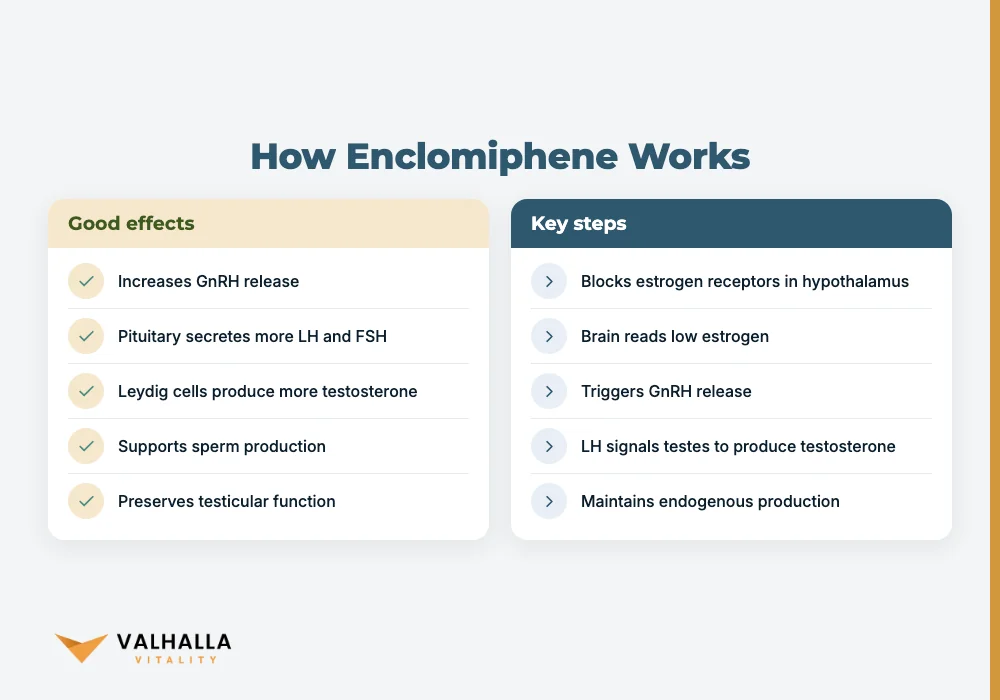
Testosterone production depends on a feedback loop connecting the hypothalamus, pituitary gland, and testes, often called the hypothalamic-pituitary-gonadal (HPG) axis. When this axis sends weak signals, the testes produce less testosterone than the body requires. The compound intervenes at the start of that chain.
Enclomiphene is the trans-isomer of clomiphene citrate. It binds to estrogen receptors in the hypothalamus, blocking estrogen's inhibitory signal. The brain reads that as low estrogen. That triggers a release of gonadotropin-releasing hormone (GnRH), which prompts the pituitary to secrete more luteinizing hormone (LH) and follicle-stimulating hormone (FSH). Higher LH then tells the Leydig cells in the testes to produce more testosterone.
The cascade in brief:
- Enclomiphene blocks estrogen receptors at the hypothalamus
- GnRH release increases
- The pituitary secretes more LH and FSH
- LH signals Leydig cells to produce testosterone
- FSH supports sperm production alongside testosterone
The testes remain active. That distinguishes this approach from direct testosterone therapy, which tends to suppress the HPG axis over time and can reduce testicular output. Preserving endogenous production matters for both fertility and long-term hormonal function.
Enclomiphene capsules vs clomiphene: what is the difference?
Clomiphene citrate is a 50/50 mixture of two isomers: enclomiphene (trans) and zuclomiphene (cis). They behave very differently. Enclomiphene clears the body within days. Zuclomiphene is estrogenic, persists far longer, and is linked to the mood disturbances and visual side effects that some patients report with full clomiphene citrate.
Isolating enclomiphene removes zuclomiphene from the formulation. A 2025 systematic review and meta-analysis by Hohl et al., published in the Archives of Endocrinology and Metabolism, examined randomized controlled trials comparing enclomiphene and clomiphene for male hypogonadism and found comparable efficacy between the two. Both raised testosterone and gonadotropin levels. Differences in tolerability tracked with isomer composition. Because the two isomers have different half-lives and receptor profiles, the clinical rationale for choosing enclomiphene capsules over full clomiphene often comes down to tolerability history and a provider's individualized assessment.
Enclomiphene vs clomiphene is a clinical decision. A licensed provider reviews intake, lab results, and history to determine which formulation is appropriate. Neither is a supplement or an over-the-counter option.
Does enclomiphene work for low testosterone?
Yes, within the mechanism it targets. Enclomiphene capsules are designed for secondary hypogonadism, where the HPG axis is the problem rather than the testes themselves. A 2016 expert review by Rodriguez et al. in Expert Opinion on Pharmacotherapy examined enclomiphene citrate as a secondary hypogonadism treatment and found it raised testosterone while preserving or improving sperm parameters in the men studied.
The distinction between primary and secondary hypogonadism matters for prescribing. In primary hypogonadism, the testes cannot produce testosterone even when stimulated properly. When considering enclomiphene for low testosterone caused by secondary hypogonadism, the key is that the signal is deficient, but the testes can still respond when prompted. Providers confirm which type is present through labs measuring LH, FSH, and total testosterone before prescribing.
Enclomiphene testosterone levels are tracked through regular bloodwork throughout treatment, since the goal is to restore levels to a healthy physiological range, not to push them higher. Individual responses vary. Changes in LH, FSH, and related markers may begin appearing within weeks of starting treatment, according to the clinical data, though ongoing monitoring guides any adjustments. For men with secondary hypogonadism, this approach addresses the root of the problem rather than bypassing it.
Enclomiphene capsules and male fertility
Testosterone replacement therapy and male fertility are often in conflict. The data on enclomiphene, fertility in men, and long-term sperm health points to a meaningfully different outcome. Enclomiphene capsules work differently.
By raising LH and FSH at the same time, enclomiphene supports testosterone production and spermatogenesis simultaneously. A systematic review and meta-analysis by Huijben et al., published in Andrology in 2022, examined clomiphene citrate use in men with hypogonadism and found improvements in sperm parameters alongside testosterone increases, though evidence quality varied across included studies. The Rodriguez et al. (2016) expert review specifically cited this dual action as a reason enclomiphene may be appropriate when fertility preservation is a priority.
For men evaluating enclomiphene's impact on fertility, the clinical profile is an important consideration. A provider assesses semen analysis results and hormone panels before recommending treatment, since the compound's usefulness depends on the specific cause of any reduction in sperm parameters.
What are the side effects of enclomiphene?
Enclomiphene side effects are generally less pronounced than those associated with full clomiphene citrate, partly because zuclomiphene is absent. That said, enclomiphene capsules raise testosterone, and the downstream effects of elevated androgens are possible. Providers monitor these throughout treatment.
Reported enclomiphene side effects include mood changes, acne, and shifts in libido. Increased facial hair growth may occur as testosterone rises. If testosterone climbs above the target range, a licensed provider adjusts the approach. The side effects of enclomiphene are more manageable when lab monitoring is part of the protocol.
Can enclomiphene cause hair loss?
Higher testosterone can convert to dihydrotestosterone (DHT) through the 5-alpha reductase enzyme. In men genetically predisposed to androgenic alopecia, elevated DHT may accelerate hair loss. Enclomiphene capsules are not primarily associated with hair loss in published research, but the hormonal pathway makes it a relevant question for men with a family history of it. A provider monitors DHT and testosterone levels throughout treatment.
Can enclomiphene cause gyno?
Gynecomastia results from an imbalance where estrogen activity exceeds androgen activity in breast tissue. Enclomiphene works by blocking estrogen receptors at the hypothalamus, which drives testosterone production upward and generally moves the estrogen-to-testosterone ratio in a favorable direction. Individual variation exists. If estrogen rises significantly, a provider evaluates and intervenes. Lab monitoring is standard practice with enclomiphene treatment for exactly this reason.
Do you need a prescription for enclomiphene?
Yes. Enclomiphene is a prescription medication in the United States. It is filled by compounding pharmacies operating under 503A or 503B regulations, not sold over the counter or as a supplement. Treating yourself without medical oversight carries risks given the hormonal changes involved.
A telehealth provider begins with a medical intake and lab review. If enclomiphene capsules are appropriate, the provider writes the prescription and it goes to a compounding pharmacy. The enclomiphene dosage for men is determined by a licensed provider after reviewing your results, not by patient selection. Availability varies by state.
Valhalla Vitality connects patients with licensed providers who review each case individually. Full details are on the Valhalla Vitality homepage. Provider approval typically happens within 24 business hours of order placement, and medication arrives approximately 3 to 7 business days after the prescription reaches the pharmacy.
Ask a licensed provider
If you want to know whether enclomiphene capsules may be appropriate for your situation, a licensed provider can review your intake and labs and give you a clear answer. Enclomiphene capsules require a prescription and a personalized provider assessment. Book Your Consultation to begin.
FAQ
Does enclomiphene work for secondary hypogonadism?
Yes, secondary hypogonadism is the primary indication for enclomiphene capsules. The compound restores HPG axis signaling, prompting the testes to produce more testosterone on their own. A 2016 review by Rodriguez et al. found that enclomiphene raised testosterone levels while preserving sperm parameters in the men studied.
What are the most common enclomiphene side effects?
Reported enclomiphene side effects include mood changes, acne, and libido shifts, often tied to rising testosterone rather than to enclomiphene directly. Increased facial hair growth is also possible. A licensed provider monitors hormone levels throughout treatment and adjusts as needed.
Can enclomiphene cause hair loss?
Elevated testosterone can increase DHT, which may accelerate androgenic alopecia in men who are genetically predisposed to it. Hair loss is not a primary adverse event in published enclomiphene research, but the hormonal mechanism makes it a realistic concern for some patients. A provider monitors relevant markers throughout treatment.
What is enclomiphene's regulatory status in the U.S.?
Enclomiphene citrate has not received standalone FDA approval as a finished drug. It is prescribed in the United States through compounding pharmacies under 503A or 503B frameworks, which differ from standard FDA drug approval. A licensed provider will explain what this means for your specific situation.
How does enclomiphene differ from testosterone replacement therapy?
Testosterone replacement therapy supplies the hormone externally, which tends to suppress the testes and reduce sperm production. Enclomiphene capsules stimulate the body's own production by acting on the HPG axis, keeping testicular function intact. That difference matters most for men who want to address low testosterone without sacrificing fertility.
Sources
- Hohl A et al. (2025). Clomiphene or enclomiphene citrate for the treatment of male hypogonadism: a systematic review and meta-analysis of randomized controlled trials. Archives of Endocrinology and Metabolism. PubMed
- Rodriguez KM et al. (2016). Enclomiphene citrate for the treatment of secondary male hypogonadism. Expert Opinion on Pharmacotherapy. PubMed
- Huijben M et al. (2022). Clomiphene citrate for men with hypogonadism: a systematic review and meta-analysis. Andrology. PubMed
You May Also Like
 Enclomiphene
Enclomiphene Before and After: Physical Changes Explained
Enclomiphene before and after: what physical changes to expect, how the results timeline unfolds, and why provider monitoring matters for outcomes.
October 21, 2026 ETRead more → Enclomiphene
Enclomiphene Vision Side Effects: Eye Floaters & More
Enclomiphene vision side effects include eye floaters, blurry vision, and light sensitivity. Know the warning signs and when to contact your provider.
October 21, 2026 ETRead more → Enclomiphene
Enclomiphene Drug Test: Detection, WADA, and Disclosure
Enclomiphene drug test detection depends on the test type. Learn how workplace panels, military screening, and WADA rules treat this SERM.
October 21, 2026 ETRead more →