
The following blog post is for entertainment and informational purposes only. It is not intended to provide medical advice or diagnosis. Please consult your doctor before making any health-related decisions.
Enclomiphene for low testosterone works by reactivating the body's own hormone-signaling pathway rather than delivering testosterone from an external source. It blocks estrogen receptors at the hypothalamus and pituitary, which prompts those glands to release more luteinizing hormone (LH) and follicle-stimulating hormone (FSH). The testes respond by producing more testosterone on their own. Men with secondary hypogonadism, where the signaling system underperforms rather than the testes themselves being the problem, are the primary candidates, and enclomiphene therapy is evaluated through a licensed provider after reviewing lab results.
What is enclomiphene citrate?
Enclomiphene citrate is the trans-isomer of clomiphene citrate. Clomiphene, used in reproductive medicine for decades, is a mixture of two stereoisomers: zuclomiphene (the cis form) and enclomiphene (the trans form). Researchers found that enclomiphene carries most of the estrogen-receptor-blocking activity and clears the body faster, without the prolonged estrogenic effects associated with the zuclomiphene fraction.
As a selective estrogen receptor modulator (SERM), enclomiphene does not add testosterone to the body. It changes the feedback signal the hypothalamus and pituitary receive, reducing the estrogen brake on GnRH and LH output. The body responds. Testosterone production may rise as a result.
This is what makes enclomiphene for low testosterone mechanistically different from testosterone replacement therapy. TRT delivers testosterone from outside the body. Enclomiphene prompts the body to produce more of its own. That distinction has meaningful consequences for fertility, testicular function, and long-term hormone management.
A 2016 review in Expert Opinion on Pharmacotherapy described enclomiphene citrate as targeting secondary male hypogonadism specifically, where the testes are capable of production but the upstream signaling is insufficient. That remains the most accurate clinical framing of what the compound does.
How enclomiphene works: the HPG axis
The hypothalamic-pituitary-gonadal (HPG) axis is the hormonal relay that controls testosterone production. The hypothalamus releases gonadotropin-releasing hormone (GnRH), which signals the pituitary to release LH and FSH. LH then stimulates Leydig cells in the testes to produce testosterone. As testosterone and its estrogen derivatives rise, they feed back to the hypothalamus and pituitary to reduce GnRH and LH output. That feedback loop keeps levels in a regulated range.
In secondary hypogonadism, this loop produces testosterone below the normal range even though the testes are functional. The problem sits upstream. Enclomiphene blocks the estrogen receptors at the hypothalamus and pituitary that apply that brake, allowing LH and FSH to rise and driving the testes to increase output.
FSH plays a parallel role. It supports spermatogenesis, the ongoing production of sperm. When enclomiphene raises FSH alongside LH, sperm production is typically maintained or may improve. That is the biological basis for the fertility-preservation argument that consistently distinguishes enclomiphene from TRT.
The HPG axis remains active throughout enclomiphene treatment. That contrasts with testosterone replacement therapy, where elevated exogenous testosterone progressively suppresses GnRH and LH output, effectively shutting down the axis while therapy continues. Both outcomes on the axis matter when choosing between treatments.
Enclomiphene vs TRT: key differences
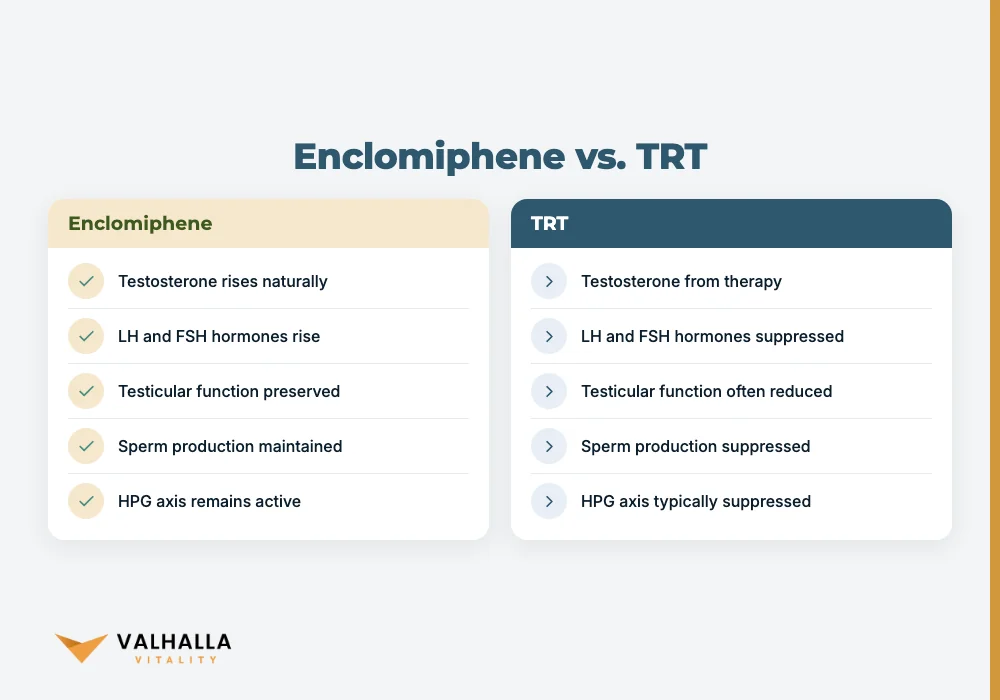
The question of enclomiphene vs TRT starts with mechanism. The two therapies reach higher testosterone through entirely different paths, with different downstream effects on fertility and axis function.
| Factor | Enclomiphene | TRT |
|---|---|---|
| How testosterone rises | Endogenous, via HPG stimulation | Exogenous, from the therapy itself |
| Effect on LH and FSH | Both rise | Both suppressed |
| Testicular function | Preserved | Often reduced over time |
| Spermatogenesis | Maintained or improved | Suppressed in most men |
| HPG axis activity | Remains active | Typically suppressed while on therapy |
| Common delivery | Oral | Injection, gel, patch, pellet |
The differences carry clinical weight, particularly for men in their reproductive years or those who want to preserve long-term testicular function. Understanding the mechanism is what allows a provider to match therapy to diagnosis rather than defaulting to one approach for all cases.
Is enclomiphene better than testosterone replacement therapy?
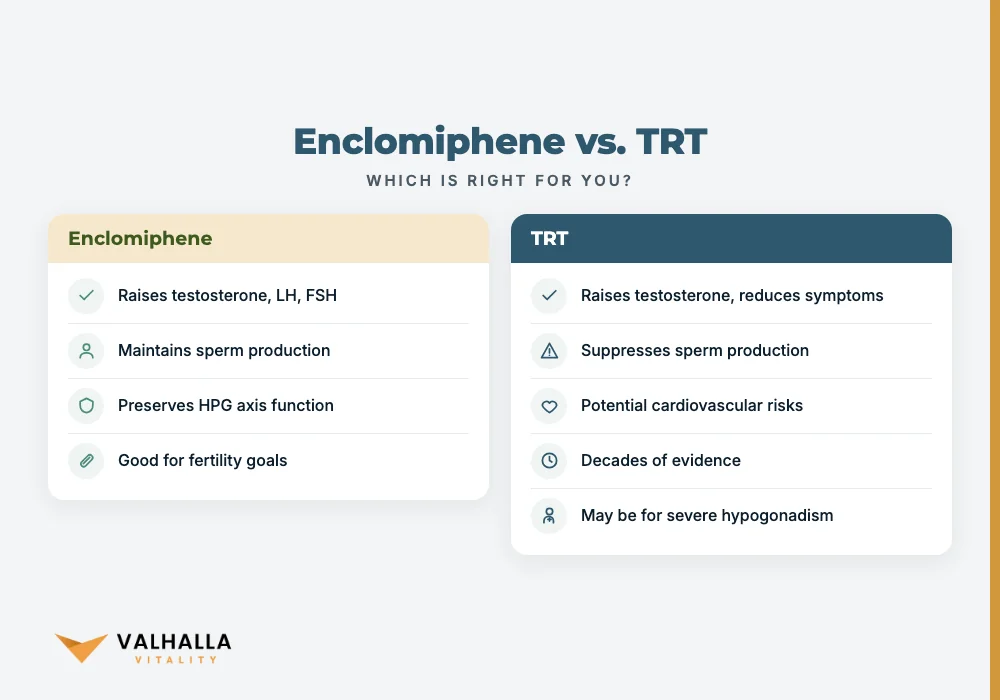
Neither is universally better. The right choice depends on the cause of low testosterone, fertility goals, and what a licensed provider determines after reviewing labs and clinical history.
TRT is well-established for raising testosterone and reducing symptoms of hypogonadism. A 2024 systematic review in Health Technology Assessment confirmed TRT's effectiveness for improving fatigue, libido, and mood in men with low T. That same review documented meaningful cardiovascular and hematological risks with long-term use, including polycythemia.
A 2024 clinical guidance paper in Expert Opinion on Pharmacotherapy noted that no TRT delivery method, regardless of formulation, avoids suppression of the HPG axis while it is being used.
Spermatogenesis is a specific concern. A 2025 review in Nature Reviews Urology found that TRT suppresses sperm production in the majority of reproductive-age men, and recovery after stopping cannot be assumed for all of them.
Enclomiphene addresses the testosterone deficit without triggering that suppression. A 2025 systematic review and meta-analysis in Archives of Endocrinology and Metabolism found that enclomiphene significantly raised serum testosterone, LH, and FSH in men with secondary hypogonadism, while semen parameters were maintained or improved. The overall safety profile was broadly acceptable, though the evidence base is still narrower than the decades-long TRT dataset.
For men trying to preserve fertility or maintain HPG axis function, enclomiphene is the more clinically compelling option. For men not planning for children, with more severe hypogonadism, or who have not responded to enclomiphene, TRT may be more appropriate. Some patients may benefit from a combined approach; the article on how enclomiphene citrate may enhance TRT outcomes covers that protocol in more detail.
Can you use enclomiphene if you have low testosterone?
Enclomiphene is appropriate for secondary hypogonadism: low testosterone caused by insufficient signaling from the hypothalamus or pituitary, not by damage to the testes themselves.
If the testes are functional but receiving weak upstream signals, enclomiphene may prompt them to increase testosterone output. If the testes are the primary site of the problem (primary hypogonadism), raising LH and FSH will not produce the intended result, because the downstream target cannot respond adequately.
Identifying which pattern is present requires lab work. The key markers are total testosterone, LH, and FSH. Low testosterone paired with suppressed or low-normal LH and FSH points toward secondary hypogonadism. Low testosterone with elevated LH and FSH points toward primary hypogonadism. Those are different clinical situations requiring different approaches.
Recognizing the symptoms that prompt a lab evaluation is a useful first step. The article on signs and symptoms of low testosterone by age covers how presentation varies across decades of life, which helps clarify when testing is worth pursuing.
Lab results and a provider's interpretation determine whether enclomiphene is appropriate. Symptom patterns alone are not sufficient to make that call.
Enclomiphene for low testosterone: clinical evidence and benefits
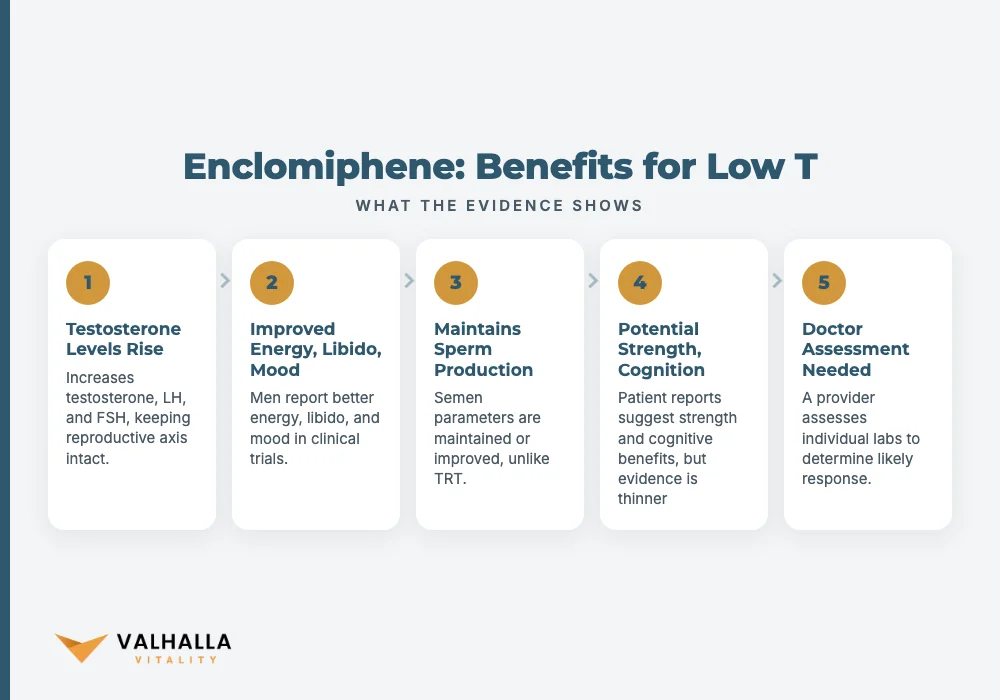
The primary benefit of enclomiphene for low testosterone is raising serum testosterone through a mechanism that keeps the reproductive axis intact. In clinical studies of men with secondary hypogonadism, testosterone rose alongside LH and FSH, confirming the HPG axis was responding as intended.
Beyond the hormone numbers, men in trials reported improvements in energy, libido, and mood. These track what clinicians associate with correcting low T by any method, not outcomes specific to enclomiphene. What sets this compound apart is that those improvements may occur while sperm production is maintained or improved.
The fertility-related finding is clinically distinctive. A 2025 meta-analysis in Archives of Endocrinology and Metabolism found semen parameters were maintained or improved in enclomiphene treatment groups. A 2025 review in Nature Reviews Urology noted that TRT suppresses spermatogenesis as a routine consequence of use. For men in their reproductive years, that contrast is significant.
Strength and cognitive function appear frequently in patient-reported outcomes, but the evidence for those specific benefits is thinner than the testosterone and fertility data. No benefit should be assumed from reading an article; a provider assessment of individual lab results determines whether a specific person is likely to respond.
The full profile of enclomiphene citrate benefits and clinical applications is examined in this clinical overview of enclomiphene citrate.
How long does enclomiphene take to increase testosterone?
LH and FSH typically begin to rise within the first one to two weeks of starting enclomiphene, as the HPG axis responds to reduced estrogen inhibition. Testosterone follows as the testes ramp up production. Noticeable symptom changes, such as improved energy or libido, often lag behind the lab numbers by several additional weeks.
The timeline is not fixed. Baseline testosterone level, the severity of the signaling deficit, age, body composition, and overall metabolic health all affect how quickly the testes respond. A provider will schedule follow-up labs after a defined interval to measure whether testosterone has reached the target range, adjusting the plan based on results.
Realistic expectations matter. Enclomiphene corrects a signaling deficit through the body's own mechanisms. It does not work like a stimulant. Consistent use under provider supervision, with labs at scheduled checkpoints, is how the therapy is actually managed.
What are the side effects of enclomiphene citrate?
Enclomiphene is generally well tolerated. The most commonly reported side effects are nausea, headache, transient visual disturbances, and breast tenderness in some men. These are usually mild and temporary. They should be reported to the prescribing provider if they persist, worsen, or appear in combination.
A 2025 systematic review and meta-analysis in Archives of Endocrinology and Metabolism examined the safety profile across multiple randomized trials and found enclomiphene broadly tolerable. The authors noted that long-term safety data is still more limited than what exists for TRT, where decades of post-market reporting have accumulated.
Comparing the risk profiles adds useful context. TRT carries a well-documented risk of polycythemia, testicular atrophy, and sustained HPG axis suppression. A 2024 review in American Family Physician listed polycythemia and spermatogenesis suppression as established TRT risks. Enclomiphene does not carry those same risks mechanistically, though it is not without side effect potential.
Men with a history of estrogen-sensitive conditions or a prior allergy to clomiphene should disclose those details before starting any SERM. The article covering enclomiphene side effects, monitoring, and safety addresses reporting thresholds and clinical warning signs in detail.
What is the recommended enclomiphene dosage for men?
A licensed provider determines the appropriate enclomiphene dosage for men based on labs and clinical history. No single amount applies across all men, because the correct level depends on baseline testosterone, LH and FSH values, initial treatment response, and the provider's clinical judgment.
Self-dosing or adjusting based on online protocols carries real risk. Under-dosing may leave testosterone below the target range; over-dosing can push testosterone or estrogen outside normal limits and create avoidable side effects. Lab-guided titration, with scheduled monitoring, avoids both outcomes.
The standard workflow: order baseline labs covering total testosterone, LH, FSH, complete blood count, and a metabolic panel. A starting dose is selected based on those results. Follow-up labs are ordered after a defined interval. The dose is adjusted based on response. That cycle continues until the target range is stable.
Telehealth providers like Valhalla Vitality manage this process online, routing intake, lab orders, and prescriptions through licensed providers in applicable states. Availability varies by state for telehealth prescribing of enclomiphene.
Who is a good candidate for enclomiphene?
The clearest candidate profile for enclomiphene for low testosterone is a man with documented secondary hypogonadism: low total testosterone combined with normal or low LH and FSH, indicating the HPG axis is underperforming rather than depleted. That lab pattern suggests the testes are capable of responding to a stronger upstream signal.
Men in their reproductive years who want to avoid spermatogenesis suppression represent another well-defined group. Preserving fertility is not only relevant for men actively planning to have children. Testicular function and sperm production are connected to broader long-term hormonal health, and maintaining them may carry value beyond immediate family planning.
Men with primary hypogonadism, where the testes are the site of the problem, are generally not candidates. Men whose HPG axis has been suppressed by prior TRT use may potentially respond to enclomiphene after stopping, but that scenario requires careful clinical management and is not a straightforward transition.
Prior history shapes eligibility in other ways. A known allergy to clomiphene or enclomiphene is a contraindication. Certain estrogen-sensitive conditions and medications that interact with SERMs should be disclosed during the provider intake process. That intake is where eligibility factors are formally evaluated, not self-assessed.
Low T treatment options: understanding the full range
Enclomiphene is one option within a broader set of low T treatment options. Where it fits in the decision sequence depends on the lab picture and what a provider determines after evaluation.
Lifestyle factors affect testosterone more than many men expect. Consistent sleep, resistance training, weight management, and limiting alcohol all influence hormone levels. Many providers encourage addressing those factors before or alongside any prescription therapy. Some men find their levels normalize with lifestyle changes alone.
For men whose testosterone is clinically low and does not respond to lifestyle changes, prescription options come into view. TRT is the most widely used. Enclomiphene addresses the same endpoint through a different mechanism, and its distinct risk profile makes it the preferred choice for specific clinical groups. A 2024 review in American Family Physician noted that candidate selection and monitoring are essential for any testosterone-related therapy.
For men curious about options that do not require a prescription, the article on over-the-counter low testosterone treatments covers what is available without a prescription and what the evidence shows for those compounds.
A provider evaluation is the shared starting point across all these paths. Labs establish whether testosterone is actually low and identify the type of hypogonadism. That diagnosis drives treatment selection.
Ready to discuss enclomiphene for low testosterone with a provider?
If enclomiphene for low testosterone is something you want to evaluate with clinical guidance, the practical next step is a provider review of your labs and history. Book Your Consultation to start that process.
FAQ
Can you use enclomiphene if you have low testosterone?
Enclomiphene is designed for secondary hypogonadism, where low testosterone results from insufficient HPG axis signaling rather than impaired testes. A provider will review labs to confirm the hormone pattern fits that clinical picture before prescribing. Men with primary hypogonadism, where the testes are the underlying problem, typically do not benefit from enclomiphene.
How long does enclomiphene take to increase testosterone?
LH and FSH typically begin rising within the first one to two weeks, and testosterone follows as the testes respond to those signals. Symptom changes often lag behind lab improvements by several additional weeks. Individual response depends on baseline values, age, and overall metabolic health.
What are the side effects of enclomiphene citrate?
The most commonly reported side effects are nausea, headache, transient visual changes, and breast tenderness. A 2025 systematic review in Archives of Endocrinology and Metabolism found enclomiphene broadly tolerable across clinical trials. Persistent or worsening side effects should be reported to the prescribing provider promptly.
Is enclomiphene better than testosterone replacement therapy?
Enclomiphene and TRT address low testosterone through different mechanisms and suit different clinical profiles. Enclomiphene preserves HPG axis function and spermatogenesis, which TRT typically suppresses. Neither is universally preferable; the right choice depends on diagnosis, fertility goals, and a licensed provider's evaluation.
What is the recommended enclomiphene dosage for men?
A licensed provider determines the appropriate dose based on baseline labs, clinical presentation, and response to initial treatment. No single dose applies across all men; lab-guided titration under ongoing provider supervision is standard practice for managing this therapy safely.
Sources
- Hohl A et al. (2025). Clomiphene or enclomiphene citrate for the treatment of male hypogonadism: a systematic review and meta-analysis of randomized controlled trials. Archives of endocrinology and metabolism. PubMed
- Cruickshank M et al. (2024). The effects and safety of testosterone replacement therapy for men with hypogonadism: the TestES evidence synthesis and economic evaluation. Health technology assessment (Winchester, England). PubMed
- Rodriguez KM et al. (2016). Enclomiphene citrate for the treatment of secondary male hypogonadism. Expert opinion on pharmacotherapy. PubMed
- Naelitz BD et al. (2025). Testosterone replacement therapy and spermatogenesis in reproductive age men. Nature reviews. Urology. PubMed
- Heidelbaugh JJ et al. (2024). Testosterone Replacement Therapy for Male Hypogonadism. American family physician. PubMed
- Luther PM et al. (2024). Testosterone replacement therapy: clinical considerations. Expert opinion on pharmacotherapy. PubMed
You May Also Like
 Enclomiphene
Enclomiphene Before and After: Physical Changes Explained
Enclomiphene before and after: what physical changes to expect, how the results timeline unfolds, and why provider monitoring matters for outcomes.
October 21, 2026 ETRead more → Enclomiphene
Enclomiphene Vision Side Effects: Eye Floaters & More
Enclomiphene vision side effects include eye floaters, blurry vision, and light sensitivity. Know the warning signs and when to contact your provider.
October 21, 2026 ETRead more → Enclomiphene
Enclomiphene Drug Test: Detection, WADA, and Disclosure
Enclomiphene drug test detection depends on the test type. Learn how workplace panels, military screening, and WADA rules treat this SERM.
October 21, 2026 ETRead more →