Enclomiphene for testosterone: how it works and who it helps

The following blog post is for entertainment and informational purposes only. It is not intended to provide medical advice or diagnosis. Please consult your doctor before making any health-related decisions.
Enclomiphene for testosterone is a treatment approach for men with secondary hypogonadism, a condition where testosterone falls because the brain has stopped sending adequate signals to the testes rather than because the testes themselves have failed. By blocking estrogen receptors in the hypothalamus and pituitary gland, it prompts those structures to release more luteinizing hormone (LH) and follicle-stimulating hormone (FSH), which then drive the testes to produce testosterone naturally. This preserves the body's own production axis rather than bypassing it entirely. When lab results and symptoms point toward a signaling gap, scheduling a provider intake is the logical next step.
What is enclomiphene citrate used for?
Enclomiphene citrate is used to treat secondary male hypogonadism by stimulating the body's own testosterone production pathway. Secondary hypogonadism means testosterone is low because the brain-to-testes signaling system is underperforming, not because the testes have lost the ability to respond.
The compound originates from clomiphene citrate, a medication used in fertility contexts for decades. Clomiphene citrate is a mixture of two stereoisomers: zuclomiphene (the cis-isomer) and enclomiphene (the trans-isomer). These two behave very differently once in the body. Zuclomiphene has a long half-life, accumulates with repeated dosing, and exhibits partial estrogen agonist activity at some receptor sites. This mixed behavior is why men using full clomiphene sometimes report side effects such as mood changes and visual disturbances. Enclomiphene is the isolated trans-isomer. It acts as a clean estrogen receptor antagonist at the hypothalamus and pituitary, clears faster between doses, and does not accumulate in the same way. A 2016 review in Expert Opinion on Pharmacotherapy identified these pharmacological distinctions as the reason enclomiphene represents an advance over mixed clomiphene for secondary male hypogonadism.
The distinction between primary and secondary hypogonadism is worth understanding at a practical level. In secondary hypogonadism, the testes are structurally intact and capable of testosterone production; they simply are not receiving the hormonal instruction to do so at adequate levels. Think of it as a factory that is fully functional but has not received the production order. Enclomiphene restores the order. Primary hypogonadism, where the factory itself is damaged, is a different situation: no amount of upstream signaling will change the output, because the response capacity is gone.
Lab results reflect this distinction. Secondary hypogonadism typically shows low total testosterone alongside LH and FSH that are either low or inappropriately normal for that level of deficiency, indicating the problem sits upstream in the brain. Primary hypogonadism produces elevated LH and FSH as the body compensates for unresponsive testes. Enclomiphene is designed for the first pattern, not the second.
Understanding the full range of low testosterone treatment options, including lifestyle factors, hormonal approaches, and their respective trade-offs, can help men prepare for a more productive provider consultation.
How does enclomiphene for testosterone work?
Enclomiphene for testosterone raises T levels by removing a braking signal from the body's own hormone axis rather than adding testosterone from an external source. This is the central mechanism that sets it apart from testosterone replacement therapy.
The hypothalamic-pituitary-gonadal (HPG) axis operates as a feedback loop. The hypothalamus releases gonadotropin-releasing hormone (GnRH), which tells the pituitary to secrete LH and FSH. LH travels to the testes and signals Leydig cells to produce testosterone. FSH supports the Sertoli cells that maintain sperm development. When testosterone and estradiol rise high enough, they feed back to the hypothalamus and pituitary and reduce GnRH, LH, and FSH output. In secondary hypogonadism, this feedback suppression runs too strong or the initial signal is too weak. Testosterone never reaches a healthy level.
Enclomiphene blocks estrogen receptors at the hypothalamus and pituitary. The brain reads the situation as though estrogen is low and responds by increasing GnRH output. LH and FSH follow. The testes receive a stronger drive and produce more testosterone.
| HPG axis stage | In secondary hypogonadism | With enclomiphene |
|---|---|---|
| Hypothalamus | GnRH output suppressed or weak | Estrogen receptor block removes inhibition |
| Pituitary | LH and FSH low or low-normal | LH and FSH levels rise |
| Leydig cells (testes) | Testosterone production reduced | Testosterone production increases |
| Sertoli cells (testes) | Sperm support may be compromised | Spermatogenesis maintained by rising FSH |
The practical result is that enclomiphene LH FSH levels increase together, and those elevated gonadotropins sustain the testes' ongoing output. Because testosterone is produced by the testes rather than delivered from outside, testicular size and function remain intact during treatment. The 2016 review in Expert Opinion on Pharmacotherapy confirmed measurable increases in LH, FSH, and total testosterone in men treated with enclomiphene for secondary hypogonadism. A 2025 systematic review and meta-analysis in Archives of Endocrinology and Metabolism updated this picture by pooling randomized controlled trial data on enclomiphene and related compounds for male hypogonadism.
Early clinical data noted that hormonal changes, visible through LH and FSH elevations, can appear within the first day or two of dosing as the receptor blockade takes effect quickly at the pituitary. Subjective symptom improvements in energy, mood, and libido typically emerge over several weeks of consistent treatment, as the rising testosterone signal accumulates in tissue and downstream effects unfold.
Clomiphene vs enclomiphene: what the research shows
Clomiphene citrate was the standard off-label option for men who wanted to raise testosterone without suppressing fertility before enclomiphene was isolated as a distinct compound. The clomiphene vs enclomiphene comparison explains why the two are not interchangeable despite sharing a common origin.
The original rationale for using clomiphene in men was sound: its estrogen receptor antagonism at the pituitary raised LH and FSH without delivering exogenous testosterone. The limitation was the formulation itself. Clomiphene contains roughly equal parts zuclomiphene and enclomiphene, and that mix was a constraint of what was available at the time, not a deliberate clinical choice. Isolating enclomiphene removes the problem fraction entirely.
What remains is a targeted estrogen receptor antagonist at the pituitary and hypothalamus with a shorter half-life and a more predictable clearance profile. Zuclomiphene's longer half-life means it lingers after each dose, accumulates over time, and carries partial agonist properties that can produce estrogenic side effects, including breast tenderness, mood disturbance, and in some cases visual symptoms. None of that applies to isolated enclomiphene.
The 2025 systematic review and meta-analysis in Archives of Endocrinology and Metabolism examined the randomized controlled trial evidence for both compounds in male hypogonadism. The pooled data supports enclomiphene's improved tolerability relative to mixed clomiphene, alongside comparable testosterone restoration. Providers who previously relied on clomiphene for this indication now have a more refined option.
Whether enclomiphene, clomiphene, or TRT is appropriate for a specific patient depends on the lab profile, symptom picture, comorbidities, and treatment goals. A provider makes that judgment with complete information; the purpose of this comparison is to clarify the pharmacological differences, not to guide self-treatment.
Is enclomiphene better than testosterone replacement therapy?
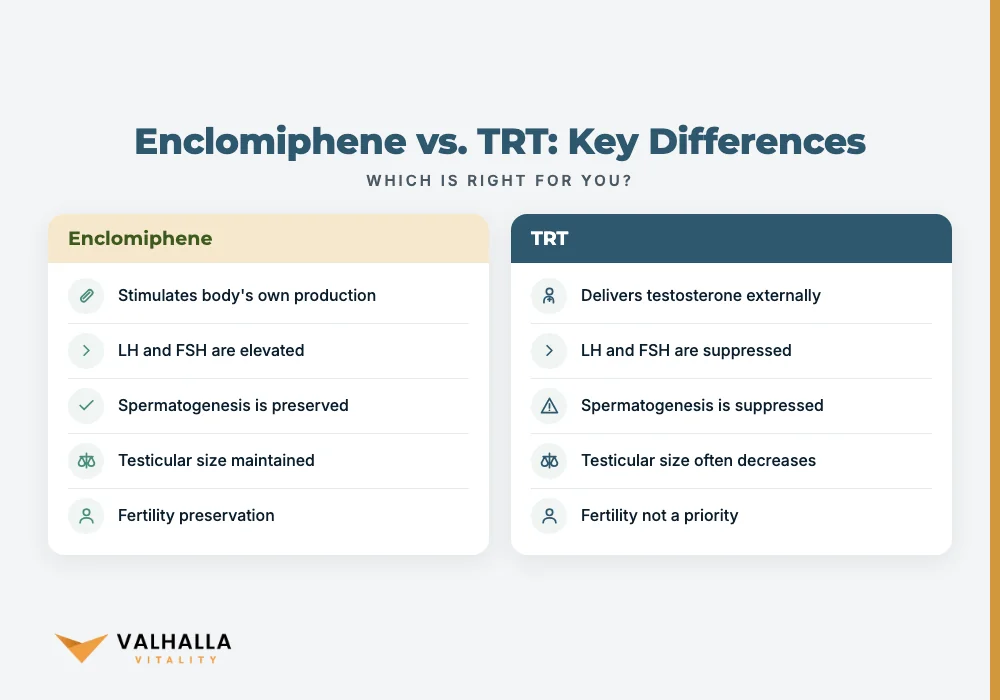
The honest answer is that neither is universally better. Enclomiphene for testosterone and TRT address the same end goal, raising serum testosterone, through mechanisms that differ in ways that can be decisive depending on the patient's situation.
TRT delivers exogenous testosterone directly. Serum T rises, but the HPG axis detects it and shuts down LH and FSH output. A 2025 review in Nature Reviews Urology found that TRT consistently suppresses spermatogenesis in reproductive-age men, often substantially, with recovery timelines that vary by formulation and individual. A 2024 evidence synthesis in Health Technology Assessment confirmed spermatogenesis suppression as a key clinical consideration for men who want to preserve fertility or testicular function during treatment.
Enclomiphene for testosterone works the opposite way. LH and FSH go up rather than down. The testes keep receiving their natural signal, continue producing testosterone, and maintain sperm development simultaneously.
| Feature | Enclomiphene for testosterone | Testosterone replacement therapy |
|---|---|---|
| Mechanism | Stimulates body's own production | Delivers testosterone externally |
| LH and FSH during treatment | Elevated | Suppressed |
| Testicular size | Maintained | Often decreases with prolonged use |
| Spermatogenesis | Preserved | Suppressed (Naelitz et al., 2025) |
| Delivery route | Oral tablet | Injection, gel, patch, or pellet |
| Natural hormone axis | Active | Bypassed |
| Best fit | Secondary hypogonadism, fertility preservation | Primary or secondary hypogonadism, fertility not a priority |
TRT is a well-established, effective therapy. A 2024 review in American Family Physician describes it as a first-line option for confirmed hypogonadism when fertility is not a concern. A 2024 clinical review in Expert Opinion on Pharmacotherapy outlines the range of TRT delivery formats and their respective risk-benefit profiles, noting that different formulations carry distinct considerations around testosterone stability, injection frequency, and skin contact transfer risk. For men who have completed their families or who have primary hypogonadism, TRT may be the right call.
For men exploring testosterone therapy alternatives that avoid suppressing fertility, or whose low testosterone reflects an upstream signaling gap rather than testicular failure, enclomiphene for testosterone offers a structurally different pathway. A provider with access to full lab work determines which approach matches the individual.
To understand more about how these two treatment paths interact in a clinical context, see how enclomiphene affects TRT outcomes.
Enclomiphene citrate benefits for men
The clinical case for enclomiphene traces directly to its mechanism. Because it stimulates rather than replaces testosterone production, the advantages are both hormonal and structural.
Testosterone restoration while keeping the axis running. Enclomiphene for testosterone raises T levels by driving LH and FSH upward. The testes remain functionally active throughout treatment. The body retains some regulatory capacity, which matters when treatment is eventually adjusted or paused.
Axis continuity after stopping. Men on TRT who discontinue treatment often experience a period of low testosterone as the suppressed axis slowly reactivates. For men on enclomiphene, the natural axis has been running the entire time. This may simplify any eventual transition to a monitoring-only phase, though a licensed provider guides all decisions about adjusting or ending hormonal treatment.
Fertility preservation. This is the most clinically significant enclomiphene citrate benefit relative to TRT. Because FSH rises instead of falling, Sertoli cells continue supporting sperm development during treatment. Men who want to preserve biological fatherhood as a future option, even without immediate plans, maintain that option structurally. The 2025 review in Nature Reviews Urology on TRT-driven spermatogenesis suppression made this distinction clinically prominent for reproductive-age men.
Oral administration. Enclomiphene is taken as a tablet. This removes the logistical demands of injectable testosterone, which requires either self-injection technique or periodic clinical visits. It also removes the cold-chain and sterile preparation complexity that injectable regimens involve. For men with busy schedules or frequent travel, a tablet-based routine can be easier to maintain consistently.
Potential improvement in energy, libido, and mood. These are recognized features of testosterone deficiency, and normalizing T levels may support improvement in all three. Early research on the compound noted subjective well-being improvements alongside hormonal changes. A licensed provider determines the dose after labs and monitors response at scheduled intervals; results vary by individual.
Bone density and muscle mass support. Testosterone plays a documented role in maintaining bone mineral density and lean muscle mass. Restoring T toward normal ranges may support both in men whose levels have been chronically low. The extent of benefit depends on factors a provider assesses individually.
For a comprehensive review of the documented clinical profile, including safety data across studies, a detailed breakdown of enclomiphene citrate uses, benefits, and side effects provides additional depth.
What are the side effects of enclomiphene?
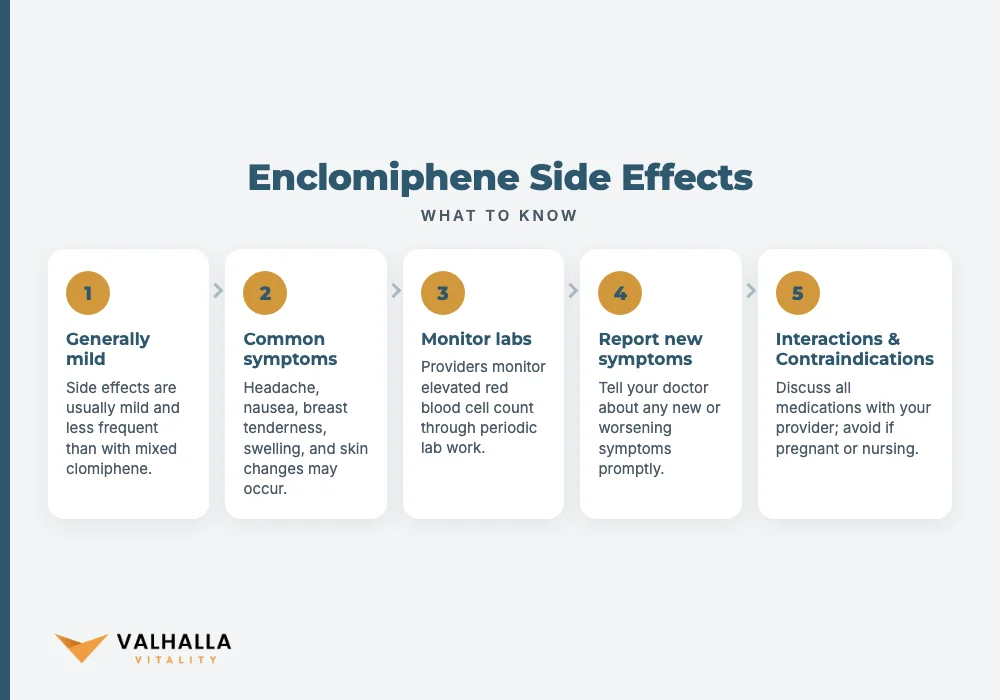
Enclomiphene side effects in men are generally mild and less frequent than those associated with mixed clomiphene, reflecting the removal of the zuclomiphene fraction. Not everyone experiences side effects; individual response varies with baseline hormonal status and other health factors.
Side effects reported in clinical literature include:
- Headache
- Nausea and abdominal bloating
- Breast tenderness
- Swelling, particularly in the lower extremities
- Skin changes, including acne
- Elevated red blood cell count, which providers monitor through periodic lab work
- Visual disturbances, reported less frequently than with clomiphene but worth monitoring if they occur
- Increased libido in early treatment, which reflects rising testosterone rather than an adverse effect and typically stabilizes over time
Drug interactions. Original pharmacological literature on the compound notes mild potential interactions with a broad range of medications. This does not disqualify most people from treatment but underscores why a provider needs a complete and current medication list before prescribing. Known allergy to enclomiphene or related selective estrogen receptor modulators is a contraindication.
Populations who should not use enclomiphene. Pregnant women should avoid this compound. Its profile during lactation has not been fully characterized, so nursing mothers should also avoid it. Men on medications with significant interaction risk should have those reviewed carefully before starting.
Any new or worsening symptoms during treatment should be reported to the prescribing provider promptly rather than waiting for a scheduled check-in. A licensed provider determines the dose after labs, monitors response at agreed intervals, and adjusts the plan if side effects emerge or T levels do not respond as expected.
How long does enclomiphene take to work?
Enclomiphene for testosterone produces measurable hormonal changes quickly after the first dose. LH and FSH respond within the first day or two as the estrogen receptor blockade takes effect at the pituitary. These early gonadotropin changes do not mean testosterone has normalized; the testes require additional time to respond to the elevated LH signal and produce testosterone at increased levels.
Meaningful improvements in energy, libido, and cognitive clarity typically emerge over weeks rather than days. Early clinical research on the compound noted that subjective change often becomes detectable around six weeks of consistent use, though individual timelines vary considerably.
Factors that influence how quickly a response develops:
- Baseline testosterone, LH, and FSH levels at the start of treatment
- Accuracy of the secondary hypogonadism diagnosis as the underlying mechanism
- Consistent adherence to the prescribed regimen
- Individual variability in testicular responsiveness to increased LH stimulation
- Presence of other hormonal or metabolic conditions that may blunt the response
Scheduled follow-up lab work is the reliable way to evaluate whether testosterone levels are moving appropriately. Symptom change is useful information but not sufficient on its own to judge clinical response. If testosterone is not responding within the expected treatment window, the provider reassesses whether enclomiphene for testosterone is the right approach or whether other low testosterone treatment options warrant consideration.
Enclomiphene for testosterone: who makes a good candidate?
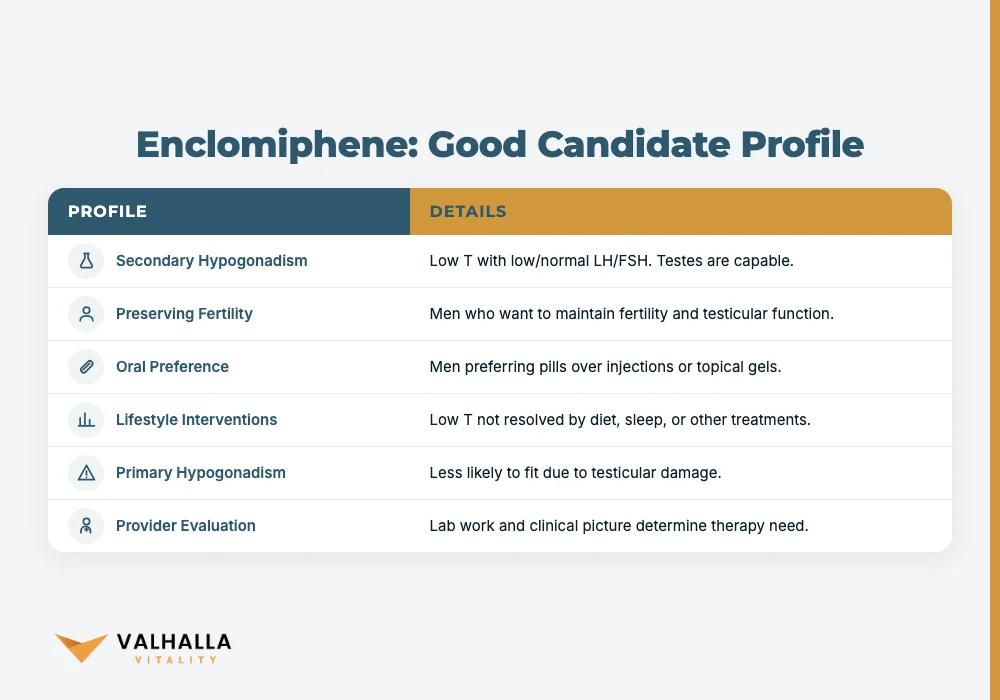
Enclomiphene addresses a specific hormonal problem. Knowing whether it applies to a given situation requires lab work that distinguishes secondary from primary hypogonadism, not a symptom questionnaire alone.
In secondary hypogonadism, testosterone is low but LH and FSH are also low or inappropriately normal for that degree of deficiency. The testes are capable; they simply are not being told to produce. Enclomiphene fixes the signal. In primary hypogonadism, LH and FSH are already elevated because the body is compensating for testes that cannot respond. Adding more stimulation via enclomiphene will not change the output in that situation.
An important nuance: a single low testosterone measurement does not confirm hypogonadism. Testosterone levels fluctuate across the day and respond to acute illness, poor sleep, and stress. Most clinical guidelines recommend confirming the diagnosis with at least two fasting morning measurements before initiating treatment. This is one reason why a provider-led evaluation matters; interpreting the full clinical picture accurately determines whether any therapy is warranted at all.
Profiles that may fit enclomiphene:
- Confirmed secondary hypogonadism with low total testosterone and low or inappropriately normal gonadotropins
- Men who want to address low testosterone while preserving fertility and testicular function
- Men who prefer an oral regimen over injections or transdermal applications
- Men whose low testosterone has not resolved with lifestyle interventions such as weight management, improved sleep, or treatment of underlying conditions
Profiles that are less likely to fit:
- Primary hypogonadism caused by testicular damage, genetic conditions such as Klinefelter syndrome, radiation, or chemotherapy
- Known allergy to enclomiphene or related SERMs
- Situations where significant drug interactions cannot be managed
- Men whose low testosterone appears to be a secondary consequence of an untreated primary condition, where treating the root cause is the more appropriate first step
Understanding where testosterone levels typically land for men on hormonal treatments can provide useful context before a provider consultation and help frame the conversation around realistic targets.
Availability of enclomiphene therapy varies by state.
What to expect from the evaluation and treatment process
Starting enclomiphene for testosterone through a telehealth platform follows a defined sequence. Knowing that sequence reduces uncertainty and helps men decide whether this route matches their situation and preferences.
Intake begins with an online questionnaire covering symptoms, medical history, and current medications. A licensed provider reviews the submission, typically within 24 business hours. If lab work is needed before a prescribing decision, the provider may order at-home testing or direct the patient to a local draw site. Once a diagnosis is confirmed and enclomiphene is determined appropriate, the prescription moves to a compounding pharmacy. Delivery typically takes approximately three to seven business days from the point the prescription is transferred.
Monitoring does not end with the first prescription. The provider sets a schedule for follow-up lab work that checks testosterone, LH, FSH, red blood cell count, and other markers relevant to the individual case. Results at the first follow-up, typically a few weeks into treatment, show whether the gonadotropin response is developing as expected and whether testosterone is moving toward the target range. The provider adjusts the plan based on those results. If levels are not responding, the clinical approach changes.
This cycle of prescribing, measuring, and adjusting is what distinguishes supervised hormonal care from obtaining a compound without clinical oversight. The ongoing review is not a formality; it is where the clinical value of the treatment actually lives.
Valhalla Vitality operates on this model. Licensed providers handle intake review and prescribing decisions. Prescriptions are fulfilled through partner US compounding pharmacies operating under 503A and 503B standards, and patients manage follow-up through their online accounts. Availability varies by state.
Ready to find out if enclomiphene is the right path?
Book Your Consultation with a licensed provider to review your symptoms and lab results and determine whether enclomiphene for testosterone is appropriate for your situation.
FAQ
Is enclomiphene the same as clomiphene?
No. Clomiphene citrate is a mixture of two isomers, zuclomiphene and enclomiphene. Enclomiphene is the isolated trans-isomer, with a shorter half-life and a pure antagonist profile at the hypothalamus and pituitary. Providers often prefer it for testosterone support in men because it produces a more targeted hormonal response without the side effect burden associated with the zuclomiphene fraction.
Does enclomiphene affect sperm count?
Enclomiphene generally preserves or supports spermatogenesis because it raises FSH levels rather than suppressing them. Sertoli cells receive the FSH signal needed for sperm development during treatment. This contrasts directly with testosterone replacement therapy, which suppresses FSH and often substantially reduces sperm production in reproductive-age men.
What labs does a provider check before prescribing enclomiphene?
A provider typically reviews total and free testosterone, LH, FSH, and additional markers to confirm whether secondary hypogonadism is present and whether enclomiphene is appropriate. The exact panel may vary by clinical situation. A licensed provider determines whether a therapy is appropriate only after reviewing the intake form and lab results together.
How is enclomiphene different from testosterone injections?
Enclomiphene raises LH and FSH, prompting the testes to produce testosterone naturally. Testosterone injections deliver testosterone directly, which raises serum T but suppresses the body's own production axis. Enclomiphene preserves the natural axis; injections bypass it, which is why injections typically reduce sperm production while enclomiphene does not.
Can enclomiphene be obtained without a prescription?
No. Enclomiphene requires a valid prescription from a licensed provider who has reviewed lab results and medical history. Any source offering it without a lawful prescribing process falls outside the standards that govern compounded medications in the United States.
Sources
- Rodriguez KM et al. (2016). Enclomiphene citrate for the treatment of secondary male hypogonadism. Expert opinion on pharmacotherapy. PubMed
- Hohl A et al. (2025). Clomiphene or enclomiphene citrate for the treatment of male hypogonadism: a systematic review and meta-analysis of randomized controlled trials. Archives of endocrinology and metabolism. PubMed
- Naelitz BD et al. (2025). Testosterone replacement therapy and spermatogenesis in reproductive age men. Nature reviews. Urology. PubMed
- Cruickshank M et al. (2024). The effects and safety of testosterone replacement therapy for men with hypogonadism: the TestES evidence synthesis and economic evaluation. Health technology assessment (Winchester, England). PubMed
- Heidelbaugh JJ et al. (2024). Testosterone Replacement Therapy for Male Hypogonadism. American family physician. PubMed
- Luther PM et al. (2024). Testosterone replacement therapy: clinical considerations. Expert opinion on pharmacotherapy. PubMed