Enclomiphene Side Effects: Safety, Risks, and What to Expect

The following blog post is for entertainment and informational purposes only. It is not intended to provide medical advice or diagnosis. Please consult your doctor before making any health-related decisions.
Enclomiphene side effects are typically mild and reversible. The most commonly reported include headache, nausea, acne, and changes in libido. Because enclomiphene is a selective estrogen receptor modulator (SERM) that signals the body to produce testosterone rather than replacing it directly, many men who pursue enclomiphene therapy as a secondary hypogonadism treatment find it better tolerated than exogenous testosterone. That said, the full side effect picture depends on hormone levels, individual sensitivity, and how well the regimen is monitored, and a licensed provider determines whether this therapy is appropriate after reviewing labs and medical history.
What enclomiphene is and why it matters
Clomiphene is composed of two structural isomers: zuclomiphene and enclomiphene. Enclomiphene is the trans-isomer, the one responsible for the desired hormonal activity. Zuclomiphene is the cis-isomer, and it may counteract some of enclomiphene's intended effects. Standard clomiphene preparations contain both.
Enclomiphene citrate was studied specifically in men with secondary hypogonadism. This is a condition where the testes remain capable of producing testosterone but signaling from the hypothalamus and pituitary is insufficient or dysregulated. Low testosterone coexists with abnormal or inadequate LH and FSH, and that combination is the therapeutic target.
As a SERM, enclomiphene blocks estrogen receptors in the hypothalamus and pituitary. That block removes a feedback signal that would otherwise suppress gonadotropin release. The pituitary then releases more LH and FSH, which travel to the testes and stimulate testosterone production and sperm development.
This mechanism is fundamentally different from testosterone replacement therapy (TRT). TRT delivers testosterone directly, which suppresses the body's own LH and FSH and reduces sperm counts over time. Enclomiphene keeps the body's own hormonal axis active.
According to a 2016 review in Expert Opinion on Pharmacotherapy, enclomiphene citrate may raise total testosterone levels while preserving spermatogenesis in secondary hypogonadal men (Rodriguez et al., 2016). That distinction matters for men where fertility is part of the clinical picture.
Enclomiphene side effects: quick-reference table
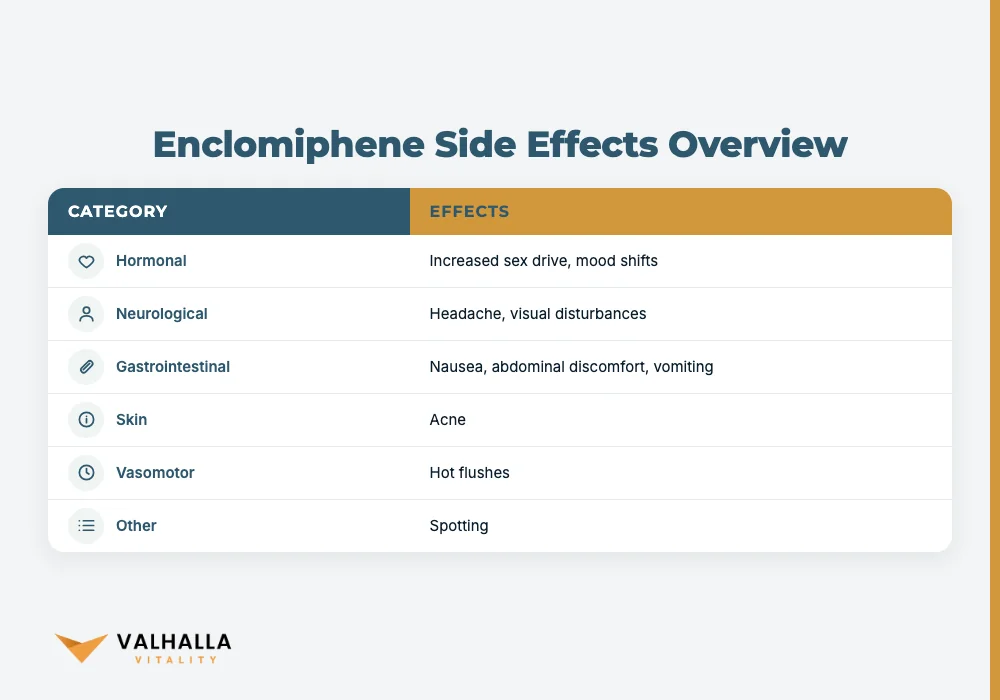
| Category | Common effects | Less common or overdose-related |
|---|---|---|
| Hormonal / libido | Increased sex drive | Mood shifts if testosterone rises sharply |
| Neurological | Headache | Visual disturbances |
| Gastrointestinal | Nausea, abdominal discomfort | Vomiting |
| Skin | Acne | |
| Vasomotor | Hot flushes | |
| Other | Spotting |
These categories reflect the clinical literature and original use records for enclomiphene citrate. A licensed provider determines whether any reported effect is within expected range or warrants a change in management.
What are the most common side effects of enclomiphene?
Headache is the single most frequently reported enclomiphene side effect. It tends to appear in the first few weeks of treatment as hormone levels shift and usually resolves on its own as the body adjusts. Persistent headache warrants provider contact.
Nausea and abdominal discomfort also appear commonly, particularly during the initial adjustment period. These gastrointestinal effects are generally transient rather than a sign of ongoing toxicity.
Acne and other skin changes reflect rising androgen activity. As testosterone increases, sebaceous glands become more active. This parallels skin changes some men notice on exogenous TRT and is typically manageable.
Increased libido is listed as a side effect in the clinical literature, though in the setting of treating low testosterone symptoms many men interpret it as a marker of improving hormonal function. A 2016 review confirmed that enclomiphene citrate significantly raised LH and FSH production, which in turn drove testosterone output (Rodriguez et al., 2016).
Mood changes are worth noting separately. Irritability or emotional shifts can occur if testosterone rises quickly or overshoots the therapeutic range. This is one reason why enclomiphene therapy results in structured monitoring. Without lab-based follow-up, there is no way to know whether testosterone has reached a therapeutic level or exceeded it.
The full list of reported enclomiphene side effects includes hot flushes and, at high doses or in overdose scenarios, vomiting and spotting. These are uncommon during properly managed therapy.
Can enclomiphene cause vision problems?
Visual disturbances are a recognized risk with SERMs for low testosterone, and enclomiphene is no exception. This is a class effect tied to estrogen receptor activity in ocular tissue, shared with clomiphene. Blurred vision and other visual distortions are the typical presentations.
During normal therapeutic use, vision problems are uncommon. They are more closely associated with overdose or unusual individual sensitivity. The risk is real enough, however, that it carries specific guidance: anyone who notices vision changes while taking enclomiphene should stop the medication and contact a provider immediately.
Operating vehicles or machinery while experiencing visual symptoms is unsafe and should be avoided until the symptom is fully evaluated and resolved.
Providers reviewing enclomiphene candidacy typically ask about pre-existing eye conditions and vision history for this reason. A history of visual disturbances with hormonal medications may indicate closer monitoring is warranted or that a different approach is preferable.
How long do enclomiphene side effects last?
Mild enclomiphene side effects, particularly headache and nausea, tend to resolve within the first few weeks as hormone levels adjust and stabilize. These are adjustment-phase effects, not persistent ones.
Acne and skin changes may last as long as androgen levels remain elevated. If testosterone is well-managed within a therapeutic range, these effects stay limited. If testosterone rises significantly above target, acne can worsen and the provider will need to reassess.
Vision disturbances, if they occur, typically clear after stopping the medication. Any visual symptom that persists after discontinuation should prompt a formal ophthalmologic evaluation.
Mood-related effects follow the testosterone curve. Once levels stabilize, irritability and mood volatility typically settle. The first few weeks carry the most hormonal fluctuation; enclomiphene therapy results in a more stable pattern once the body reaches a new equilibrium. That equilibrium is confirmed through follow-up labs, not through symptom observation alone.
Is enclomiphene safe for long-term use?
The honest answer is that long-term data specific to enclomiphene in men is still accumulating. A 2025 systematic review and meta-analysis of randomized controlled trials found that both enclomiphene and clomiphene produced effective testosterone restoration with acceptable safety profiles across the reviewed trial periods (Hohl et al., 2025). This is the most current high-quality synthesis available.
For context, the longer-term clomiphene data spans up to three years of treatment in some patients and shows continued hormonal normalization in a portion of the treated group. Since enclomiphene is the isolated active isomer from the same compound, this data provides partial context. But enclomiphene and clomiphene are not identical, and direct extrapolation has limits.
Ongoing monitoring is standard for any extended enclomiphene course. The labs that matter include total testosterone, LH, FSH, estradiol, and hematocrit. Elevated hematocrit is a concern with androgen-raising therapies generally because higher testosterone can stimulate red blood cell production. Catching this early is why providers schedule follow-up labs rather than issuing an open-ended prescription.
Long-term use also warrants attention to prostate health. While enclomiphene works through the HPG axis rather than delivering exogenous testosterone, the net effect is higher androgens. PSA monitoring is relevant for men in age groups where prostate surveillance is already clinically recommended.
The takeaway: enclomiphene appears safe in the timeframes studied, but long-term safety data continues to develop. A licensed provider assesses whether continuing therapy is justified at each review visit based on current labs and the individual's overall response.
What dose of enclomiphene should men take?
A licensed provider determines the dose after labs. There is no universal starting amount because the right therapeutic level depends on baseline testosterone, LH and FSH values, symptom profile, and how the individual responds during the initial monitoring period.
Decisions about enclomiphene dosage for men involve more than selecting an amount. They require interpreting follow-up labs in the context of symptom changes, tolerability, and any enclomiphene side effects that emerged. Adjustments are based on bloodwork rather than a fixed protocol.
What clinical studies confirm is that enclomiphene citrate produced meaningful increases in LH, FSH, and total testosterone in men with secondary hypogonadism. The dose-response relationship means the amount prescribed influences how strongly testosterone responds, but higher is not automatically better if testosterone overshoots the therapeutic range and creates new problems.
For more clinical background on treatment options for low testosterone, the enclomiphene citrate for low testosterone overview explains why individualized dosing decisions matter and how they differ from one-size protocols.
Enclomiphene vs clomid: how the side effect profiles compare
The practical question in secondary hypogonadism treatment is often: why choose enclomiphene over standard clomiphene? From a side effect standpoint, the isomer distinction is the central argument.
Clomiphene contains both zuclomiphene and enclomiphene. Zuclomiphene has a significantly longer half-life and may remain in circulation for weeks after a dose. During that extended presence, it can act as an estrogen agonist in some tissues, which in men may contribute to mood instability, gynecomastia risk, or more persistent visual complaints.
Enclomiphene, as the isolated trans-isomer, removes the zuclomiphene fraction. The intended result is a hormonal signal that is more targeted and shorter-lived between doses. This theoretical advantage in side effect profile was part of the rationale for developing enclomiphene separately from clomiphene.
The 2025 meta-analysis by Hohl et al. offers the most current comparative perspective in the peer-reviewed literature. Head-to-head randomized controlled trials directly comparing the two compounds in men remain limited, which means the side effect advantage of enclomiphene over clomiphene has not been definitively quantified. Both appear effective. The cleaner isomer composition is the pharmacological case for preferring enclomiphene.
A detailed breakdown of the clinical and pharmacological distinctions between the two compounds is available in the enclomiphene vs clomid comparison.
Enclomiphene citrate benefits alongside the side effect risks
Understanding enclomiphene side effects makes more sense alongside what the therapy is designed to achieve. For men with secondary hypogonadism, the core enclomiphene citrate benefits include:
- Testosterone recovery through the body's own hormonal axis rather than exogenous replacement
- Preservation of spermatogenesis, which exogenous TRT directly suppresses
- Normalization of LH and FSH, addressing the root HPG-axis signaling problem
- Oral administration rather than injection or transdermal application
These benefits do not make enclomiphene risk-free. They explain why a licensed provider may prefer it over alternatives for specific presentations.
Low testosterone does not automatically mean enclomiphene is the right answer. Whether the cause of secondary hypogonadism is reversible, whether fertility is a priority, and how the individual's hormone levels actually respond all factor into the benefit-risk calculation. The net assessment of enclomiphene citrate benefits versus side effects is a clinical judgment, not a consumer purchasing decision.
Men interested in the broader hormone health treatment options available at Valhalla Vitality can review the full service menu to understand how enclomiphene fits within a wider clinical picture.
Who should not use enclomiphene
Several medical conditions are contraindications for enclomiphene use. Based on clinical guidance, these include:
- Pituitary tumors, which disrupt the signaling pathway enclomiphene relies on
- Craniopharyngiomas, which similarly compromise hypothalamic-pituitary function
- Hemochromatosis, where iron overload can damage the pituitary and testes directly
- Congenital GnRH deficiency, where the HPG axis never developed the capacity to respond
In these conditions, enclomiphene cannot produce its expected effect because the mechanism it depends on is structurally compromised. Using it would not raise testosterone through the intended pathway and could cause unintended effects without any meaningful benefit.
Enclomiphene is also not appropriate in pregnancy or breastfeeding. The compound is not approved for women in these circumstances, there is no clinical evidence supporting it, and some data suggests it may inhibit lactation.
The intended population is men with secondary hypogonadism specifically. These men have low testosterone and abnormal LH or FSH tracing back to a dysfunctional but potentially reversible hypothalamic-pituitary axis.
Men with primary hypogonadism are not appropriate candidates. When the testes themselves are the source of the problem, no amount of HPG-axis stimulation produces a meaningful testosterone response.
What to discuss with your provider before starting
A full pre-prescribing evaluation is standard before any enclomiphene regimen begins. The baseline labs that typically matter include total testosterone (morning draw), LH, FSH, estradiol, and a semen analysis when fertility is part of the clinical question.
Medical history details that directly affect prescribing include any prior diagnosis of a pituitary or hypothalamic condition, head trauma or radiation history that could affect pituitary function, known hemochromatosis or iron overload, and personal or family history of venous thromboembolism. Vision history is also relevant given the known ocular risk profile of SERM-class compounds.
Current medications and supplements matter too. Some compounds affect sex hormone-binding globulin (SHBG) levels or estrogen metabolism, both of which influence how enclomiphene behaves and what the measured testosterone results actually reflect.
Providers offering enclomiphene-based men's health treatment through telehealth typically collect this history through a structured medical intake. Provider review is completed within 24 business hours of a completed submission. Availability varies by state.
Book your consultation
If you want to understand whether enclomiphene is appropriate for your situation, a licensed provider can review your intake and labs. Book Your Consultation to start the process.
FAQ
What are the most common side effects of enclomiphene?
The most commonly reported enclomiphene side effects are headache, nausea, abdominal discomfort, acne, and increased libido. These effects are generally mild and tend to emerge during the first few weeks as hormone levels shift. A licensed provider monitors labs to determine whether adjustments are needed.
How long do enclomiphene side effects last?
Mild side effects like headache and nausea typically resolve within the first few weeks as hormone levels stabilize. Acne may persist as long as androgen levels remain elevated. Vision disturbances, if they occur, usually clear after stopping the medication.
Is enclomiphene safe for long-term use?
A 2025 systematic review found both enclomiphene and clomiphene showed acceptable safety profiles across the trial periods reviewed. Long-term data specific to enclomiphene continues to accumulate. Ongoing lab monitoring is standard practice for any extended course, and a licensed provider reassesses suitability at each review.
Can enclomiphene cause vision problems?
Visual disturbances are a known risk with SERMs including enclomiphene, though they are uncommon at therapeutic levels and more associated with overdose or individual susceptibility. Any vision change during treatment should prompt immediate contact with a provider and stopping the medication until it is evaluated.
What dose of enclomiphene should men take?
There is no single correct dose. A licensed provider determines the appropriate amount after reviewing baseline labs including testosterone, LH, and FSH. Dose adjustments rely on follow-up bloodwork rather than a fixed starting protocol.
Sources
- Rodriguez KM et al. (2016). Enclomiphene citrate for the treatment of secondary male hypogonadism. Expert Opinion on Pharmacotherapy. PubMed
- Hohl A et al. (2025). Clomiphene or enclomiphene citrate for the treatment of male hypogonadism: a systematic review and meta-analysis of randomized controlled trials. Archives of Endocrinology and Metabolism. PubMed