
The following blog post is for entertainment and informational purposes only. It is not intended to provide medical advice or diagnosis. Please consult your doctor before making any health-related decisions.
Testosterone therapy for women is a real treatment option when hormone levels fall too low. Women produce testosterone in the ovaries and adrenal glands, and levels decline with age, surgical menopause, or adrenal dysfunction. A 2021 clinical practice guideline from the International Society for the Study of Women's Sexual Health confirmed that systemic testosterone is appropriate for hypoactive sexual desire disorder in postmenopausal women. A licensed provider reviews your labs and medical history before deciding whether therapy is right for your situation. Understanding female testosterone levels on TRT shows what normal ranges look like.
What are signs of low testosterone in women?
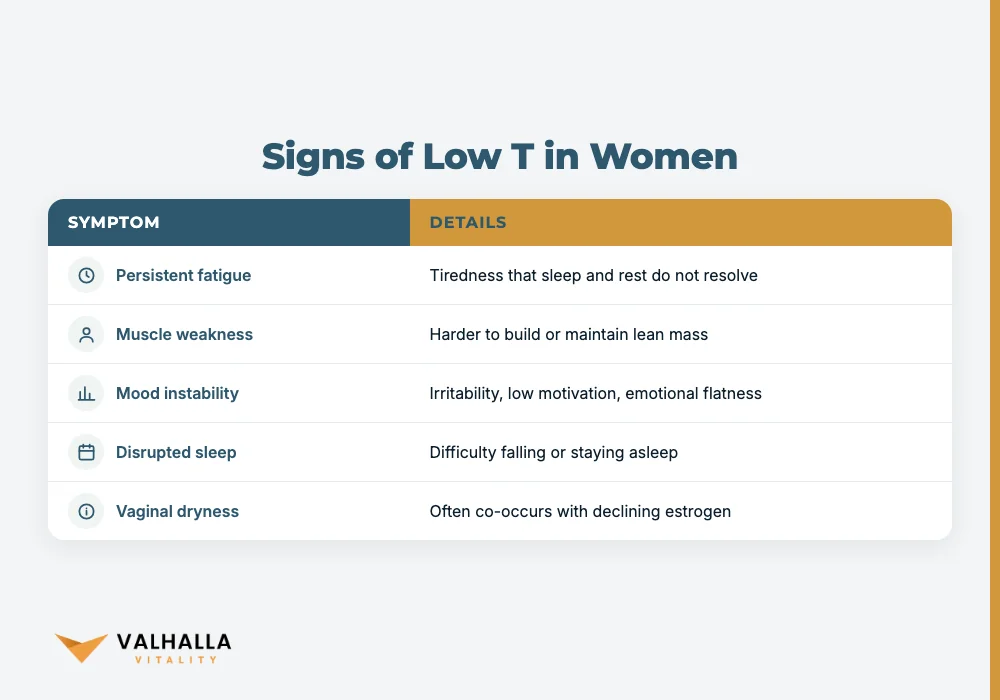
Low testosterone symptoms women experience overlap with several other conditions, which is why a blood test is required for any diagnosis. The signs of low T in women cannot be confirmed from symptoms alone.
The most commonly reported symptoms:
| Symptom | How it typically presents |
|---|---|
| Reduced libido | Flat or absent interest in sex, not tied to circumstances |
| Persistent fatigue | Tiredness that sleep and rest do not resolve |
| Muscle weakness | Harder to build or maintain lean mass |
| Mood instability | Irritability, low motivation, emotional flatness |
| Disrupted sleep | Difficulty falling or staying asleep |
| Bone density loss | Often silent, increases fracture risk over time |
| Vaginal dryness | Frequently co-occurs with declining estrogen |
A 2020 review in Acta Obstetricia et Gynecologica Scandinavica found that declining testosterone in menopausal women correlates directly with reduced sexual function and overall well-being. Because these same symptoms also point to thyroid disorders, depression, and chronic stress, a provider typically runs a full diagnostic panel before attributing them to low female testosterone levels.
How does low testosterone affect women's energy and libido?
Low testosterone affects women's energy and libido through direct physiological mechanisms. Testosterone receptors exist throughout the brain and body. Their underactivation has measurable consequences, not imagined ones.
Women with low female testosterone levels often describe their energy as flat rather than simply tired. Rest does not fix it. Libido follows a similar pattern. The ISSWSH 2021 guideline found that testosterone therapy significantly improves sexual desire, arousal, and satisfaction in postmenopausal women with hypoactive sexual desire disorder. That evidence base is specific and well-supported. A provider evaluation clarifies whether it applies to your situation.
What causes female testosterone levels to drop?
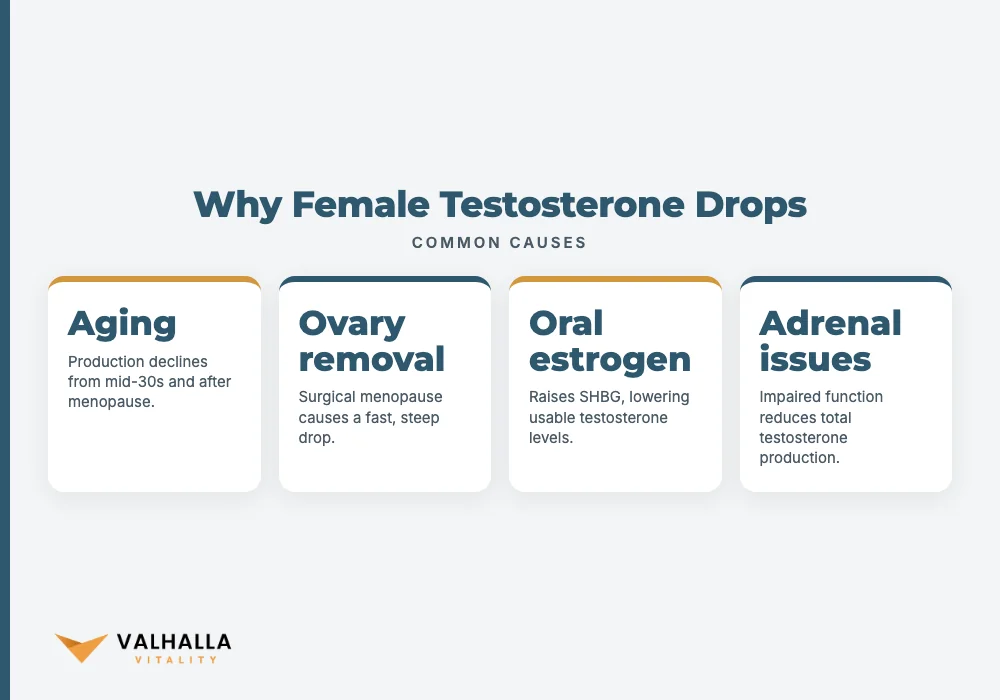
Several mechanisms can lower a woman's testosterone:
- Natural aging: Production begins declining from the mid-30s and continues after natural menopause.
- Surgical menopause: Removing both ovaries ends primary testosterone production at once, causing a faster, steeper drop than natural menopause.
- Oral estrogen therapy: Oral estrogen raises sex hormone-binding globulin (SHBG), which binds free testosterone and lowers usable levels. This is a recognized effect of some women hormone replacement protocols.
- Adrenal dysfunction: The adrenal glands contribute to testosterone output; impaired adrenal function reduces total production.
- Pituitary disorders: Upstream signaling problems cascade to affect all hormone production, including testosterone.
Understanding the cause matters. For women on oral estrogen who develop low-T symptoms, switching to a non-oral estrogen route may be the first step a provider considers, well before any additional testosterone.
When should a woman consider testosterone replacement?
A woman may be a candidate for testosterone replacement when lab results confirm low levels and other causes have been ruled out. Symptoms alone are not sufficient. A blood panel measuring total and free testosterone, combined with a full medication review and hormonal profile, gives the provider the complete picture.
The ISSWSH guideline targets postmenopausal women with hypoactive sexual desire disorder who have not responded to other interventions. Women who undergo surgical menopause often notice symptoms more acutely because the hormone drop happens faster. If a woman is still menstruating, testosterone fluctuates across the cycle, and a provider may recommend retesting at a specific phase before drawing any conclusions.
Testosterone therapy for women is not a first-line treatment for every symptom on the list above. It is a targeted intervention for a confirmed hormonal deficit. To understand how oral testosterone fits into the broader picture, the impact and benefits of oral testosterone for women covers the key clinical considerations.
What are the side effects of testosterone therapy for women?
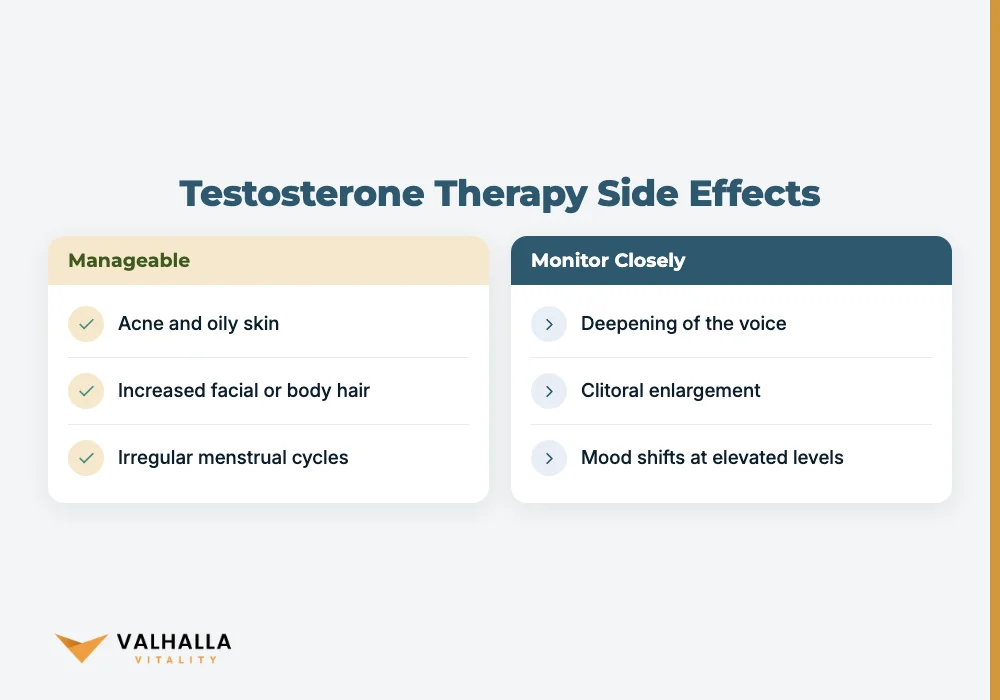
It carries real risks. Most adverse effects are dose-dependent. A 2021 review in Sexual Medicine Reviews found that keeping testosterone within the female physiological range substantially reduces androgenic side effects.
Reported side effects include:
- Acne and oily skin
- Increased facial or body hair
- Deepening of the voice
- Clitoral enlargement
- Mood shifts at elevated levels
- Irregular menstrual cycles
Many of these effects may be reversible when therapy is adjusted early. A licensed provider determines the dose after reviewing labs and schedules follow-up testing to catch any level drift before side effects take hold. No testosterone product is currently authorized by the FDA for use in women in the United States. Off-label prescribing, typically through compounded formulations, makes provider expertise and consistent monitoring essential.
Can women use testosterone cream safely?
Testosterone cream can be used safely when a licensed provider prescribes and monitors it. It is one of several delivery formats alongside pellet therapy. Testosterone injections females receive are typically given subcutaneously or intramuscularly. Transdermal application bypasses first-pass liver metabolism, which some providers prefer for maintaining stable blood levels.
The primary safety concern is unintentional transfer. Skin-to-skin contact can expose a partner or child to testosterone. Application sites should be covered, and hands washed immediately after use. Testosterone cream side effects follow the same pattern as other delivery forms. They are dose-dependent and caught through regular lab work.
A licensed provider determines the dose after reviewing labs, not based on symptoms alone. For a clear comparison of delivery methods, comparing oral testosterone and injection methods walks through the practical differences between options.
Talk to a licensed provider
A licensed provider at Valhalla Vitality reviews your intake and lab results to determine whether testosterone therapy for women is appropriate in your situation. Availability varies by state. Book Your Consultation.
FAQ
What blood tests confirm low testosterone in women?
A provider typically orders total and free testosterone levels. Results are interpreted alongside other markers such as SHBG, estradiol, and thyroid function, since low-T symptoms overlap significantly with other conditions.
Has the FDA authorized testosterone therapy for women?
No testosterone product is currently authorized by the FDA for use in women in the United States. Providers prescribe it off-label, most often using compounded formulations regulated under 503A or 503B pharmacy standards.
Can testosterone cream transfer to a partner or child?
Yes. Skin-to-skin contact at the application site can expose others to testosterone. Covering the area after applying and washing hands immediately are standard precautions that reduce this risk.
Does testosterone therapy help with menopause symptoms?
It may help with specific menopause-related symptoms, particularly low libido and persistent fatigue. A 2020 review in Acta Obstetricia et Gynecologica Scandinavica found evidence supporting testosterone as part of menopausal hormone treatment, though individual responses vary.
What happens if a woman's testosterone becomes too high?
Excess testosterone in women may cause acne, increased body or facial hair, voice deepening, clitoral enlargement, and irregular periods. Regular lab monitoring allows a provider to adjust the dose before these effects take hold.
Sources
- Parish SJ et al. (2021). International Society for the Study of Women's Sexual Health Clinical Practice Guideline for the Use of Systemic Testosterone for Hypoactive Sexual Desire Disorder in Women. The journal of sexual medicine. PubMed
- Johansen N et al. (2020). The role of testosterone in menopausal hormone treatment. What is the evidence?. Acta obstetricia et gynecologica Scandinavica. PubMed
- Twitchell DK et al. (2021). Controversies in Testosterone Therapy. Sexual medicine reviews. PubMed