
The following blog post is for entertainment and informational purposes only. It is not intended to provide medical advice or diagnosis. Please consult your doctor before making any health-related decisions.
Enclomiphene insomnia is a real, documented concern for some men who start treatment for low testosterone. Enclomiphene acts directly on the hypothalamus, the brain region that coordinates both reproductive hormone signaling and sleep-wake cycles, so sleep disruption is a recognized side effect. For men considering enclomiphene for low testosterone, understanding how the medication may affect sleep, and how long that effect tends to last, helps set accurate expectations before the first dose.
Does enclomiphene cause insomnia?
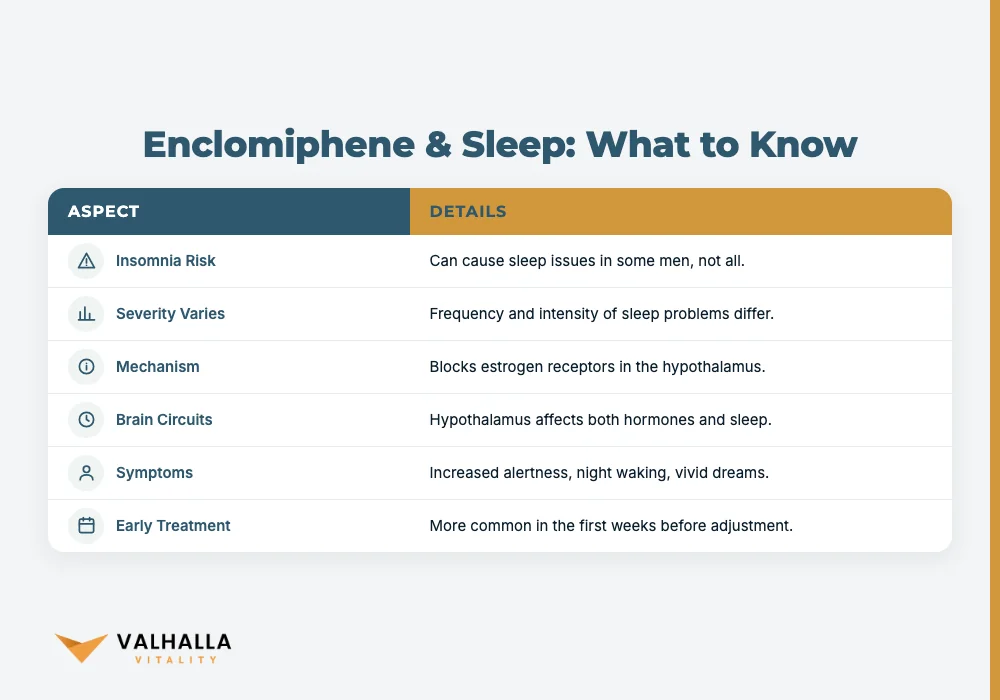
Enclomiphene can cause insomnia in some men, though not in all. In clinical work on enclomiphene citrate for secondary male hypogonadism, Rodriguez et al. (2016) in Expert Opinion on Pharmacotherapy identified sleep disturbances among the adverse effects noted in study participants, alongside headache and nausea as known but uncommon occurrences. The frequency and severity of enclomiphene sleep issues vary considerably between individuals. Recognizing enclomiphene insomnia as distinct from pre-existing sleep difficulties is an important step in tracking whether symptoms are improving or worsening over the first month of treatment.
The mechanism starts in the hypothalamus. Enclomiphene blocks estrogen receptors there to trigger the release of gonadotropin-releasing hormone (GnRH), which signals the pituitary to produce luteinizing hormone (LH) and follicle-stimulating hormone (FSH). That cascade raises testosterone. A 2023 review in Science by Adamantidis et al. found that the hypothalamus contains circuits that govern both circadian timing and reproductive hormone output. Those circuits overlap. Disrupting estrogen receptor activity in that region, even when the goal is beneficial hormonal correction, can alter both hormonal and sleep-related signaling at the same time.
Why enclomiphene insomnia occurs
Estrogen receptors in the brain play a confirmed role in sleep regulation. In men, these receptors influence both NREM and REM sleep architecture. When enclomiphene blocks them, particularly in the early treatment weeks before the body adjusts, some men feel more alert in the evening, wake during the night without a clear cause, or experience vivid and sometimes unsettling dreams. Sleep pressure does not disappear. The timing and quality of sleep shift.
A 2023 paper in Progress in Cardiovascular Diseases by Baranwal et al. outlined how tightly the neuroendocrine system and sleep architecture are connected. Even interventions designed to restore normal hormone levels can temporarily disrupt sleep-wake balance before the system stabilizes. This matters. That adjustment phase is transient for most men, and knowing that in advance reduces unnecessary alarm.
The table below separates the two patterns that most often get confused with each other.
Sleep disruption patterns: low testosterone vs. enclomiphene treatment
| Characteristic | Low testosterone (untreated) | Enclomiphene-related insomnia |
|---|---|---|
| Onset | Gradual, often months before diagnosis | Typically within the first one to four weeks of therapy |
| Common pattern | Reduced REM, early morning waking, non-restorative sleep | Difficulty falling asleep, vivid dreams, fragmented night waking |
| Likely cause | Reduced androgen signaling and altered cortisol rhythms | Estrogen receptor modulation in the hypothalamus |
| Trajectory | Persistent until the underlying hormonal imbalance is treated | Usually resolves as hormone levels stabilize |
| What helps | Addressing the hormonal deficiency | Timing adjustments, consistent sleep hygiene, lab-guided provider review |
Understanding which pattern applies to a specific case is the first step toward addressing it correctly.
Low testosterone sleep problems: understanding the baseline
Before attributing every new sleep difficulty to enclomiphene, it is worth recognizing that low testosterone disrupts sleep on its own. Men with hypogonadism commonly report fatigue that does not improve with rest, difficulty reaching or sustaining deep sleep, more frequent nighttime awakenings, and reduced REM. These low testosterone sleep problems can persist for months, sometimes longer, before the hormonal connection is ever considered.
A 2020 systematic review in Applied Physiology, Nutrition, and Metabolism by Chaput et al. confirmed that sleep timing consistency and hormonal health outcomes are directly linked in adult men. That connection runs in both directions: disrupted sleep lowers testosterone, and low testosterone disrupts sleep. Men entering enclomiphene therapy often carry substantial pre-existing sleep debt that has nothing to do with the medication.
That overlap creates diagnostic confusion. A man who starts enclomiphene and notices broken sleep in week two may place all the blame on the drug, when his sleep was already compromised before the first dose.
Keeping a simple sleep log in the days before starting treatment, even just noting sleep onset time, wake time, and a rough quality rating, provides a comparison point that may prove useful at the first follow-up visit.
The hypothalamic circuits that enclomiphene stimulates also regulate body temperature patterning and cortisol rhythms during the night. Men who already have disrupted baseline hormone levels may experience the early adjustment phase more acutely than men with a more stable hormonal baseline. This does not make them poor candidates for therapy. It does mean the first four to six weeks reward closer attention and open communication with the prescriber.
Men who experience low testosterone sleep problems before starting treatment do not necessarily face more disruption on enclomiphene. But tracking sleep carefully from the beginning, and reporting changes accurately, makes early adjustments possible when they are needed.
What are the sleep side effects of enclomiphene?
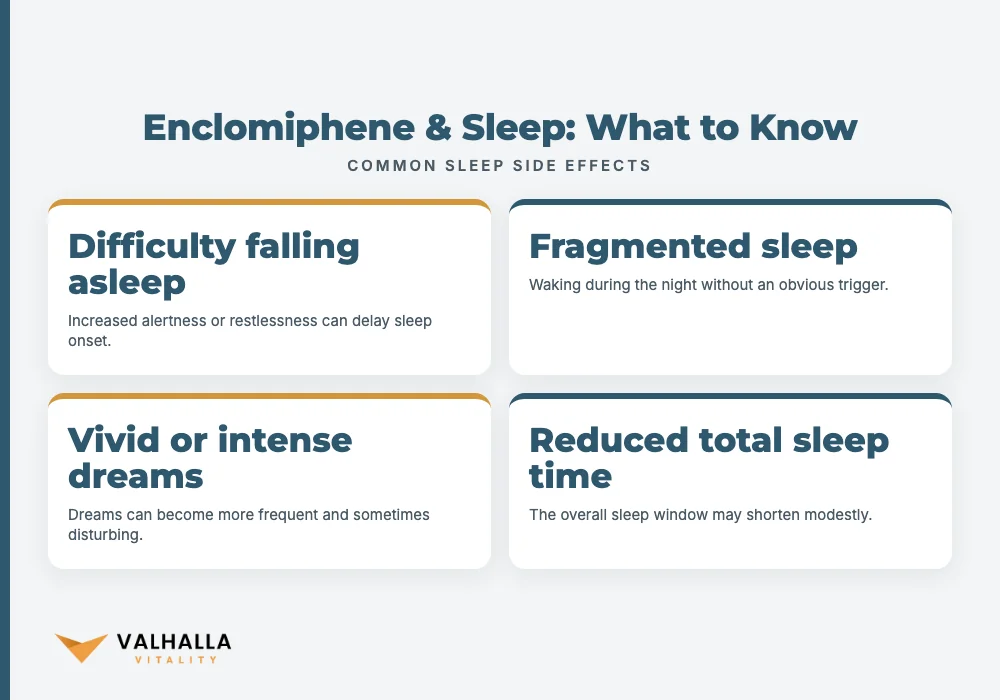
The enclomiphene citrate side effects associated with sleep appear in several distinct patterns in clinical literature and practice. When enclomiphene insomnia does occur, it typically takes one of these forms:
- Difficulty falling asleep: increased alertness or mild restlessness in the evening pushes sleep onset later than usual
- Fragmented sleep: men wake one or more times during the night without an obvious external trigger and often have difficulty returning to sleep afterward
- Vivid or intense dreams: dream content becomes more frequent and sometimes disturbing during REM sleep, which some men find more disruptive than the actual hours of lost sleep
- Reduced total sleep time: the overall window of sleep may shorten modestly during the early treatment phase
- Night warmth or mild sweating: some men report brief episodes of warmth or perspiration overnight; enclomiphene shares structural features with clomiphene, and similar thermal patterns appear with other selective estrogen receptor modulators
These enclomiphene side effects in men are not universal. A 2025 systematic review and meta-analysis by Hohl et al. in Archives of Endocrinology and Metabolism, covering randomized controlled trials of enclomiphene and clomiphene citrate for male hypogonadism, confirmed that both agents raise testosterone effectively but that tolerability, including sleep-related adverse effects, varies widely between individuals.
The relationship between enclomiphene and sleep operates across a spectrum. Some men notice only mild changes, such as slightly more vivid dreams or a brief delay in sleep onset that resolves within a week. Others experience more sustained disruption that warrants provider attention. The difference often comes down to individual baseline hormone levels and how quickly testosterone rises in response to treatment. A faster rate of change tends to produce more acute early side effects, including sleep disruption, before the body compensates.
For a complete picture of enclomiphene's safety profile and lab monitoring during treatment, including how providers assess hormonal response at follow-up visits, that resource covers the clinical picture in detail.
Does enclomiphene affect sleep quality?
Yes, enclomiphene can affect sleep quality in ways that go beyond simple insomnia. The distinction matters in practice. Insomnia refers to problems initiating or maintaining sleep. Sleep quality captures the restorative depth of the sleep that does occur, the proportion of slow-wave and REM stages, and how rested someone feels on waking.
Some men on enclomiphene report spending adequate time in bed but waking up exhausted. That pattern points toward disrupted deep sleep architecture rather than just total sleep duration. Tononi et al. (2024) in Neuron described how sleep quality depends on the integrity of specific neural circuits, including those subject to neuroendocrine modulation. Hormonal shifts during early enclomiphene treatment can reach those circuits.
Eight hours of fragmented or shallow sleep is not equivalent to eight hours of restorative sleep. Reporting the specific pattern to a provider, rather than a general complaint of "bad sleep," helps the provider distinguish whether sleep architecture or sleep duration is the variable to investigate. That distinction changes what the provider looks for in labs and follow-up.
Estradiol levels also warrant attention during this period. Enclomiphene stimulates the HPG axis, raising both testosterone and estradiol proportionally. When estradiol climbs faster than the body can accommodate, some men report increased sensitivity to overnight temperature changes, mild restlessness, and less restorative sleep. Providers who monitor both values at follow-up labs can identify this pattern early and adjust the treatment plan accordingly. Tracking these hormone levels alongside sleep symptoms gives providers the clearest picture of whether enclomiphene insomnia is resolving at the expected pace.
Should you take enclomiphene before bed?
"Should you take enclomiphene before bed?" is one of the most common questions men raise when they start reading about enclomiphene and sleep. The practical answer: most providers recommend against it.
Enclomiphene is absorbed orally and reaches peak plasma concentration within a few hours of ingestion. When that stimulatory window coincides with the hours before sleep, the acute activation of the HPG axis can contribute to alertness and difficulty winding down. Taking enclomiphene before bed increases the chance of that overlap. Morning dosing shifts the peak stimulatory effect into waking hours, where it is far less likely to interfere with sleep onset.
A licensed provider determines the optimal timing for each individual based on labs, symptom patterns, and pharmacokinetic response. That guidance must come from the prescriber. What an article like this can do is flag this as a real and practical question worth raising at the intake visit or the first follow-up.
Timing strategies worth discussing with a provider
Several practical patterns are worth raising directly with a prescriber:
- Consistent morning dosing aligns peak HPG-axis stimulation with the body's natural cortisol curve, which peaks in the early waking hours
- Avoiding dosing within four to six hours of bedtime reduces the chance that elevated HPG-axis activity coincides with sleep onset
- Tracking dose time against sleep onset in a simple daily log can reveal a direct relationship within two to three weeks, giving the provider concrete data rather than a general complaint
- Reviewing the testosterone-to-estradiol ratio at follow-up labs helps distinguish whether sleep disruption is driven by the rate of hormonal change or by timing alone
Timing adjustments are often the simplest and most effective first intervention for enclomiphene insomnia. They should be made in consultation with the prescriber, not unilaterally.
How long does enclomiphene insomnia last?
Enclomiphene insomnia most commonly peaks in the first two to four weeks of treatment, as the body adjusts to altered estrogen receptor signaling in the hypothalamus and hormone levels reach a new equilibrium. For most men, sleep may gradually stabilize over this period.
Rodriguez et al. (2016) noted that adverse effects in enclomiphene-treated participants, including sleep disturbances, were generally transient in clinical study settings. That finding aligns with the biology: once the HPG axis recalibrates to the altered estrogen feedback environment, the acute stimulatory effects that disrupt sleep tend to diminish.
Persistent enclomiphene insomnia beyond four to six weeks warrants direct provider attention. Possible explanations at that point include a testosterone-to-estradiol ratio that has not yet stabilized, an underlying sleep disorder that was present before treatment began and is now more apparent, or a dose schedule that continues to generate HPG-axis activation at the wrong time of day. Sleep quality and hormonal improvement are not mutually exclusive. When enclomiphene insomnia extends past the typical adjustment period, that is a signal to review the plan, not to abandon either objective.
A 2020 review by Chaput et al. reinforced that sustained sleep disruption, regardless of cause, carries real downstream health effects, including disrupted hormonal regulation, impaired glucose metabolism, and reduced recovery capacity. Sleep during enclomiphene treatment is a clinical priority, not a secondary concern.
Managing enclomiphene insomnia: what works
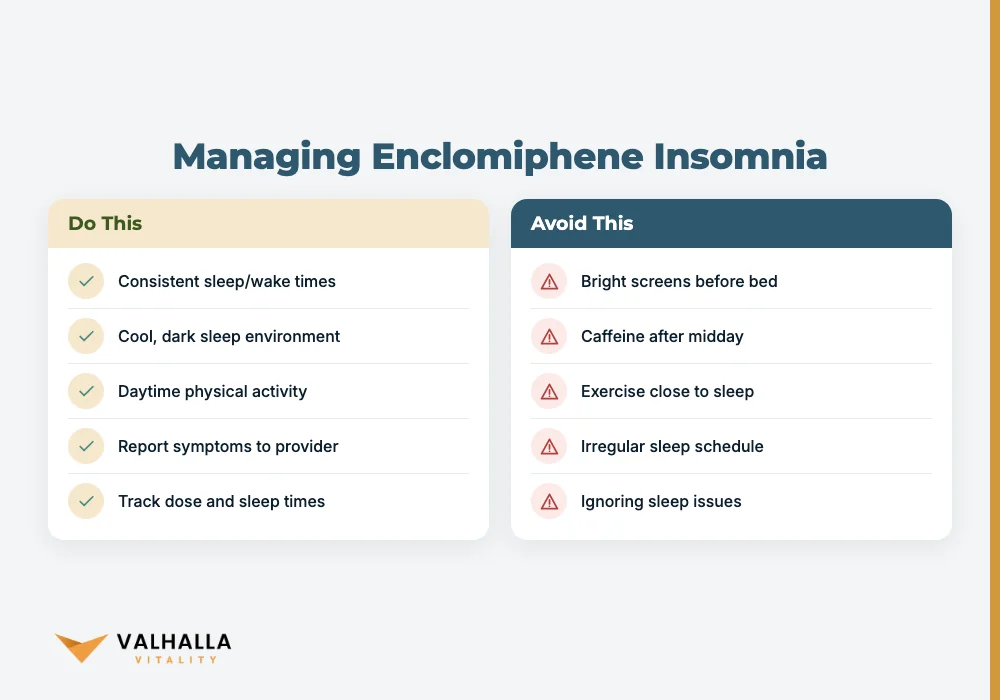
Managing enclomiphene insomnia effectively means combining structured sleep hygiene with proactive provider communication. Each element addresses a different part of the problem.
Baranwal et al. (2023) outlined core sleep hygiene principles that hold across causes of disruption: consistent sleep and wake times seven days a week, a cool and dark sleeping environment, limiting bright screen exposure in the 90 minutes before bed, avoiding caffeine after midday, and keeping physical activity to daytime hours rather than within three hours of sleep onset. Irregular sleep schedules compound neuroendocrine disruption. A stable schedule reduces overnight hormonal variability and reinforces the body's circadian anchors. The enclomiphene side effects men report most consistently, disrupted sleep onset, fragmented nights, and reduced overall sleep quality, respond to these hygiene measures at different rates and timelines.
Provider communication matters just as much. Lab review at scheduled follow-up visits, paired with accurate symptom reporting, allows targeted adjustments that sleep hygiene alone cannot provide. Providers at Valhalla Vitality structure enclomiphene programs around lab-based check-ins, which is where sleep tracking data becomes directly actionable. Understanding how enclomiphene interacts with the HPG axis and the testosterone-estradiol balance helps men ask more specific questions and report symptoms more precisely during those visits.
What to track and report
A simple daily log, requiring less than two minutes, creates a pattern a provider can act on at the next check-in:
- Note the time of each dose consistently
- Record sleep onset time and final wake time each morning
- Count nighttime awakenings and note approximate times
- Rate morning energy on a simple one-to-five scale
- Flag any associated symptoms: night sweats, racing pulse, anxious waking, or unusual dream intensity
Specific data points resolve much faster than vague reports. A log showing that sleep fragmentation consistently follows a particular dose timing gives the provider a concrete variable to test. That level of specificity can turn a general complaint about poor sleep into a manageable clinical problem with a clearer path forward.
Start the conversation with a licensed provider
Book Your Consultation to discuss your sleep symptoms, hormone labs, and whether enclomiphene is an appropriate option for your situation.
FAQ
Does enclomiphene cause insomnia in all men?
No. Sleep disruption is a recognized but not universal side effect. Many men complete enclomiphene therapy without notable changes to their sleep, while others experience disruption primarily in the first few weeks as hormone levels shift and the body adjusts.
Can enclomiphene improve sleep over time?
For some men, yes. Because low testosterone itself degrades sleep quality, treating the underlying hormonal imbalance may gradually improve sleep over the course of therapy. Initial disruption from enclomiphene may give way to better sleep once testosterone levels stabilize and the neuroendocrine system adjusts.
What should I tell my provider if enclomiphene disrupts my sleep?
Report the specific pattern: when the disruption occurs relative to the time of dosing, whether the problem is falling asleep or staying asleep, and how many weeks it has been happening. Specific detail helps the provider determine whether a timing change, a lab review, or another intervention is most appropriate.
Is enclomiphene insomnia a reason to stop treatment?
Not automatically. Transient sleep disruption in the first few weeks is a known and typically manageable effect. Persistent insomnia beyond four to six weeks, or disruption that significantly impairs daytime function, should be reviewed with the prescribing provider before any decision to discontinue treatment.
How does enclomiphene affect sleep differently than testosterone replacement therapy?
Enclomiphene stimulates the body's own testosterone production through the hypothalamus and pituitary, while testosterone replacement therapy delivers testosterone directly. The hypothalamic mechanism of enclomiphene is more likely to transiently affect sleep-related circuits in that brain region. Replacement therapy bypasses that activation pathway but carries its own hormonal adjustment considerations, and a provider can help assess which approach fits a specific symptom profile.
Sources
- Hohl A et al. (2025). Clomiphene or enclomiphene citrate for the treatment of male hypogonadism: a systematic review and meta-analysis of randomized controlled trials. Archives of Endocrinology and Metabolism. PubMed
- Rodriguez KM et al. (2016). Enclomiphene citrate for the treatment of secondary male hypogonadism. Expert Opinion on Pharmacotherapy. PubMed
- Adamantidis AR et al. (2023). Sleep and the hypothalamus. Science. PubMed
- Baranwal N et al. (2023). Sleep physiology, pathophysiology, and sleep hygiene. Progress in Cardiovascular Diseases. PubMed
- Chaput JP et al. (2020). Sleep timing, sleep consistency, and health in adults: a systematic review. Applied Physiology, Nutrition, and Metabolism. PubMed
- Tononi G et al. (2024). Consciousness and sleep. Neuron. PubMed
You May Also Like
 Enclomiphene
Enclomiphene vs Nolvadex: PCT and Low Testosterone Guide
Enclomiphene vs nolvadex: compare how each SERM restores testosterone after a cycle, which is safer for PCT, and how a provider decides between them.
October 16, 2026 ETRead more → Enclomiphene
Enclomiphene and Alcohol: What Men on Therapy Need to Know
Enclomiphene and alcohol may reduce therapy effectiveness. Learn how drinking affects testosterone, estrogen, and liver metabolism on therapy.
October 16, 2026 ETRead more → Enclomiphene
Enclomiphene Acne: Causes, Treatment and Prevention
Enclomiphene acne develops when rising testosterone overstimulates oil glands. Learn which men face the highest risk and how to manage breakouts.
October 16, 2026 ETRead more →