Liraglutide Mechanism of Action: How GLP-1 Therapy Works

The following blog post is for entertainment and informational purposes only. It is not intended to provide medical advice or diagnosis. Please consult your doctor before making any health-related decisions.
The liraglutide mechanism of action centers on activating GLP-1 receptors distributed across the pancreas, brain, and gastrointestinal tract. By mimicking the natural gut hormone glucagon-like peptide-1, liraglutide stimulates insulin release, suppresses glucagon secretion, slows gastric emptying, and reduces appetite through hypothalamic pathways. These effects make it one of the most studied agents for liraglutide obesity treatment. A licensed provider reviews each patient's intake before prescribing to determine whether GLP-1 therapy is appropriate.
What makes liraglutide a GLP-1 receptor agonist?
When patients ask "how does liraglutide work," the answer begins with its relationship to a hormone the body already produces. Natural GLP-1 is an incretin hormone secreted from L-cells in the small intestine in response to food intake. It targets the pancreas, brain, and gastrointestinal tract to coordinate the body's post-meal response.
Its limitation is brevity. The enzyme dipeptidyl peptidase-4 (DPP-4) degrades natural GLP-1 within minutes of release, making it impractical as a standalone therapeutic agent.
Liraglutide addresses this through structural modification. It retains close similarity to human GLP-1 but carries a fatty acid side chain that binds reversibly to albumin in the bloodstream. Albumin binding shields liraglutide from DPP-4 degradation. The result is a substantially extended duration of action, allowing once-daily administration to maintain steady receptor activation throughout the day.
Is liraglutide a GLP-1 agonist or antagonist?
Liraglutide is a GLP-1 receptor agonist, not an antagonist. Agonists bind to a receptor and activate it; antagonists bind and block it. Liraglutide attaches to GLP-1 receptors and triggers the same downstream signaling cascades as natural GLP-1, but for far longer and more consistently.
This distinction shapes the clinical picture. Because liraglutide activates normal physiological receptors rather than overriding them, its effects broadly mirror what the body does after eating, amplified and sustained across a full day rather than confined to the first hour post-meal. That biological continuity is central to how researchers explain both its efficacy and its tolerability profile.
The liraglutide mechanism of action: six key pathways
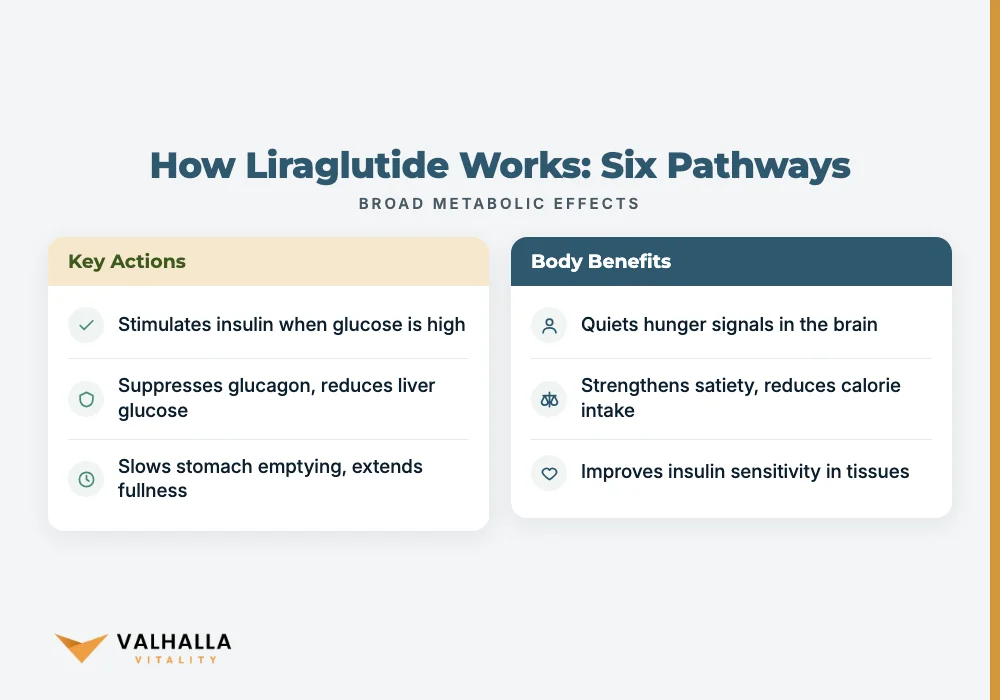
Before examining each pathway in depth, a structured overview maps the core effects that explain why liraglutide produces broad metabolic and appetite changes:
- Liraglutide stimulates insulin secretion from pancreatic beta cells when blood glucose is elevated.
- It suppresses glucagon from pancreatic alpha cells, which reduces the liver's glucose release.
- Gastric emptying slows, extending fullness after meals and moderating post-meal glucose spikes.
- Hypothalamic GLP-1 receptors activate, quieting hunger-promoting neuropeptides.
- Satiety signals strengthen, leading to a natural reduction in caloric intake.
- Insulin sensitivity improves in skeletal muscle and other peripheral tissues.
None of these pathways operates in isolation. Their combined effect is what distinguishes the liraglutide mechanism of action from single-target appetite drugs.
How does liraglutide affect appetite and hunger?
Liraglutide reduces appetite through two distinct and complementary routes: direct central nervous system signaling and peripheral gastrointestinal effects. Both pathways lower caloric intake, but through different mechanisms.
The hypothalamic pathway and liraglutide appetite suppression
GLP-1 receptors are densely expressed in the hypothalamus, particularly in regions governing energy balance. When liraglutide activates these receptors, it suppresses neuropeptide Y (NPY) and agouti-related protein (AgRP), both potent hunger-promoting neuropeptides. Simultaneously, activity increases in pro-opiomelanocortin (POMC) neurons, which signal satiety and reduce food-seeking behavior.
The net effect is a recalibration of the brain's appetite balance. Hunger signals quiet. Satiety signals strengthen. Meal sizes tend to decrease. A 2021 analysis in Advances in Therapy by Ard et al. described this dual hypothalamic action as a central driver of the sustained weight loss observed across GLP-1 receptor agonist trials, more durable than diet-driven appetite reduction alone.
Gastric emptying and the gut-brain axis
Liraglutide also slows the rate at which food leaves the stomach. This extends the mechanical feeling of fullness after meals, moderates how quickly glucose enters the bloodstream, and reduces intestinal fat absorption from food. All three effects contribute to the overall reduction in net caloric gain from each meal.
The vagus nerve carries satiety signals from the gut to the brainstem, where they reinforce the central appetite effects described above. This gut-brain feedback loop means liraglutide appetite suppression operates at multiple levels simultaneously. It is not purely a brain drug. It is not purely a gastrointestinal drug. Both axes contribute, and their interaction is part of what makes the appetite-reducing effect clinically meaningful.
Liraglutide insulin secretion and pancreatic effects
The pancreas is where clinical study of liraglutide began. Its effects on beta cells and alpha cells are thoroughly characterized and central to its role in glycemic management.
Beta cell stimulation
Liraglutide binds GLP-1 receptors on pancreatic beta cells, triggering a cyclic AMP (cAMP)-mediated cascade that promotes insulin gene expression and increases liraglutide insulin secretion. One critical feature is glucose dependence. The effect on insulin release is strongest when blood glucose is elevated and weakens as glucose approaches normal levels.
That glucose-dependent pattern has significant clinical implications. Unlike some older drug classes that stimulate insulin secretion regardless of blood glucose, liraglutide's response is regulated rather than fixed. The risk of hypoglycemia is substantially reduced as a result. GLP-1 receptor activation has also been associated with effects supportive of beta cell health, including reduced apoptosis, though these effects are better characterized in preclinical settings than in large human trials.
Glucagon suppression and hepatic glucose output
Pancreatic alpha cells secrete glucagon, which signals the liver to release stored glucose into circulation. Liraglutide suppresses glucagon from alpha cells in a glucose-dependent manner analogous to its effect on beta cells. By reducing glucagon, liraglutide decreases hepatic glucose production, lowering both fasting glucose and post-meal glucose peaks.
The dual action is significant. Stimulating insulin while suppressing glucagon simultaneously gives liraglutide two coordinated handles on glycemic control, producing a more balanced metabolic response than either action alone would achieve.
What are the metabolic effects of liraglutide?
The metabolic effects of liraglutide extend well beyond glycemic management. Multiple systems respond to GLP-1 receptor activation, and the downstream changes touch insulin sensitivity, energy balance, cardiovascular markers, and central nervous system function.
Insulin sensitivity in peripheral tissues
Liraglutide improves insulin sensitivity in skeletal muscle and other peripheral tissues. More responsive muscle cells take up glucose more readily. This reduces the compensatory demand on beta cells and can interrupt the progressive cycle of insulin resistance associated with obesity-related metabolic dysfunction.
Improved peripheral insulin sensitivity may also influence body composition. Efficient glucose uptake in muscle tissue reduces glucose redirection toward fat synthesis, contributing to metabolic improvement independent of the caloric deficit from reduced food intake.
Energy expenditure and caloric balance
Some research suggests that GLP-1 receptor agonists modestly increase resting energy expenditure. The Ard et al. 2021 review characterized this as a secondary contributor to weight outcomes, with appetite suppression remaining the primary driver. The two effects compound. A quieted appetite reduces caloric intake. A modestly elevated metabolic rate widens the resulting deficit.
Cardiovascular and lipid effects
GLP-1 receptors are present on cardiac tissue and in vascular endothelium. Activation of these receptors has been linked to modest reductions in blood pressure and improvements in cardiac function markers. A 2016 review by Kim in Postgraduate Medical Journal identified these cardiovascular effects as a distinct dimension of GLP-1 receptor agonist therapy, separate from glucose lowering. Some lipid parameters also show favorable changes, though the degree varies across studies and populations.
GLP-1 receptors in the brain
GLP-1 receptors are distributed throughout the central nervous system beyond the hypothalamus. A 2025 review by Hou et al. in Experimental and Clinical Endocrinology and Diabetes examined GLP-1 receptor signaling in relation to inflammatory and metabolic pathways that may be relevant to cognitive function, particularly in metabolic disease contexts. This is an active area of early-stage research. Clinical significance for patients without existing neurological conditions remains under investigation.
How does liraglutide cause weight loss?
GLP-1 receptor agonist weight loss through liraglutide is not the product of a single pathway. Several mechanisms operate simultaneously.
Appetite decreases. Satiety increases. Gastric emptying slows. Caloric intake falls. Insulin secretion improves. Glucagon is suppressed. Together, these shifts generate a sustained caloric deficit. When intake falls consistently below expenditure, the body draws on stored fat for energy.
The Ard et al. 2021 review in Advances in Therapy examined this mechanism directly. The analysis concluded that sustained weight reduction with GLP-1 receptor agonists is mechanistically tied to ongoing appetite suppression and metabolic normalization, not a transient effect. Weight often returns when therapy stops because the appetite-regulating and metabolic effects that sustained the deficit are no longer present.
Liraglutide for weight loss is most effective as part of a comprehensive program. The drug reduces the appetite signals that make dietary adherence difficult. It does not replace behavioral change. Diet and physical activity remain integral to any GLP-1-assisted weight management plan.
How fast do you lose weight on liraglutide?
The pace varies considerably between individuals. No universal timeline applies. A 2025 systematic review by Moiz et al. in Annals of Internal Medicine found that GLP-1 receptor agonists, including liraglutide, produced significant weight loss in adults without diabetes across multiple randomized controlled trials. Individual results and timelines differed across studies and patient populations.
Baseline body weight, dietary choices, physical activity, metabolic history, and adherence all influence outcomes. A licensed provider determines whether GLP-1 therapy is appropriate after reviewing your intake and helps set expectations grounded in your specific clinical picture, rather than a generic projection.
Liraglutide for obesity: what the research shows
Interest in liraglutide obesity treatment extends through decades of incretin biology research. The drug attracted clinical attention because its mechanism addresses multiple physiological contributors to obesity simultaneously, rather than targeting a single pathway in isolation.
A 2016 review by Kim in Postgraduate Medical Journal positioned GLP-1 receptor agonists among the most mechanistically broad obesity pharmacotherapies at the time, noting their capacity to act across appetite regulation, glucose homeostasis, and cardiovascular markers in a single agent.
The picture sharpened considerably with more recent data. The 2025 systematic review by Moiz et al. in Annals of Internal Medicine examined randomized controlled trials of GLP-1 receptor agonists for weight loss in adults without diabetes and found a consistent pattern of significant weight reduction, with a predominantly gastrointestinal adverse event profile that was largely transient across the included studies.
These findings reinforce the clinical rationale for liraglutide as a pharmacological component of structured obesity treatment. The research also consistently frames GLP-1 therapy as a complement to lifestyle intervention. Behavioral and pharmacological components produce better outcomes together than either approach does separately.
How a provider evaluates liraglutide therapy
A prescription for GLP-1 therapy follows a clinical evaluation. A licensed provider reviews multiple factors before determining whether liraglutide is appropriate for a given patient.
Relevant considerations include personal and family history of thyroid disease, cardiovascular history, kidney function, current medications that interact with glucose metabolism, and prior experience with weight management interventions. The intake form covers these areas in detail. Depending on the platform and the patient's clinical profile, lab work may be requested before a decision is made.
Understanding the side effects profile before starting is part of informed consent. Gastrointestinal effects, including nausea, vomiting, and diarrhea, are the most frequently reported adverse events and tend to be most pronounced during the first weeks of therapy. More detail on what patients typically experience and what to monitor is covered in our guide to side effects and tolerability.
At Valhalla Vitality, provider review is completed within 24 business hours of order placement, and delivery is approximately 3 to 7 business days from prescription dispatch. Availability varies by state.
How liraglutide compares to other GLP-1 receptor agonists
Liraglutide is one of several agents in the GLP-1 receptor agonist class. The liraglutide mechanism of action shares the core principle of GLP-1 receptor activation with these agents, but liraglutide differs in molecular structure, half-life, dosing frequency, and receptor selectivity. Some newer agents target additional hormone receptors alongside GLP-1, which may produce distinct or additive metabolic effects.
For a detailed clinical comparison of how these mechanistic differences translate in practice, see our analysis of how liraglutide compares to newer GLP-1 receptor agonists.
What distinguishes liraglutide is its long-term safety record and the volume of clinical trial data behind it. The 2025 review by Moiz et al. included multiple GLP-1 RAs and noted liraglutide's position as one of the most studied agents in the class for adults without diabetes. The choice between agents depends on clinical profile, individual tolerability, and what a licensed provider determines is most appropriate given a patient's history.
What to expect from liraglutide injections
Liraglutide is delivered by subcutaneous injection. The once-daily schedule reflects its extended duration of action following the structural modification that resists rapid degradation. Patients self-administer after initial instruction. Most find the technique straightforward after a brief orientation.
Once-daily GLP-1 injection therapy functions within a structured treatment plan that includes dietary guidance and regular provider monitoring. The injection is not a standalone treatment. It is one component of a program where pharmacological and behavioral elements reinforce each other.
Understanding why the injection maintains steady GLP-1 receptor activation, and why that sustained activation matters for appetite regulation and metabolic control, helps patients engage more actively with the treatment plan and recognize when the therapy is producing its intended effects.
Speak with a licensed provider about GLP-1 therapy
If you are exploring whether GLP-1 therapy may fit your clinical situation, a consultation with a licensed provider is the appropriate next step. Availability varies by state.
FAQ
What is the primary mechanism of liraglutide?
Liraglutide mimics the natural hormone GLP-1 by binding to GLP-1 receptors throughout the body, primarily in the pancreas, hypothalamus, and gastrointestinal tract. This triggers a coordinated response: insulin secretion increases, glucagon is suppressed, gastric emptying slows, and appetite signals decrease. These combined effects support both glycemic control and weight reduction as part of a structured treatment program.
Does liraglutide work for weight loss without diabetes?
Yes. A 2025 systematic review by Moiz et al. in Annals of Internal Medicine found that GLP-1 receptor agonists, including liraglutide, produced significant weight loss in adults without diabetes across multiple randomized controlled trials. Individual outcomes vary, and a licensed provider evaluation is required before starting therapy.
How does the liraglutide mechanism of action differ from older weight loss drugs?
Traditional weight loss drugs typically act on a single pathway, often targeting catecholamine or serotonin systems in the brain. The liraglutide mechanism of action is multi-systemic: it reduces hunger centrally, slows digestion peripherally, improves insulin sensitivity in skeletal muscle, and suppresses glucagon in the pancreas. This breadth across multiple organ systems distinguishes GLP-1 receptor agonists from earlier single-target approaches.
What side effects are most common with liraglutide?
Nausea, vomiting, diarrhea, and abdominal discomfort are the most frequently reported effects, particularly during the early weeks of therapy as the body adjusts. These effects tend to diminish over time. A provider monitors tolerance throughout treatment and adjusts the approach if needed.
Is liraglutide effective long-term?
Research indicates that the weight-reducing and metabolic effects of liraglutide persist as long as therapy continues, because the drug sustains the appetite suppression and metabolic normalization that generate the caloric deficit. The Ard et al. 2021 review noted that weight typically returns after therapy stops, which is why long-term use is evaluated individually with a licensed provider as part of ongoing treatment planning.
Sources
- Ard J et al. (2021). Weight Loss and Maintenance Related to the Mechanism of Action of Glucagon-Like Peptide 1 Receptor Agonists. Advances in Therapy. PubMed
- Moiz A et al. (2025). Efficacy and Safety of Glucagon-Like Peptide-1 Receptor Agonists for Weight Loss Among Adults Without Diabetes: A Systematic Review of Randomized Controlled Trials. Annals of Internal Medicine. PubMed
- Kim S (2016). Drugs to treat obesity: do they work?. Postgraduate Medical Journal. PubMed
- Hou Y et al. (2025). The Mechanism and Treatment of Cognitive Dysfunction in Diabetes: A Review. Experimental and Clinical Endocrinology and Diabetes. PubMed
You May Also Like
 Liraglutide, Semaglutide
Saxenda and Metformin for Weight Loss: What to Know
Saxenda and metformin can be used together for weight loss and blood sugar control. Learn how the combination works, who it suits, and what to expect.
November 2, 2026 ETRead more → Liraglutide, Semaglutide
Liraglutide for Weight Loss: What the Evidence Shows
Liraglutide for weight loss: how GLP-1 injections work, what the clinical evidence shows, side effects to know, and how it compares to semaglutide.
November 2, 2026 ETRead more → Liraglutide, Semaglutide
Liraglutide Side Effects: What Patients Need to Know
Liraglutide side effects range from nausea to rare but serious risks. Learn what to expect, how long they last, and when to call your provider.
November 1, 2026 ETRead more →