
The following blog post is for entertainment and informational purposes only. It is not intended to provide medical advice or diagnosis. Please consult your doctor before making any health-related decisions.
Tadalafil and vardenafil are both PDE5 inhibitor options for treating erectile dysfunction, working through the same mechanism to increase blood flow to penile tissue. The core tadalafil vs vardenafil difference is timing: vardenafil typically acts within 25 to 60 minutes and stays active for 4 to 5 hours, while tadalafil has a broader 30-minute to 2-hour onset window but lasts up to 36 hours. Neither drug is objectively superior across all situations. A licensed provider determines whether a therapy is appropriate after reviewing your intake and labs.
At a glance: tadalafil vs vardenafil
| Feature | Tadalafil | Vardenafil |
|---|---|---|
| Drug class | PDE5 inhibitor | PDE5 inhibitor |
| Onset of action | 30 min to 2 hours | 25 to 60 minutes |
| Duration of effect | Up to 36 hours | 4 to 5 hours |
| Food sensitivity | Minimal effect on onset | High-fat meals delay absorption |
| Back pain and muscle aches | More commonly reported | Less commonly reported |
| Prolonged erection risk | Higher reported incidence | Lower reported incidence |
Which works faster, tadalafil or vardenafil?
Vardenafil acts faster. Most men experience its effects within 25 to 60 minutes of taking it. That is a narrower, more predictable vardenafil onset time compared to the broader window of tadalafil.
Tadalafil can begin working in as little as 30 minutes but may take up to 2 hours to reach peak effectiveness for some men. The wider onset window reflects how the drug distributes before reaching therapeutic concentration. For situations where timing is critical, that variability matters.
A 2021 systematic review and meta-analysis in Advances in Therapy (Wang et al.) confirmed that vardenafil produces clinically significant improvements in erectile function scores across moderate and severe presentations. Fast onset adds practical value. It does not, by itself, determine which drug is the better fit overall.
How long does vardenafil last compared to tadalafil?
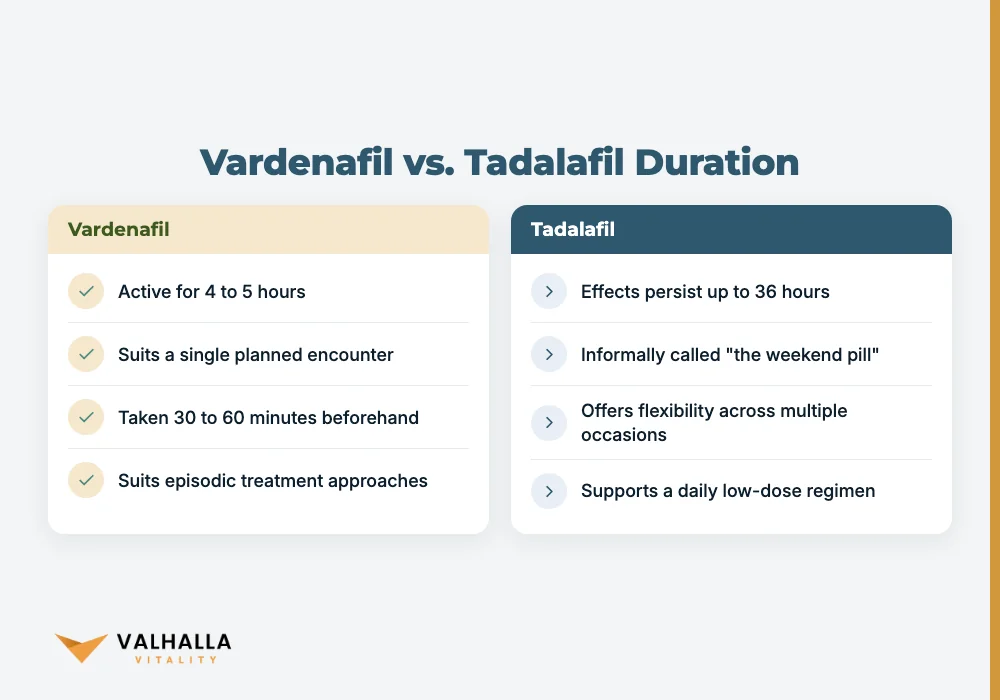
Vardenafil remains active for approximately 4 to 5 hours. That window suits a single planned encounter with the medication taken 30 to 60 minutes beforehand.
Tadalafil is in a different category. Its effects can persist for up to 36 hours. That is not incidental; it is the drug's most clinically meaningful characteristic. The 36-hour ED medication duration is what gave tadalafil the informal label "the weekend pill," and it has real practical implications for how men schedule intimacy without coordinating around a narrow dosing window.
The gap between these two drugs is significant. For men who want flexibility across multiple occasions without retaking a dose, tadalafil's duration is unmatched among approved oral options. A 2026 narrative review in the World Journal of Urology (Zhou et al.) notes that vardenafil suits episodic treatment approaches, while tadalafil's longer profile supports a broader range of scheduling and lifestyle contexts.
Tadalafil also supports a daily low-dose regimen that maintains steady concentrations in the bloodstream, removing the timing question entirely. For what the clinical research shows about that approach, see tadalafil's daily dosing approach and long-term outcomes.
Is tadalafil or vardenafil better for spontaneous sex?
Tadalafil. Its 36-hour window requires no planning within that period. No timing doses around a specific encounter, no narrow activity window to coordinate.
Vardenafil requires more coordination. Because it stays active for 4 to 5 hours, the dose needs to be taken closer to the anticipated time. That is not a flaw; some men prefer knowing the drug is active, then having a clear off window afterward.
Which ED pill lasts longer? Tadalafil by a wide margin. No other currently approved oral PDE5 inhibitor matches the 36-hour active period. The question of which drug is "better" for spontaneity has a clear pharmacological answer, even if individual preference still shapes the final choice.
What are the main differences in side effects between tadalafil and vardenafil?
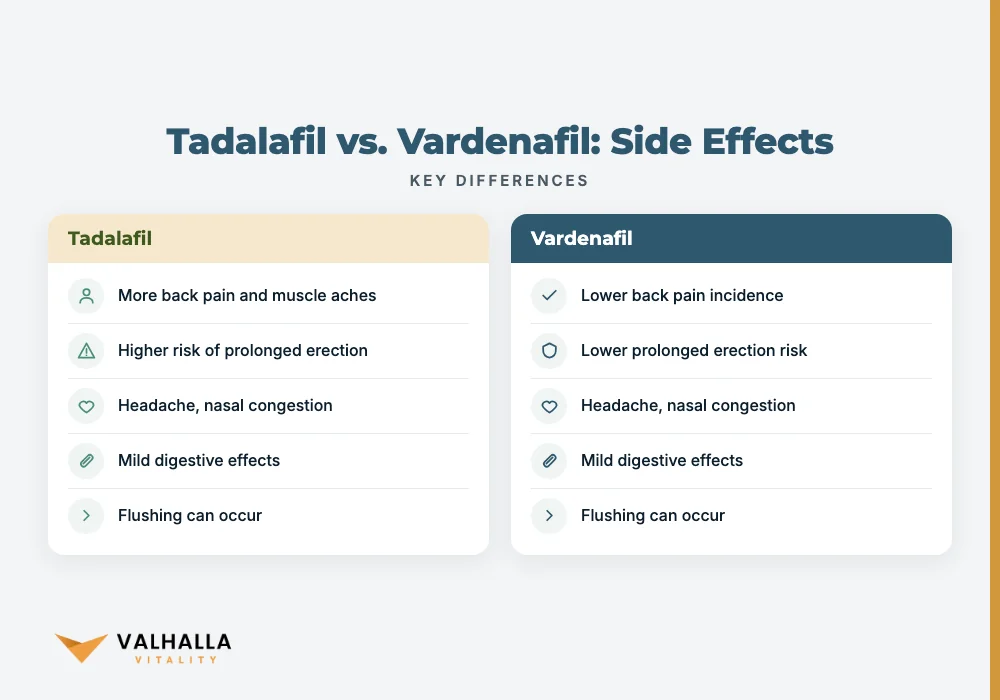
Back pain and prolonged erection risk distinguish the two most clearly. Everything else largely overlaps.
Both drugs commonly cause headache, nasal congestion, and mild digestive effects. These are generally transient and resolve as the medication clears the system.
The specific differences are consistent across clinical data:
- Back pain and muscle aches appear more frequently with tadalafil. This is one of the most reliable tolerability distinctions between the two drugs in practice.
- Prolonged erection (priapism) carries a higher reported incidence with tadalafil compared to vardenafil. For men with any history of this risk, the difference is worth discussing with a provider.
- Flushing occurs with both and is typically mild and self-limiting.
A 2021 meta-analysis (Wang et al., Advances in Therapy) found that vardenafil side effects remained manageable across diverse study populations, with low discontinuation rates. For a clinical walkthrough of how tadalafil's adverse effects present and when they warrant provider contact, see managing tadalafil's side effect profile in practice.
Vardenafil's overall profile tracks closely with the PDE5 inhibitor class. The lower incidence of back pain and prolonged erection compared to tadalafil is a real tolerability advantage for certain men.
Can you drink alcohol while taking tadalafil or vardenafil?
Both share the same general guidance. Moderate consumption does not significantly impair effectiveness for either drug. Excessive intake is a different matter.
Tadalafil and vardenafil are both vasodilators. Alcohol is also a vasodilator. Combining them at high volumes compounds the blood pressure effect and raises the risk of dizziness, flushing, and cardiovascular strain. The practical advice is identical for both: keep consumption moderate and avoid drinking heavily around the time of use.
No meaningful tadalafil vs vardenafil difference exists on the alcohol question. Individual cardiovascular history is the more relevant variable, and that is exactly what a provider weighs before prescribing.
Food and timing: a practical difference
Tadalafil is not sensitive to food. It can be taken with a full meal, a light snack, or on an empty stomach without changing how quickly or effectively it works.
Vardenafil behaves differently. High-fat meals can slow absorption and push back the onset window. For the most reliable vardenafil onset time, a light meal or empty stomach is the better approach.
The drug still works with food. The timing may shift later. Men whose routines regularly involve large meals before intimacy will find tadalafil's flexibility around food a genuinely useful advantage in day-to-day use.
Choosing between tadalafil vs vardenafil
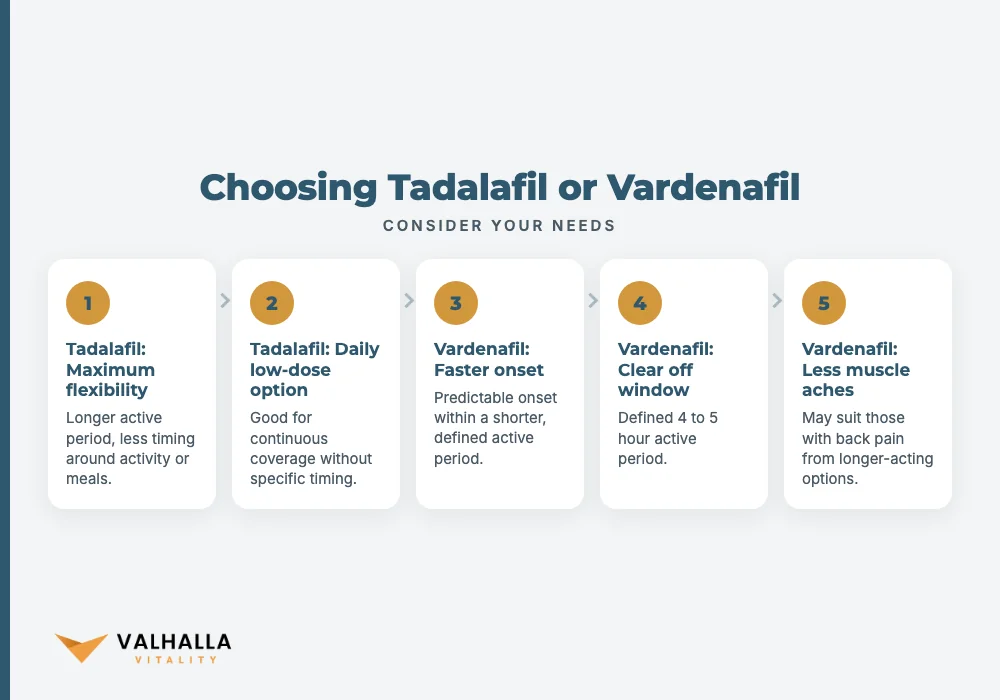
This tadalafil vs vardenafil decision comes down to timing, lifestyle, and individual health factors. Both are established PDE5 inhibitors with strong efficacy records. The comparison is not about which drug works; it is about which works better for a specific person's pattern of use and health context.
Tadalafil tends to suit men who:
- Want maximum flexibility without timing doses around specific activity
- Are considering a daily low-dose approach for continuous coverage
- Accept a broader onset window in exchange for a 36-hour active period
- Cannot easily control meal timing around medication intake
Vardenafil tends to suit men who:
- Prefer a faster, more predictable onset within a shorter window
- Want a defined 4 to 5 hour active period followed by a clear off window
- Experience back pain or muscle aches with longer-acting PDE5 inhibitors
Both require a provider's review before prescribing. For context on how tadalafil also compares with sildenafil, the tadalafil vs sildenafil breakdown covers that PDE5 inhibitor comparison directly.
Ready to find the right option?
If you have questions about tadalafil vs vardenafil for your specific situation, a licensed clinician can review your intake and health history and determine which therapy is appropriate. Book Your Consultation to get a recommendation based on your profile, not a general comparison.
FAQ
Which works faster, tadalafil or vardenafil?
Vardenafil generally acts faster, with effects starting within 25 to 60 minutes for most men. Tadalafil has a broader onset window, ranging from 30 minutes to 2 hours. If predictable rapid onset is a priority, vardenafil has the advantage on that dimension.
How long does vardenafil last compared to tadalafil?
Vardenafil remains active for approximately 4 to 5 hours. Tadalafil can stay effective for up to 36 hours. That gap is substantial, and it is the central reason men who want flexibility without retaking a dose often prefer tadalafil.
Can you drink alcohol while taking tadalafil or vardenafil?
Moderate alcohol consumption is generally acceptable with both. Excessive intake raises the risk of low blood pressure and dizziness with either medication, since both are vasodilators. A provider can advise based on individual cardiovascular history.
What are the main differences in side effects between tadalafil and vardenafil?
Both drugs commonly cause headache, nasal congestion, and mild digestive effects. Tadalafil is more frequently linked to back pain, muscle aches, and a higher rate of prolonged erection compared to vardenafil. Vardenafil carries a lower reported incidence of those two specific effects.
Is tadalafil or vardenafil better for spontaneous sex?
Tadalafil's 36-hour active window makes it the stronger option for spontaneous sex. No timing is required around the dose within that window. Vardenafil's 4 to 5 hour window suits planned encounters where taking a dose an hour or so beforehand is acceptable.
Sources
- Wang H et al. (2021). Vardenafil in the Treatment of Male Erectile Dysfunction: A Systematic Review and Meta-Analysis. Advances in Therapy. PubMed
- Zhou J et al. (2026). Vardenafil in the multidisciplinary management of erectile dysfunction: a narrative review on multidimensional outcomes and clinical integration. World Journal of Urology. PubMed
You May Also Like
 Tadalafil
 Erectile Dysfunction: What You Need to Know
Tadalafil erectile dysfunction treatment: how PDE5 inhibition works, daily vs as-needed dosing, side effects, and how it compares with sildenafil.
November 18, 2026 ETRead more → Tadalafil
Avanafil vs Tadalafil: ED Medication Comparison Guide
Avanafil vs tadalafil compared: onset speed, duration, side effects, and when to choose each. See which ED medication fits your needs and lifestyle.
November 12, 2026 ETRead more → Tadalafil
 Drug Class: Mechanism, Uses, and Comparisons
Tadalafil drug class belongs to PDE5 inhibitors. Learn how tadalafil works in the body, what conditions it treats, and how it differs from sildenafil.
November 12, 2026 ETRead more →