
The following blog post is for entertainment and informational purposes only. It is not intended to provide medical advice or diagnosis. Please consult your doctor before making any health-related decisions.
MIC B12 oral describes lipotropic supplements that combine Methionine, Inositol, Choline, and Vitamin B12 in a form taken by mouth rather than injected. Products range from mic b12 sublingual drops held briefly under the tongue to swallowed liquids and mic b12 pill form capsules. If you are weighing which format fits your situation, our MIC B12 pill form guide covers how oral and injectable options differ in formulation and delivery. A licensed provider reviews your health intake and lab values to determine which format is appropriate for you.
What oral MIC B12 actually contains
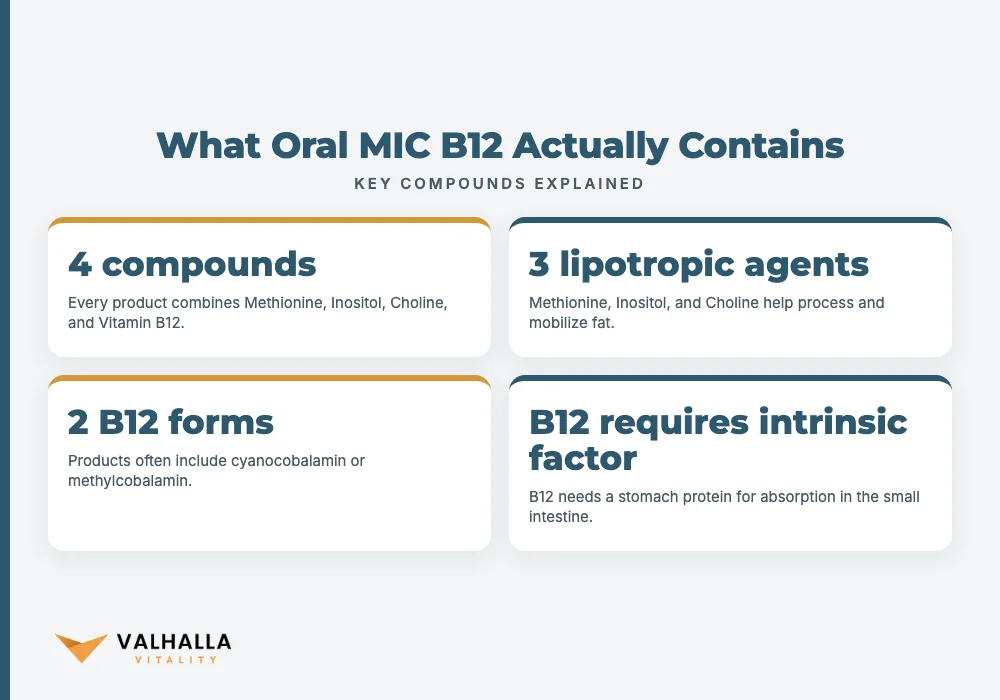
Every such product combines the same four active compounds. What each does individually explains why they are always grouped together.
| Compound | Primary function |
|---|---|
| Methionine | Essential amino acid; supports fat metabolism and liver processing |
| Inositol | B-vitamin relative; supports lipid signaling and mood-related neurochemical pathways |
| Choline | Essential nutrient; prevents liver fat accumulation and supports neurotransmitter synthesis |
| Vitamin B12 | Cofactor for energy metabolism and red-blood-cell production |
The term "oral lipotropic supplement" is accurate because Methionine, Inositol, and Choline are all lipotropic agents. They help the body process and mobilize fat, particularly in the liver. B12 is added for its energy and neurological functions, which is why MIC and B12 appear together in every product in this category.
Products in this category often include one of two B12 forms: cyanocobalamin, which is stable and widely available, or methylcobalamin, which some consider more bioavailable. The B12 form affects how the supplement behaves after absorption. If you are comparing mic b12 pills or drops, the B12 form is worth noting on the supplement facts panel.
How the absorption path shapes what you actually get
The four active compounds in these oral formulations behave differently under digestive conditions. B12 requires binding to intrinsic factor, a protein produced in the stomach, before absorption in the small intestine. Methionine absorbs through the same pathways as dietary protein. Inositol and choline absorb readily in the small intestine under normal conditions.
For someone with intact digestion, oral delivery works through established pathways. For someone with known absorption issues, B12 delivery in particular may be compromised regardless of whether the format is a drop, a capsule, or a swallowed liquid. That is a conversation to have with a provider before selecting a format.
The active ingredients are identical whether you take mic b12 oral drops, mic b12 pills, or an injectable. What changes is the absorption path, and that difference matters most for the B12 component.
Does MIC B12 come in pill form?
Yes. Mic b12 pill form capsules and tablets are commercially available from supplement brands, alongside the more widely distributed sublingual liquids. The original clinical format for MIC B12 is intramuscular injection, but mic b12 pills have expanded access for people who prefer a non-injectable daily option.
Standard capsules contain the four MIC B12 compounds in powdered form. Some are enteric-coated, designed to survive stomach acid and release contents in the small intestine where absorption may be more favorable. Others are basic gelatin capsules. Formulations vary, so the supplement facts panel is the definitive reference for what a specific product actually contains.
Convenience is the main reason people choose mic b12 pill form. No needles. No clinic visit. No cold-chain storage in most cases. The practical consideration is that capsule absorption works differently than sublingual or injectable delivery, and that difference matters depending on your health status and goals.
Oral formats compared: drops, pills, and swallowed liquid
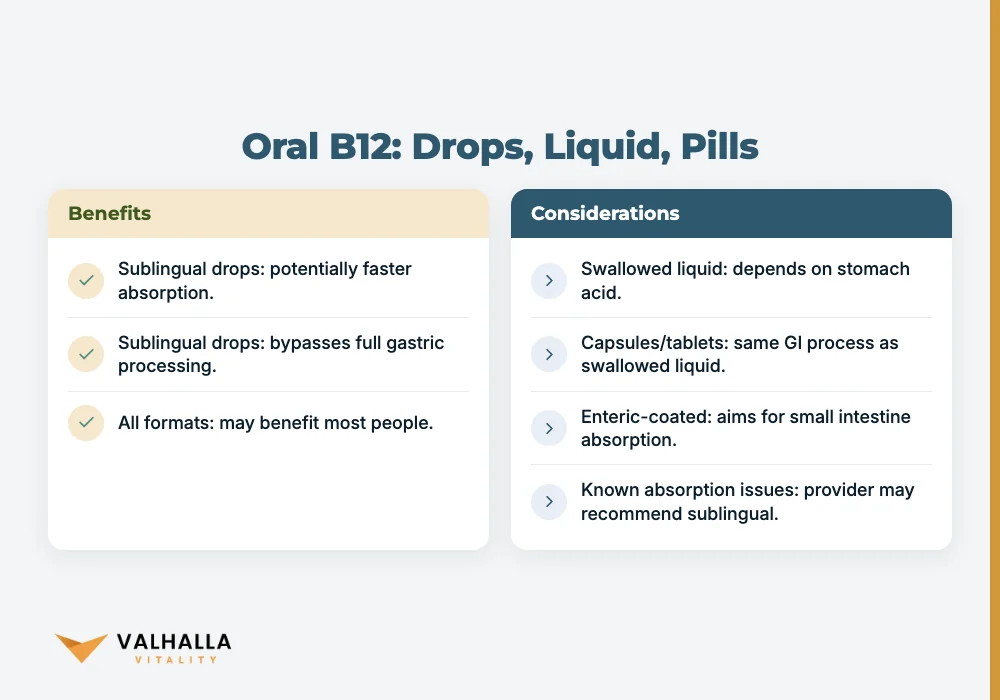
Three oral delivery formats of mic b12 oral exist, each with a different absorption profile. Understanding the differences helps when discussing options with a provider.
Sublingual drops. The liquid is placed under the tongue and held briefly before swallowing. The mucous membrane under the tongue allows certain nutrients to enter local blood vessels without full gastric processing. Mic b12 sublingual products are described as potentially faster-absorbing than swallowed alternatives for this reason. The original formulation guidance described sublingual delivery as "believed to enhance absorption," and that hedged phrasing remains accurate.
Swallowed liquid. Some of these products are taken without sublingual holding. These follow standard gastrointestinal digestion. Absorption depends on stomach acid levels, transit time, and individual intrinsic factor availability.
Capsules and tablets. Mic b12 pills go through the same GI process as swallowed liquid. Enteric-coated versions aim to shift absorption to the small intestine where conditions may be more favorable for certain compounds. Standard capsules dissolve in the stomach.
For most people without documented absorption issues, all three oral formats may provide benefit from the lipotropic compounds. For individuals with known B12 absorption problems, a provider is more likely to recommend sublingual or injectable delivery where the GI route is bypassed more fully.
Is oral MIC B12 as effective as injections?
No controlled head-to-head trial has compared the full MIC formula across delivery formats. What is known about relative effectiveness comes primarily from B12 absorption research.
Injections deliver nutrients directly into circulation. No digestion required. No intrinsic factor needed. No absorption variability between individuals. For people with severe B12 deficiency or documented absorption conditions, injections are the clinically reliable option.
Mic b12 sublingual delivery bypasses some gastrointestinal processing. It is a practical middle ground for people who want more absorption reliability than a swallowed capsule provides but do not need an injection. Swallowed formulations depend entirely on GI absorption, which varies by individual and health status.
For people whose B12 is within a normal range and who want ongoing nutritional support rather than deficiency correction, oral formats may provide adequate benefit. The lipotropic drops benefits linked to Methionine, Inositol, and Choline are less dependent on absorption precision than B12 itself, since these compounds are present in common food sources as well.
The choice between mic b12 oral and injectable delivery is a clinical decision, not a product decision. A provider determines which format fits your intake and lab values. For the injection-based side of this comparison, our complete overview of MIC B12 injections covers how the injection route works in detail.
How do you take MIC B12 oral drops?
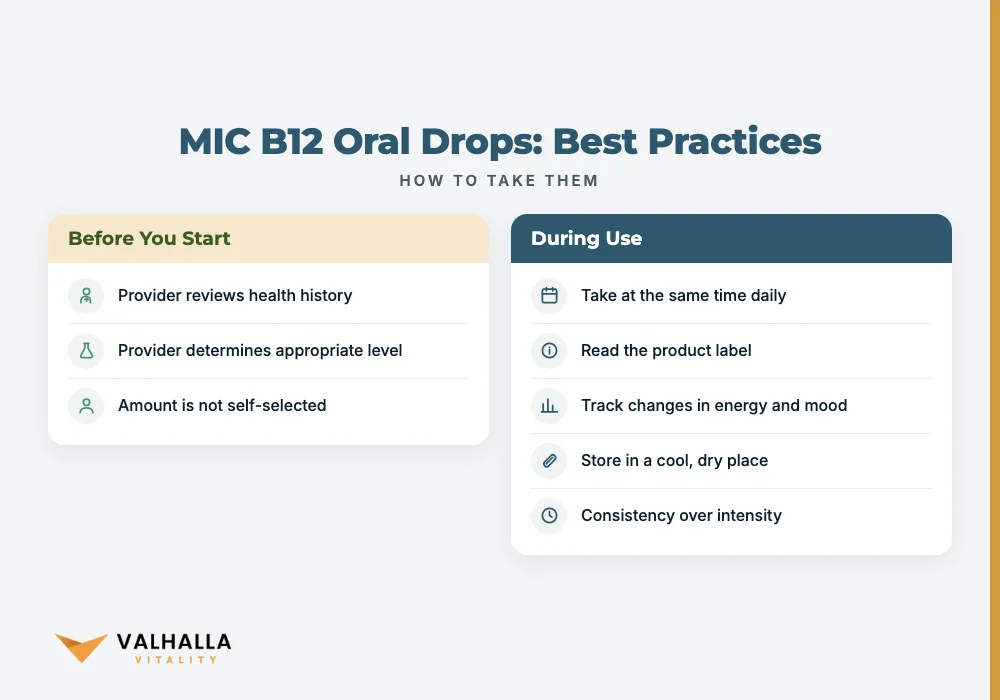
The standard approach for mic b12 sublingual drops is to place the product's specified volume under your tongue and hold it briefly before swallowing. That brief contact with the mucous membrane is what separates sublingual delivery from simply swallowing the liquid. After holding, swallow normally.
Before you start
A licensed provider should review your health history and goals before you begin any mic b12 oral protocol. The amount used is not self-selected. A licensed provider determines the appropriate level after reviewing your intake and baseline lab values.
During use
- Take at the same time each day. Consistency in timing supports steady circulating levels.
- Store in a cool, dry place away from direct sunlight. Heat and light affect B12 stability in particular.
- Read the product label. Instructions vary by manufacturer, and the label is the reference for your specific formulation.
- Track changes in energy, mood, and digestion. These are the domains where such protocols tend to show early signals.
Consistency over intensity
A well-timed consistent daily routine tends to outperform irregular use at any amount. Mic b12 oral protocols are designed for daily use as part of a sustainable plan. If daily consistency is difficult with your schedule, let your provider know so the approach can be adjusted.
Benefits of an oral lipotropic supplement
The lipotropic drops benefits attributed to mic b12 oral formulations span four main areas: fat metabolism, energy production, liver health, and mood and cognitive support. These are the same mechanisms associated with injectable formats. The distinction is in absorption reliability, not in what the compounds are capable of doing.
Weight management and fat metabolism
Methionine's role in fat metabolism is the primary reason it appears in mic b12 weight loss protocols. It helps the body convert stored fat into usable energy, most relevant during caloric deficit when metabolic efficiency matters most.
This does not mean that taking an oral lipotropic supplement alone causes weight loss. It means that when nutrition and activity habits are already in place, methionine and choline may support more efficient fat processing. Inositol plays a secondary role through insulin signaling, which affects how the body handles glucose and stores fat.
For context on how lipotropic protocols fit a broader weight-management approach, how lipotropic support fits a weight-loss plan covers how dietary and supplement support work together.
Energy production and fatigue
Vitamin B12 is required for converting food into usable cellular energy. When B12 falls below optimal, that conversion slows and fatigue follows. Supplementing with these formulations may restore this process if B12 insufficiency is contributing to low energy.
The energy effect is biochemical. It is not stimulant-based, and it does not produce an immediate kick. For people who start with normal B12 levels, the perceived benefit may be modest. For people who were running low, the difference can be noticeable over several weeks of consistent use.
Liver health and lipid balance
Choline is classified as essential partly because of how central it is to liver function. It prevents excess fat from accumulating in liver cells, a process that develops silently and reduces liver efficiency over time. Methionine contributes through the methionine cycle, which supports liver detoxification and methylation processes.
This liver-focused function gets less attention in supplement marketing than weight or energy benefits. The biochemical role, though, is well-established in nutritional science. For people whose diets are high in fat or who consume alcohol regularly, supporting the liver's fat-processing capacity has direct relevance.
Mood regulation and cognitive support
Inositol has a known role in neurochemical signaling linked to serotonin receptor function. Its presence in these formulations reflects this established connection to mood-related pathways in nutritional science. Effects depend on baseline nutritional status and actual absorption from the specific product used.
Choline supports the synthesis of acetylcholine, the neurotransmitter central to memory and concentration. Adequate choline intake is considered important for maintaining neurological function. For people experiencing both low energy and cognitive sluggishness, the B12 and choline components in these formulations may address two contributing factors at once.
What are the side effects of oral MIC B12?
Oral MIC B12 is generally well-tolerated. The most common reactions are gastrointestinal. Mild nausea, stomach discomfort, or loose stools can occur when starting, particularly when taken on an empty stomach. These tend to settle as the body adjusts.
Sublingual drops typically cause less GI disruption than swallowed capsules because less volume reaches the stomach directly. If you are generally sensitive to supplements, sublingual delivery may be a smoother starting point than mic b12 pills. Taking any oral lipotropic supplement with food can also reduce early GI sensitivity.
B12 itself rarely causes adverse effects at supplemental amounts. It is water-soluble, and the body excretes what it does not use. Methionine at the amounts found in standard mic b12 oral products is not associated with significant adverse effects in healthy adults.
Allergic reactions are rare but possible. Reading the full ingredient list before starting matters, particularly if you have known sensitivities. If unexpected or persistent symptoms appear, stop use and speak with a provider. For people comparing how injection-specific side effects differ from oral delivery, that article covers what to monitor after the injection-based version.
How long does it take for MIC B12 oral to work?
The timeline depends on your starting point. People with meaningful B12 insufficiency often notice improved energy within several weeks of consistent use. Those who start with normal B12 levels may notice less, because the supplement is maintaining rather than correcting.
Methionine and choline effects on liver health and fat metabolism are slower and harder to perceive without lab data. A follow-up panel checking B12 levels and relevant markers provides objective data that subjective energy levels alone cannot give you.
Mic b12 sublingual formats may produce initial changes faster than capsules, because some absorption bypasses gastric processing. Over weeks of consistent use, the difference between oral formats tends to narrow.
Give any mic b12 oral supplement a consistent run before evaluating results. Maintain stable nutrition and activity habits throughout. Work with a provider who can order labs at follow-up so you have objective data alongside how you feel, rather than comparing yourself to a fixed timeline from a product page.
Ready to find the right format for you?
A licensed provider reviews your health intake and determines whether mic b12 oral, sublingual, or injection-based delivery is appropriate for your situation. Book Your Consultation to get a clinical review and a clear path forward.
FAQ
Does MIC B12 come in pill form?
Yes, mic b12 pill form products exist as capsules and tablets containing the same MIC and B12 compounds as liquid drops. Absorption may differ from sublingual or injectable delivery depending on the product and your individual digestion.
Is oral MIC B12 as effective as injections?
Oral MIC B12 depends on gastrointestinal absorption, while injections deliver nutrients directly to the bloodstream. Mic b12 sublingual drops may improve absorption over swallowed formulations, but a provider determines which format fits your health status and lab values.
How do you take MIC B12 oral drops?
Place the product's specified volume under your tongue and hold it briefly before swallowing. Follow the manufacturer's label instructions and store the product in a cool, dry place away from direct sunlight.
What are the side effects of oral MIC B12?
The most common reactions are mild gastrointestinal sensitivity, including nausea or stomach discomfort, particularly when taken on an empty stomach. These effects are generally temporary. Stop use and consult a provider if anything unexpected or persistent occurs.
How long does it take for MIC B12 oral to work?
People with B12 insufficiency often notice energy improvements within several weeks of consistent use. Effects on fat metabolism and liver function take longer and are best confirmed with follow-up labs rather than by subjective feel alone.
You May Also Like
 MIC B12
 injection benefits: energy, fat & metabolism
MIC B12 injection benefits include energy support, fat metabolism, liver health, and mood. Find out how lipotropic shots work and who may benefit.
November 22, 2026 ETRead more → MIC B12
 Injections: Benefits, Weight Loss & How They Work
MIC B12 injections use methionine, inositol, choline, and B12 to support fat metabolism and energy. Learn what the evidence shows and who may benefit.
November 22, 2026 ETRead more → MIC B12
 Injection Benefits: Energy, Fat Loss & Mood
MIC B12 injection benefits include faster fat metabolism, higher energy, and improved mood. Learn how methionine, inositol, and choline work together.
November 21, 2026 ETRead more →