Testosterone Decanoate vs Undecanoate: Key Differences

The following blog post is for entertainment and informational purposes only. It is not intended to provide medical advice or diagnosis. Please consult your doctor before making any health-related decisions.
Testosterone decanoate vs undecanoate are two testosterone esters that differ in half-life, ester chain length, and available administration routes. Decanoate is injectable only. Undecanoate comes as both an intramuscular injection and a daily oral capsule, making it the more versatile option in a testosterone ester comparison, as covered in the testosterone undecanoate injection guide. A licensed provider reviews your labs to determine which form is appropriate.
What is the difference between testosterone decanoate and undecanoate?
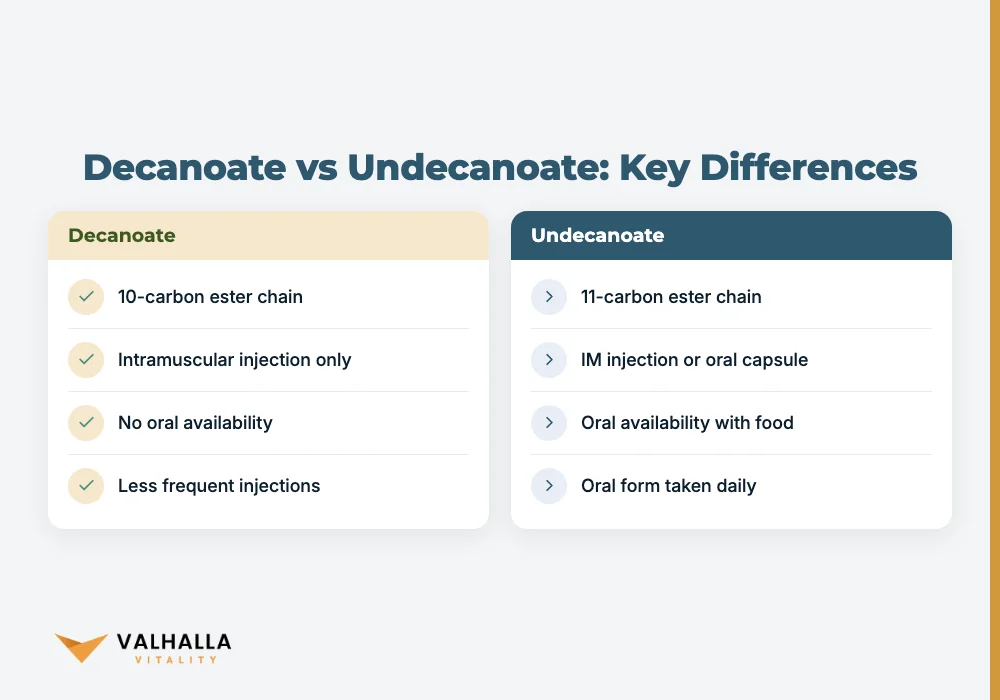
Testosterone decanoate vs undecanoate differ at the ester chemistry level. Both compounds attach testosterone to a fatty acid chain, but decanoate uses a 10-carbon chain while undecanoate uses an 11-carbon chain. That single extra carbon affects how slowly the ester is cleaved after injection and how long testosterone remains active in circulation.
Route of administration provides the second major distinction: decanoate is available only as an intramuscular injection. Undecanoate extends to both an intramuscular injection and an oral capsule, where it absorbs through intestinal lymph vessels rather than passing through the liver first. This makes oral testosterone absorption with undecanoate mechanistically distinct from any injectable option.
| Feature | Testosterone decanoate | Testosterone undecanoate |
|---|---|---|
| Ester chain | 10 carbons | 11 carbons |
| Half-life class | Long (injectable) | Long (injectable) / Shorter (oral) |
| Administration | Intramuscular injection only | IM injection or oral capsule |
| Oral availability | No | Yes, taken with food |
| TRT injection frequency | Less frequent | Injection: less frequent; oral: daily |
What is the half-life of testosterone decanoate?
Testosterone decanoate's half-life is among the longer ones available in clinical TRT. After intramuscular injection, the 10-carbon ester is cleaved gradually at the injection depot, releasing testosterone into circulation over an extended period. This produces sustained hormone levels without requiring frequent dosing.
Shorter esters like propionate clear quickly and require more frequent administration. Decanoate sits at the longer end of the spectrum. Because of the decanoate half-life, adjusting a regimen takes time: any given dose remains active well beyond the injection date, which limits how quickly a protocol can be modified.
Injectable testosterone undecanoate has a comparable half-life to decanoate. The oral form clears substantially faster, which is why dosing strategy for each route requires separate planning, as discussed in the undecanoate injection timing and intervals guide.
How often do you inject testosterone decanoate?
TRT injection frequency for testosterone decanoate is lower than for mid-range esters like enanthate or cypionate. The long decanoate half-life means hormone levels remain above the therapeutic floor for an extended period between injections. A licensed provider determines the specific injection interval after reviewing baseline labs, follow-up testosterone levels, and individual clinical response.
This lower frequency appeals to patients who find frequent self-injection difficult or inconvenient. The tradeoff is reduced flexibility: adjusting a regimen is slower when a previous injection is still active over a longer timeline.
Is oral testosterone undecanoate effective for TRT?
Oral testosterone absorption is the central challenge for any androgen taken by mouth. Testosterone itself breaks down rapidly during first-pass liver metabolism. Testosterone undecanoate sidesteps this by absorbing through intestinal lymph vessels, largely bypassing the liver on the initial pass.
A 2025 review in Sexual Medicine Reviews (Goldstein et al.) found that newer oral testosterone undecanoate formulations demonstrate improved bioavailability and a favorable liver safety profile compared to older oral androgens. The same review confirmed that taking the capsule with a fat-containing meal is required for adequate absorption. Missing the meal significantly reduces oral testosterone absorption efficiency.
Testosterone undecanoate dosing in oral form must account for faster clearance: daily administration with meals is necessary to maintain stable serum testosterone levels. Patients who prefer to avoid injections may find this manageable, and the oral testosterone capsule research and therapy protocols covers how this form fits into a full hormone therapy plan.
Availability varies by state.
Which testosterone ester lasts the longest?
Among commonly used TRT options, injectable testosterone undecanoate and decanoate have the longest half-lives. Both require less frequent injections than mid-range esters, making them suitable when patients or providers need longer intervals between administrations.
A 2023 expert review in Expert Review of Endocrinology & Metabolism (Fink et al.) noted that long-acting injectable formulations continue to expand the available options for low testosterone treatment, reflecting their established clinical utility.
Here is how common esters compare on the half-life spectrum:
- Propionate: short-acting, requires the most frequent administration
- Enanthate: mid-range half-life, widely used in TRT
- Cypionate: similar to enanthate, the most common US TRT option
- Decanoate: long-acting injectable
- Undecanoate: long-acting injectable or shorter-acting oral form
Outside of medical TRT, bodybuilding testosterone esters with extended half-lives, including decanoate-containing blends, have historically been selected for their reduced injection frequency. The clinical application differs, but the pharmacokinetic reasoning is identical.
Adverse effects and clinical considerations
Both esters share a broadly similar adverse effect profile. Both may cause acne, water retention, changes in mood, and shifts in lipid levels. Route of administration introduces route-specific risks.
Injectable formulations carry a rare but documented risk of pulmonary oil microembolism (POME), reported most frequently with intramuscular testosterone undecanoate injections, according to a 2023 literature review in the International Journal of Impotence Research (Adam et al.). Symptoms may include coughing, dizziness, and respiratory distress shortly after injection. This is why injectable undecanoate is typically given in a clinical setting with a post-injection observation period.
Oral undecanoate avoids injection risks but requires consistent fat intake at each dose for predictable absorption. A provider monitors labs at regular intervals regardless of the form. For context on how these esters have been used outside clinical TRT, see bodybuilding and clinical contexts for oral testosterone esters.
Testosterone decanoate vs undecanoate: which is right for you?
Patient preference, lifestyle, and clinical factors all shape which form a provider recommends. Someone who wants fewer clinic visits or injection events may prefer a long-acting injectable. Someone who wants to avoid injections entirely may find daily oral undecanoate workable, provided they can take it consistently with a meal.
Neither form is universally preferable. A complete testosterone ester comparison for any individual accounts for injection tolerance, daily routine, how tightly hormone levels need to be managed, and individual tolerability. A licensed provider at Valhalla Vitality reviews all of these factors before recommending a protocol.
Ready to discuss your TRT options?
If you want to understand which testosterone ester fits your situation, Book Your Consultation with a licensed provider who can review your labs and recommend the right approach.
FAQ
What is the difference between testosterone decanoate and undecanoate?
Testosterone decanoate uses a 10-carbon ester chain and is available only as an intramuscular injection, while testosterone undecanoate uses an 11-carbon chain and is available as both an injection and an oral capsule. The oral form absorbs through intestinal lymph vessels, bypassing first-pass liver metabolism. Route of administration is the most practical difference for most patients.
How often do you inject testosterone decanoate?
Testosterone decanoate's long half-life allows less frequent injections compared to shorter-acting esters. A licensed provider determines the exact interval after reviewing baseline and follow-up lab results. The schedule is set individually based on hormone levels and clinical response.
What is the half-life of testosterone decanoate?
Testosterone decanoate has a long half-life because its 10-carbon ester chain slows cleavage after injection, producing a prolonged release of testosterone from the injection site. Injectable testosterone undecanoate has a comparable half-life. The oral undecanoate form clears substantially faster, since lymphatic absorption and clearance differ from intramuscular depot release.
Is oral testosterone undecanoate effective for TRT?
Oral testosterone undecanoate is an established TRT option when taken with a fat-containing meal, which is required for adequate lymphatic absorption. A 2025 review in Sexual Medicine Reviews found that modern formulations show improved bioavailability and a favorable liver safety profile. A licensed provider determines whether this form is appropriate after reviewing intake information and lab results.
Which testosterone ester lasts the longest?
Among common TRT esters, the injectable forms of testosterone undecanoate and decanoate have the longest half-lives, followed by enanthate and cypionate in the mid-range, with propionate at the shorter end. For most patients, the choice between long-acting esters comes down to formulation availability, route preference, and individual tolerability. A provider helps weigh these factors during the intake process.
Sources
- Goldstein I et al. (2025). Newer formulations of oral testosterone undecanoate: development and liver side effects. Sexual medicine reviews. PubMed
- Adam JA et al. (2023). Occurrence of pulmonary oil microembolism (POME) with intramuscular testosterone undecanoate injection: literature review. International journal of impotence research. PubMed
- Fink J et al. (2023). Novel methods for the treatment of low testosterone. Expert review of endocrinology & metabolism. PubMed
You May Also Like
 Oral Testosterone Undecanoate
Testosterone Undecanoate Oral Dosage: Complete TRT Guide
Testosterone undecanoate oral dosage is set by a licensed provider after lab review. Understand oral TRT protocol, Kyzatrex dosage, and key dosing factors.
October 7, 2026 ETRead more → Oral Testosterone Undecanoate
Testosterone Undecanoate vs Cypionate: Full TRT Guide
Testosterone undecanoate vs cypionate: compare esters, injection frequency, side effects, and oral TRT options to discuss with your provider.
October 6, 2026 ETRead more → Oral Testosterone Undecanoate
Testosterone Undecanoate vs Enanthate: TRT Comparison
Testosterone undecanoate vs enanthate: compare injection schedules, the oral option, and how a licensed provider selects your TRT formulation.
October 6, 2026 ETRead more →