Testosterone Undecanoate Injection: Complete TRT Guide

The following blog post is for entertainment and informational purposes only. It is not intended to provide medical advice or diagnosis. Please consult your doctor before making any health-related decisions.
Testosterone undecanoate injection is a long-acting form of testosterone replacement therapy used to treat clinically confirmed low testosterone, or hypogonadism. It releases testosterone gradually over weeks. That slow release means fewer injections than most other injectable TRT options require. A licensed provider determines whether this therapy is appropriate after reviewing labs and full medical history. If you're weighing how this approach fits alongside other hormone replacement therapy delivery methods, current evidence addresses what it treats, how it compares to alternatives, and what ongoing monitoring involves.
What is testosterone undecanoate injection used for?
Testosterone undecanoate injection treats hypogonadism, a medical condition in which the testes do not produce adequate testosterone. Symptoms alone are not a diagnosis. Blood tests are required. A provider reviews labs, medical history, and current medications before recommending any injectable TRT option.
There are two forms of hypogonadism. Primary hypogonadism originates in the testes themselves, from conditions such as Klinefelter syndrome or prior testicular injury. Secondary hypogonadism involves disrupted signaling between the pituitary gland and the testes, reducing the hormonal trigger the body needs for testosterone production. It addresses the resulting hormone deficiency in both cases.
Conditions typically evaluated for this therapy
- Primary hypogonadism: testicular dysfunction with confirmed low serum testosterone, such as after injury or from a congenital condition.
- Secondary hypogonadism: pituitary or hypothalamic signaling disruptions that reduce the stimulus for testosterone production.
- Age-associated decline: confirmed by lab testing when symptoms affect quality of life and no other cause explains them.
No one qualifies automatically. Availability varies by state for telehealth-based prescribing of any injectable TRT option.
Testosterone undecanoate benefits: what the research shows
The documented testosterone undecanoate benefits cover several body systems. Restoring testosterone to a normal range may support energy, mood, sexual function, body composition, bone density, and cognitive performance. The evidence is strongest for energy and sexual health. Cognitive benefits are supported by early research but lack the depth of evidence that musculoskeletal and sexual outcomes have.
Energy and mood. Men with hypogonadism often report persistent fatigue and mood instability. That goes beyond ordinary tiredness; it can affect drive, patience, and emotional resilience. Normalizing testosterone levels may reduce these symptoms over weeks to months of treatment.
Sexual function. Testosterone drives libido and contributes to erectile function. Replacing deficient levels may improve both. Other factors, including cardiovascular health and mental health, also influence outcomes, so providers consider the full clinical picture rather than treating testosterone as the sole variable.
Muscle and bone. Testosterone supports protein synthesis and bone mineral density. Low levels accelerate muscle loss, especially with age. Long-acting testosterone therapy may slow that process. Combined with resistance training, it may support modest improvements in lean mass and skeletal strength over time.
Cardiovascular markers. Testosterone interacts with lipid metabolism and vascular function. Replacement may improve some cardiovascular risk indicators, though individual cardiac history heavily influences this assessment. Providers weigh the benefit-to-risk balance on a case-by-case basis.
Cognition. Some men with low testosterone report difficulty concentrating and memory gaps. Early evidence suggests normalization of hormone levels may offer modest cognitive improvements, though this remains an area where research is still developing.
How often do you inject testosterone undecanoate?
Low TRT injection frequency is one of the clearest practical advantages of testosterone undecanoate injection. After an initial loading phase, maintenance injections are spaced many weeks apart. That is a substantial difference from shorter-acting injectables, which require more frequent dosing to maintain stable hormone levels.
The pharmacokinetics explain the interval. Testosterone undecanoate is dissolved in an oil-based carrier. Absorption from the injection site is slow. The result is a gradual, sustained hormone release that produces a flatter serum profile than short-acting forms. A 2021 study in Sexual Medicine Reviews found that longer-acting testosterone formulations suppress FSH and LH more consistently than shorter-acting ones, supporting their use when hormonal stability is the clinical goal (Masterson et al., 2021).
How the injection schedule is structured
An initial injection is followed by a second injection at an interval the provider sets. This loading phase builds stable serum testosterone more quickly than starting on maintenance dosing alone. From there, the testosterone undecanoate cycle continues at a schedule established by the provider based on follow-up labs and clinical response.
The exact schedule varies by individual. No universal timing applies. Throughout the testosterone undecanoate cycle, regular blood work confirms that levels remain in the therapeutic target range and informs any timing adjustments.
What are the side effects of testosterone undecanoate injection?
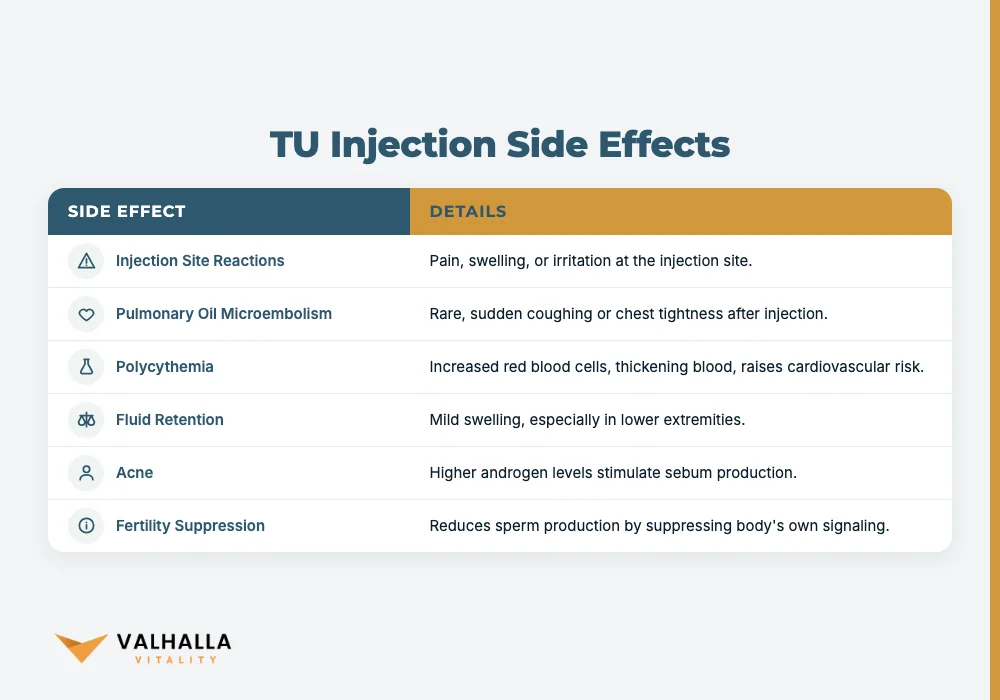
Every injectable TRT option carries potential side effects. This therapy has a documented safety profile, and most adverse effects are manageable with monitoring and dose adjustment. Providers discuss these before starting therapy.
Injection site reactions. Pain, swelling, or local irritation at the injection site can occur. These are typically mild and resolve within days.
Pulmonary oil microembolism (POME). The oil-based carrier creates a small but documented risk of oil entering the bloodstream during administration. A 2023 literature review found POME events are rare, typically presenting as sudden coughing, chest tightness, or dizziness within minutes of the injection (Adam et al., 2023). Standard practice is in-clinic administration with a post-injection monitoring period of at least 30 minutes after each dose.
Polycythemia. Testosterone replacement increases red blood cell production. A 2022 systematic review and Bayesian network meta-analysis in The Journal of Urology found that intramuscular testosterone delivery is associated with greater hematocrit increases than other routes (Nackeeran et al., 2022). Elevated hematocrit thickens the blood and raises cardiovascular risk. Routine blood counts catch this early.
Fluid retention. Some patients experience mild swelling, particularly in the lower extremities. This is more common in men with pre-existing cardiovascular or kidney conditions and is tracked at follow-up visits.
Acne. Higher androgen levels stimulate sebum production. Existing acne may worsen, or new breakouts may appear.
Fertility suppression. Testosterone replacement works by providing the hormone externally, which suppresses the body's own signaling and reduces sperm production. A 2025 review in Nature Reviews Urology confirmed that spermatogenesis is significantly reduced during TRT, though recovery after stopping therapy is documented in many men (Naelitz et al., 2025). This is a critical consideration for men of reproductive age.
How does testosterone undecanoate injection compare to other TRT forms?
Men evaluating injectable TRT options often compare testosterone undecanoate injection against shorter-acting injectables, topical forms, and oral alternatives. Each delivers testosterone differently. Each has practical trade-offs a provider weighs against individual circumstances.
Shorter-acting injectables (cypionate, enanthate). These require more frequent injections and produce larger hormonal peaks and troughs between doses. Some providers and patients prefer the granular control this affords for protocol adjustments. For a detailed look at how the pharmacological profiles differ, this side-by-side comparison of undecanoate and enanthate covers the clinical data.
Transdermal gels and patches. These avoid injections but require daily application. Skin-to-skin transfer to partners or children is a real-world concern that providers address during counseling.
Oral testosterone undecanoate. This form uses a modified delivery mechanism designed to survive gut absorption. A 2025 review in Sexual Medicine Reviews noted that newer oral formulations were developed specifically to manage hepatic exposure concerns associated with older oral androgens (Goldstein et al., 2025). The absorption characteristics differ from injections, which affects scheduling and consistency.
No single form is universally better. Providers consider lifestyle, tolerability, and clinical goals when recommending a delivery route. Valhalla Vitality's online TRT evaluation process connects licensed providers with patients to determine which option fits each person's profile.
What is the recommended dosage for testosterone undecanoate injections?
A licensed provider determines the dose after labs. Testosterone undecanoate dosage is not the same for every patient. A starting protocol is built around baseline serum testosterone and other markers from the intake labs. Follow-up bloodwork informs any adjustments to amount or timing.
The loading phase is deliberate. An initial injection is followed by a second injection to establish stable hormone concentrations more quickly. Maintenance doses then follow at the interval the provider determines. Throughout the testosterone undecanoate cycle, labs track key markers to confirm that therapy is both effective and safe.
Do not adjust timing or amount outside a clinical review. Changes without current lab data risk under-replacement or over-replacement, both of which require medical intervention to correct.
Monitoring and long-term considerations
This form of long-acting testosterone therapy requires ongoing clinical oversight. It is not a one-time decision. Providers check serum testosterone, hematocrit, PSA, and lipid panels at regular intervals throughout treatment. Men with pre-existing cardiovascular or prostate conditions face additional monitoring requirements.
Long-term safety evidence is still accumulating. Current guidance supports testosterone replacement in men with confirmed hypogonadism who receive appropriate monitoring. Men with active prostate concerns, uncontrolled cardiovascular disease, or plans for future fertility may need a different approach or closer oversight before and during treatment.
Understanding how this formulation behaves pharmacokinetically helps make sense of dosing intervals and lab timing. This article on how injectable testosterone undecanoate behaves over time explains the absorption and clearance data relevant to that question.
Lifestyle factors also matter. Regular physical activity, adequate sleep, and a nutrient-dense diet support overall health and may complement the benefits of long-acting testosterone therapy. These factors do not replace clinical management, but providers typically discuss them as part of the overall treatment picture.
Take the next step
If you'd like to know whether testosterone undecanoate injection fits your situation, Book Your Consultation with a licensed Valhalla Vitality provider who reviews your intake and determines whether this therapy is appropriate for you.
FAQ
What is testosterone undecanoate injection used for?
It treats hypogonadism, a clinical condition diagnosed through blood tests and provider review, not symptoms alone. The therapy restores testosterone to a normal range to address symptoms such as fatigue, reduced libido, and mood changes. A provider confirms the diagnosis and determines whether injectable TRT is appropriate.
How often is testosterone undecanoate injected?
After an initial loading phase, maintenance injections are spaced many weeks apart, making this among the least frequent injectable TRT options available. The exact interval is set by a licensed provider based on lab results and clinical response. This extended schedule is why patients and providers often prefer it for long-acting testosterone therapy.
What are the most common side effects?
Common side effects include injection site discomfort, acne, fluid retention, and elevated red blood cell counts. A rare but documented risk is pulmonary oil microembolism (POME), which is why in-clinic administration with post-injection monitoring is standard. Regular blood work allows providers to identify and address issues early.
Can testosterone undecanoate injection affect fertility?
Yes. Testosterone replacement suppresses the body's natural hormone signaling, which reduces sperm production. A 2025 review confirmed that spermatogenesis is significantly reduced during TRT, though recovery after stopping therapy is documented in many men. Men who want to preserve fertility should discuss this with their provider before starting any testosterone replacement.
How does this injection differ from testosterone gels or patches?
Gels and patches require daily application and carry a skin-transfer risk to people in the same household. Testosterone undecanoate injection is administered far less often and delivers a sustained hormone release without daily effort. A provider compares all injectable TRT options and topical forms during the intake review to identify the best fit.
Sources
- Adam JA et al. (2023). Occurrence of pulmonary oil microembolism (POME) with intramuscular testosterone undecanoate injection: literature review. International journal of impotence research. PubMed
- Masterson TA et al. (2021). The Effect of Longer-Acting vs Shorter-Acting Testosterone Therapy on Follicle Stimulating Hormone and Luteinizing Hormone. Sexual medicine reviews. PubMed
- Nackeeran S et al. (2022). The Effect of Route of Testosterone on Changes in Hematocrit: A Systematic Review and Bayesian Network Meta-Analysis of Randomized Trials. The Journal of urology. PubMed
- Naelitz BD et al. (2025). Testosterone replacement therapy and spermatogenesis in reproductive age men. Nature reviews. Urology. PubMed
- Goldstein I et al. (2025). Newer formulations of oral testosterone undecanoate: development and liver side effects. Sexual medicine reviews. PubMed
You May Also Like
 Oral Testosterone Undecanoate
Testosterone Decanoate vs Undecanoate: Key Differences
Testosterone decanoate vs undecanoate: compare half-life, injection frequency, and oral absorption to choose the right TRT ester for your needs.
October 7, 2026 ETRead more → Oral Testosterone Undecanoate
Testosterone Undecanoate Oral Dosage: Complete TRT Guide
Testosterone undecanoate oral dosage is set by a licensed provider after lab review. Understand oral TRT protocol, Kyzatrex dosage, and key dosing factors.
October 7, 2026 ETRead more → Oral Testosterone Undecanoate
Testosterone Undecanoate vs Cypionate: Full TRT Guide
Testosterone undecanoate vs cypionate: compare esters, injection frequency, side effects, and oral TRT options to discuss with your provider.
October 6, 2026 ETRead more →