
The following blog post is for entertainment and informational purposes only. It is not intended to provide medical advice or diagnosis. Please consult your doctor before making any health-related decisions.
Enclomiphene benefits for men include higher testosterone, improved sperm count, and preserved fertility. The compound achieves these outcomes by stimulating the body's own testosterone production rather than replacing it externally. Men exploring hormone health options for secondary hypogonadism will find that upstream distinction underpins nearly every clinical advantage the compound offers.
Specifically, enclomiphene blocks estrogen receptors in the hypothalamus, which triggers the pituitary to release luteinizing hormone (LH) and follicle-stimulating hormone (FSH), and those hormones signal the testes to produce both testosterone and sperm. A 2016 review in Expert Opinion on Pharmacotherapy identified enclomiphene citrate as a treatment option for secondary male hypogonadism for this precise reason (Rodriguez et al., 2016).
What are the benefits of enclomiphene for men?
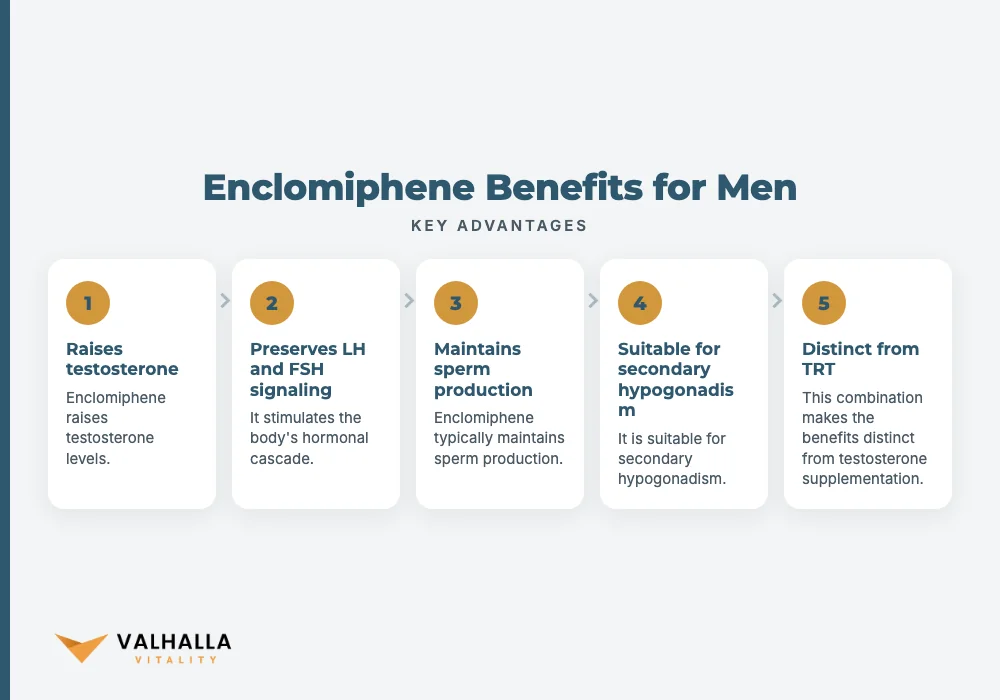
The main enclomiphene benefits cluster around three areas: testosterone restoration, sperm preservation, and secondary improvements to body composition. Unlike testosterone replacement therapy (TRT), enclomiphene citrate for men works by stimulating the body's hormonal cascade rather than replacing it. That single distinction changes several downstream outcomes, as shown below.
| Factor | Enclomiphene | TRT |
|---|---|---|
| Raises testosterone | Yes | Yes |
| Preserves LH and FSH signaling | Yes | No |
| Maintains sperm production | Typically yes | Typically no |
| Suitable for secondary hypogonadism | Yes | Yes |
| Has regulatory approval for male hypogonadism | Not as of 2025 | Yes (some formulations) |
| Long-term safety data | Still accumulating | Established |
A 2025 systematic review and meta-analysis in Archives of Endocrinology and Metabolism found enclomiphene raised testosterone levels in men with secondary hypogonadism comparably to TRT, while preserving spermatogenesis (Hohl et al., 2025). That combination makes the enclomiphene benefits profile distinct from straightforward testosterone supplementation. Understanding the full scope starts with examining each area in turn.
Does enclomiphene build muscle?
Enclomiphene muscle growth is a secondary benefit, not a primary clinical indication. Testosterone promotes protein synthesis and supports lean muscle tissue. When the compound raises testosterone levels from a hypogonadal baseline into a normal physiological range, the body may respond with measurable improvements in strength, muscle mass, and recovery time.
Among the enclomiphene benefits tied to body composition, those improvements trace back to testosterone's role in protein metabolism rather than any direct anabolic action of the compound. The magnitude depends on how far below normal baseline testosterone is. Men with significant deficits are more likely to notice change.
Bone density follows a related pathway. Adequate testosterone supports skeletal mineralization, and correcting a documented deficiency may reduce the risk of age-related bone loss. That matters for men in their 40s and 50s, where bone changes often precede other symptoms of hormonal decline.
Mood and cognitive function often improve alongside physical changes. Research has linked testosterone to energy, concentration, and general well-being, and men running below the normal range sometimes describe hormonal normalization as mentally clarifying before seeing measurable physical change. For a detailed look at the physiology, the research on enclomiphene citrate and muscle adaptation is worth reviewing.
A licensed provider determines the dose after labs. Body composition improvements, where they occur, are a monitored secondary outcome rather than the reason for initiating treatment.
Does enclomiphene increase sperm count?
Yes. Among enclomiphene benefits, the effect on sperm count is one of the clearest clinical differentiators. By raising FSH, enclomiphene directly stimulates the Sertoli cells in the testes that support sperm development. Enclomiphene sperm count outcomes follow from this mechanism consistently across the clinical literature.
TRT works in the opposite direction. A 2025 review in Nature Reviews Urology found that exogenous testosterone consistently suppresses LH and FSH in reproductive-age men, reducing spermatogenesis and leading to azoospermia in a significant proportion of patients (Naelitz et al., 2025). That outcome is sometimes reversible after stopping TRT, but recovery varies and is not assured.
Enclomiphene keeps the production pathway active. Sperm production typically continues throughout treatment. For men who have not completed their families, this is often the most important factor in the decision. More detail on enclomiphene and sperm parameter outcomes is available for men comparing their options.
Does enclomiphene improve fertility?
Enclomiphene for fertility represents one of the clearest enclomiphene benefits for men who want to raise testosterone without compromising reproductive capacity. Secondary hypogonadism involves testes that are functionally capable but not receiving adequate LH and FSH signals from the pituitary, and enclomiphene works by restoring those signals rather than bypassing them.
Rodriguez et al. (2016) described enclomiphene as a selective estrogen receptor modulator that reactivates LH and FSH secretion from the pituitary. Both testosterone and sperm production then continue simultaneously. That is the core fertility advantage: the testes stay active throughout treatment.
Fertility outcomes depend on a thorough evaluation of both partners. A licensed provider reviews clinical history and lab results before recommending any course of action. What enclomiphene offers is a route to addressing testosterone deficiency that does not require sacrificing sperm production.
Can enclomiphene replace testosterone therapy?
It depends on the diagnosis. Enclomiphene vs TRT is not a universal comparison because the two compounds suit different physiological situations. TRT is the established standard for primary hypogonadism, where the testes cannot produce adequate testosterone regardless of signaling (Heidelbaugh et al., 2024). That distinction defines where each therapy fits.
Enclomiphene is appropriate when the testes are functional but not receiving sufficient signals from the hypothalamus and pituitary. For men with secondary hypogonadism and an intact HPG axis, enclomiphene may be the better starting point.
Hohl et al. (2025) confirmed enclomiphene raises testosterone comparably to TRT in this group while preserving fertility. That evidence base is still growing, but it supports enclomiphene as a first-line consideration when fertility matters.
Cardiovascular history factors into the decision as well. A 2022 review in the International Journal of Impotence Research noted ongoing questions about TRT and cardiovascular outcomes, particularly in men with pre-existing risk factors (Auerbach et al., 2022). Enclomiphene does not carry that same established signal, though long-term cardiovascular data for the compound itself remain limited.
The right therapy depends on more than one variable. A provider works through all of it after reviewing labs.
Enclomiphene benefits: what the evidence actually covers
The enclomiphene benefits documented in clinical trials apply to a specific patient profile: men with secondary hypogonadism who have functional testes and an intact HPG axis. Within that population, the compound raises testosterone, maintains sperm production, and avoids the fertility suppression associated with TRT.
The evidence also has real limits. FDA approval for male hypogonadism is pending as of 2025. Long-term safety data extend across only a limited number of randomized trials. The compound is not appropriate for primary testicular failure.
Availability varies by state. A licensed provider at Valhalla Vitality reviews enclomiphene testosterone levels and lab results before any therapy is recommended. For men weighing their options, a detailed comparison of how enclomiphene citrate interacts with TRT protocols provides additional clinical context.
Talk to a licensed provider
Book Your Consultation to connect with a licensed provider who reviews your intake and lab results before any therapy is recommended.
FAQ
What are the main enclomiphene benefits compared to TRT?
Enclomiphene raises testosterone while keeping LH and FSH active, which preserves sperm production and the body's natural hormonal signaling. TRT delivers testosterone directly but suppresses the pituitary signals the testes need to function. Men who want to raise testosterone without shutting down fertility will typically consider enclomiphene first.
Does enclomiphene increase sperm count?
Enclomiphene sperm count outcomes are generally positive because the compound raises FSH, the primary hormonal driver of sperm development. Unlike TRT, enclomiphene does not suppress spermatogenesis and may improve sperm parameters in men with secondary hypogonadism. A licensed provider evaluates baseline labs to determine whether the hormonal response is clinically adequate.
Does enclomiphene build muscle?
Enclomiphene muscle growth is an indirect effect: when testosterone rises to a normal physiological range, protein synthesis, recovery, and lean mass may improve alongside it. The effect is most relevant for men whose deficient testosterone is already limiting their physical response. A provider sets the clinical course based on labs, with body composition as a monitored secondary outcome.
Can enclomiphene be used if I want children?
Yes. Enclomiphene for fertility is one of its primary clinical applications because it stimulates LH and FSH rather than suppressing them. Sperm production typically remains active during treatment, unlike with TRT. Couples should discuss complete fertility evaluations with a licensed provider, since outcomes depend on factors beyond testosterone alone.
Is enclomiphene citrate safe for long-term use?
Current trial data are promising, but long-term safety evidence is still accumulating. The 2025 meta-analysis by Hohl et al. found enclomiphene effective and generally well tolerated across randomized trials, though the authors noted the need for longer follow-up data. Providers monitor labs throughout treatment to track both effectiveness and safety.
Sources
- Rodriguez KM et al. (2016). Enclomiphene citrate for the treatment of secondary male hypogonadism. Expert Opinion on Pharmacotherapy. PubMed
- Hohl A et al. (2025). Clomiphene or enclomiphene citrate for the treatment of male hypogonadism: a systematic review and meta-analysis of randomized controlled trials. Archives of Endocrinology and Metabolism. PubMed
- Naelitz BD et al. (2025). Testosterone replacement therapy and spermatogenesis in reproductive age men. Nature Reviews. Urology. PubMed
- Auerbach JM et al. (2022). Testosterone replacement therapy and cardiovascular disease. International Journal of Impotence Research. PubMed
- Heidelbaugh JJ et al. (2024). Testosterone Replacement Therapy for Male Hypogonadism. American Family Physician. PubMed
You May Also Like
 Enclomiphene
Enclomiphene Hair Loss: DHT, Follicles, and the Evidence
Enclomiphene hair loss is not a listed side effect, but testosterone raises DHT, which can affect follicles. Here is what clinical research shows.
October 12, 2026 ETRead more → Enclomiphene
Enclomiphene for Gyno: Causes, Prevention & Treatment
Enclomiphene for gyno: how this SERM may help reduce gynecomastia by rebalancing estrogen and testosterone levels. Talk to a licensed provider today.
October 11, 2026 ETRead more → Enclomiphene
Enclomiphene vs Tamoxifen for PCT and Testosterone
Enclomiphene vs tamoxifen: compare how each SERM supports testosterone recovery, PCT protocols, and side effect profiles before talking to a provider.
October 11, 2026 ETRead more →