
The following blog post is for entertainment and informational purposes only. It is not intended to provide medical advice or diagnosis. Please consult your doctor before making any health-related decisions.
Enclomiphene weight gain during therapy almost always reflects fluid accumulation rather than new body fat. The medicine raises testosterone by blocking estrogen receptors in the hypothalamus, which indirectly shifts estrogen and sodium balance and can cause temporary swelling, bloating, or puffiness. Most cases are mild and manageable with straightforward lifestyle adjustments, book your consultation with a licensed provider to review your options. If you want background on how enclomiphene is used in men's health, that guide covers the broader clinical picture.
Does enclomiphene cause weight gain?
Enclomiphene weight gain is one of the most common early concerns for men starting therapy, and the direct answer is yes, though the type of weight change matters considerably. The scale can move upward because enclomiphene raises both testosterone and estrogen. Both hormones influence how the body handles sodium and fluid. What enclomiphene does not do, based on its mechanism, is directly increase body fat.
Fluid-related weight changes arrive quickly. A man might notice the scale up several pounds within the first week or two of therapy, without any change in diet. That pattern, a rapid onset closely tied to sodium intake, points strongly to water retention rather than fat accumulation. Fat builds slowly, over weeks and months. It does not swing several pounds in days.
The distinction matters practically. Men who understand what is driving a weight change are far less likely to stop therapy unnecessarily or make dietary adjustments that backfire. Fluid-related enclomiphene weight gain is, in most cases, transient and responds to consistent lifestyle changes.
Enclomiphene does support testosterone production, and some men may notice genuine changes in lean mass over a longer timeframe. That is a separate outcome from the acute fluid gain that can appear in the first few weeks. For a closer look at how enclomiphene relates to body composition more broadly, the article on enclomiphene and body weight examines both sides of that question.
How enclomiphene works
Enclomiphene is a selective estrogen receptor modulator, commonly referred to as a SERM. It binds to estrogen receptors in the hypothalamus, the brain region that regulates the hormonal chain responsible for testosterone production.
Under normal signaling, circulating estrogen tells the hypothalamus to reduce GnRH output. This acts as a natural feedback brake on testosterone production. Enclomiphene occupies that receptor, so the estrogen signal no longer gets through. The brake releases.
Without that suppressive input, the hypothalamus increases GnRH production. Higher GnRH prompts the pituitary to release more FSH and LH. Those gonadotropins signal the testes to produce more testosterone. The testes remain active throughout, which distinguishes this approach from direct testosterone replacement therapy.
The downstream consequence of more circulating testosterone is the starting point for understanding enclomiphene water retention and enclomiphene bloating. Some testosterone converts to estrogen through aromatization. Estrogen, in turn, acts on fluid-regulating systems in the kidneys. A licensed provider determines whether this therapy is appropriate after reviewing your intake and lab results.
Why does enclomiphene increase estrogen levels?
Enclomiphene is selective. It blocks estrogen receptors in the hypothalamus and pituitary but not in peripheral tissues throughout the rest of the body. That targeted action is what drives testosterone upward. It also means estrogen activity continues unimpeded everywhere else.
As testosterone climbs, aromatase enzymes convert a portion of it into estradiol. These enzymes concentrate in fat tissue, the liver, and muscle. More testosterone means more substrate for conversion, so estrogen levels rise alongside testosterone as a direct consequence.
This matters for enclomiphene fluid retention because estrogen drives aldosterone production. Aldosterone is the primary mineralocorticoid responsible for sodium and water balance in the kidneys. When estrogen rises, aldosterone rises with it, and the kidneys retain more sodium. Sodium draws water into surrounding tissues. That chain explains most cases of enclomiphene edema and enclomiphene swelling.
For men concerned about additional estrogen-related effects alongside this hormonal shift, the article on estrogen-related risks like gynecomastia addresses that specific concern with the same mechanistic grounding.
Does enclomiphene cause water retention?
Yes. Enclomiphene water retention is a recognized effect of the therapy, occurring through the hormonal pathways described above. The degree varies significantly between individuals, from barely noticeable to several pounds of retained fluid that makes clothing feel tight and joints feel stiff.
Aldosterone and sodium retention
The central pathway is estrogen raising aldosterone, which prompts the kidneys to hold on to sodium. Sodium retention brings water retention as a direct consequence, since water follows sodium through osmotic pressure. That extra fluid distributes into interstitial spaces throughout the body, producing the puffiness, enclomiphene swelling, and abdominal tightness that men on this therapy may notice.
This pathway is consistent across estrogen-sensitive conditions. It is a direct consequence of the medicine's intended effect of raising testosterone while allowing estrogen to move upward in parallel.
Testosterone and sodium reabsorption
Beyond the aromatization route, elevated testosterone may also promote sodium reabsorption in the kidneys through a separate mechanism. This second pathway is less pronounced than the estrogen-aldosterone route, but it compounds the fluid-retaining effect in some men.
The combination of these mechanisms explains why enclomiphene fluid retention can persist even when estrogen stays within a technically normal range. It also explains why reducing sodium intake is the most immediately effective lifestyle intervention available.
| Mechanism | Hormone involved | Effect on the kidneys |
|---|---|---|
| Estrogen raises aldosterone | Estradiol | Sodium and water retained in tubules |
| Aromatization amplifies estrogen | Testosterone converts to estradiol | Compounds estrogenic kidney effect |
| Direct sodium reabsorption | Testosterone | Mild additional fluid accumulation |
Recognizing the signs: enclomiphene swelling and edema
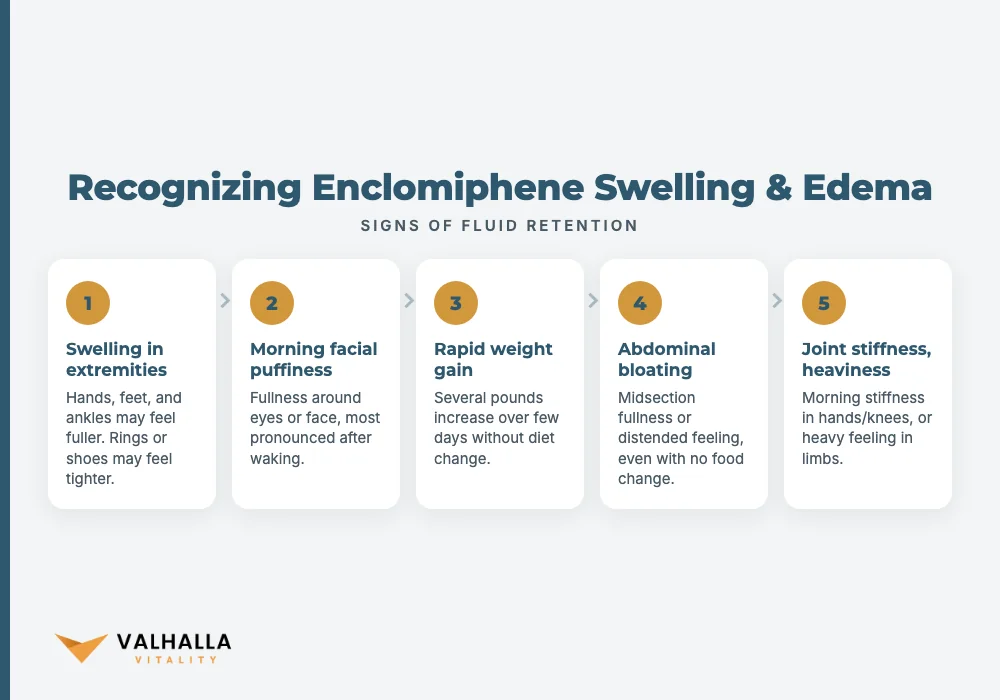
Enclomiphene side effects involving fluid show up in recognizable patterns. Severity ranges widely. Most cases fall on the mild end, and knowing what to look for makes monitoring more straightforward.
- Swelling in the extremities. Hands, feet, and ankles are the most common sites of enclomiphene swelling. Rings may feel tighter than usual, shoes may feel snug by late afternoon, and ankles may look fuller than they did in the morning. This swelling is typically symmetrical, appearing on both sides, which distinguishes it from injury-related or vascular causes.
- Morning facial puffiness. Some men notice fullness around the eyes or across the face that is most pronounced immediately after waking and reduces gradually through the day as the body moves and fluid redistributes.
- Rapid enclomiphene weight gain. A scale increase of several pounds over fewer than five days, without a change in eating habits, is a strong indicator of fluid retention. This type of enclomiphene weight gain is distinct from fat accumulation in both its speed and its responsiveness to sodium reduction.
- Abdominal bloating. Enclomiphene bloating in the midsection can range from mild fullness to a noticeably tight or distended feeling. Some men report this even when food intake has not changed, reflecting the hormonal influence on fluid distribution rather than a digestive cause.
- Joint stiffness and heaviness. Fluid in soft tissue around joints may cause morning stiffness, particularly in the hands and knees, or a heavy, fatigued feeling in the arms or legs. This typically improves with movement through the day.
- Reduced urination. When the kidneys are retaining more fluid than usual, urination frequency may decrease. This is a practical sign that the body is conserving water rather than releasing it.
- Pitting edema. Pressing a finger against the shin or inner ankle firmly for five seconds and observing whether an indent lingers is a simple self-check. A dent that takes more than a few seconds to fill back in, called pitting edema, warrants clinical attention.
- Clothing that suddenly fits differently. Waistbands, pant legs, or sleeves that feel meaningfully tighter without a change in weight or diet are worth reporting to a provider.
- Shortness of breath. Rare but serious. Fluid accumulating near the lungs can restrict breathing. Any new or worsening shortness of breath during enclomiphene therapy warrants same-day medical evaluation, not a wait-and-see approach.
Keeping a simple symptom log, noting when swelling appears and whether it responds to changes in sodium or physical activity, gives a provider useful data if an adjustment becomes necessary.
Does enclomiphene cause bloating in everyone?
No. Enclomiphene bloating does not affect all men on the therapy. Many report no noticeable abdominal fullness at all. Individual susceptibility depends on several factors working together.
Men with naturally higher aromatase activity convert more testosterone to estrogen for any given testosterone level. Because aromatase concentrates in adipose tissue, men carrying more body fat tend to experience more pronounced estrogenic effects, including bloating and enclomiphene fluid retention.
Baseline sodium intake compounds the picture. A diet heavy in processed or packaged foods provides the kidneys with more sodium to retain when aldosterone is elevated. Two men on the same therapy can have very different experiences with bloating based largely on this one dietary variable.
Genetic variation in aldosterone sensitivity adds another layer. Some men's kidneys respond more strongly to aldosterone signaling, making fluid retention more pronounced regardless of diet. This variation is not routinely tested, but it explains why side effect experiences can differ markedly even between men with similar hormone levels.
When enclomiphene bloating does occur, it typically follows a recognizable pattern: most noticeable in the first two to four weeks as hormone levels rise and stabilize, then gradually easing as the body adjusts to its new hormonal environment. Early bloating that subsides over the first month reflects normal hormonal adjustment, not a worsening problem.
How do I reduce bloating on enclomiphene?
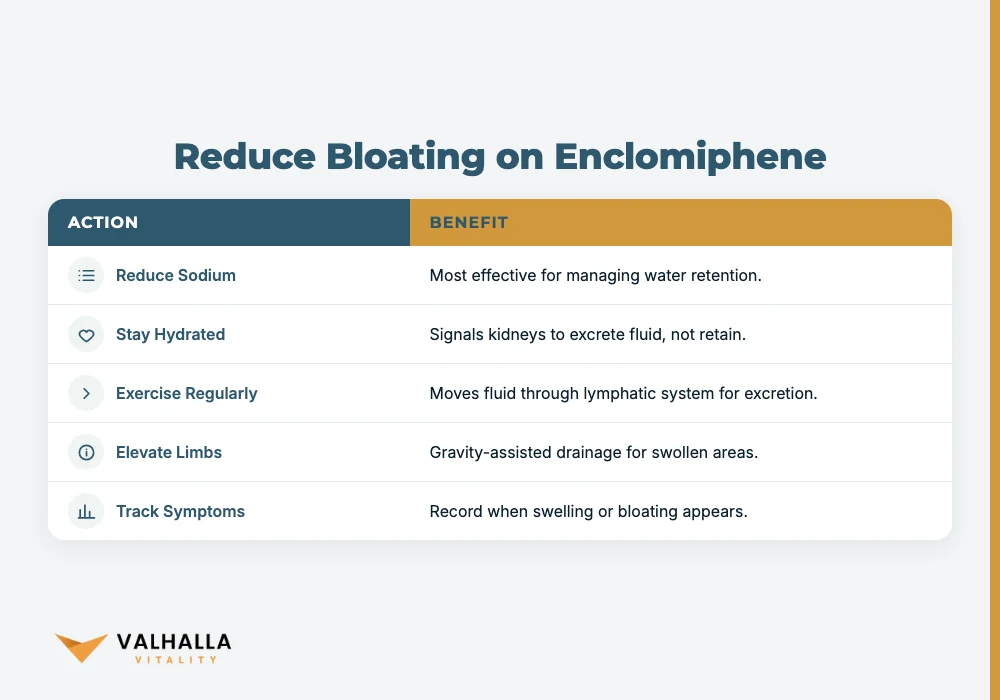
Addressing enclomiphene weight gain from fluid and the accompanying bloating comes down to managing the inputs that drive fluid accumulation: sodium, hydration, and physical movement. Most cases respond well to consistent lifestyle measures, and improvements can appear within days.
- Reduce sodium intake. This is the most directly effective dietary change for managing enclomiphene water retention. Processed foods, canned goods, condiments, and restaurant meals are the primary sources of hidden sodium in most diets. Shifting toward fresh produce, unprocessed proteins, and home-prepared meals reduces the sodium available for the kidneys to retain. A provider can advise on a specific intake target based on individual labs.
- Stay consistently hydrated. The kidneys conserve fluid more aggressively when they sense inadequate water intake. Steady hydration throughout the day signals that fluid is not scarce, encouraging excretion rather than retention. This is why increasing water intake can reduce, rather than worsen, enclomiphene fluid retention.
- Exercise regularly. Cardiovascular movement pushes fluid through the lymphatic system and back into circulation for excretion. A daily moderate session, whether walking, cycling, or swimming, manages fluid distribution more effectively than sporadic intense activity. Movement matters even on days when bloating feels most noticeable.
- Elevate affected limbs. When ankles or feet are visibly swollen toward the end of the day, lying down and raising the legs above heart level for 20 to 30 minutes promotes gravity-assisted drainage. This addresses discomfort directly but does not change the underlying hormonal cause.
- Track symptoms and report them. Recording when enclomiphene swelling or bloating appears, what sodium intake looked like that day, and whether the scale shifted gives a provider the information needed to evaluate whether any therapy adjustment is appropriate. A licensed provider determines next steps after reviewing those observations alongside updated labs.
- Seek clinical review if symptoms persist. Enclomiphene bloating that does not improve after four to six weeks of consistent sodium management, or that worsens progressively, should prompt a provider visit rather than continued self-management. A telehealth check-in through Valhalla Vitality can be arranged within 24 business hours of intake, making it straightforward to raise concerns without waiting for an in-person appointment. In some situations, an aromatase inhibitor or a short course of a diuretic may be appropriate, but those are clinical decisions informed by lab results.
| Strategy | What it targets | Practical note |
|---|---|---|
| Low-sodium diet | Kidney sodium retention | Whole foods replace processed; specific targets from a provider |
| Consistent hydration | Kidney fluid conservation reflex | Even intake throughout the day outperforms large single amounts |
| Daily cardiovascular exercise | Lymphatic fluid circulation | Moderate daily activity; not occasional high-intensity sessions |
| Limb elevation | Gravity-dependent peripheral swelling | Most useful in the evening for ankle and foot swelling |
| Provider follow-up | Persistent or progressive symptoms | Labs guide any clinical adjustment |
When enclomiphene swelling needs medical attention
Most enclomiphene edema is mild and does not require urgent care. Certain patterns, however, fall outside what self-management can address safely.
Swelling that appears in one leg only, rather than both, warrants prompt evaluation. Asymmetric lower extremity swelling can indicate a vascular issue unrelated to hormonal fluid balance. Enclomiphene-related fluid retention is almost always bilateral, so asymmetry is a signal worth acting on quickly.
Shortness of breath alongside swelling, or new chest tightness that develops during therapy, is a reason for same-day care. Fluid near the lungs or heart is a serious condition requiring immediate assessment.
Progressive pitting edema that worsens over several consecutive days, rather than stabilizing or improving, also warrants a clinical visit. Normal hormonal adjustment produces fluid retention that reaches a level and then holds. Worsening after the first few weeks is atypical and should be evaluated.
Routine provider check-ins during therapy are not only for adjusting hormone levels. They are also the appropriate time to assess fluid status, review labs, and catch early signs of imbalance before they become significant. For a comprehensive overview of what to watch during treatment, the complete side effect guide for enclomiphene covers the full monitoring picture.
Separating fluid gain from fat: what the pattern tells you
Enclomiphene weight gain from fluid and enclomiphene weight gain from fat behave differently in practical, observable ways. Recognizing the difference reduces unnecessary anxiety about scale changes.
Fluid gain is fast. Several pounds over fewer than seven days, without a meaningful change in caloric intake, is almost exclusively fluid. The affected areas feel soft and puffy rather than solid. Pressing firmly on a swollen spot may leave a temporary indent. The scale can move back toward baseline within days of reducing sodium.
Fat gain is slow. Accumulating body fat requires a sustained caloric surplus maintained over weeks and months. That kind of change does not arrive suddenly after a salty meal or a few days of reduced activity. Fat tissue does not cause pitting on the skin and does not respond to short-term changes in hydration or sodium.
The scale number alone cannot reliably distinguish between the two. The pattern over time is the more informative signal. Sudden and variable points to fluid; gradual and persistent despite no dietary excess points to fat. Neither outcome is best managed in isolation when active therapy is involved, but lifestyle choices that reduce sodium, support hydration, and maintain regular movement are appropriate alongside any provider-guided plan.
Take the next step
Book Your Consultation with a licensed provider to discuss whether enclomiphene therapy is appropriate for you and what monitoring looks like throughout treatment.
FAQ
Does enclomiphene cause weight gain?
Enclomiphene weight gain is common and is almost always fluid-related rather than fat accumulation. The therapy raises testosterone and estrogen, both of which influence how the kidneys handle sodium and water. A sudden scale increase over a matter of days is characteristic of fluid retention, not new body fat.
Does enclomiphene cause water retention?
Yes, indirectly. Enclomiphene raises estrogen, which elevates aldosterone, which prompts the kidneys to retain sodium and water. Enclomiphene water retention varies in severity between individuals, and factors including sodium intake, body composition, and aromatase activity all influence how pronounced it becomes.
Does enclomiphene cause bloating in everyone?
No. Enclomiphene bloating is frequent but not universal. Men with higher aromatase activity or a high-sodium baseline diet are more susceptible. When bloating does occur, it is typically most noticeable in the first few weeks and tends to ease as the body adjusts to the new hormonal environment.
How do I reduce bloating on enclomiphene?
Reducing dietary sodium, staying consistently hydrated, and maintaining regular cardiovascular exercise are the most effective first steps for managing enclomiphene bloating. Elevating swollen limbs provides short-term relief for discomfort. A provider should be consulted if symptoms do not improve within four to six weeks or if they worsen.
Why does enclomiphene increase estrogen levels?
Enclomiphene selectively blocks estrogen receptors in the hypothalamus and pituitary, which raises testosterone. As testosterone rises, aromatase enzymes convert some of it to estradiol throughout the body, lifting estrogen levels alongside testosterone. That elevated estrogen drives the aldosterone pathway responsible for enclomiphene fluid retention.
Sources
- Estrogen's role in aldosterone regulation and sodium retention, referenced in the "Why does enclomiphene increase estrogen levels?" and water retention sections.
- Aromatase distribution in adipose tissue, liver, and muscle, referenced in the mechanism and bloating susceptibility sections.
- Selective estrogen receptor modulator (SERM) mechanism in the hypothalamus-pituitary-gonadal axis, referenced in the "How enclomiphene works" section.
- Testosterone's independent effect on renal sodium reabsorption, referenced in the water retention mechanism table.
- Pitting edema as a clinical sign of fluid accumulation, referenced in the "Recognizing the signs" section.
You May Also Like
 Enclomiphene
 Before and After: Physical Changes Explained
Enclomiphene before and after: what physical changes to expect, how the results timeline unfolds, and why provider monitoring matters for outcomes.
October 21, 2026 ETRead more → Enclomiphene
 Vision Side Effects: Eye Floaters & More
Enclomiphene vision side effects include eye floaters, blurry vision, and light sensitivity. Know the warning signs and when to contact your provider.
October 21, 2026 ETRead more → Enclomiphene
 Drug Test: Detection, WADA, and Disclosure
Enclomiphene drug test detection depends on the test type. Learn how workplace panels, military screening, and WADA rules treat this SERM.
October 21, 2026 ETRead more →