
The following blog post is for entertainment and informational purposes only. It is not intended to provide medical advice or diagnosis. Please consult your doctor before making any health-related decisions.
OTC testosterone treatment covers everything from supplement stacks sold at pharmacies to lifestyle protocols men can start today, but not every option carries the same evidence. Most over-the-counter approaches may modestly support hormone balance; they are not a substitute for prescription therapy when testosterone is clinically low. Understanding that gap matters. If you are weighing specific therapies, reading about which testosterone therapy fits your goals gives useful context.
What are the early symptoms of low testosterone in men?
The most common low T symptoms in men include persistent fatigue that sleep does not fix, reduced sex drive, difficulty concentrating, and mood changes that range from low-grade irritability to mild depression. Some men also notice reduced muscle mass, increased body fat around the midsection, and disrupted sleep patterns. These symptoms can build gradually over years, which makes them easy to attribute to stress or normal aging rather than a hormonal shift.
These signs overlap with several other conditions, so they are not diagnostic on their own. A blood test measuring total and free testosterone is the only way to confirm whether low T is actually the cause. For a detailed look at how low T symptoms in men evolve across different age groups, see how testosterone symptoms shift across decades.
OTC testosterone treatment options at a glance
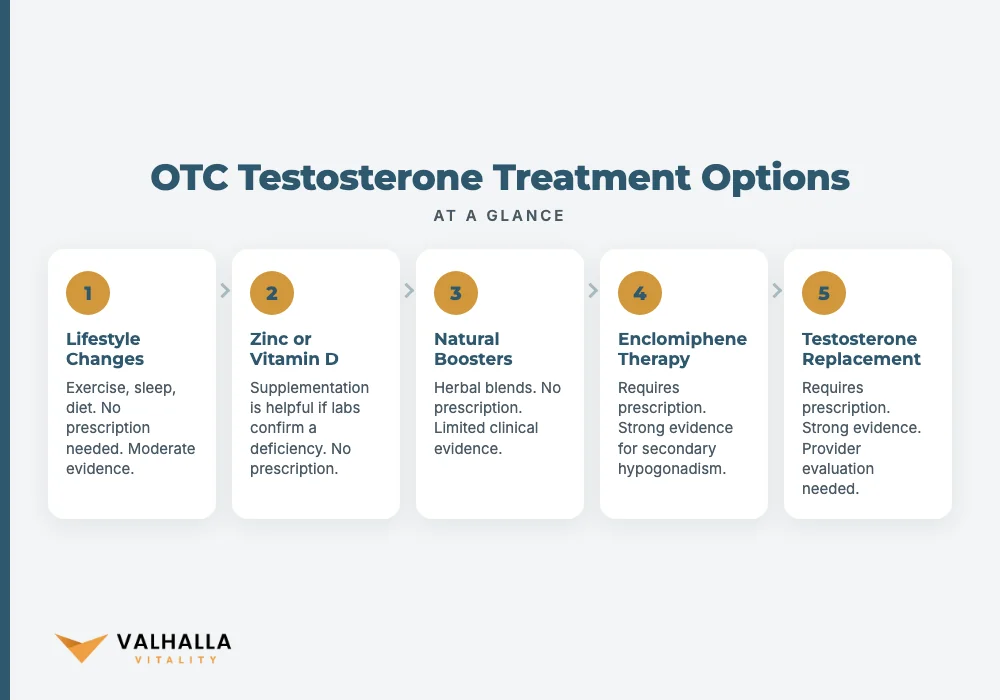
The options below span approaches that anyone can start today to those that require a licensed provider to review labs and write a prescription.
| Option | Prescription required? | Evidence |
|---|---|---|
| Lifestyle changes (exercise, sleep, diet) | No | Moderate; strongest for mild, lifestyle-driven low T |
| Zinc or vitamin D supplementation | No | Helpful when labs confirm a deficiency |
| Natural testosterone boosters (herbal blends) | No | Limited clinical evidence (Kuchakulla et al., 2021; Morgado et al., 2024) |
| Enclomiphene therapy | Yes | Strong for secondary hypogonadism (Huijben et al., 2022) |
| Testosterone replacement therapy | Yes | Strong (Salonia et al., 2025) |
Prescription options require a licensed provider to evaluate your intake and laboratory results before anything is prescribed. Availability varies by state. The sections below walk through what the evidence actually says about each tier.
Can you treat low testosterone without a prescription?
Yes, but only to a point. Several testosterone therapy alternatives are available without a prescription, and for men with borderline hormone levels tied to lifestyle factors, they can produce measurable improvement. For men with confirmed hypogonadism, non-prescription approaches alone are not a clinical solution.
Lifestyle strategies that may support testosterone naturally:
- Regular resistance training is the lifestyle intervention most consistently linked to higher testosterone in men, with several sessions per week providing the most benefit.
- Maintaining a healthy body weight reduces aromatase activity, the enzyme that converts testosterone to estrogen; moderate weight loss can improve hormone balance in overweight men.
- Getting seven to nine hours of sleep each night supports testosterone production, which peaks during slow-wave sleep and declines significantly with chronic sleep restriction.
- Managing chronic stress helps preserve testosterone output, since sustained high cortisol suppresses the hypothalamic-pituitary-gonadal axis.
- Eating a diet that provides stable blood sugar and adequate micronutrient intake gives the body the raw materials for healthy hormone synthesis.
These changes work over weeks and months, not days. They form the foundation of any hormone health strategy, whether or not a prescription therapy is eventually added. If low T symptoms persist after three to six months of consistent effort, a provider evaluation is a reasonable next step.
What are the best OTC supplements for low testosterone?
The most widely marketed testosterone supplements for men contain ingredients such as zinc, vitamin D, ashwagandha, fenugreek, and various herbal extracts. A 2021 systematic review in the International Journal of Impotence Research found that most popular testosterone and erectile dysfunction supplements lacked high-quality clinical evidence for their testosterone-raising claims (Kuchakulla et al., 2021). A 2026 pharmacological analysis found that while some natural compounds show androgen-modulating activity in laboratory studies, consistent clinical translation in men remains limited (Sharma et al., 2026).
Two ingredients have more support than the rest. Zinc and vitamin D are both associated with lower testosterone when deficient, and correcting a confirmed deficiency may help restore levels to a normal range. Foods like oysters, beef, and pumpkin seeds are reliable dietary zinc sources; fatty fish and eggs contribute to vitamin D intake. Supplementing beyond adequate levels, however, does not appear to raise testosterone further.
Natural testosterone boosters are best understood as supportive tools for men who are already eating well and exercising consistently. They are appropriate alongside a clinical evaluation, not as a reason to delay one.
Do over-the-counter testosterone boosters actually work?
Rarely, and not in the way the marketing suggests. A 2024 systematic review in the International Journal of Impotence Research examined whether OTC testosterone boosters actually increase serum total testosterone and found limited evidence that they do (Morgado et al., 2024). Many products in the review contained micronutrients that may correct deficiency-driven testosterone decline. That is different from actively raising testosterone above a person's normal baseline.
Some ingredients show early promise in laboratory research. A 2026 pharmacological analysis found that select natural compounds modulate androgen pathways in cell and animal models (Sharma et al., 2026). The gap between those findings and measurable clinical outcomes in men, however, remains wide.
For men with clinically low testosterone, OTC testosterone treatment through supplements alone is unlikely to restore levels to a healthy range. That requires a licensed provider to assess lab results and determine whether a prescription therapy is appropriate.
Is enclomiphene available over the counter?
No. Enclomiphene is a prescription medication in the United States and requires a provider review before it can be prescribed. It is not an OTC option.
What separates enclomiphene from conventional OTC testosterone treatment is its mechanism. Rather than delivering external testosterone, it stimulates the pituitary gland to produce more LH and FSH, which in turn signals the testes to increase their own output. This preserves natural hormone signaling and fertility potential. A 2022 systematic review and meta-analysis in Andrology found that clomiphene citrate, the parent compound of enclomiphene, significantly raised testosterone in men with hypogonadism while maintaining reproductive function (Huijben et al., 2022). The 2025 European Association of Urology guidelines on male hypogonadism recognized enclomiphene as an evidence-supported option for secondary hypogonadism (Salonia et al., 2025).
Valhalla Vitality connects men with licensed providers who review labs and determine whether enclomiphene or another therapy is the right fit, with provider review typically completed within 24 business hours. A licensed provider determines the dose after labs; there is no patient-selected dosing.
Because enclomiphene preserves the body's own testosterone production, it is often preferred by men who want to avoid the suppression of natural hormone output associated with TRT. Men researching enclomiphene for low testosterone are often drawn to it precisely because it works with the body's existing hormonal axis rather than overriding it. To understand how enclomiphene works in practice, read what enclomiphene does and who it helps. For a detailed look at how prescription testosterone is actually delivered, see the methods used in testosterone replacement therapy.
Talk to a licensed provider
Whether you have already tried OTC testosterone treatment or are still researching your options, a provider review clarifies what is actually driving your symptoms. If you are ready to start, a consultation is the right next step: Book Your Consultation.
FAQ
Can OTC testosterone supplements replace prescription therapy?
No. OTC supplements may help correct nutritional deficiencies that contribute to low T, but they do not restore testosterone to a normal range when there is a clinical deficiency. A licensed provider reviews labs to determine whether supplementation alone is sufficient or whether a prescription therapy is needed.
What lifestyle changes may help boost testosterone naturally?
Resistance training, adequate sleep, healthy body weight, and stress reduction are the lifestyle changes most consistently linked to higher testosterone levels in men. These approaches work best when low T is mild and related to lifestyle factors rather than a structural or medical condition. Results develop over weeks and months, not days.
Is enclomiphene the same as an OTC testosterone booster?
No. Enclomiphene is a prescription medication that works by stimulating the body's own testosterone production through the pituitary gland, not by delivering external hormones. OTC testosterone boosters are unregulated supplements with limited clinical evidence. A licensed provider determines whether enclomiphene is appropriate after reviewing your labs.
When should I see a provider about low T symptoms?
If persistent fatigue, reduced libido, mood changes, or poor sleep are affecting daily life, a blood test can confirm whether testosterone is actually low. OTC options are not a substitute for clinical evaluation when symptoms are meaningful. A provider review is the right starting point before choosing any therapy.
Sources
- Sharma K et al. (2026). Analysis of androgen modulation by natural products. Pharmacological research. PubMed
- Kuchakulla M et al. (2021). A systematic review and evidence-based analysis of ingredients in popular male testosterone and erectile dysfunction supplements. International journal of impotence research. PubMed
- Huijben M et al. (2022). Clomiphene citrate for men with hypogonadism: a systematic review and meta-analysis. Andrology. PubMed
- Salonia A et al. (2025). European Association of Urology Guidelines on Male Sexual and Reproductive Health: 2025 Update on Male Hypogonadism, Erectile Dysfunction, Premature Ejaculation, and Peyronie's Disease. European urology. PubMed
- Morgado A et al. (2024). Do "testosterone boosters" really increase serum total testosterone? A systematic review. International journal of impotence research. PubMed
You May Also Like
 Testosterone
DHEA and TRT: Why Testosterone Alone Is Not Enough
DHEA and TRT address more than testosterone alone. Learn how DHEA adrenal hormones, isomers, and androgen balance factor into a complete hormone strategy.
September 27, 2026 ETRead more → Testosterone
TRT vs Enclomiphene: Which Therapy Fits Your Goals
TRT vs enclomiphene: understand how each low testosterone treatment works, who qualifies for each, and what a licensed provider assesses first.
September 26, 2026 ETRead more →
Enclomiphene Prostate Cancer: PSA, BPH & Safety Guide
Enclomiphene prostate cancer risk explained: how PSA monitoring works, how it compares to TRT, and what men with BPH need to know before starting.
October 21, 2026 ETRead more →