
The following blog post is for entertainment and informational purposes only. It is not intended to provide medical advice or diagnosis. Please consult your doctor before making any health-related decisions.
TRT and enclomiphene both treat low testosterone, but they approach the problem in opposite ways. TRT vs enclomiphene comes down to mechanism: TRT delivers testosterone directly, while enclomiphene works upstream, prompting the body to produce its own by acting on the hypothalamus and pituitary. For context on how the two treatments can interact, see how enclomiphene may enhance TRT outcomes. A licensed provider determines which, if either, is appropriate after reviewing your labs and full health intake.
How do I know if I have low testosterone?
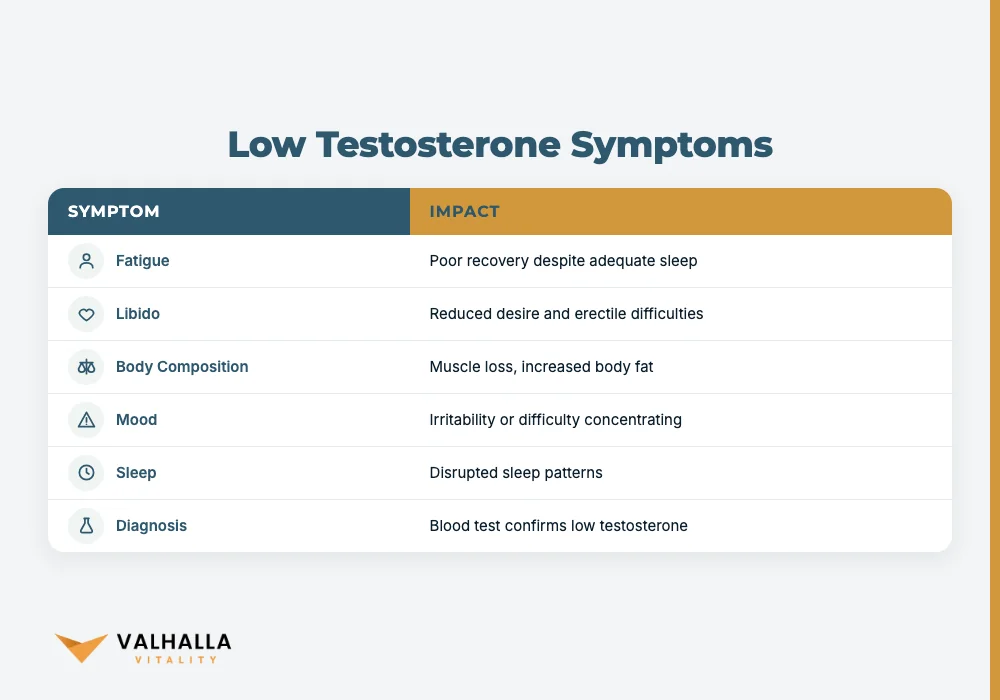
A blood test confirms it. Symptoms alone are not enough, because the signs overlap with many other conditions.
Common low T symptoms in men include:
- Persistent fatigue and poor recovery despite adequate sleep
- Reduced libido and erectile difficulties
- Gradual muscle loss alongside increased body fat
- Mood changes, including increased irritability or difficulty concentrating
- Disrupted sleep patterns
- Reduced bone density over time
In clinical practice, testosterone levels below 250 ng/dL are generally considered low, though a provider interprets lab values in context rather than acting on a single number. If several of these patterns are present, a lab draw is the appropriate first step. Availability of testing and treatment varies by state.
TRT vs enclomiphene: how they compare
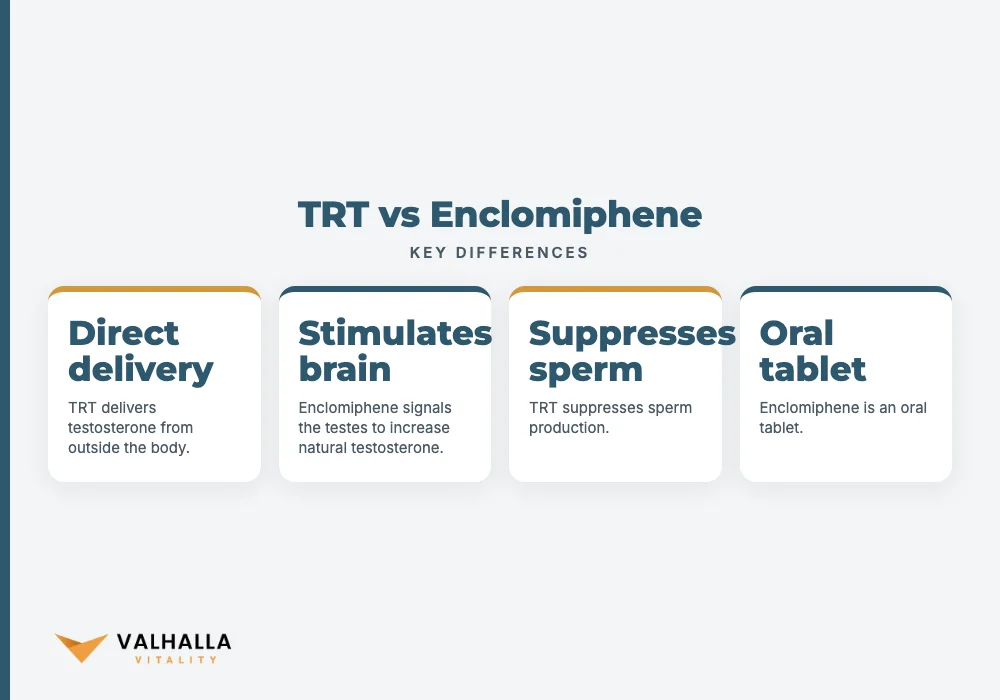
These are the two primary pharmacological paths for low testosterone treatment. They address the same problem from opposite ends of the hormonal chain.
| TRT | Enclomiphene | |
|---|---|---|
| Mechanism | Delivers testosterone directly | Stimulates the brain to signal the testes |
| HPG axis | Bypassed | Preserved and stimulated |
| Fertility | Suppresses sperm production | Preserves or may support sperm production |
| Delivery | Injections, gels, patches, pellets | Oral tablet |
| Best suited for | Primary or secondary hypogonadism | Secondary hypogonadism |
| Regulatory status | Indicated for hypogonadism | Off-label; studied in randomized controlled trials |
TRT delivers testosterone from outside the body. The range of administration options for testosterone therapy includes injectable, topical, and implanted formats, each with a different schedule and monitoring profile. A 2024 evidence synthesis in Health Technology Assessment confirmed that TRT improves testosterone levels and symptom burden in men with hypogonadism, though individual outcomes vary (Cruickshank et al., 2024).
Enclomiphene is the pure trans-isomer of clomiphene. Clomid combines enclomiphene with zuclomiphene, where zuclomiphene is the weaker isomer. Using enclomiphene alone isolates the more active component.
Enclomiphene selectively blocks estrogen receptors in the hypothalamus and pituitary. This triggers LH and FSH release, signaling the testes to increase natural testosterone output. A 2016 review in Expert Opinion on Pharmacotherapy described it as effective for secondary male hypogonadism, the type caused by upstream signaling failure rather than testicular failure (Rodriguez et al., 2016).
Is TRT or enclomiphene better for low testosterone?
For most men with confirmed hypogonadism, TRT is the established standard. It is well-established, studied across decades, and effective for both primary and secondary presentations.
Enclomiphene becomes the stronger choice when fertility matters. A 2025 review in Nature Reviews Urology found that TRT consistently suppresses spermatogenesis in reproductive-age men, and sperm recovery after stopping is not assured (Naelitz et al., 2025).
A 2025 systematic review in Archives of Endocrinology and Metabolism found that enclomiphene raises testosterone in hypogonadal men with favorable effects on LH and FSH compared to clomiphene (Hohl et al., 2025). Because enclomiphene keeps the natural hormonal axis intact, it is often preferred when preserving fertility is a priority.
The TRT vs enclomiphene choice also depends on the type of hypogonadism. Enclomiphene only works when the testes can still respond to hormonal signals. Primary hypogonadism, where the testes themselves are failing, typically requires TRT. Secondary hypogonadism, a signaling problem upstream, is where enclomiphene may fit. Lab work is what makes this distinction clear.
What are the side effects of testosterone therapy?
Testosterone replacement risks are real and well-documented. A provider weighs them before prescribing.
Known TRT side effects include elevated red blood cell count (polycythemia), testicular atrophy, sleep disturbances, and suppression of natural sperm production. The 2024 Cruickshank evidence synthesis identified cardiovascular and prostate monitoring as standard components of ongoing TRT management. These are expected considerations, not rare events. They require periodic lab review throughout treatment.
In the TRT vs enclomiphene comparison, enclomiphene's side effect profile is generally milder. Reported effects include gastrointestinal discomfort, mild acne, and occasional visual disturbances. Because enclomiphene works upstream rather than replacing testosterone directly, the testosterone therapy side effects associated with HPG axis suppression, including fertility impairment and testicular atrophy, are substantially reduced.
Neither option is risk-free. Neither should be started without proper lab work and provider oversight.
Who is a good candidate for enclomiphene therapy?
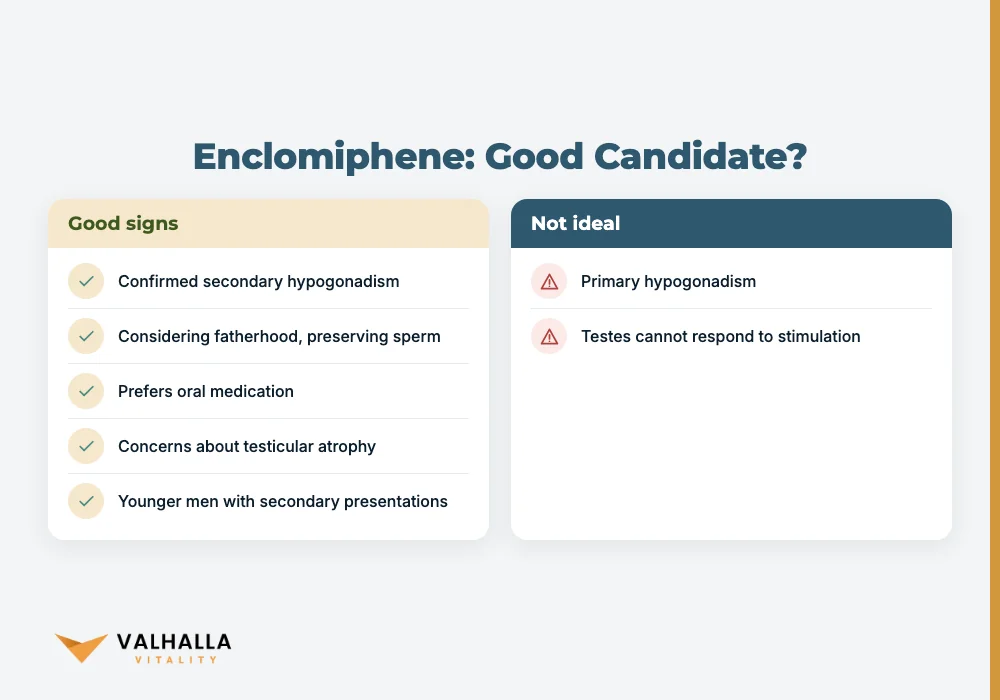
Enclomiphene is best suited for men with secondary hypogonadism: the testes are functional, but the brain's signaling pathway is underperforming.
Enclomiphene benefits men who:
- Have confirmed secondary hypogonadism on lab work
- Are considering fatherhood and want to preserve sperm production
- Prefer an oral option over injections or topical applications
- Have concerns about testicular atrophy associated with external testosterone
Men with primary hypogonadism are generally not candidates, since enclomiphene depends on the testes being able to respond to LH and FSH stimulation. A 2023 review in Expert Opinion on Investigational Drugs described enclomiphene as an emerging hypogonadism treatment option that preserves endogenous testosterone production, with particular relevance for younger men with secondary presentations (Corona et al., 2023).
If TRT was used previously and the goal is to restore natural production, what the switch from TRT to enclomiphene involves is a practical reference before making a change.
What a provider checks before prescribing
Labs come first. This is the step where the TRT vs enclomiphene decision is actually made, and it is one area most comparison articles skip entirely.
Before recommending either therapy, a licensed provider typically reviews total and free testosterone, LH, FSH, estradiol, a complete blood count, and baseline lipid and prostate markers. These values distinguish primary from secondary hypogonadism and flag contraindications. Without this baseline, the wrong therapy may be selected or an underlying condition may go undetected.
Ongoing monitoring is part of responsible care for both options. TRT requires periodic checks for polycythemia, cardiovascular markers, and prostate health. Enclomiphene monitoring focuses on testosterone response and estradiol balance. At Valhalla Vitality, a licensed provider reviews your intake within 24 business hours and determines the appropriate path based on the full clinical picture.
What drugs are used to boost testosterone?
TRT and enclomiphene are the two primary evidence-backed pharmacological options for low testosterone treatment in men. TRT directly replaces testosterone; enclomiphene stimulates natural production by acting on the HPG axis. Both require a prescription and ongoing provider supervision.
Some men also explore hypogonadism treatment options without a prescription. For an overview of non-prescription approaches to managing low T, the evidence base is considerably thinner than for clinical therapies. OTC products are not substitutes for diagnosed hypogonadism requiring licensed provider management.
Take the next step
A licensed provider can review your labs and determine whether TRT, enclomiphene, or another approach is the right fit. Book Your Consultation.
FAQ
Is enclomiphene better than TRT for low testosterone?
Neither option is universally better. TRT is established and indicated for hypogonadism; enclomiphene is often preferred when preserving fertility or when secondary hypogonadism is confirmed. A licensed provider determines the appropriate path after reviewing lab results and intake.
Can enclomiphene be used alongside TRT?
In some clinical protocols, enclomiphene is used together with or after TRT to help preserve natural testosterone signaling. This approach requires provider supervision and regular lab monitoring to assess how each treatment is affecting hormone levels.
What is the difference between enclomiphene and clomid?
Clomid (clomiphene) is a mixture of two isomers: enclomiphene and zuclomiphene. Enclomiphene is the more active trans-isomer; zuclomiphene is the weaker component. Isolating enclomiphene removes the weaker isomer and may produce a more targeted hormonal response.
Does TRT affect sperm production?
TRT suppresses the body's natural signaling pathway, which reduces sperm production in most men. A 2025 review in Nature Reviews Urology found this suppression is consistent in reproductive-age men and may not fully recover after stopping. Men with fertility concerns should discuss this risk with a provider before starting TRT.
How does a provider decide between TRT and enclomiphene?
The decision depends on the type of hypogonadism, lab values, fertility goals, and any contraindications identified during review. Primary hypogonadism typically points toward TRT; secondary hypogonadism may be a fit for enclomiphene. A full intake and blood panel inform the recommendation.
Sources
- Cruickshank M et al. (2024). The effects and safety of testosterone replacement therapy for men with hypogonadism: the TestES evidence synthesis and economic evaluation. Health Technology Assessment. PubMed
- Hohl A et al. (2025). Clomiphene or enclomiphene citrate for the treatment of male hypogonadism: a systematic review and meta-analysis of randomized controlled trials. Archives of Endocrinology and Metabolism. PubMed
- Corona G et al. (2023). Developments and challenges for new and emergent preparations for male hypogonadism treatment. Expert Opinion on Investigational Drugs. PubMed
- Naelitz BD et al. (2025). Testosterone replacement therapy and spermatogenesis in reproductive age men. Nature Reviews. Urology. PubMed
- Rodriguez KM et al. (2016). Enclomiphene citrate for the treatment of secondary male hypogonadism. Expert Opinion on Pharmacotherapy. PubMed
You May Also Like
 Testosterone
DHEA and TRT: Why Testosterone Alone Is Not Enough
DHEA and TRT address more than testosterone alone. Learn how DHEA adrenal hormones, isomers, and androgen balance factor into a complete hormone strategy.
September 27, 2026 ETRead more → Testosterone
OTC Testosterone Treatment Options for Men With Low T
OTC testosterone treatment: explore evidence-backed supplements, lifestyle strategies, and when a licensed provider review is the right next step.
September 26, 2026 ETRead more → Testosterone
Best TRT for Men: Therapy Options, Benefits, and Risks
Best TRT for men explained: compare injections, pellets, and gels, understand testosterone replacement benefits and risks, and get expert guidance.
September 22, 2026 ETRead more →