Saxenda and Metformin for Weight Loss: What to Know

The following blog post is for entertainment and informational purposes only. It is not intended to provide medical advice or diagnosis. Please consult your doctor before making any health-related decisions.
Saxenda and metformin address weight and blood sugar management through complementary mechanisms, and providers frequently prescribe them together. Saxenda (liraglutide) is an injectable GLP-1 receptor agonist that reduces hunger by acting on brain and gut receptors, while metformin is an oral medication that lowers liver glucose output and improves insulin sensitivity. If you are exploring GLP-1 weight loss therapy, understanding how these two agents interact is a useful starting point before speaking with a licensed provider.
How saxenda and metformin work
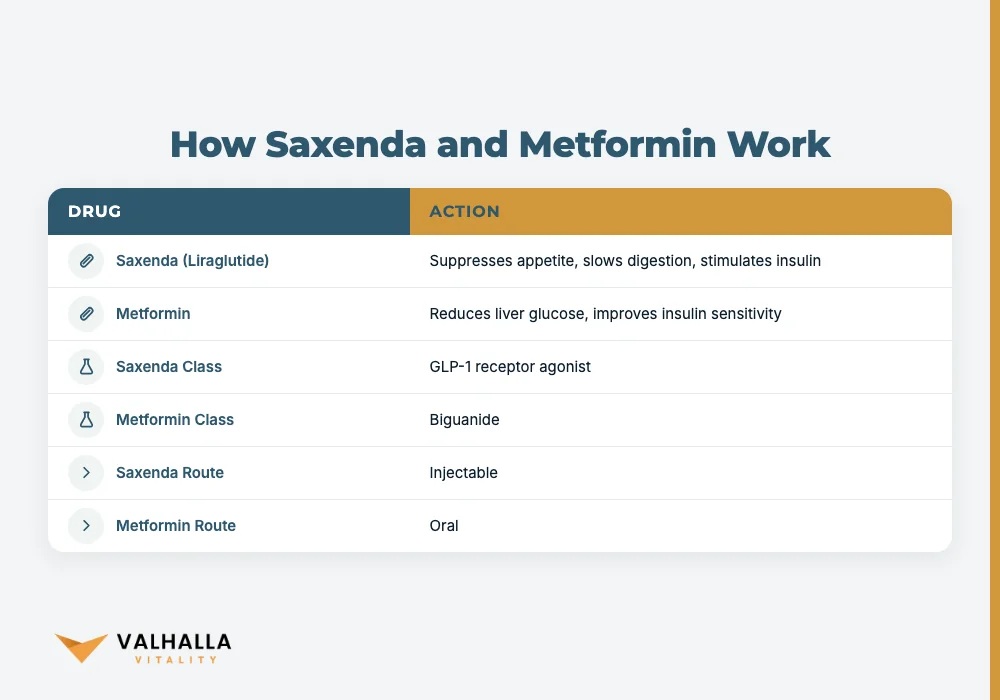
Each drug targets weight and blood sugar through a distinct pathway, which explains why they are often paired.
| Saxenda (liraglutide) | Metformin | |
|---|---|---|
| Drug class | GLP-1 receptor agonist | Biguanide |
| Route | Injectable | Oral |
| Primary action | Appetite suppression, slows gastric emptying, stimulates insulin release | Reduces hepatic glucose production, improves insulin sensitivity |
| Common use | Weight management, type 2 diabetes | Type 2 diabetes, PCOS |
| Main side effects | Nausea, vomiting, diarrhea | Nausea, diarrhea, reduced B12 absorption |
Liraglutide activates GLP-1 receptors across the brain and gastrointestinal tract, triggering early satiety signals and reducing overall calorie intake. A 2016 review in American Family Physician confirmed liraglutide produces meaningful body weight reductions at the doses studied (Whitten, 2016). Metformin has been in clinical use for over six decades. A 2023 analysis in Nature Reviews Endocrinology confirmed its primary mechanism: inhibition of hepatic glucose production through mitochondrial complex I (Foretz et al., 2023). A 2022 review in Metabolism highlighted metformin's broader effects on insulin sensitivity and potential cardiovascular benefits beyond glycemic control (Triggle et al., 2022). For a closer look at how GLP-1 receptor agonists act across the brain and gut, that article covers the full receptor pathway.
Can you take Saxenda and metformin together?
Yes. The two can be prescribed together. Combining them does not significantly raise the risk of hypoglycemia in the absence of other glucose-lowering agents such as sulfonylureas or insulin.
The two drugs act through separate mechanisms and generally produce additive, not competing, effects on weight and glycemic control. Both carry individual contraindications. Metformin is not appropriate in certain kidney conditions, and liraglutide carries a warning for patients with a personal or family history of specific thyroid tumors. A licensed provider determines whether a therapy is appropriate after reviewing your intake, labs, and current medications.
Does combining Saxenda with metformin improve weight loss?
The data suggest it does. Studies in overweight and obese patients with type 2 diabetes reported 4 to 8 percent weight loss over 12 weeks of combined liraglutide and metformin treatment.
A 2025 systematic review and meta-analysis in Diabetes, Obesity and Metabolism found that combined liraglutide and metformin therapy produced significantly greater weight reduction and metabolic improvements in overweight women with polycystic ovary syndrome than either agent alone (Ling et al., 2025). The GLP-1 metformin weight loss pattern in that population is consistent with findings from type 2 diabetes trials. Individual results vary based on caloric intake, activity level, and baseline health. No specific outcome can be promised.
Is Saxenda or metformin better for weight loss?
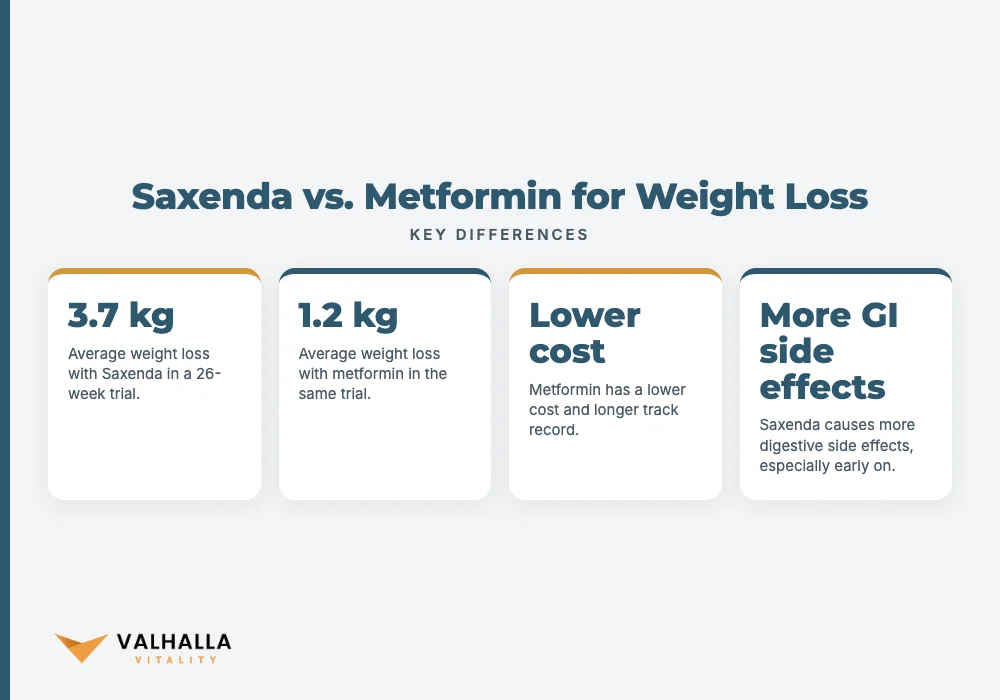
When compared head to head, Saxenda produces greater weight reduction. A 26-week clinical trial showed an average 3.7 kg weight loss with liraglutide compared with 1.2 kg for metformin (Whitten, 2016). That difference is clinically meaningful.
Metformin has a longer track record, a well-established safety profile, and lower cost. Saxenda produces stronger appetite suppression but causes more GI side effects, especially early in treatment. Victoza, a lower-dose formulation of liraglutide used for type 2 diabetes management, carries a similar tolerability profile to Saxenda; Victoza metformin weight loss data also show improvement, though the weight-focused head-to-head trials used the Saxenda dose.
The saxenda vs metformin comparison matters less when combination therapy is on the table. Most providers consider combining both when metformin monotherapy has not produced sufficient benefit, particularly in patients with PCOS or significant insulin resistance.
What are the side effects of taking liraglutide with metformin?
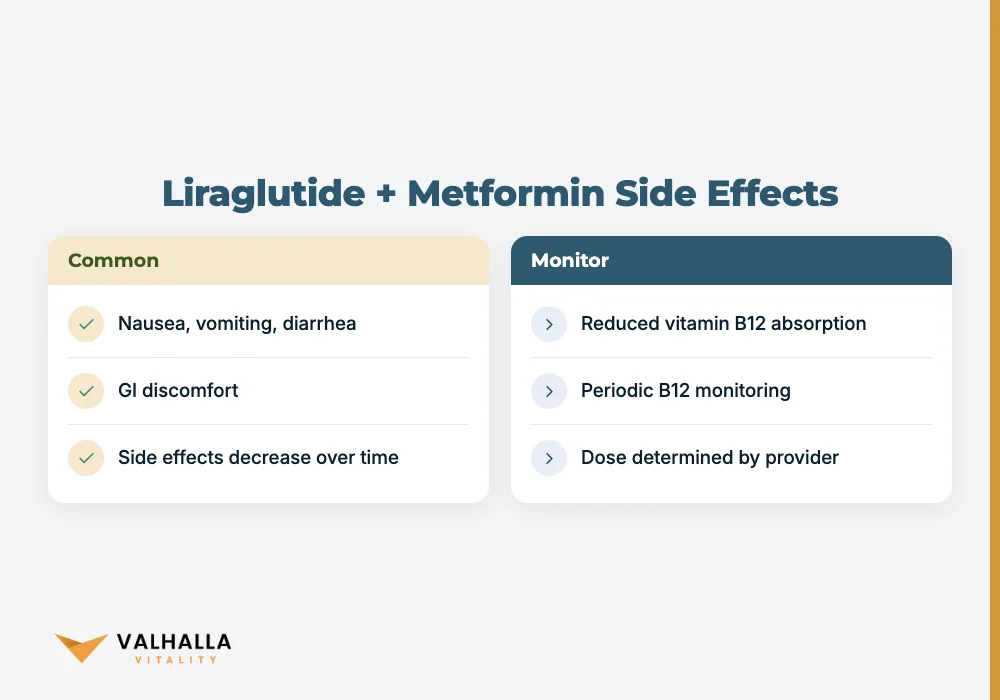
The most common side effects of this combination are gastrointestinal. Nausea, vomiting, and diarrhea occur with both drugs individually and may be more pronounced when starting them together.
Liraglutide-related nausea is typically most noticeable in the first few weeks and decreases as the body adjusts. Metformin can cause similar GI discomfort, and long-term use has been linked to reduced vitamin B12 absorption, which requires periodic monitoring (Dutta et al., 2023). A licensed provider determines the dose after labs and typically starts at a lower level to reduce tolerability issues before titrating upward. Hypoglycemia is not a significant concern with this pairing alone.
For a practical overview of managing GLP-1 therapy side effects and when to contact a provider, that resource covers monitoring steps and common questions.
Saxenda and metformin for PCOS
Polycystic ovary syndrome affects up to 10 percent of women of reproductive age. It involves irregular ovulation, elevated androgens, and metabolic dysfunction, including insulin resistance, which is where metformin has historically been most useful.
Research now supports the liraglutide metformin combination specifically in this population. A 2025 systematic review in Diabetes, Obesity and Metabolism found the combined approach significantly outperformed metformin monotherapy for weight loss, insulin resistance, and reproductive markers in overweight and obese women with PCOS (Ling et al., 2025). A 2026 meta-analysis in the same journal confirmed liraglutide's effects on both metabolic and reproductive outcomes in PCOS patients (Lu et al., 2026). Women with PCOS who have not responded adequately to metformin alone may benefit from the combination, but this requires a provider evaluation.
How much weight can you lose on Saxenda and metformin?
Clinical trials have reported 4 to 8 percent body weight loss over 12 weeks with the saxenda and metformin combination in relevant patient groups. Over longer treatment periods, with structured dietary and activity changes, the proportion of patients achieving clinically meaningful weight loss increases.
Metformin weight loss results as monotherapy are more modest. GLP-1 metformin weight loss data are consistently stronger when both agents are combined and supported by lifestyle modification. No exact figure applies to every individual, and outcomes depend on dosing, adherence, and baseline health. Availability varies by state. For a broader comparison, how metformin and tirzepatide compare as weight management options covers the newer agents alongside established treatments.
Working with a licensed provider
A licensed provider reviews your medical history, current medications, and lab results before determining whether this combination is an appropriate approach. At Valhalla Vitality, the intake process is handled online, provider review typically completes within 24 business hours, and medication ships from FDA-inspected U.S. pharmacies with delivery in approximately 3 to 7 business days from prescription transfer.
Ready to take the next step?
A licensed provider can review your intake and advise on whether saxenda and metformin is the right approach for your situation. Book Your Consultation to get started.
FAQ
Can you take Saxenda and metformin together?
Yes, the two are frequently prescribed together. They work through different mechanisms and do not significantly raise the risk of hypoglycemia in the absence of other glucose-lowering agents. A licensed provider evaluates whether the combination is appropriate based on your health history and labs.
Does combining Saxenda with metformin improve weight loss?
Clinical data indicate that the combination produces greater weight reduction than either drug alone, with studies reporting 4 to 8 percent weight loss over 12 weeks in relevant populations. Results vary by individual and depend on diet, activity, and baseline health. No specific outcome can be assumed.
What are the most common side effects of this combination?
Nausea, vomiting, and diarrhea are the most frequently reported side effects with both liraglutide and metformin. GI symptoms are typically most noticeable at the start of treatment and often ease over time. Long-term metformin use has also been associated with reduced vitamin B12 absorption.
Is Saxenda or metformin better for weight loss?
Head-to-head trial data show Saxenda produces greater weight loss than metformin alone, averaging 3.7 kg versus 1.2 kg over 26 weeks. The combination of both drugs outperforms either as monotherapy based on available studies.
How long does it take to see results with Saxenda and metformin?
Clinical studies have tracked meaningful outcomes at 12 and 26 weeks. Individual response varies based on dosing, lifestyle factors, and baseline health status. A licensed provider determines the appropriate treatment timeline during the intake review.
Sources
- Whitten JS (2016). Liraglutide (Saxenda) for Weight Loss. American Family Physician. PubMed
- Triggle CR et al. (2022). Metformin: Is it a drug for all reasons and diseases?. Metabolism: clinical and experimental. PubMed
- Ling J et al. (2025). Combined liraglutide and metformin therapy in overweight or obese women with polycystic ovary syndrome: A systematic review and meta-analysis. Diabetes, obesity & metabolism. PubMed
- Foretz M et al. (2023). Metformin: update on mechanisms of action and repurposing potential. Nature reviews. Endocrinology. PubMed
- Lu YT et al. (2026). Efficacy of liraglutide on metabolic and reproductive outcomes in women with polycystic ovary syndrome: A systematic review and meta-analysis. Diabetes, obesity & metabolism. PubMed
- Dutta S et al. (2023). Metformin: A Review of Potential Mechanism and Therapeutic Utility Beyond Diabetes. Drug design, development and therapy. PubMed
You May Also Like
 Liraglutide, Semaglutide
Liraglutide for Weight Loss: What the Evidence Shows
Liraglutide for weight loss: how GLP-1 injections work, what the clinical evidence shows, side effects to know, and how it compares to semaglutide.
November 2, 2026 ETRead more → Liraglutide, Semaglutide
Liraglutide Mechanism of Action: How GLP-1 Therapy Works
Liraglutide mechanism of action explained: how this GLP-1 receptor agonist regulates appetite, stimulates insulin secretion, and supports weight loss.
November 2, 2026 ETRead more → Liraglutide, Semaglutide
Liraglutide Side Effects: What Patients Need to Know
Liraglutide side effects range from nausea to rare but serious risks. Learn what to expect, how long they last, and when to call your provider.
November 1, 2026 ETRead more →