
The following blog post is for entertainment and informational purposes only. It is not intended to provide medical advice or diagnosis. Please consult your doctor before making any health-related decisions.
The most well-researched habits for longevity share a common thread: they reduce chronic inflammation, protect cellular health, and lower the risk of cardiovascular disease, metabolic dysfunction, and cognitive decline. A 2025 systematic review published in Investigacion y educacion en enfermeria (Joshi et al.) confirmed that combined lifestyle interventions consistently improved markers of healthy aging across multiple outcome measures. No single habit dominates; a cluster of behaviors, sustained over time, shifts the odds meaningfully. For structured clinical support alongside these practices, a personalized anti-aging plan pairs these principles with provider oversight from the start.
What daily habits add the most years to your life?
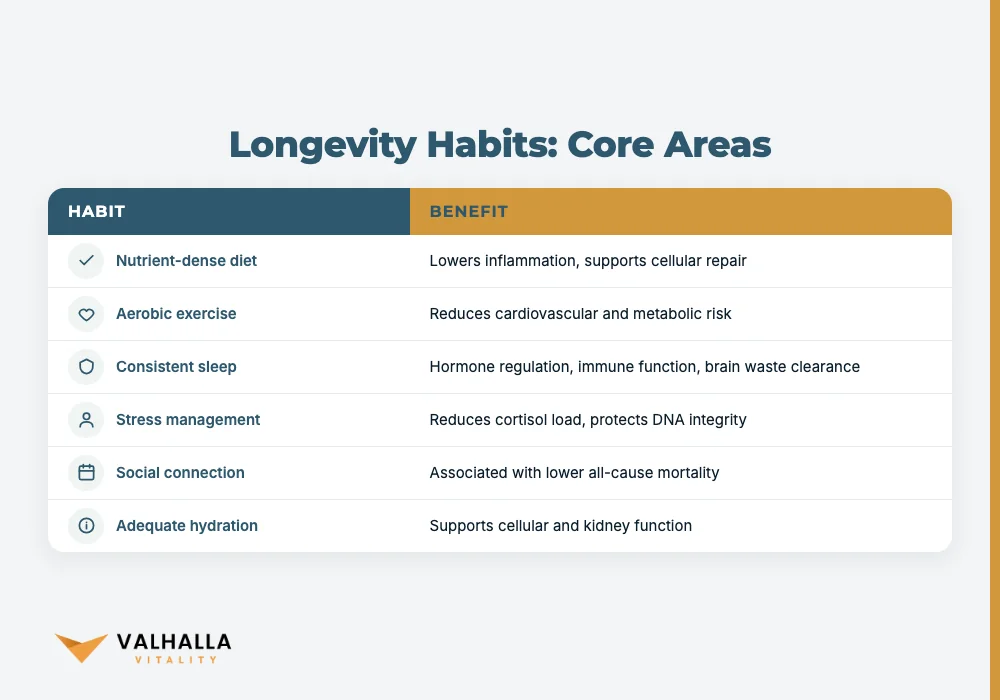
Research consistently shows that combinations of behavior, not any single action, produce the largest longevity gains. Single-factor approaches fall short. The Joshi et al. 2025 systematic review confirmed that integrated programs covering diet, movement, sleep, and psychological resilience outperformed single-intervention models when measuring improvements in healthy aging markers.
The table below maps the core areas and their practical starting points.
| Habit | Primary benefit | Practical starting point |
|---|---|---|
| Nutrient-dense diet | Lowers inflammation, supports cellular repair | Whole foods at most meals |
| Aerobic exercise | Reduces cardiovascular and metabolic risk | 150+ min/week, moderate intensity |
| Resistance training | Preserves muscle mass and metabolic rate | 2 sessions/week |
| Consistent sleep | Hormone regulation, immune function, brain waste clearance | 7-9 hours per night |
| Stress management | Reduces cortisol load, protects DNA integrity | Daily practice, even brief |
| Social connection | Associated with lower all-cause mortality | Regular meaningful contact |
| Adequate hydration | Supports cellular and kidney function | Steady intake throughout the day |
The habits for longevity with the strongest evidence base
- Avoiding tobacco removes one of the most potent accelerators of cellular aging and cardiovascular risk.
- Limiting excessive alcohol reduces liver burden, cancer risk, and cardiovascular strain at the same time.
- Maintaining a stable, healthy weight through movement and whole-food eating reduces systemic inflammation over years.
- Daily physical activity at any age matters. Sedentary older adults who adopt movement routines still improve key health markers.
- Consistent sleep gives the body time for tissue repair, hormonal regulation, and metabolic waste clearance from the brain.
- Meaningful social engagement associates with lower all-cause mortality in cohort studies, partly through downstream effects on stress biology.
These habits reinforce each other in ways single-habit summaries miss. Exercise improves sleep quality. Better sleep lowers resting cortisol. Lower cortisol reduces inflammatory markers. The biological system is linked. When these habits for longevity are built gradually, each one tends to support the others.
Durability matters more than ambition at the start. How to build habits that actually last covers the behavioral science behind why most attempts stall and what actually sustains change.
What foods do longevity experts recommend eating every day?
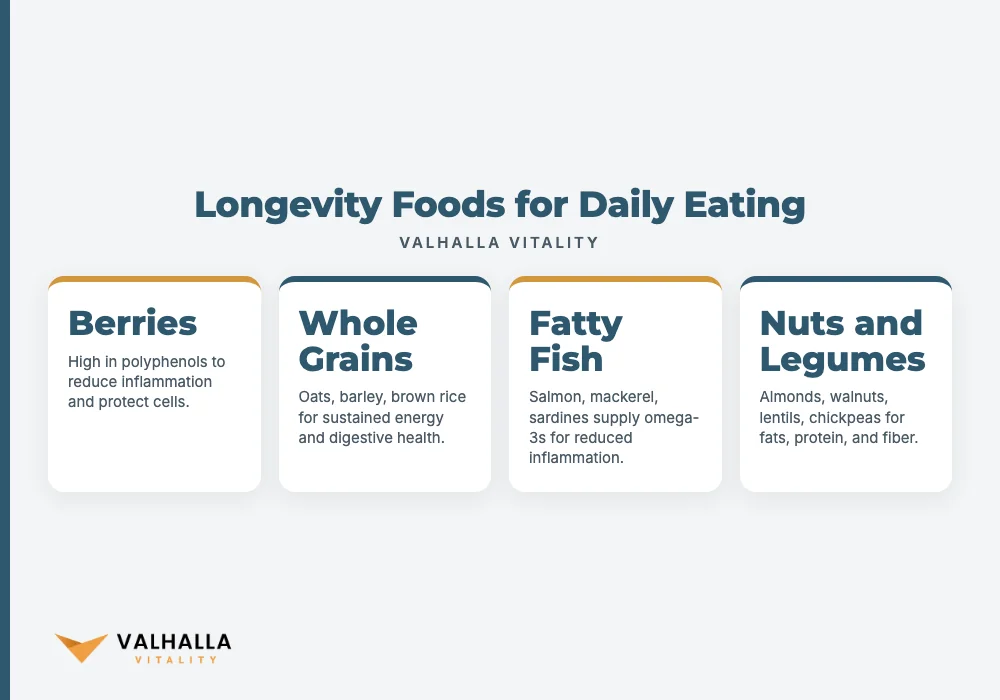
Longevity foods share several properties: high fiber content, dense micronutrients, minimal processing, and support for a diverse gut microbiome. A 2024 epidemiological review by Hu in the Journal of Internal Medicine identified plant-based dietary patterns as among the most consistent predictors of healthy aging in large population datasets. The blue zone diet patterns documented among the world's longest-lived populations, and the Mediterranean diet studied extensively in aging research, both align closely with this evidence base.
Berries and colorful produce. Blueberries, strawberries, and raspberries carry high concentrations of polyphenols. These compounds reduce inflammatory markers and protect cells from oxidative damage that underlies chronic disease. Dark leafy greens and cruciferous vegetables add micronutrients that are difficult to replicate through supplements alone.
Whole grains. Complex carbohydrates from oats, barley, and brown rice provide sustained energy and support digestive health through dietary fiber. Whole grains appear consistently in blue zone diet research and in Mediterranean dietary patterns associated with healthy aging.
Fatty fish. Salmon, mackerel, and sardines supply omega-3 fatty acids associated with reduced systemic inflammation and lower blood pressure. A 2021 study by Mazza et al. in The Journal of Nutrition, Health & Aging found that the Mediterranean diet, which emphasizes regular fish consumption, improved multiple markers of healthy aging in older adults.
Nuts and legumes. Almonds and walnuts deliver unsaturated fats, plant protein, and essential minerals. Legumes including lentils and chickpeas are efficient sources of protein and fiber. A 2026 review by Frias-Toral et al. in the Journal of Translational Medicine found that centenarian populations across multiple regions consistently relied on legumes and minimally processed plant foods as dietary staples.
What to reduce. Ultra-processed foods, products high in added sugars, and trans fats appear consistently as dietary risk factors in longevity research. Gradual reduction is more achievable than total elimination for most people.
Knowing how to live longer naturally through diet does not require a specialized protocol. Build meals around plants, add a whole-food protein source, and minimize packaged foods with long ingredient lists. These longevity foods form the dietary cornerstone of habits for longevity that the strongest research consistently supports.
What does science say about exercise and longevity?
Exercise is among the most well-documented habits for longevity. A 2025 global consensus paper by Izquierdo et al. in The Journal of Nutrition, Health & Aging recommended a combination of aerobic and resistance training for older adults seeking to maintain healthy longevity, citing evidence that both forms independently reduce all-cause mortality risk.
Aerobic exercise (walking, cycling, swimming) supports cardiovascular health, lung function, and blood sugar regulation. Thirty minutes of moderate-intensity activity most days remains a well-supported minimum. Accumulated movement in shorter bouts across the day also produces meaningful benefit, which helps people whose schedules resist a single dedicated session.
Resistance training is often underemphasized in longevity discussions. Preserving lean muscle mass protects metabolic rate, reduces fall risk, and supports insulin sensitivity as the body ages. Two sessions per week is the minimum commonly cited in clinical exercise guidelines for maintaining a healthy aging lifestyle.
The consistency trade-off. Moderate-intensity activity maintained across years outperforms sporadic high-intensity efforts on longevity outcomes. A person who walks daily for a decade accumulates substantially more benefit than one who sprints occasionally and sits most of the week.
Exercise also generates downstream benefits: improved sleep architecture, lower resting cortisol, better mood regulation, and reduced systemic inflammatory markers. This cascade is why physical activity appears near the top of every evidence-based longevity framework, and why skipping it cannot be offset by supplements alone.
How much sleep do you actually need for a longer life?
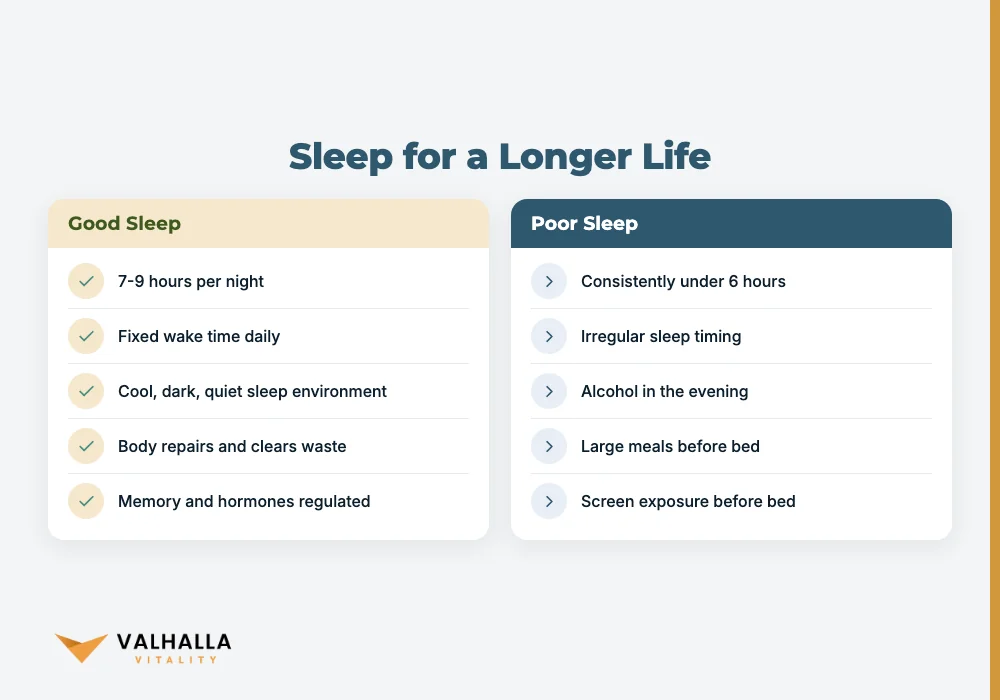
Seven to nine hours per night is the target for most adults. That range is not a loose estimate. Chronic sleep deprivation, consistently under six hours, is associated with elevated inflammatory markers, impaired glucose metabolism, and higher cardiovascular risk across large population studies.
Adequate sleep is one of the most undervalued habits for longevity. These anti-aging sleep tips address both quantity and quality:
- Keep a fixed wake time every day, including weekends. Irregular timing disrupts circadian regulation more than most people expect.
- Keep the sleep environment cool, dark, and quiet. Light exposure at night suppresses melatonin and fragments sleep cycles.
- Limit alcohol in the evening. Alcohol may induce initial drowsiness but reliably disrupts REM sleep and reduces overall restorative quality.
- Avoid large meals within two to three hours of bedtime. Active digestion competes with the repair processes that peak during deep sleep.
- Reduce screen exposure in the hour before bed. Blue-spectrum light signals wakefulness to the circadian system.
Sleep is when the body consolidates memory, regulates hormones including growth hormone, and clears metabolic byproducts from the brain through the glymphatic system. These are not background maintenance functions. They are central to how healthy aging works at a biological level.
If behavioral changes do not resolve persistent sleep problems, a provider can screen for underlying causes. Sleep apnea significantly affects cardiovascular and metabolic health when unmanaged, and it is common and frequently underdiagnosed.
Can stress reduction techniques improve lifespan?
Chronic psychological stress accelerates biological aging through several well-characterized pathways: elevated cortisol, increased pro-inflammatory cytokines, and shortened telomere length. The connection between chronic stress and reduced longevity is mechanistic.
Mindfulness practice. Regular mindfulness, defined as sustained non-judgmental attention to present experience, has been shown across multiple trials to reduce perceived stress, lower cortisol reactivity, and improve emotional regulation over time. Brief daily practice produces more cumulative benefit than occasional longer sessions.
Controlled breathing. Slow diaphragmatic breathing activates the parasympathetic nervous system within minutes. It requires no equipment and fits into any pause in the day.
Social engagement. Loneliness raises inflammatory markers at levels comparable to other recognized health risks. Regular, meaningful contact with others buffers stress biology and independently associates with lower mortality in cohort studies.
Physical activity. Exercise lowers baseline cortisol and is one of the most studied non-pharmacological interventions for anxiety and low-grade depression. The daily wellness routine that best supports longevity keeps stress management and movement intertwined, because their benefits compound when practiced together.
Time in nature. Exposure to natural environments has been associated with lower cortisol and reduced blood pressure in experimental studies. Even brief sessions outdoors produce measurable physiological effects.
The habits for longevity that address stress do not require an elaborate program. Consistency in small, regular practices over months produces cumulative biological benefits that isolated longer efforts do not match.
Longevity supplements: what the evidence currently shows
Supplements occupy a growing share of the healthy aging lifestyle conversation. They work best alongside the core habits described above, not as a substitute for them. Several compounds have accumulated enough scientific attention to be worth understanding clearly.
Spermidine is a naturally occurring polyamine found in wheat germ, aged cheese, and mushrooms. It activates autophagy, the cellular process by which damaged proteins and organelles are cleared and recycled. Animal data and observational human studies suggest it may support healthy aging biology at the cellular level. How spermidine contributes to cellular renewal and aging pathways covers the mechanism in detail. For a side-by-side look at related compounds, spermine and spermidine as complementary longevity compounds explains how the two differ in function and evidence base.
Telomere-supporting compounds. Cycloastragenol has attracted research interest for its potential effects on telomerase activity, the enzyme involved in maintaining chromosomal telomere length. Human evidence remains at an earlier stage than animal data. Cycloastragenol and telomere health research provides a current overview of what the science shows.
The bottom line. The 2025 systematic review by Joshi et al. confirmed that combined lifestyle interventions produced the most consistent longevity outcomes, while supplement evidence varied considerably by compound and population studied. Supplements complement the habits for longevity described in this article but cannot replace them. A licensed provider can review lab values and health history to determine whether specific supplements are appropriate for your baseline.
Ready to apply these habits with clinical support?
A licensed provider can help identify which habits for longevity are most relevant for your health profile and whether any supplements or therapies may complement your routine. Book Your Consultation to take the next step.
FAQ
What are the most evidence-backed habits for longevity?
Research consistently identifies a cluster of behaviors: a diet centered on whole, minimally processed foods, regular aerobic and resistance exercise, seven to nine hours of sleep, stress management practices, and consistent social engagement. A 2025 systematic review confirmed that combined lifestyle interventions produced the most meaningful improvements in longevity markers.
Is the blue zone diet difficult to follow?
The core pattern is straightforward: build meals around plants, make legumes and whole grains dietary staples, include fatty fish regularly, and minimize ultra-processed foods. No food group needs total elimination. Most people can shift toward this pattern gradually over several months without overhauling their entire diet at once.
Can longevity supplements replace healthy lifestyle habits?
No supplement replaces the benefits of consistent exercise, adequate sleep, and a nutrient-dense diet. Supplements may complement a strong lifestyle foundation, but a licensed provider should review labs and health history before recommending any specific regimen.
At what age should I start focusing on habits for longevity?
Earlier is better, but no age is too late. Lifestyle changes made in midlife or later still produce measurable benefits for cardiovascular health, muscle preservation, and cognitive function. Starting now produces more benefit than waiting for a more convenient time.
How does stress affect biological aging?
Chronic stress elevates cortisol, increases inflammatory markers, and has been linked to accelerated telomere shortening. Regular stress reduction practices, including mindfulness, controlled breathing, physical activity, and social connection, counteract these effects through multiple biological pathways.
Sources
- Joshi S et al. (2025). Evidence-Based Pathways to Healthy Aging: A Systematic Review and Meta-analysis of Lifestyle Interventions for Longevity and Well-Being. Investigacion y educacion en enfermeria. PubMed
- Mazza E et al. (2021). Mediterranean Diet In Healthy Aging. The journal of nutrition, health & aging. PubMed
- Frias-Toral E et al. (2026). Nutrition and longevity - diet in centenarians. Journal of translational medicine. PubMed
- Hu FB (2024). Diet strategies for promoting healthy aging and longevity: An epidemiological perspective. Journal of internal medicine. PubMed
- Izquierdo M et al. (2025). Global consensus on optimal exercise recommendations for enhancing healthy longevity in older adults (ICFSR). The journal of nutrition, health & aging. PubMed
You May Also Like
 Semaglutide
 Sodium vs Semaglutide: Key Differences Explained
Semaglutide sodium vs semaglutide: how these GLP-1 formulations compare in structure, side effects, and what a provider weighs before prescribing.
November 5, 2026 ETRead more →
Wegovy Insurance Coverage: What Plans Actually Cover
Wegovy insurance coverage requires prior authorization and medical criteria. Learn how to qualify, appeal a denial, and what Medicare covers in 2025.
November 5, 2026 ETRead more → Featured
At Home STI Test: How It Works, Accuracy & Privacy
At home STI test kits let you screen for chlamydia, HIV, and more with private, rapid STI results. Learn how to use them and what to do next.
November 5, 2026 ETRead more →