Enclomiphene Libido: Effects on Sex Drive and Testosterone

The following blog post is for entertainment and informational purposes only. It is not intended to provide medical advice or diagnosis. Please consult your doctor before making any health-related decisions.
Enclomiphene libido effects work through a clear hormonal chain. The compound blocks estrogen receptors in the hypothalamus and pituitary, restoring the signaling that drives natural testosterone production. Testosterone is the primary hormonal driver of sexual desire in men, so when levels rise in men with secondary hypogonadism, many experience meaningful improvements in sex drive and energy. For men weighing this path, how enclomiphene works for secondary hypogonadism walks through the full evaluation-to-treatment sequence.
How enclomiphene and testosterone are connected
Sexual desire is not a standalone function. It depends on a hormonal environment that testosterone anchors. The Endocrine Society's 2018 clinical practice guideline identifies reduced libido as one of the defining symptoms of male hypogonadism, alongside fatigue, depressed mood, reduced muscle mass, and fewer morning erections (Bhasin et al., 2018). That connection between testosterone and sex drive is the clinical foundation for all enclomiphene libido research.
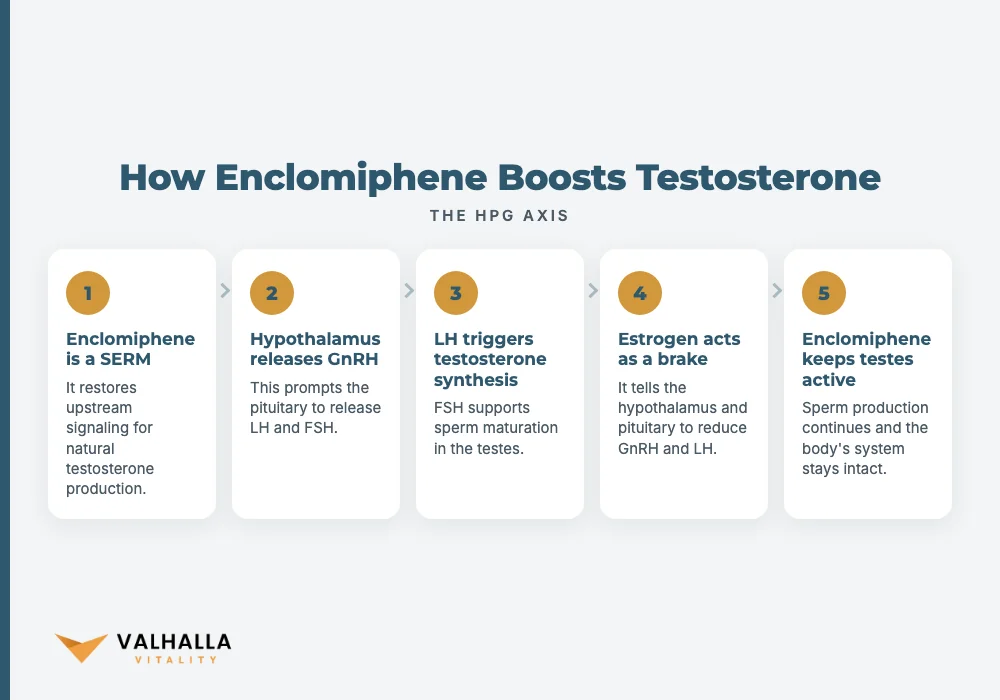
Enclomiphene is the trans-isomer of clomiphene. It is a nonsteroidal selective estrogen receptor modulator (SERM). Unlike testosterone replacement therapy (TRT), which delivers testosterone externally and suppresses the body's own production through negative feedback, enclomiphene restores the upstream signaling that tells the testes to produce testosterone on their own. The testes remain active. Sperm production continues. The body's regulatory system stays intact.
This distinction shapes who benefits from enclomiphene and in what ways, and it defines how enclomiphene libido improvements are structured differently from TRT-based outcomes.
The HPG axis: what drives testosterone production
The hypothalamic-pituitary-gonadal (HPG) axis controls testosterone through a chain of hormonal signals. The hypothalamus releases gonadotropin-releasing hormone (GnRH), which prompts the pituitary to release luteinizing hormone (LH) and follicle-stimulating hormone (FSH). LH reaches the testes and triggers testosterone synthesis. FSH supports sperm maturation.
Estrogen acts as a brake. Rising estrogen tells the hypothalamus and pituitary to reduce GnRH and LH output, slowing testosterone production. In men with secondary hypogonadism, this brake is over-engaged or the overall signaling has degraded. LH and FSH are low or inappropriately normal, testosterone falls, and the symptoms of testosterone deficiency appear. The testes retain the ability to produce testosterone. They are not receiving adequate signal.
Enclomiphene blocks the estrogen receptor at the hypothalamus and pituitary. With the inhibitory signal reduced, GnRH pulses increase. LH and FSH rise. The testes receive a stronger drive to produce testosterone, and serum levels climb.
How does enclomiphene affect testosterone levels?
The hormonal changes are consistent across clinical data. A 2016 review by Rodriguez et al. in Expert Opinion on Pharmacotherapy described enclomiphene as capable of raising LH, FSH, and total testosterone in men with secondary hypogonadism while preserving the HPG axis (Rodriguez et al., 2016). A 2025 systematic review and meta-analysis in Archives of Endocrinology and Metabolism confirmed these findings across randomized controlled trials, showing enclomiphene raised serum testosterone in hypogonadal men (Hohl et al., 2025).
The table below summarizes key hormonal changes observed with enclomiphene:
| Hormone or marker | Typical direction | Clinical significance |
|---|---|---|
| Luteinizing hormone (LH) | Rises | Directly drives testosterone synthesis in the testes |
| Follicle-stimulating hormone (FSH) | Rises | Supports sperm development and maturation |
| Total testosterone | Rises | Supports libido, energy, mood, and muscle mass |
| Estradiol | Variable; monitored | Excess estradiol can counteract testosterone benefits |
| Sperm count and motility | May improve | Maintained or increased, unlike with TRT |
Individual responses to enclomiphene testosterone levels depend on baseline hormone status, the cause of hypogonadism, and how the HPG axis responds once estrogen feedback is reduced. A licensed provider determines the dose after labs and monitors both testosterone and estradiol throughout treatment.
Does enclomiphene increase libido?
Enclomiphene may increase libido in men whose reduced sexual desire is driven by low testosterone. The mechanism of enclomiphene libido improvement is indirect. The compound raises testosterone, and testosterone supports sexual desire. When the hormonal deficit is corrected, libido often improves alongside energy, mood, and morning erections.
Men with testosterone deficiency often describe reduced libido not as a sudden loss but as a gradual fading over months or years. Spontaneous desire diminishes. Morning erections become less reliable. The interest in initiating sex declines while the physical capacity to respond may remain.
These patterns are characteristic of testosterone deficiency rather than purely psychological causes. When testosterone rises with enclomiphene, the spontaneous dimension of desire tends to recover first.
Multiple clinical studies report increased serum testosterone in men undergoing enclomiphene therapy alongside improvements in self-reported energy and sexual function. The 2025 meta-analysis by Hohl et al. reviewed randomized controlled trials in hypogonadal men and found meaningful testosterone elevation, with enclomiphene showing a cleaner hormonal profile than standard clomiphene because it lacks the estrogenic activity of the cis-isomer zuclomiphene.
That cleaner profile has practical significance for enclomiphene libido outcomes. Standard clomiphene contains zuclomiphene alongside enclomiphene. Zuclomiphene is weakly estrogenic and can partially offset the testosterone-raising effect, which may blunt the libido benefit. Pure enclomiphene does not carry this burden. For men specifically trying to address low testosterone libido, enclomiphene is the more targeted pharmacological option.
Not every man with reduced sex drive will respond. Libido depends on psychological state, sleep quality, relationship context, and chronic stress as well as hormones. Enclomiphene corrects the hormonal side only. If low testosterone is not a contributing factor, raising it through enclomiphene will not restore desire. Lab work before treatment confirms whether low testosterone is part of the clinical picture before any intervention begins.
Does enclomiphene improve sex drive in men?
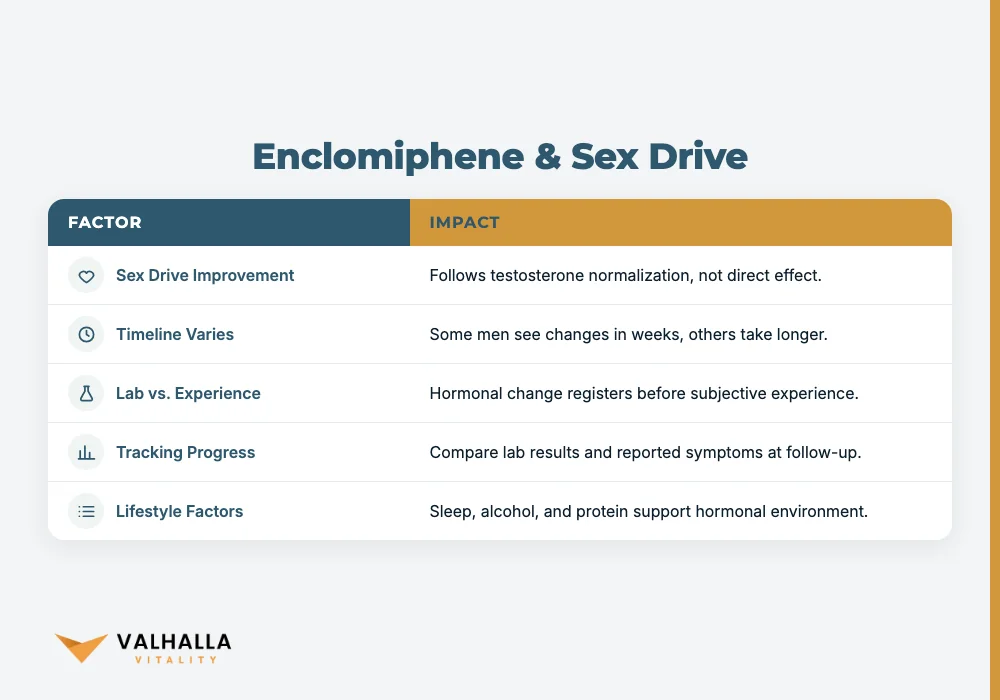
Enclomiphene sex drive improvements are reported in men with documented secondary hypogonadism. The improvement follows testosterone normalization, not a direct pharmacological effect on desire. How quickly and how substantially it occurs varies by individual.
Some men notice changes within weeks. Others take longer, particularly if testosterone was substantially below range for an extended period before treatment. The hormonal change registers on labs before it translates fully into subjective experience. That lag is normal and does not indicate the treatment is failing. Tracking enclomiphene libido progress means comparing both lab results and reported symptoms at follow-up visits, not relying on one data point.
Standard clomiphene is a 1:1 mixture of enclomiphene and zuclomiphene. A 2016 review by Rodriguez et al. pointed to enclomiphene's lack of estrogenic activity as an advantage for men seeking testosterone restoration with fewer side effects. Enclomiphene vs. clomiphene: how they differ for men with low T covers the pharmacological distinctions in detail for men evaluating both options.
Lifestyle factors also interact with enclomiphene and testosterone outcomes. Adequate sleep, reduced alcohol intake, and sufficient dietary protein all support the hormonal environment. A 2023 analysis by Whittaker examining protein intake and testosterone production noted that dietary protein provides essential substrate for hormone synthesis (Whittaker, 2023). These factors do not replace enclomiphene in men with confirmed secondary hypogonadism, but they affect how fully the testosterone rise translates into experienced improvements in sex drive and energy.
Before turning to enclomiphene, some men try supplements marketed as testosterone boosters. A 2024 systematic review in the International Journal of Impotence Research (Morgado et al.) found that most of these products do not produce meaningful increases in serum total testosterone. For a man with confirmed secondary hypogonadism, the hormonal deficit is clinically specific and too significant to be addressed by general supplements. Enclomiphene targets the HPG axis through a defined pharmacological mechanism. That is a fundamentally different category of intervention.
Enclomiphene sperm quality: the fertility advantage
One of the most practically important contrasts between enclomiphene and TRT is what each does to sperm production. Testosterone replacement suppresses LH and FSH through the same negative feedback it exploits to raise circulating testosterone. For many men on TRT, sperm production decreases significantly or stops. This is not an abstract concern for men in their 30s and 40s whose partners are trying to conceive.
Enclomiphene raises LH and FSH rather than suppressing them. Higher FSH supports the Sertoli cells central to sperm development. Higher LH drives intratesticular testosterone production, the locally concentrated testosterone that sperm maturation specifically requires. The Endocrine Society guideline acknowledges TRT's suppressive effect on spermatogenesis as a clinically significant concern, particularly in younger men (Bhasin et al., 2018).
Enclomiphene sperm quality improvements have been documented in studies showing higher sperm counts and improved motility in treated men. For men experiencing low testosterone libido who also want to preserve fertility, this dual effect is practically significant. Addressing hormonal symptoms and maintaining reproductive function are not competing goals with enclomiphene; they run in parallel.
A provider factors fertility goals into the treatment decision during initial evaluation. Men who want to preserve the option of conceiving while addressing hormonal symptoms have a strong clinical rationale for starting with enclomiphene rather than exogenous testosterone.
Enclomiphene libido outcomes alongside preserved fertility
For men managing both concerns simultaneously, the compound's mechanism is a practical advantage: the same hormonal cascade that supports enclomiphene libido recovery also sustains sperm production, rather than trading one for the other.
Can enclomiphene cause erectile dysfunction?
Enclomiphene does not typically cause erectile dysfunction. When low testosterone is contributing to erectile difficulties, raising testosterone through enclomiphene may reduce that contribution. The compound works on the hormonal component of erectile function, not directly on the vascular or neurological systems that erections also depend on.
The scenario where enclomiphene erectile dysfunction concerns become relevant involves estradiol. Enclomiphene stimulates testosterone production, and testosterone aromatizes into estradiol through enzyme activity in various tissues. If estradiol rises substantially above the normal male range, some men report dampened sexual desire or mood changes that can affect sexual performance. This is not common under proper clinical monitoring, but it can occur when hormone levels are not being tracked.
The Endocrine Society guideline notes that erectile dysfunction in men with hypogonadism frequently involves a combination of hormonal and non-hormonal contributors: vascular, neurological, and psychological factors all play a role (Bhasin et al., 2018). This is why providers do not prescribe enclomiphene for erectile dysfunction without first establishing whether low testosterone is part of the picture. When it is, enclomiphene targets the hormonal root cause. When it is not, additional options need consideration. How tadalafil and vardenafil compare for treating erectile dysfunction provides relevant context for non-hormonal approaches in that space.
Monitoring testosterone, estradiol, LH, and FSH throughout enclomiphene therapy is standard practice. Regular lab review is what keeps estradiol-related effects manageable and enclomiphene libido changes interpretable.
Can enclomiphene lower libido?
For most men with secondary hypogonadism, enclomiphene raises rather than lowers libido. The concern comes up in clinical conversations, and it deserves a direct answer.
Three specific circumstances can produce disappointing enclomiphene libido outcomes. First, testosterone levels take time to normalize after treatment begins. Early in therapy, some men interpret the gap between improved lab results and unchanged subjective experience as the drug reducing desire. This misread leads to premature discontinuation when the appropriate response is patience and a follow-up blood draw.
Second, if estradiol rises significantly during treatment, the subjective experience can resemble low testosterone: dampened desire, mood changes, reduced morning erections. The mechanism is estrogen excess rather than testosterone deficiency, but the symptoms overlap. Identifying which situation is present requires labs, not guesswork. A provider monitoring both testosterone and estradiol can distinguish between "testosterone has not risen enough yet" and "estradiol has climbed too high" and adjust accordingly. A licensed provider determines the dose after labs for exactly this reason, not before.
Third, if reduced libido is primarily psychological, sleep-related, or tied to relationship factors, normalizing testosterone will not resolve it. Enclomiphene is a hormonal intervention. It addresses a hormonal problem. Non-hormonal causes require different approaches.
The documented side effects in clinical trials include hot flashes, mood fluctuations, and mild gastrointestinal symptoms. These match the known profile of the broader clomiphene class. Long-term safety data for extended enclomiphene use continues to accumulate, and a provider weighs this in the overall risk-benefit assessment.
Who benefits most from enclomiphene libido therapy
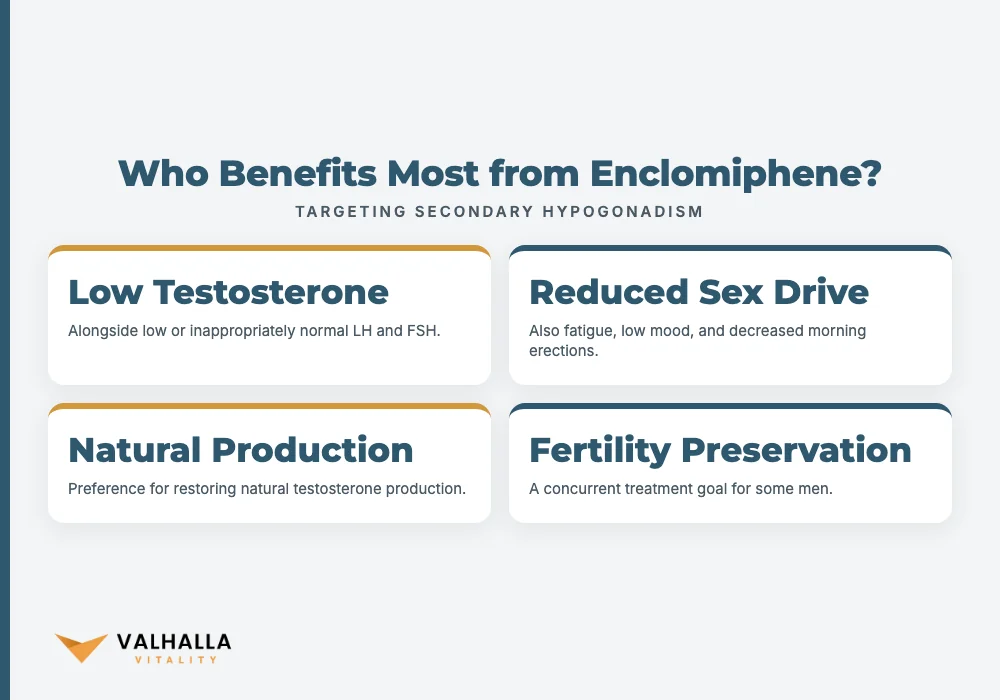
Enclomiphene targets secondary hypogonadism specifically: the hormonal pattern where testosterone is low because pituitary-to-testes signaling is insufficient, not because the testes themselves have intrinsic dysfunction. Identifying this pattern requires lab work. Low or low-normal LH and FSH alongside low testosterone points to a secondary cause. Elevated LH and FSH with low testosterone suggests primary hypogonadism, where enclomiphene would produce a weak or absent testosterone response because the issue lies in the testes, not the signaling chain.
Men most likely to benefit from enclomiphene for low testosterone libido typically present with:
- Documented low testosterone alongside low or inappropriately normal LH and FSH
- Symptoms that include reduced sex drive, fatigue, low mood, and decreased morning erections
- A preference for restoring natural testosterone production rather than replacing it externally
- Fertility preservation as a concurrent treatment goal
- No contraindication to SERM-class medications
The 2016 review by Rodriguez et al. found that enclomiphene raised testosterone to mid-normal ranges in appropriately selected men with secondary hypogonadism. Selection is the operative word. The same compound that reliably raises testosterone in a man with secondary hypogonadism produces minimal response in a man with primary testicular failure.
Before prescribing, a provider reviews total testosterone, free testosterone, LH, FSH, estradiol, and the broader health picture. Cardiovascular health, metabolic status, and medication interactions all factor in. This initial evaluation is what a structured online medical intake captures before the provider consultation. Getting the diagnostic picture right is what separates targeted enclomiphene libido therapy from a trial-and-error approach.
At Valhalla Vitality, licensed providers review intake information and lab results to determine whether enclomiphene fits a specific hormonal pattern before writing any prescription. Availability varies by state.
For men who want to understand the pharmacology before that conversation, enclomiphene citrate pharmacology and clinical applications covers how the compound works and what clinical evaluation involves.
Ready to evaluate your options
A licensed provider reviews your intake and lab results to determine whether enclomiphene is appropriate for your hormonal picture. Book Your Consultation to start that process.
FAQ
Does enclomiphene increase libido?
Enclomiphene may increase libido in men whose reduced sexual desire stems from low testosterone caused by secondary hypogonadism. Individual enclomiphene libido response depends on the underlying cause of low sex drive and overall hormonal status. The compound restores HPG axis signaling that drives natural testosterone production, and higher testosterone is associated with stronger sexual desire.
How does enclomiphene improve sex drive differently than TRT?
Enclomiphene raises the body's own testosterone production by restoring HPG axis signaling, while TRT delivers testosterone directly and suppresses that same signaling. Both raise serum testosterone and may improve enclomiphene sex drive in appropriately selected men, but enclomiphene preserves sperm production and the body's natural feedback loop, which TRT typically suppresses.
Can enclomiphene cause erectile dysfunction?
Enclomiphene is not associated with causing erectile dysfunction and may help men whose difficulties are tied to low testosterone. If estradiol rises substantially during treatment without monitoring, some men experience mood or desire changes that can affect sexual performance, which is why estradiol is tracked alongside testosterone throughout therapy.
Does enclomiphene affect sperm quality?
Unlike TRT, which suppresses LH and FSH and can significantly reduce sperm production, enclomiphene raises both and may improve enclomiphene sperm quality, count, and motility. Studies have documented these gains in treated men, making it a practical option for those who want to address low testosterone libido while preserving fertility.
Who is a good candidate for enclomiphene for low testosterone libido?
A good candidate has confirmed secondary hypogonadism: low testosterone alongside low or low-normal LH and FSH, indicating the testes can produce testosterone but lack adequate signaling. A provider confirms this pattern through labs before prescribing. Men with primary hypogonadism, where elevated LH and FSH point to testicular insufficiency, would not see the same benefit.
Sources
- Bhasin S et al. (2018). Testosterone Therapy in Men With Hypogonadism: An Endocrine Society Clinical Practice Guideline. The Journal of Clinical Endocrinology and Metabolism. PubMed
- Rodriguez KM et al. (2016). Enclomiphene citrate for the treatment of secondary male hypogonadism. Expert Opinion on Pharmacotherapy. PubMed
- Hohl A et al. (2025). Clomiphene or enclomiphene citrate for the treatment of male hypogonadism: a systematic review and meta-analysis of randomized controlled trials. Archives of Endocrinology and Metabolism. PubMed
- Whittaker J (2023). High-protein diets and testosterone. Nutrition and Health. PubMed
- Morgado A et al. (2024). Do "testosterone boosters" really increase serum total testosterone? A systematic review. International Journal of Impotence Research. PubMed
You May Also Like
 Enclomiphene
 Before and After: Physical Changes Explained
Enclomiphene before and after: what physical changes to expect, how the results timeline unfolds, and why provider monitoring matters for outcomes.
October 21, 2026 ETRead more → Enclomiphene
 Vision Side Effects: Eye Floaters & More
Enclomiphene vision side effects include eye floaters, blurry vision, and light sensitivity. Know the warning signs and when to contact your provider.
October 21, 2026 ETRead more → Enclomiphene
 Drug Test: Detection, WADA, and Disclosure
Enclomiphene drug test detection depends on the test type. Learn how workplace panels, military screening, and WADA rules treat this SERM.
October 21, 2026 ETRead more →