
The following blog post is for entertainment and informational purposes only. It is not intended to provide medical advice or diagnosis. Please consult your doctor before making any health-related decisions.
Enclomiphene heart palpitations are reported by some men during treatment for low testosterone, though they rank among the less frequent side effects rather than routine ones. Enclomiphene works by stimulating the body's own testosterone production rather than supplying hormones externally, which gives it a cardiovascular profile distinct from traditional testosterone replacement. A licensed provider determines whether the therapy is appropriate after reviewing labs and medical history. Understanding what enclomiphene therapy involves for men with low testosterone is useful context before weighing any cardiac concerns.
How enclomiphene interacts with the cardiovascular system
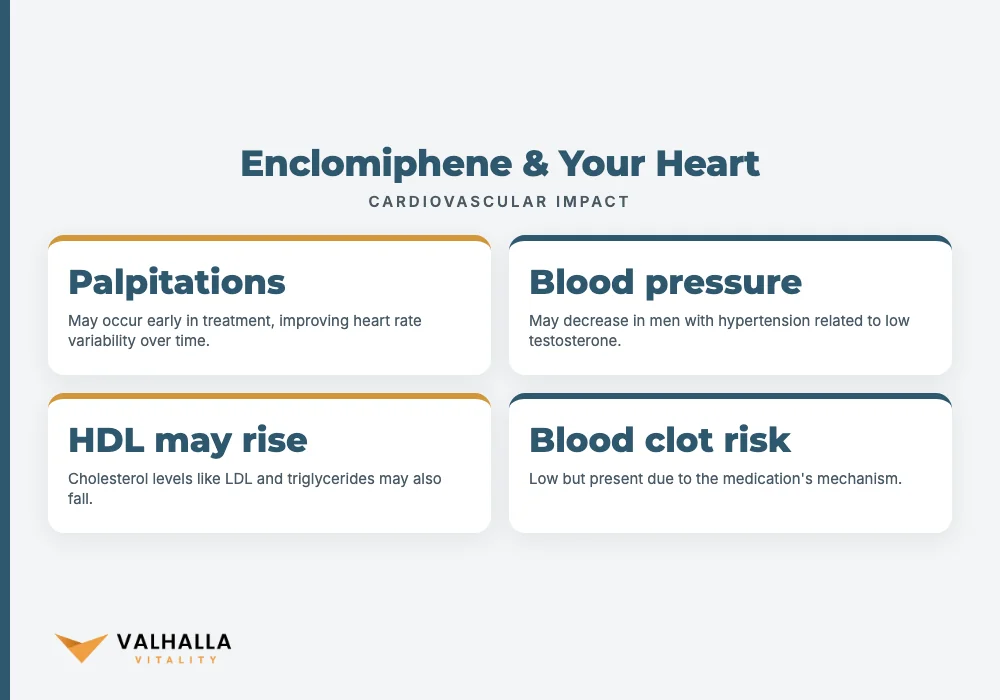
Enclomiphene blocks estrogen receptors in the hypothalamus. That triggers a rise in GnRH, which drives LH and FSH upward. Those hormones then signal the testes to produce more testosterone. Because testosterone directly influences vascular tone, lipid metabolism, and the autonomic nervous system, a meaningful shift in hormone levels can ripple into cardiovascular function.
Low testosterone has been associated with worse lipid profiles, endothelial dysfunction, and higher prevalence of metabolic syndrome. Restoring levels toward a normal physiological range may address some of those patterns. How much benefit a man sees depends on where his baseline sits.
| Cardiovascular area | Possible direction of change | What providers typically monitor |
|---|---|---|
| Heart rate and rhythm | Palpitations early in treatment; improved HRV over time | Resting heart rate, symptom reports, ECG if indicated |
| Blood pressure | May decrease in men with hypogonadism-related hypertension | BP at baseline and during follow-up |
| Cholesterol levels | HDL may rise; LDL and triglycerides may fall | Lipid panel before and periodically during therapy |
| Blood clot risk | Low but present given SERM mechanism | History of DVT or clotting disorder at intake |
Does enclomiphene cause heart palpitations?
Enclomiphene heart palpitations do occur in some men, most often in the early weeks of treatment while hormone levels are still adjusting. The mechanism is indirect: as testosterone and estrogen simultaneously shift, the autonomic nervous system recalibrates. That recalibration can produce a heightened awareness of the heartbeat or brief episodes of racing. For most men, the symptoms are mild and transient.
Palpitations that are frequent, last more than a few seconds, or come with chest discomfort or shortness of breath need prompt medical evaluation. An ECG can confirm whether an arrhythmia underlies the symptoms. Men with a prior history of cardiac arrhythmia carry a higher baseline risk and benefit from ECG monitoring before treatment begins.
When enclomiphene heart palpitations give way to improved rhythm
Research suggests that normalized testosterone levels are associated with better heart rate variability (HRV), a marker of autonomic nervous system function that is inversely linked to cardiovascular events. For men whose palpitations stem from autonomic imbalance caused by low testosterone, enclomiphene heart palpitations may gradually give way to more stable cardiac rhythm as therapy stabilizes hormone levels. Some data also suggest that maintaining physiological testosterone may reduce the incidence of atrial fibrillation in hypogonadal men, though a provider should evaluate this in any individual case.
Can enclomiphene increase blood pressure?
Enclomiphene blood pressure effects are generally neutral to favorable in men whose hypertension is tied to testosterone deficiency. Testosterone promotes vasodilation through nitric oxide signaling. That reduces vascular resistance and eases cardiac workload. Restoring hormone levels through enclomiphene may therefore contribute to modest blood pressure reduction in men with hypogonadism-related hypertension.
Individual responses still vary. Some men see a small reduction in readings. Others notice no meaningful change. A subset may see a temporary rise, particularly early in treatment when the hormonal environment is shifting. Routine blood pressure monitoring during therapy lets a provider detect any upward trend before enclomiphene high blood pressure becomes a sustained concern rather than a transient one.
For a thorough review of the clinical evidence, see the article on how enclomiphene affects blood pressure in men, which covers both the research and what follow-up monitoring looks like in practice.
Does enclomiphene affect cholesterol levels?
Enclomiphene cholesterol levels can shift in a favorable direction when therapy normalizes testosterone. Normal testosterone concentrations correlate with higher HDL and lower LDL and triglyceride levels. Clinical data from enclomiphene trials consistently show that moving testosterone toward a physiological range tends to improve the lipid panel in a heart-protective direction.
HDL elevation is the most reliably reported change. Higher HDL is inversely associated with atherosclerosis progression and coronary artery disease risk. The degree of improvement depends on baseline levels and how much hormone change occurs during treatment.
A diet rich in healthy unsaturated fats and regular aerobic exercise reinforce the lipid improvements that normalized testosterone may support on its own. A baseline lipid panel and periodic follow-up testing give both the patient and provider the clearest view of how cholesterol responds over time.
Can enclomiphene cause blood clots?
Enclomiphene blood clots risk is real but considered low in otherwise healthy men. Enclomiphene is a selective estrogen receptor modulator (SERM). Compounds in this class can interact with clotting pathways through partial estrogenic activity at specific receptor sites. That introduces a small but nonzero risk. Because enclomiphene is the more selective isomer compared to conventional clomiphene, its risk profile in this area is more favorable, though not zero.
Men with a personal or family history of deep vein thrombosis, pulmonary embolism, or clotting disorders should disclose that history at intake. During therapy, unexplained swelling, warmth, or redness in a limb, or sudden shortness of breath, are signs that require immediate medical attention. For a full evidence review and prevention guidance, see the dedicated article on enclomiphene and blood clot risk.
Is enclomiphene safe for men with heart conditions?
A pre-existing heart condition does not automatically disqualify a man from enclomiphene therapy. It raises the bar for evaluation. Enclomiphene high blood pressure, a prior arrhythmia, or recent cardiac events call for a comprehensive intake review before a licensed provider makes any determination. Enclomiphene side effects cardiovascular in origin are monitored throughout treatment regardless of baseline health, and more thorough upfront workup is appropriate for men with known cardiac history.
A licensed provider reviews cardiovascular history, current medications, resting blood pressure, and a baseline lab panel covering testosterone, LH, FSH, and lipids. Men with significant pre-existing conditions may need an ECG or specialist input before a provider determines whether therapy is appropriate and what monitoring to put in place.
Ongoing oversight is what keeps enclomiphene cardiovascular risk low. Periodic labs, blood pressure checks, and open reporting of any new cardiac symptoms allow a provider to catch changes early.
Consistent exercise, adequate sleep, and a heart-focused diet reinforce whatever cardiovascular improvements normalized testosterone may support. Valhalla Vitality builds that ongoing provider relationship into its telehealth model for men in supported states.
Talk with a licensed provider
Book Your Consultation and a licensed provider will review your cardiovascular history and labs to determine whether enclomiphene therapy is appropriate for you.
FAQ
Do enclomiphene heart palpitations go away on their own?
For most men, palpitations during early enclomiphene therapy are transient and resolve within the first few weeks as hormone levels stabilize. Any palpitations that are frequent, prolonged, or accompanied by chest pain or dizziness should be reported to a provider without delay.
How does enclomiphene compare to testosterone replacement for cardiovascular risk?
Enclomiphene stimulates natural testosterone production rather than introducing exogenous hormones, which avoids some cardiovascular concerns associated with testosterone replacement therapy, such as elevated hematocrit. A provider can compare these approaches based on individual labs and medical history.
Should I monitor blood pressure while taking enclomiphene?
Yes. Blood pressure can shift as testosterone levels change, and a baseline reading taken before therapy begins gives the clearest reference point for any changes during treatment. Routine blood pressure checks are a standard part of provider follow-up.
Does enclomiphene affect cholesterol for better or worse?
Most clinical data show enclomiphene supporting improved lipid profiles in men with low testosterone, particularly through HDL elevation. A baseline lipid panel lets a provider track whether an individual's response follows that pattern or needs additional management.
Sources
- Kaminetsky J, et al. "A randomized, double-blind study of enclomiphene citrate for the treatment of secondary hypogonadism." Journal of Sexual Medicine, 2013.
- Kim ED, et al. "Oral enclomiphene citrate stimulates the endogenous production of testosterone and sperm counts in men with low testosterone." Journal of Urology, 2016.
- Shores MM, et al. "Low serum testosterone and mortality in male veterans." Archives of Internal Medicine, 2006.
- Malkin CJ, et al. "Testosterone therapy in men with moderate severity heart failure: a double-blind randomized placebo controlled trial." European Heart Journal, 2006.
- Svartberg J, et al. "The associations of age, lifestyle factors and cardiovascular disease with testosterone in men." European Journal of Endocrinology, 2003.
- Traish AM, et al. "Testosterone deficiency and risk factors for cardiovascular disease: theoretical basis and clinical evidence." Journal of Andrology, 2007.
You May Also Like
 Enclomiphene
 Before and After: Physical Changes Explained
Enclomiphene before and after: what physical changes to expect, how the results timeline unfolds, and why provider monitoring matters for outcomes.
October 21, 2026 ETRead more → Enclomiphene
 Vision Side Effects: Eye Floaters & More
Enclomiphene vision side effects include eye floaters, blurry vision, and light sensitivity. Know the warning signs and when to contact your provider.
October 21, 2026 ETRead more → Enclomiphene
 Drug Test: Detection, WADA, and Disclosure
Enclomiphene drug test detection depends on the test type. Learn how workplace panels, military screening, and WADA rules treat this SERM.
October 21, 2026 ETRead more →