
The following blog post is for entertainment and informational purposes only. It is not intended to provide medical advice or diagnosis. Please consult your doctor before making any health-related decisions.
Enclomiphene and pregnenolone work through separate but complementary mechanisms to support testosterone and broader hormonal balance in men. Enclomiphene raises LH and FSH by blocking estrogen receptors in the hypothalamus and pituitary, prompting the testes to produce more testosterone naturally. Pregnenolone is the first molecule in the steroid hormone cascade, supplying the precursor that downstream hormones, including testosterone, depend on for synthesis. Men exploring how enclomiphene supports natural testosterone production will want to understand both sides of this hormone stack before speaking with a licensed provider.
What enclomiphene and pregnenolone each do
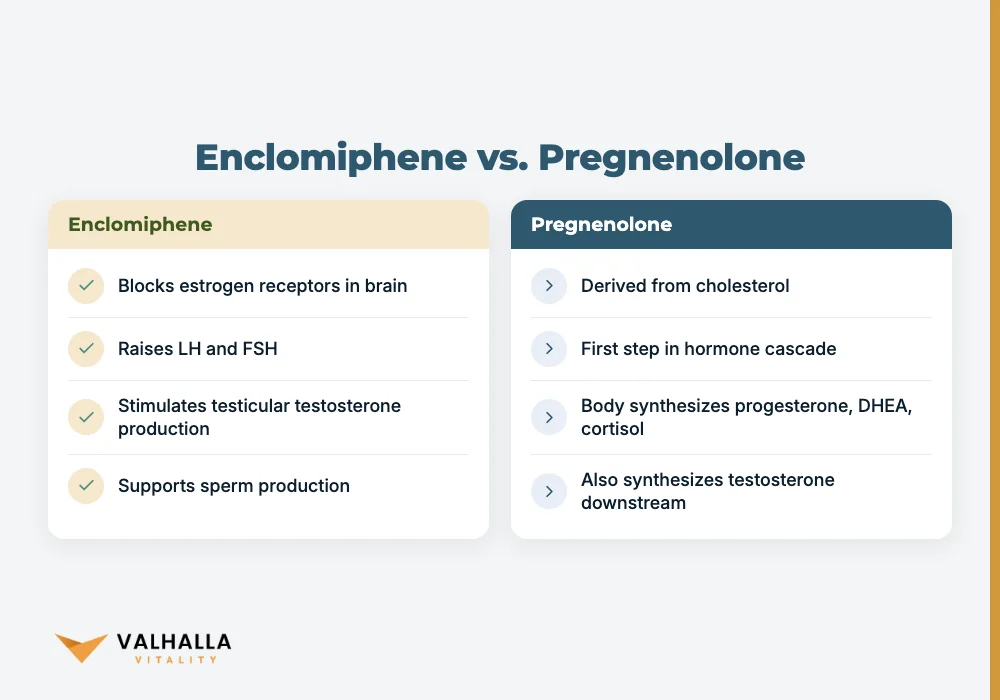
These two compounds operate at different points in the hormonal system. That separation is exactly what makes combining them clinically meaningful.
Enclomiphene is a selective estrogen receptor modulator (SERM). It occupies estrogen receptors in the hypothalamus and pituitary without activating them. The brain interprets this as low estrogen and responds by releasing more gonadotropin-releasing hormone (GnRH), which drives LH and FSH upward. Higher LH signals the Leydig cells in the testes to produce testosterone. Higher FSH supports sperm production. A 2016 review by Rodriguez et al. in Expert Opinion on Pharmacotherapy confirmed that this mechanism restores testosterone while preserving or improving sperm count in men with secondary hypogonadism, a key advantage over exogenous testosterone, which suppresses the body's natural production.
Pregnenolone is a neurosteroid derived directly from cholesterol. It sits at the top of the steroid hormone cascade. From pregnenolone, the body synthesizes progesterone, DHEA, cortisol, and, further downstream, testosterone. A 2016 paper by Vallée in the Journal of Steroid Biochemistry and Molecular Biology described pregnenolone as the foundational steroid compound, noting its additional neurosteroid activity at GABA-A and NMDA receptors in the brain. Pregnenolone for testosterone production means keeping the pathway fully stocked at its very first step.
Here is how the two compounds compare:
| Enclomiphene | Pregnenolone | |
|---|---|---|
| Mechanism | Blocks estrogen receptors; raises LH and FSH | Supplies first steroid hormone precursor |
| Primary target | Hypothalamic-pituitary-gonadal axis | Steroid synthesis substrate pool |
| Effect on testosterone | Stimulates testicular production via LH | Provides upstream precursor molecule |
| Fertility impact | Preserves or improves sperm production | No direct pituitary effect |
| Classification | SERM (prescription) | Neurosteroid (supplement) |
The table makes the logic of combining them clear. Enclomiphene handles the signaling side. Pregnenolone handles the substrate side. A protocol that addresses both levels covers ground that neither compound reaches alone. When testosterone is low because the pituitary is under-signaling and precursor availability is limited, treating only one problem leaves the other unsolved.
Can you take pregnenolone and enclomiphene together?
Yes. A licensed provider may recommend enclomiphene and pregnenolone together when a patient's lab results and clinical presentation support the combination. The two compounds target separate mechanisms and do not duplicate each other's effects.
The clinical rationale is straightforward. Enclomiphene drives the signal from the pituitary to the testes. Pregnenolone ensures that adequate precursor material is available for the testes to act on that signal. A 2025 systematic review and meta-analysis by Hohl et al. in Archives of Endocrinology and Metabolism confirmed that enclomiphene raises total testosterone, LH, and FSH in men with secondary hypogonadism while maintaining sperm parameters across multiple randomized controlled trials. Whether pregnenolone belongs in the protocol depends on the full hormonal evaluation, including precursor and adrenal markers.
Some clinical formulations combine enclomiphene with pregnenolone and additional supporting compounds such as DHEA or zinc, recognizing that testosterone optimization often involves more than a single hormonal axis. The composition of any such protocol is a provider decision made after a thorough lab review.
Neither compound is appropriate without oversight. The steroidogenic cascade is interconnected. Shifts in testosterone often affect estrogen, cortisol, and SHBG simultaneously, and those secondary shifts require monitoring to manage well. A provider determines whether the enclomiphene and pregnenolone combination is appropriate and adjusts the protocol as follow-up results come in.
What does pregnenolone do when combined with enclomiphene?
Pregnenolone fills a gap that enclomiphene cannot cover on its own. Enclomiphene sends the signal to produce more testosterone. Pregnenolone makes sure the raw material is there to act on that signal.
The steroid hormone pathway is a cascade with multiple branch points. Cholesterol converts to pregnenolone first. The pathway then branches into DHEA, progesterone, and cortisol, with testosterone sitting further downstream. If pregnenolone levels are insufficient, every hormone in that cascade may be affected. Vallée (2016) described pregnenolone not as a passive intermediate but as an active neurosteroid that modulates GABA-A and NMDA receptor activity, with documented effects on memory, mood, and stress response in the hippocampus and hypothalamus.
Iqbal et al. (2021), in a review published in Steroids, confirmed pregnenolone's broad biological activity across both endocrine and nervous system pathways. That breadth is why providers consider it as part of a comprehensive hormonal balance supplements approach rather than a narrow testosterone adjunct.
When enclomiphene and pregnenolone are combined, the outcome targeted extends beyond a testosterone number. It is whole-system hormonal support: improved pituitary signaling, adequate precursor availability, and potential cognitive and mood benefits that accompany better steroid hormone status overall. Men whose symptoms include fatigue, mood instability, and cognitive sluggishness alongside low testosterone may find the combination relevant to all three concerns at once.
How does enclomiphene boost testosterone naturally?
Enclomiphene removes a chemical brake. Under normal conditions, circulating estrogen tells the hypothalamus and pituitary to limit LH and FSH output. This feedback loop prevents overproduction. In men with secondary hypogonadism, the system runs too conservatively, leaving the testes under-stimulated despite being capable of producing testosterone.
Enclomiphene sits in the estrogen receptor without triggering it. The hypothalamus reads this as low estrogen and increases GnRH output. More GnRH means more LH. More LH means the Leydig cells produce more testosterone. The testes do the work. The body's own production pathway stays intact.
This is what makes enclomiphene relevant to natural testosterone optimization. Unlike exogenous testosterone, which shuts down the HPG axis, enclomiphene works within the existing system. Rodriguez et al. (2016) noted that enclomiphene raises testosterone while maintaining or improving sperm count, a clinical advantage for men who want to preserve fertility alongside hormonal support. For a direct look at how this compares with replacement approaches, our guide on how enclomiphene differs from testosterone injections as a treatment option covers the key tradeoffs in detail.
One firm limit: enclomiphene only works if the testes can respond. Primary hypogonadism, where the testes themselves have failed, does not respond to pituitary stimulation. A provider distinguishes between primary and secondary hypogonadism from lab values before recommending enclomiphene in any treatment plan.
Pregnenolone benefits men: what the evidence shows
For men, pregnenolone matters through two intersecting roles: steroid hormone synthesis and neurosteroid function.
On the synthesis side, every steroid hormone a man produces traces back to pregnenolone. As men age, upstream synthesis may decline, reducing the supply available for conversion into testosterone, DHEA, and cortisol. Supporting pregnenolone as part of a hormonal balance supplements strategy may matter beyond testosterone alone. Pregnenolone for testosterone production is part of the picture, but so is its contribution to maintaining multiple downstream hormones simultaneously.
On the neurosteroid side, pregnenolone's role is more specific than that of a generic precursor. Vallée (2016) found that the brain actively concentrates pregnenolone at levels exceeding circulating blood concentrations, suggesting it functions as a direct neurosteroid rather than merely a building block.
Pregnenolone modulates GABA-A and NMDA receptors in regions associated with memory consolidation and stress regulation. Clinical associations between low pregnenolone and mood disturbance or cognitive difficulty have been documented, though research continues to define the relationship in otherwise healthy adult men.
Iqbal et al. (2021) confirmed pregnenolone's broad endocrine and neurological activity in a review of its synthesis and biological properties. Men using an enclomiphene hormone stack who also experience fatigue, mood changes, or cognitive sluggishness alongside low testosterone may find that pregnenolone addresses multiple symptoms through a single mechanism.
What is the recommended dosage for pregnenolone with enclomiphene?
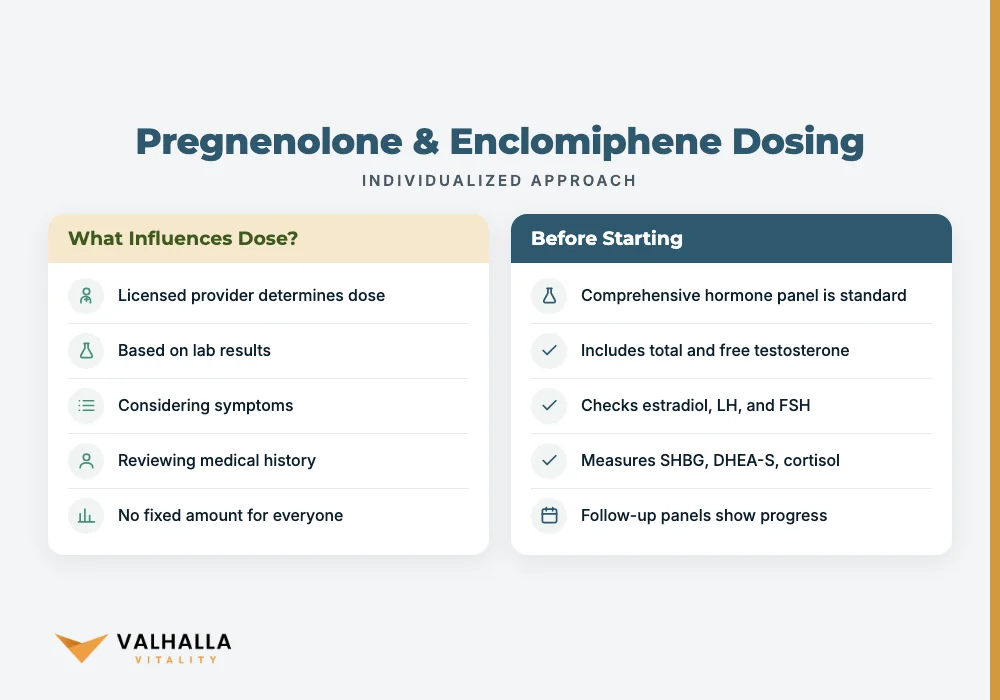
A licensed provider determines the dose after reviewing your lab results, symptoms, and medical history. There is no fixed amount that applies to every patient. That reflects how the steroid hormone cascade actually functions.
Both compounds affect an interconnected pathway. Estrogen levels, SHBG, cortisol, and adrenal output all influence how enclomiphene and pregnenolone perform in a given individual. A man with moderately low testosterone and an intact adrenal pathway will need different calibration than someone with broader hormonal disruption. Dosing accounts for that individual variation.
Before any protocol begins, a comprehensive hormone panel is standard. It typically covers:
- Total and free testosterone
- Estradiol
- LH and FSH
- SHBG
- DHEA-S and cortisol, depending on symptoms
Those baselines determine what the enclomiphene citrate protocol is designed to achieve. Follow-up panels at defined intervals show whether the approach is working and where adjustments are needed. Dosing changes follow the data, not a calendar.
What are the side effects of combining enclomiphene and pregnenolone?
Enclomiphene may cause visual disturbances, mood changes, and temporary nausea. Pregnenolone may affect mood or sleep quality at doses not calibrated to individual needs. Both require monitoring when used as part of an enclomiphene and pregnenolone protocol, and a provider will review the specific risk profile before prescribing either compound.
Enclomiphene side effects trace primarily to its estrogen-blocking action. By suppressing the negative estrogen feedback loop, enclomiphene can produce compensatory rises in circulating estrogen in some men. Providers monitor this via follow-up labs and may add adjunct support when estrogen moves outside the desired range. The 2025 meta-analysis by Hohl et al. reviewed multiple randomized controlled trials and found enclomiphene generally well-tolerated in the short term. Long-term safety data beyond one year remain limited at this stage of research. A detailed breakdown of what monitoring involves is available in our overview of enclomiphene side effects and what monitoring looks like in practice.
Pregnenolone side effects are less comprehensively characterized in clinical literature, since most research has focused on pharmacological derivatives rather than the parent compound. At doses not guided by lab values, pregnenolone may produce irritability, mood changes, or altered sleep patterns. Iqbal et al. (2021) noted that pregnenolone's broad biological activity makes individual response variable, reinforcing the need for provider oversight rather than self-dosing.
When enclomiphene and pregnenolone are combined, the central risk is that the cascade shifts in unexpected directions without regular monitoring. A well-managed protocol tracks testosterone, estrogen, LH, FSH, and any marker flagged at baseline. When a result moves outside range, the provider adjusts before symptoms develop.
Who may benefit from this hormone stack?

The enclomiphene and pregnenolone combination is typically considered for men with secondary hypogonadism: low testosterone driven by insufficient signaling from the hypothalamic-pituitary axis rather than by testicular failure. No symptom alone confirms the diagnosis. Labs do.
Common symptoms that prompt a clinical evaluation include:
- Low energy and persistent fatigue
- Reduced libido or sexual function
- Mood changes, irritability, or low mood
- Difficulty concentrating or cognitive fog
- Disrupted sleep patterns
Providers look for a specific lab pattern before recommending this path. Low total or free testosterone paired with low-to-normal LH and FSH indicates the testes are capable but under-stimulated. That combination tells the provider where the problem originates. Enclomiphene addresses the signaling deficit. Pregnenolone is added when the broader evaluation reveals low precursor availability, reduced adrenal output, or neurosteroid-related complaints such as cognitive fog or chronic mood disruption.
Men managing coexisting conditions, such as metabolic syndrome, elevated cortisol, or thyroid dysfunction, require careful evaluation before starting the enclomiphene and pregnenolone combination. Those conditions affect how the cascade responds to supplementation. Providers factor them into treatment design, and an individualized approach calibrated to the full clinical picture outperforms a generic protocol applied without lab context.
Men who would not be candidates include those with primary testicular failure, estrogen-sensitive conditions, or active cardiovascular disease. Age alone is not a disqualifier, but the presence of other hormonal pathology may shift the treatment priority. A thorough provider review is the correct starting point regardless of symptoms.
The enclomiphene citrate protocol: what providers assess
The clinical process for an enclomiphene and pregnenolone protocol follows a structured sequence. It begins with a comprehensive hormone panel that establishes individual baselines: testosterone (total and free), estradiol, LH, FSH, SHBG, and, depending on symptoms, DHEA-S and cortisol. That panel defines the starting point and frames what progress looks like.
At Valhalla Vitality, the intake process is fully online. A licensed provider reviews the medical intake within 24 business hours of submission. If the provider determines that an enclomiphene and pregnenolone protocol is appropriate, the prescription is sent to a US compounding pharmacy operating under 503A or 503B standards. Medication typically arrives within three to seven business days from the time the prescription is transmitted. Availability varies by state.
Follow-up labs are built into the protocol from the beginning. The provider reviews results at defined intervals and adjusts the protocol based on what the data shows. This iterative process distinguishes a properly managed enclomiphene citrate protocol from self-directed supplementation.
Lifestyle factors contribute alongside the pharmacological side. Consistent sleep of adequate duration supports the overnight testosterone surge that accounts for a meaningful portion of daily production. Regular resistance training activates androgen receptors and improves testosterone sensitivity.
Adequate dietary fat provides the cholesterol substrate that the entire steroid hormone cascade depends on, including pregnenolone synthesis. A provider may integrate these recommendations as part of a comprehensive natural testosterone optimization plan. For a closer look at what the clinical evaluation involves, our guide on what providers assess when evaluating men for enclomiphene treatment explains the process in detail.
Ready to explore your options?
If this approach interests you, Book Your Consultation to have a licensed provider review your intake and discuss whether the enclomiphene and pregnenolone combination may be appropriate for your situation.
FAQ
Can you take pregnenolone and enclomiphene together?
Yes, a licensed provider may prescribe enclomiphene and pregnenolone together when labs and clinical presentation support the combination. The two compounds target separate mechanisms and do not duplicate each other's effects. Whether both are appropriate depends on a full hormonal evaluation.
What does pregnenolone do when combined with enclomiphene?
Pregnenolone supplies the upstream steroid precursor that the body converts into testosterone and other key hormones. Enclomiphene drives the pituitary signal; pregnenolone supports the substrate supply for the testes to act on that signal. Together they address both the signaling and synthesis sides of the testosterone production pathway.
How does enclomiphene boost testosterone naturally?
Enclomiphene blocks estrogen receptors in the hypothalamus and pituitary, releasing the negative feedback that suppresses LH and FSH. Rising LH tells the testes to produce more testosterone while sperm production is preserved. The body's own production pathway remains active throughout the protocol.
What is the recommended dosage for pregnenolone with enclomiphene?
A licensed provider determines the appropriate dose after reviewing your labs, symptoms, and medical history. Dosing is not fixed; it is calibrated to individual baseline levels and adjusted based on follow-up lab results throughout the enclomiphene citrate protocol.
What are the side effects of combining enclomiphene and pregnenolone?
Enclomiphene may cause visual disturbances, mood changes, or nausea related to its estrogen-blocking action, while pregnenolone may affect mood or sleep quality at doses not calibrated to individual needs. Regular lab monitoring throughout a combined protocol allows a provider to catch and address adverse trends early.
Sources
- Rodriguez KM et al. (2016). Enclomiphene citrate for the treatment of secondary male hypogonadism. Expert Opinion on Pharmacotherapy. PubMed
- Hohl A et al. (2025). Clomiphene or enclomiphene citrate for the treatment of male hypogonadism: a systematic review and meta-analysis of randomized controlled trials. Archives of Endocrinology and Metabolism. PubMed
- Vallée M (2016). Neurosteroids and potential therapeutics: Focus on pregnenolone. The Journal of Steroid Biochemistry and Molecular Biology. PubMed
- Iqbal A et al. (2021). A review on synthesis and biological activities of D-ring modified pregnenolone. Steroids. PubMed
You May Also Like
 Enclomiphene
 Before and After: Physical Changes Explained
Enclomiphene before and after: what physical changes to expect, how the results timeline unfolds, and why provider monitoring matters for outcomes.
October 21, 2026 ETRead more → Enclomiphene
 Vision Side Effects: Eye Floaters & More
Enclomiphene vision side effects include eye floaters, blurry vision, and light sensitivity. Know the warning signs and when to contact your provider.
October 21, 2026 ETRead more → Enclomiphene
 Drug Test: Detection, WADA, and Disclosure
Enclomiphene drug test detection depends on the test type. Learn how workplace panels, military screening, and WADA rules treat this SERM.
October 21, 2026 ETRead more →