Enclomiphene Erectile Dysfunction: Evidence & How It Works

The following blog post is for entertainment and informational purposes only. It is not intended to provide medical advice or diagnosis. Please consult your doctor before making any health-related decisions.
Enclomiphene erectile dysfunction treatment targets the hormonal root cause that most oral ED medications bypass. For men with low testosterone, enclomiphene therapy works by stimulating LH and FSH output, which signals the testes to produce more testosterone naturally. Higher testosterone may improve libido, support erection quality, and restore broader sexual function without replacing the body's own production.
Low testosterone and ED: the hormonal link men often miss
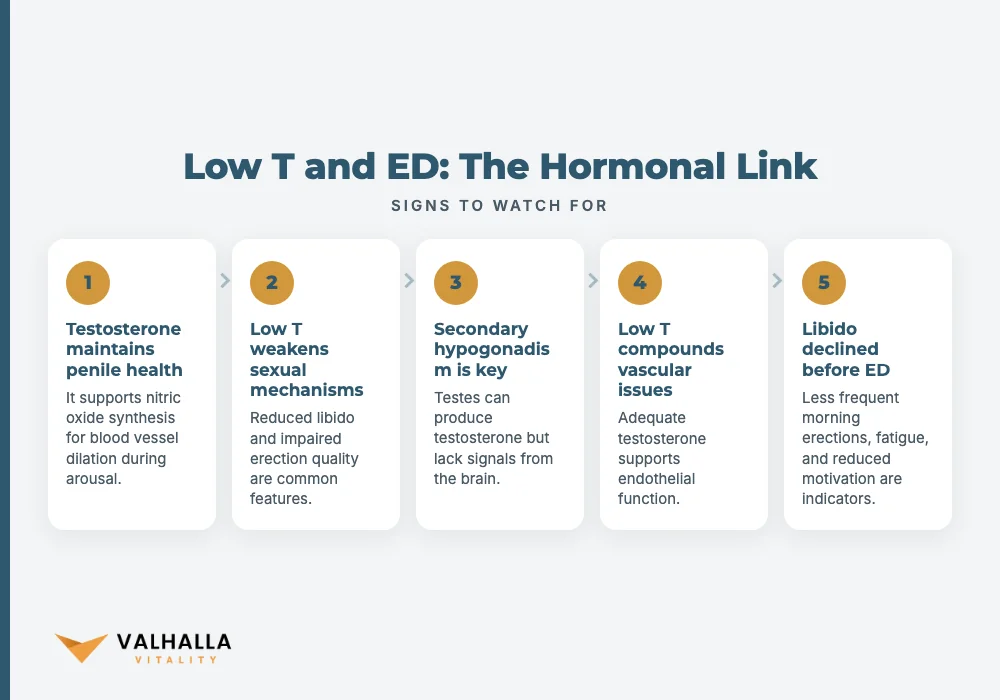
Testosterone is not simply a "sex hormone." It maintains the health of penile vascular tissue, supports nitric oxide synthesis that allows blood vessels to dilate during arousal, and drives the central nervous system signals that initiate sexual response. When levels fall below the physiological range, all three of those mechanisms weaken.
The European Academy of Andrology guidelines identify sexual symptoms, including reduced libido and impaired erection quality, as among the most common features of functional hypogonadism in men (Corona et al., 2020). Low testosterone and ED frequently appear together, and the hormonal cause is often overlooked when men receive PDE5 inhibitors without a prior hormonal workup. Addressing the underlying hormonal deficit may change outcomes meaningfully.
The distinction that matters most clinically is between primary and secondary hypogonadism. In secondary hypogonadism, the testes are capable of producing testosterone but are not receiving adequate signals from the hypothalamus and pituitary. This is the population where enclomiphene and ED research is concentrated, because the signaling pathway can potentially be restored.
Low testosterone can also compound vascular contributors to ED. Adequate testosterone supports endothelial function. When both the hormonal and vascular pathways are compromised together, the combination is harder to address than either factor in isolation.
Signs that low testosterone may be behind ED
A licensed provider assesses the full clinical picture before attributing ED to hormone status. Common indicators that a hormonal evaluation is warranted include:
- Libido that declined before or alongside erection difficulty
- Less frequent or absent morning erections
- Fatigue, reduced motivation, and mood changes accompanying sexual symptoms
- Lab-confirmed testosterone below the lower reference range
- Age-related hormonal decline in the 35-to-55 bracket without other identified causes
These indicators do not confirm a diagnosis. Lab testing combined with a provider review is the only reliable path to clarity.
How does enclomiphene erectile dysfunction therapy improve sexual function?
Enclomiphene improves erectile function by restarting the hormonal cascade that testosterone deficiency disrupts. It works upstream, at the level of the hypothalamus and pituitary, rather than acting on the erection mechanism directly.
The hypothalamus normally releases gonadotropin-releasing hormone (GnRH) in timed pulses. Estrogen feeds back on those receptors and suppresses the signal. Enclomiphene is the trans-isomer of clomiphene citrate. It selectively blocks estrogen receptors in the hypothalamus and pituitary, reducing that inhibitory feedback. GnRH pulse frequency increases. The pituitary responds by releasing more LH and FSH.
Elevated LH reaches the Leydig cells in the testes. They respond by synthesizing testosterone. This is an endogenous rise: the body produces the hormone itself rather than receiving it from an external source. Elevated FSH supports sperm production in parallel, which is relevant for men who have fertility goals alongside addressing ED.
Higher testosterone then acts on multiple targets connected to erection quality: nitric oxide synthesis in penile endothelium, smooth muscle tone, and the central arousal pathways. Enclomiphene sexual function improvements are a downstream effect of that single upstream hormonal action. This is why a hormonal approach can address what a purely vascular or psychogenic intervention cannot.
Enclomiphene hormonal ED treatment also supports libido at the central nervous system level. Testosterone drives desire as much as it supports the physical mechanics of erection. Men who report low sex drive alongside ED may see both dimensions improve when testosterone is restored to a physiological range.
Does enclomiphene help with ED?
Yes, enclomiphene may help with ED when the underlying driver is low testosterone. The evidence is specific to that population.
A 2016 expert review by Rodriguez et al. in Expert Opinion on Pharmacotherapy described enclomiphene citrate as a targeted option for secondary male hypogonadism, noting that clinical studies showed it raised serum testosterone into the normal physiological range while preserving sperm parameters. A 2022 systematic review and meta-analysis by Huijben et al. in Andrology, covering multiple randomized controlled trials, confirmed that clomiphene compounds, including enclomiphene, significantly increased testosterone in hypogonadal men. The 2025 meta-analysis by Hohl et al. in Archives of Endocrinology and Metabolism, reviewing only randomized controlled trials, found both enclomiphene and clomiphene effective for raising testosterone in men with hypogonadism.
None of these trials claim enclomiphene addresses ED. What the research establishes is a reliable hormonal effect in men where testosterone deficiency is the documented driver of sexual symptoms.
Enclomiphene libido improvements are part of the same picture. Men who report reduced sex drive alongside erection difficulty may see both improve as testosterone returns to a physiological range. The clinical studies in this area noted improvements in sexual function across populations with both primary and secondary hypogonadal states.
The evidence does not support enclomiphene erectile dysfunction treatment when testosterone is normal. For men whose ED has a predominantly vascular or psychological origin with normal hormone levels, raising testosterone further is unlikely to provide meaningful benefit. That is why a provider-led evaluation, including a lab panel to identify whether hormone deficiency is a factor, should precede any hormonal intervention.
Men who want to understand how hormonal treatment fits alongside tadalafil or vardenafil for erectile dysfunction can discuss with their provider whether a combined approach is appropriate for their situation.
Can enclomiphene cause erectile dysfunction?
No, enclomiphene does not typically cause erectile dysfunction. It is not classified as a drug with ED as a recognized adverse effect, and its mechanism runs in the opposite direction: it raises testosterone, which supports rather than impairs erection quality.
A small number of men notice temporary changes in sexual symptoms early in treatment. Two mechanisms can explain this. First, enclomiphene raises estradiol alongside testosterone, because more testosterone provides more substrate for aromatization to estrogen. If estradiol rises disproportionately during the early adjustment phase, it can temporarily reduce libido or affect erection quality. Second, if the prescribed amount does not push testosterone into the therapeutic range, symptoms may not improve and can seem worse relative to expectations.
Both scenarios are addressed through structured laboratory monitoring. A licensed provider checks testosterone and estradiol at defined follow-up intervals and adjusts treatment accordingly. This is not a flaw in enclomiphene as a molecule; it is the reason why enclomiphene erectile dysfunction management requires clinical supervision rather than self-directed dosing.
The safety data from clinical trials are reassuring. Adverse effects reported in published studies were predominantly mild: hot flashes, headaches, and occasional mild visual disturbances. These resolved with continued treatment or upon stopping the medication. Cardiovascular safety parameters in the published trial data did not reveal significant adverse events associated with enclomiphene use. Men with pre-existing cardiovascular conditions should still discuss the full risk-benefit profile with a qualified provider before starting any hormonal therapy.
Enclomiphene as a SERM for ED treatment: how it compares with TRT
Testosterone replacement therapy is the better-known hormonal ED treatment. Men researching enclomiphene erectile dysfunction treatment frequently encounter this comparison when exploring their options. Both TRT and enclomiphene raise testosterone. The mechanisms are entirely different, however, and those differences matter for specific patients.
TRT delivers exogenous testosterone: the hormone comes from an injection, gel, or patch rather than from the body itself. This reliably raises blood levels. But it also suppresses the HPG axis. The pituitary stops sending LH and FSH signals. The testes reduce or cease their own production. Sperm counts often fall significantly, and the suppression can persist for months after stopping.
Enclomiphene, as a SERM for ED treatment, stimulates the axis rather than replacing its output. The testes continue producing testosterone because the LH signal remains active. Sperm production is preserved or improved. For men who want to address low testosterone and ED while maintaining fertility, this distinction is clinically significant. The 2022 systematic review by Huijben et al. highlighted this fertility-preserving advantage as a key reason SERM-based treatment is considered when reproductive goals are present.
The key tradeoff: enclomiphene requires an intact and responsive HPG axis. Men with primary hypogonadism, where the testes cannot respond to increased LH, will not benefit. Stimulating upstream signaling cannot fix downstream testicular failure. A provider who reviews LH, FSH, and testosterone together can identify which type of hypogonadism is present before recommending either treatment path.
For men evaluating secondary hypogonadism and low testosterone management options, the distinction between these hormonal approaches is a useful foundation for the clinical conversation.
How long does enclomiphene take to work for ED?
Enclomiphene does not produce immediate results. The hormonal cascade takes time to build, and improvements in erectile function follow testosterone recovery rather than the first dose.
Testosterone levels typically begin rising within the first weeks of consistent treatment, as reflected in clinical trial data. Sexual function changes, including improved libido and better erection quality, often lag further behind. The brain and penile tissue take time to respond to recovered testosterone. Most men who experience benefit notice changes over weeks to months rather than days.
Response timing is individual. It depends on baseline testosterone level, how far below the normal range levels were at the start, how responsive the HPG axis is to stimulation, and whether other contributors to ED, including vascular health, sleep quality, and metabolic factors, are also present. A licensed provider calibrates expectations based on specific lab results and health history, not a generic timeline.
Regular follow-up labs are built into the process. If testosterone has not responded adequately after a defined evaluation period, a provider may reassess whether dose adjustment or a different approach is appropriate.
What is the recommended enclomiphene dose for erectile dysfunction?
There is no single standardized dose. A licensed provider determines the appropriate amount after reviewing laboratory results, including baseline testosterone, LH, FSH, estradiol, and relevant metabolic markers, alongside the patient's symptom profile and health history. Adjustments are made at follow-up based on hormonal response and how symptoms are tracking.
This individualization reflects genuine biological variation. The HPG axis does not respond uniformly across men. The same stimulus can produce very different hormonal outcomes in different individuals. An amount that is too low leaves testosterone unchanged. An amount that pushes estradiol disproportionately out of range introduces new symptoms.
The clinical trial protocols described in Rodriguez et al. (2016) used tiered dosing with regular monitoring and response-based adjustments. That structure illustrates why enclomiphene erectile dysfunction treatment is a supervised clinical process rather than an over-the-counter approach, and why provider calibration matters as much as the molecule itself.
Enclomiphene testosterone boost: what monitoring looks like in practice
Starting enclomiphene begins a supervised hormonal process. The prescription is not the endpoint.
A standard monitoring approach includes:
- Baseline labs before starting: typically total testosterone, free testosterone, LH, FSH, estradiol, hematocrit, and PSA for men over 40
- Follow-up labs at regular intervals to assess how testosterone and estradiol are responding to treatment
- Symptom review alongside lab values, since a number within range does not always correspond to a patient's clinical experience
- Dose adjustment or reassessment if the hormonal response is insufficient or levels move outside the target window
This structure reflects the European Academy of Andrology's approach to managing functional hypogonadism (Corona et al., 2020): treat to a target hormone level with regular follow-up, not to a fixed dose regardless of response. It is also why enclomiphene testosterone boost outcomes vary between patients: the calibration process matters as much as the prescription itself.
Men interested in understanding how enclomiphene's isomeric structure differs from clomiphene as a treatment option for men will find that pharmacological distinction relevant to both the monitoring conversation and the broader treatment decision.
Who is likely to benefit from enclomiphene for ED
Enclomiphene is not a universal ED remedy. Its clinical profile fits men in a specific hormonal situation. Men who approach enclomiphene erectile dysfunction therapy as a hormonal intervention, rather than a direct erection enhancer, arrive at the clinical conversation with more realistic expectations.
Men who may be good candidates include those with confirmed secondary hypogonadism on lab testing, meaning low testosterone alongside LH that is in the low or inappropriately normal range rather than elevated. Sexual symptoms, specifically reduced libido and impaired erection quality, that correlate with lab-confirmed low testosterone strengthen the case for a hormonal intervention. Men who prefer to preserve endogenous testosterone production rather than replacing it exogenously, and those with fertility goals where TRT-related sperm suppression is unacceptable, are the clearest match for this approach.
Those who have not responded to lifestyle optimization alone and want a provider-evaluated hormonal option before relying exclusively on PDE5 inhibitors are also likely to benefit from a full hormonal workup that includes enclomiphene as a discussion point.
Men less likely to benefit include those with primary hypogonadism (testicular failure), where the testes cannot respond to increased LH signaling regardless of how much upstream stimulus is applied. ED with a predominantly vascular cause and normal testosterone levels falls outside the therapeutic target for enclomiphene. Active contraindications to SERM therapy or conditions requiring careful hormonal management require individualized assessment before starting.
The Valhalla Vitality intake process includes a full medical review before any prescription is written, covering lab results, symptom assessment, and provider consultation. Availability varies by state.
Enclomiphene erectile dysfunction: what the research still needs to confirm
The evidence base for enclomiphene erectile dysfunction treatment is growing but not complete.
Published trials have focused primarily on testosterone as the main endpoint rather than on validated patient-reported sexual outcomes such as International Index of Erectile Function scores. Testosterone improvements are well-documented across randomized controlled trials. Direct correlations to erection quality improvements, measured consistently, require more dedicated investigation. The 2025 meta-analysis by Hohl et al. confirmed robust testosterone effects but also noted that long-term outcome data would strengthen the clinical picture.
Long-term safety data across five or more years of continuous use remain limited. Short-term trial data are reassuring on cardiovascular markers and tolerability. Longitudinal data on bone density, prostate health, and cardiovascular endpoints over extended use are areas of ongoing research. Men who start enclomiphene should engage actively with the monitoring schedule their provider sets, precisely because the long-term evidence base is still developing.
What the current evidence clearly supports: men with secondary hypogonadism can expect a reliable testosterone boost from enclomiphene, and the hormonal improvements address the physiological driver of their ED. Whether those improvements translate into clinically meaningful erection quality gains for a specific individual depends on how central testosterone deficiency was to their ED in the first place.
Ready to take the next step
Speak with a licensed provider to find out whether low testosterone is contributing to your sexual health concerns and whether enclomiphene is an appropriate next step for you.
FAQ
Does enclomiphene help with erectile dysfunction?
Enclomiphene may help with ED when the underlying cause is low testosterone. It raises endogenous testosterone by stimulating LH and FSH output, which can improve libido and erection quality in men with confirmed hormonal deficiency. It is not effective for ED caused primarily by vascular or psychological factors.
Can enclomiphene cause erectile dysfunction?
Enclomiphene does not typically cause ED. Its mechanism raises testosterone, which supports rather than impairs erectile function. Some men notice temporary changes early in treatment due to estradiol fluctuations during the adjustment phase, but these are manageable with lab monitoring and dose adjustment by a licensed provider.
How long does enclomiphene take to work for ED?
Testosterone levels often begin rising within the first few weeks of treatment, but improvements in erectile function and libido may take several weeks to a few months. Response depends on baseline hormone levels, HPG axis responsiveness, and whether factors beyond testosterone are also contributing to ED.
How does enclomiphene differ from testosterone replacement therapy for ED?
Enclomiphene stimulates the body's own HPG axis to produce testosterone by blocking estrogen feedback on the hypothalamus and pituitary. TRT delivers testosterone from an external source and suppresses the body's natural production. Enclomiphene preserves sperm production, which is a meaningful advantage for men with fertility goals.
What is the recommended enclomiphene dose for erectile dysfunction?
A licensed provider determines the dose after reviewing laboratory results, including testosterone, LH, FSH, and estradiol, alongside a symptom evaluation. There is no universal dose; it is calibrated to each patient's hormonal response and adjusted during follow-up labs.
Sources
- Hohl A et al. (2025). Clomiphene or enclomiphene citrate for the treatment of male hypogonadism: a systematic review and meta-analysis of randomized controlled trials. Archives of endocrinology and metabolism. PubMed
- Huijben M et al. (2022). Clomiphene citrate for men with hypogonadism: a systematic review and meta-analysis. Andrology. PubMed
- Rodriguez KM et al. (2016). Enclomiphene citrate for the treatment of secondary male hypogonadism. Expert opinion on pharmacotherapy. PubMed
- Corona G et al. (2020). European Academy of Andrology (EAA) guidelines on investigation, treatment and monitoring of functional hypogonadism in males. Andrology. PubMed
You May Also Like
 Enclomiphene
Enclomiphene vs Nolvadex: PCT and Low Testosterone Guide
Enclomiphene vs nolvadex: compare how each SERM restores testosterone after a cycle, which is safer for PCT, and how a provider decides between them.
October 16, 2026 ETRead more → Enclomiphene
Enclomiphene and Alcohol: What Men on Therapy Need to Know
Enclomiphene and alcohol may reduce therapy effectiveness. Learn how drinking affects testosterone, estrogen, and liver metabolism on therapy.
October 16, 2026 ETRead more → Enclomiphene
Enclomiphene Acne: Causes, Treatment and Prevention
Enclomiphene acne develops when rising testosterone overstimulates oil glands. Learn which men face the highest risk and how to manage breakouts.
October 16, 2026 ETRead more →