
The following blog post is for entertainment and informational purposes only. It is not intended to provide medical advice or diagnosis. Please consult your doctor before making any health-related decisions.
Enclomiphene muscle growth potential comes from a specific hormonal chain: this SERM raises LH levels, the testes respond with increased testosterone output, and elevated testosterone may then support protein synthesis, muscle fiber repair, and strength gains. Unlike synthetic androgens, enclomiphene works through the body's own hormonal axis and keeps sperm production intact. For a complete look at enclomiphene's core hormonal profile, that page covers the pharmacology in full. A licensed provider reviews lab results to determine whether this therapy is clinically appropriate for a given individual.
What enclomiphene citrate is
Enclomiphene citrate is the trans-isomer of clomiphene. It is a selective estrogen receptor modulator (SERM) developed to treat secondary hypogonadism and male infertility. The structural distinction matters. Standard clomiphene contains two isomers: the enclomiphene trans-isomer and zuclomiphene, the cis-isomer. Zuclomiphene is weakly estrogenic, and in men that can produce mood disturbances, visual side effects, and hormonal unpredictability. Enclomiphene isolates only the anti-estrogenic component, giving it a more predictable hormonal action for men.
That difference is why researchers studying enclomiphene testosterone boost compare it favorably to older clomiphene protocols. The guide on how enclomiphene differs from clomiphene as a treatment for men covers the isomeric and clinical distinctions in detail.
As a SERM for bodybuilding or testosterone optimization, enclomiphene acts specifically at the hypothalamus. Every anabolic downstream effect flows through testosterone.
How does enclomiphene increase testosterone naturally?
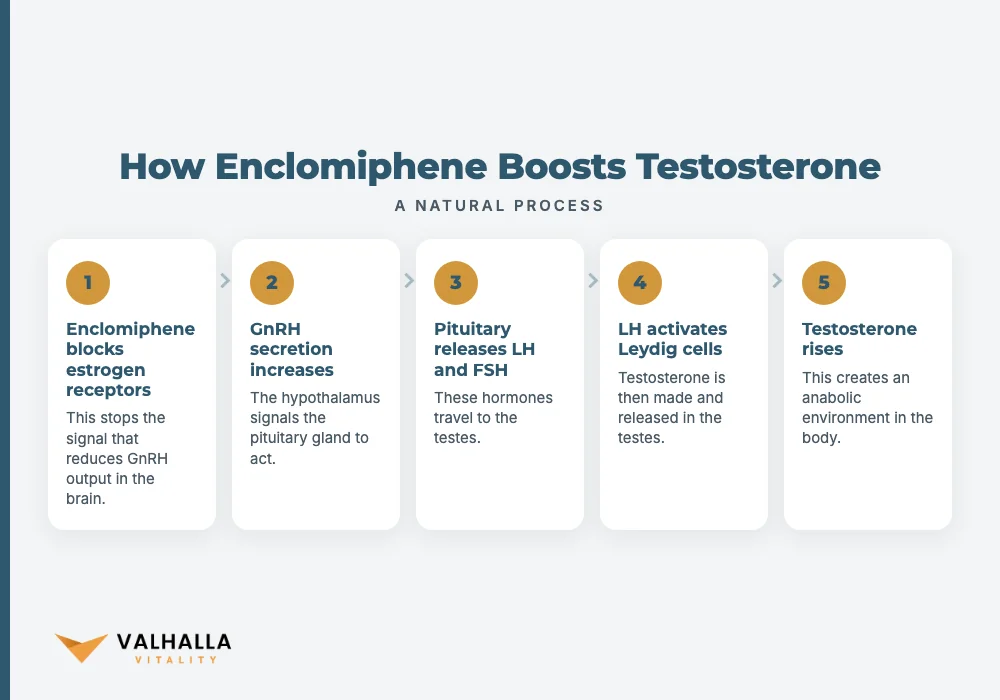
The mechanism starts in the brain, not the testes. The hypothalamus contains estrogen receptors that, when occupied by estrogen, signal a reduction in GnRH output. This is the normal negative feedback that keeps testosterone in check. Enclomiphene occupies those receptors and blocks the suppression signal. GnRH rises. The pituitary responds.
Elevated GnRH prompts the anterior pituitary to release LH and FSH, the two gonadotropins that govern gonadal function. Both travel to the testes. LH binds Leydig cells, the primary testosterone-synthesizing cells in the testes, and drives production. FSH simultaneously activates Sertoli cells and maintains sperm maturation. This dual output is why elevated enclomiphene LH levels do not come at the expense of fertility.
The table below maps each step from drug binding to testosterone output:
| Step | Event | Signal produced |
|---|---|---|
| 1 | Enclomiphene occupies hypothalamic estrogen receptors | Negative feedback on GnRH blocked |
| 2 | GnRH secretion increases | Hypothalamus signals the pituitary |
| 3 | Pituitary releases LH and FSH | Both gonadotropins enter circulation |
| 4 | LH activates Leydig cells in the testes | Testosterone synthesized and released |
| 5 | FSH activates Sertoli cells | Sperm production maintained |
| 6 | Testosterone rises in circulation | Anabolic environment established |
Enclomiphene LH levels are the primary marker clinicians watch during treatment. Rising LH paired with normalizing testosterone confirms the axis is responding. If LH rises but testosterone stays low, the testes are the limiting factor, a pattern called primary hypogonadism, where enclomiphene alone cannot correct the deficit. Labs before starting establish which pattern applies.
That distinction is what drives successful enclomiphene muscle growth outcomes: restore the hormonal signal, allow testosterone to rise within physiological ranges, and the anabolic processes that depend on it become available again.
Can enclomiphene help build muscle?
Yes. Enclomiphene may support muscle growth in men whose testosterone is clinically low. The drug does not act on muscle directly. It raises testosterone, and testosterone activates the anabolic processes that resistance training depends on.
Testosterone is a primary anabolic signal in skeletal muscle. When it is deficient, protein synthesis slows, satellite cell activity drops, recovery after training takes longer, and gaining lean mass becomes harder despite consistent effort. Restoring testosterone through enclomiphene muscle growth therapy may return the hormonal conditions under which normal training adaptations occur.
Specific mechanisms testosterone activates in muscle tissue:
- Protein synthesis: testosterone binds androgen receptors in muscle cells and triggers mRNA translation pathways that produce structural proteins required for hypertrophy. More available protein means more capacity to repair and grow after training stress.
- Satellite cell activation: satellite cells are the progenitor cells responsible for repairing and adding muscle fibers after damage. Testosterone promotes their activation and proliferation, which is why hypogonadal men show measurably slower post-exercise recovery.
- Anti-catabolic signaling: testosterone opposes the protein-degrading effects of cortisol. When deficient, this balance tips toward net muscle breakdown even with adequate training volume.
- Nitrogen retention: testosterone supports positive nitrogen balance, the metabolic condition that favors tissue synthesis over breakdown.
These mechanisms underlie enclomiphene bodybuilding results the same way they explain any intervention that normalizes testosterone. The drug raises the hormone; the hormone does the anabolic work.
When testosterone is normalized following treatment, improvements in lean body mass are consistent with the established physiology of testosterone in skeletal muscle. Those results reflect the resolution of a hormonal deficit, not a novel pharmacological action unique to enclomiphene.
The magnitude of enclomiphene muscle growth effects depends heavily on the starting deficit. A man beginning therapy with testosterone substantially below the normal reference range has more to restore and may see more pronounced changes in body composition and training response. Someone starting near the low end of normal has less room for correction. This is why individual baseline labs are the only meaningful starting point for any conversation about expected results.
One important boundary: for men with already-normal testosterone, enclomiphene muscle growth effects are unlikely to be clinically meaningful. As testosterone rises during treatment, so does estradiol, which partially rebuilds the negative feedback and limits how far above normal levels can climb. Enclomiphene is a restorative agent, not an amplifier of normal hormonal function.
Does enclomiphene improve strength and athletic performance?
For enclomiphene for athletes, the operative question is whether low testosterone is the actual limiting factor on training adaptation. When it is, enclomiphene testosterone boost therapy may remove a real physiological ceiling on progress.
Men with suboptimal testosterone describe a consistent pattern: training feels harder than the workload warrants, strength gains have stalled despite disciplined programming, and recovery between sessions takes longer than it used to. When that pattern aligns with lab-confirmed low testosterone and low-normal LH, enclomiphene is a clinically appropriate option to evaluate.
Enclomiphene anabolic effects on training outcomes may also operate through indirect pathways:
- Fatigue reduction: persistent low energy is among the most common and responsive symptoms of low testosterone. Normalizing the hormone may restore training output to expected levels.
- Sleep quality: testosterone is involved in sleep architecture, and disrupted sleep is a reliable symptom of hypogonadism. Better sleep compounds recovery over weeks of training.
- Motivation and drive: testosterone has documented effects on dopaminergic motivation pathways. The flat, disengaged quality many hypogonadal men report during training often resolves alongside hormone normalization.
- Recovery rate: testosterone supports muscle tissue repair between sessions. Shorter recovery means more productive volume accumulates over time.
These indirect benefits depend on low testosterone being the actual cause of the symptoms. That requires lab confirmation. A provider assesses the full clinical picture before attributing any of these issues to a hormonal deficit.
Enclomiphene strength gains in this context are the outcome of restoring a functional hormonal environment, not pharmacological performance enhancement beyond normal physiology.
Can you build muscle on enclomiphene without steroids?
Enclomiphene muscle growth involves no exogenous androgens. The drug stimulates endogenous testosterone production by lifting the suppression signal at the hypothalamus. It supplies nothing externally. This is the core pharmacological distinction from anabolic-androgenic steroids (AAS).
With AAS, synthetic androgens enter the circulation and suppress the HPG axis through negative feedback. LH and FSH fall. Endogenous production stops. The testes become inactive. These are well-documented, predictable consequences of exogenous androgen use.
Enclomiphene does the opposite. Removing the hypothalamic suppression signal causes LH and FSH to rise. The testes stay active. Testosterone is produced endogenously, and sperm production continues alongside it because FSH also rises. Men who want both testosterone normalization and fertility preservation frequently prefer enclomiphene over TRT for exactly this reason. That profile is covered in more depth in this guide on enclomiphene's role in fertility and testosterone support.
The safety profile that follows is substantially different from AAS. There is no HPG axis suppression to recover from, no testicular atrophy to address, and no post-cycle endocrine disruption to manage. The body continues producing testosterone through a regulated pathway.
Yes, a man with confirmed secondary hypogonadism may experience real enclomiphene muscle growth without any exogenous androgens. The improvement comes from restoring normal physiology. Men with normal testosterone have nothing to restore and should not expect muscle-building effects from enclomiphene.
What dose of enclomiphene is best for muscle growth?
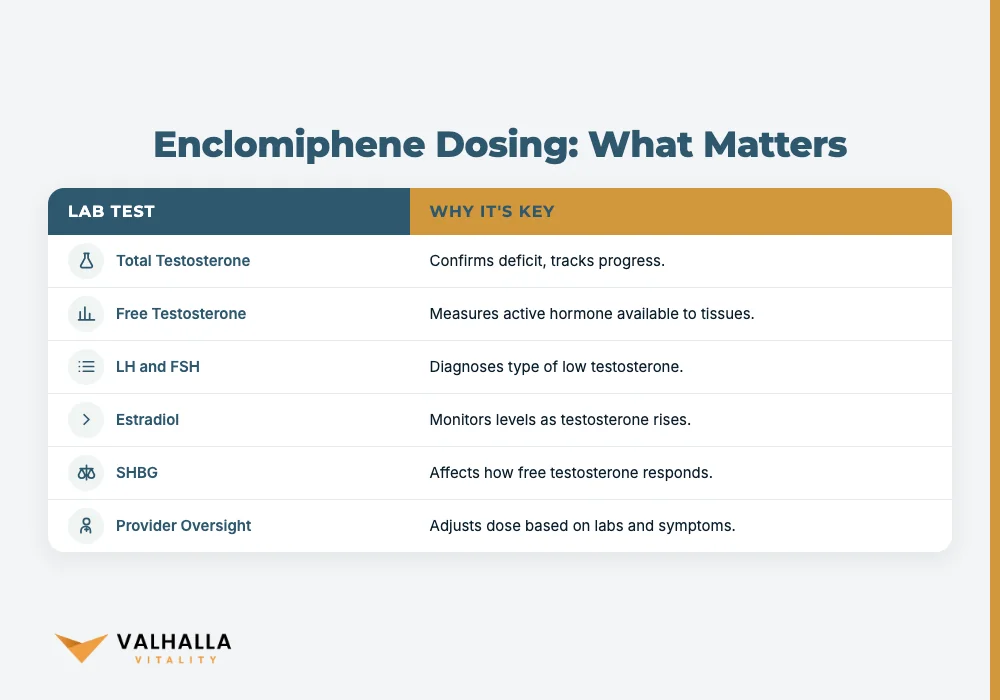
No universal dose exists for enclomiphene muscle growth therapy. A licensed provider determines the dose after reviewing lab results, with the therapeutic target being restoration of testosterone to the individual's mid-normal physiological range. What achieves that varies considerably from person to person.
Lab values that shape the prescribing decision:
- Total testosterone: confirms a clinical deficit and establishes the baseline for tracking progress
- Free testosterone: measures how much is biologically active; SHBG binds a portion and limits tissue availability
- LH and FSH: the diagnostic key. Low-normal LH with low testosterone confirms secondary hypogonadism, where enclomiphene is appropriate. High LH with low testosterone signals primary hypogonadism, where the testes are not responding and enclomiphene will not help
- Estradiol: baseline levels shape monitoring thresholds, since testosterone and estradiol rise together during treatment
- SHBG: determines how free testosterone will respond as total testosterone climbs
Once therapy begins, follow-up labs are drawn at set intervals to assess how the axis has responded. The provider adjusts up or down based on those values and symptom changes. This iterative process is standard for any SERM for bodybuilding or hormone optimization protocol.
Protocols from online forums, or doses borrowed from someone else's experience, are not a substitute for this lab-guided evaluation. Enclomiphene LH response varies significantly between individuals, and a provider who prescribes without confirming the labs is not following clinical standards.
For a walkthrough of what the clinical evaluation involves, the overview on enclomiphene for low testosterone in clinical practice covers the assessment process and what to expect.
Monitoring enclomiphene muscle growth therapy
Enclomiphene is generally well tolerated. Ongoing monitoring is still required, because hormone levels shift as the body adapts and a provider needs to track that response over time.
The most commonly reported side effects are headaches, hot flashes, and occasional mild visual disturbances. These are consistent with the broader clomiphene literature and typically resolve with dose adjustment. A detailed review of enclomiphene tolerability and the clinical risk profile covers what the evidence documents on safety.
Routine monitoring typically includes:
- Total and free testosterone, to confirm and maintain the therapeutic range
- Estradiol, which rises alongside testosterone and may require management if levels climb too high
- LH and FSH, to verify the axis is responding appropriately
- Lipid panel and cardiovascular markers, as part of standard hormone therapy oversight
Some research has reported enclomiphene's effects on lipid profiles favorably compared to exogenous testosterone therapy. Long-term safety data is less complete than for TRT because enclomiphene is a newer clinical pathway, and providers factor that context into their recommendations.
Physically active men should disclose training load, supplement use, and dietary protocols during intake. High-volume training affects hormone levels independently, and an accurate clinical baseline requires that information.
Enclomiphene muscle growth: candidacy and clinical fit
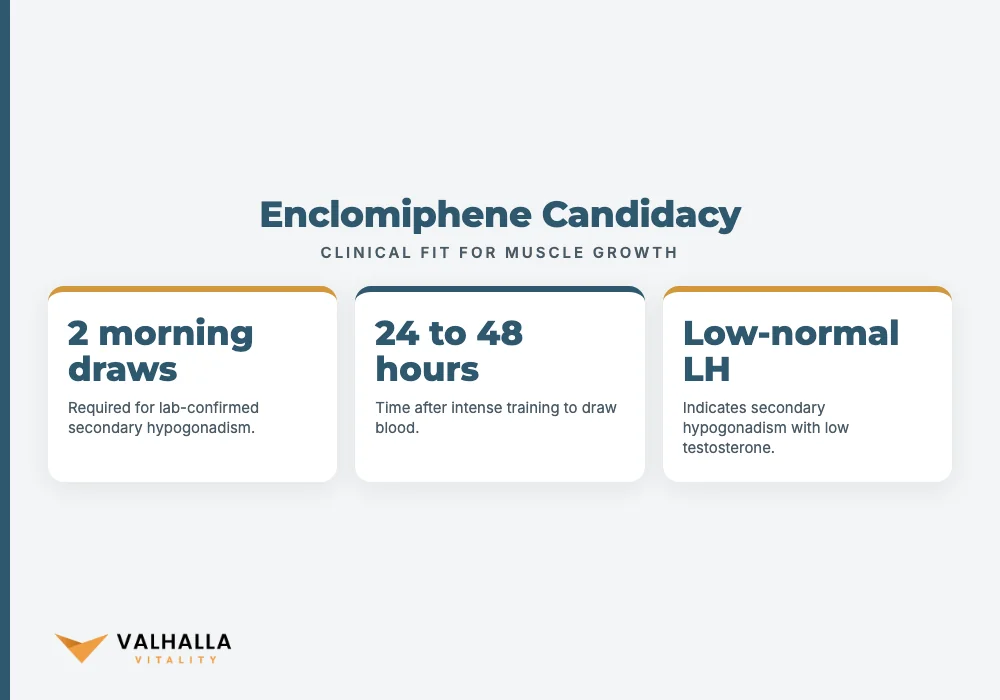
Clinical candidacy for enclomiphene muscle growth therapy is determined by lab results and symptoms, not training goals alone. A strength plateau is not a medical indication. Confirmed secondary hypogonadism is.
Providers reviewing enclomiphene for athletes consider the full clinical picture: symptom burden, lab values across two morning draws, and whether the pattern points to central signaling dysfunction rather than testicular failure. The two-draw requirement is standard because testosterone is pulsatile and a single low reading may reflect sampling variability rather than a true deficit.
Men who train intensively should know that heavy resistance training transiently lowers testosterone and LH. Drawing labs too soon after an intense session may underrepresent true baseline levels. Timing the blood draw on a rest day, or at least 24 to 48 hours after the last hard session, is worth coordinating with the ordering provider.
Men who tend to be appropriate candidates for evaluation:
- Lab-confirmed secondary hypogonadism: low testosterone on two morning draws with LH in the low-normal range
- Symptoms affecting daily function and training: persistent fatigue, reduced motivation, slow recovery, and difficulty building or maintaining lean mass despite consistent resistance training
- Interest in preserving fertility alongside testosterone normalization, since enclomiphene maintains FSH and sperm production where TRT suppresses both
Men for whom enclomiphene is less likely to be appropriate:
- Testosterone within the normal reference range with no symptoms
- High LH with low testosterone, which signals primary hypogonadism where the testes are not responding and enclomiphene cannot compensate
- Clinical presentations that require a different therapeutic approach
Availability varies by state. Providers at Valhalla Vitality review intake information and lab results before determining whether the therapy is warranted. That review is completed within 24 business hours, and if a prescription is issued, delivery from a US compounding pharmacy takes approximately 3 to 7 business days.
Start the conversation with a licensed provider
A licensed provider can review your intake and determine whether enclomiphene is appropriate for your situation. Book Your Consultation to begin that evaluation.
FAQ
Can enclomiphene build muscle if my testosterone is already normal?
Enclomiphene muscle growth effects are clinically relevant only when testosterone is deficient. The drug works by restoring a hormonal deficit, and in men with testosterone in the normal reference range, there is no deficit to correct. Meaningful anabolic effects are unlikely in that population.
How does enclomiphene compare to TRT for men focused on muscle growth?
Both raise testosterone but through different mechanisms. TRT supplies testosterone externally and suppresses the HPG axis, including sperm production. Enclomiphene stimulates endogenous production and keeps LH, FSH, and fertility intact. Men who want both testosterone normalization and fertility preservation typically find enclomiphene a better fit; men with primary hypogonadism may require TRT because enclomiphene cannot compensate for testicular failure.
Does enclomiphene suppress the natural testosterone axis like anabolic steroids do?
No. Enclomiphene activates the HPG axis by removing the hypothalamic suppression signal. Unlike exogenous androgens, which cause LH and FSH to fall and endogenous production to stop, enclomiphene causes both gonadotropins to rise. The testes remain active throughout treatment, and no post-cycle recovery period is required.
What symptoms suggest someone should be evaluated for enclomiphene?
The most relevant symptoms are persistent fatigue, reduced motivation, slow recovery after training, difficulty building or maintaining lean mass, and reduced drive. These overlap with symptoms of low testosterone, and lab confirmation is required before attributing them to hypogonadism. A provider reviews the full clinical picture, not symptoms in isolation.
Is enclomiphene safe for long-term use in men?
Enclomiphene is well tolerated in clinical studies examining men with secondary hypogonadism over the treatment periods studied. Long-term data beyond those windows is still accumulating, and providers factor that context into ongoing monitoring. Common side effects such as mild headaches or hot flashes typically resolve with dose adjustment.
Sources
- Wiehle R, Cunningham GR, Pitteloud N, et al. Testosterone restoration by enclomiphene citrate in men with secondary hypogonadism: a pharmacodynamic and pharmacokinetic study. BJU Int. 2013;112(8):1188–1200.
- Bhasin S, Woodhouse L, Casaburi R, et al. Testosterone dose-response relationships in healthy young men. Am J Physiol Endocrinol Metab. 2001;281(6):E1172–E1181.
- Griggs RC, Kingston W, Jozefowicz RF, Herr BE, Forbes G, Halliday D. Effect of testosterone on muscle mass and muscle protein synthesis. J Appl Physiol. 1989;66(1):498–503.
- Kim ED, Crosnoe L, Bar-Chama N, Khera M, Lipshultz LI. The treatment of hypogonadism in men of reproductive age. Fertil Steril. 2013;103(2):474–479.
You May Also Like
 Enclomiphene
 Before and After: Physical Changes Explained
Enclomiphene before and after: what physical changes to expect, how the results timeline unfolds, and why provider monitoring matters for outcomes.
October 21, 2026 ETRead more → Enclomiphene
 Vision Side Effects: Eye Floaters & More
Enclomiphene vision side effects include eye floaters, blurry vision, and light sensitivity. Know the warning signs and when to contact your provider.
October 21, 2026 ETRead more → Enclomiphene
 Drug Test: Detection, WADA, and Disclosure
Enclomiphene drug test detection depends on the test type. Learn how workplace panels, military screening, and WADA rules treat this SERM.
October 21, 2026 ETRead more →