
The following blog post is for entertainment and informational purposes only. It is not intended to provide medical advice or diagnosis. Please consult your doctor before making any health-related decisions.
The primary enclomiphene benefits are raised testosterone, preserved sperm production, and maintained testicular function. Enclomiphene achieves this by blocking estrogen receptors at the hypothalamus, which prompts the pituitary to release more LH and FSH and drives the testes to produce testosterone naturally. This mechanism keeps the body's own hormone axis intact, a key difference from testosterone replacement therapy that men exploring low-testosterone treatment options should understand before choosing a path. A licensed provider reviews labs and intake before determining whether any therapy is appropriate.
What are enclomiphene benefits for men?
Enclomiphene benefits men with secondary hypogonadism by raising testosterone through natural production rather than external supply. A 2025 systematic review and meta-analysis in Archives of Endocrinology and Metabolism (Hohl et al.) found that enclomiphene and clomiphene citrate significantly raised testosterone and gonadotropin levels in hypogonadal men compared with baseline. Testicular function stayed intact. Sperm production continued. That combination is uncommon among testosterone therapies.
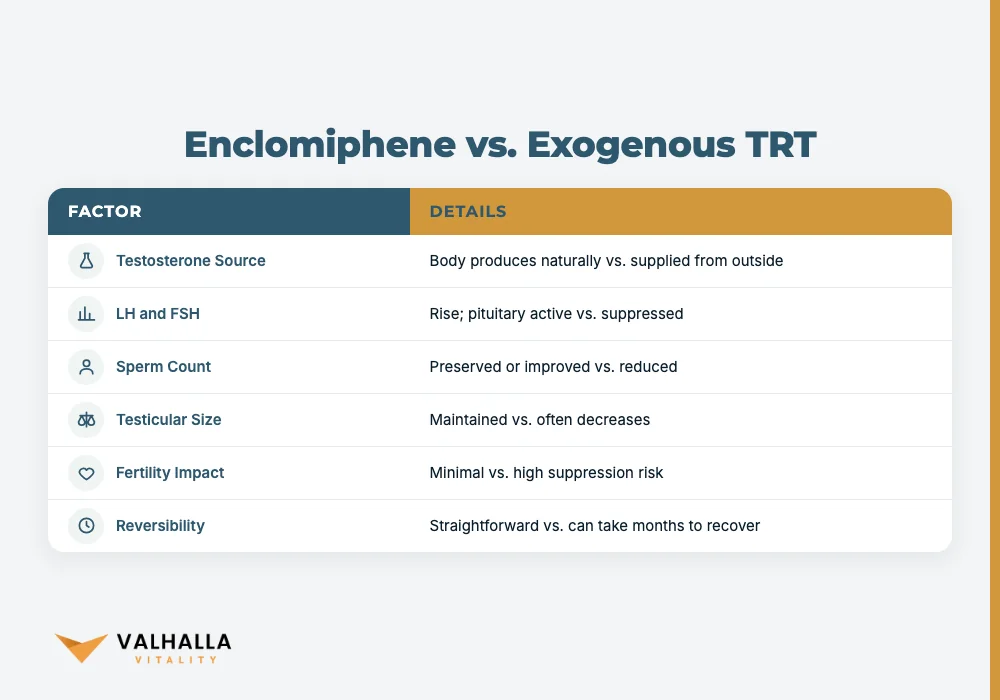
The practical differences between enclomiphene and exogenous TRT are clearest side by side:
| Factor | Enclomiphene | Exogenous TRT |
|---|---|---|
| Testosterone source | Body produces it naturally | Supplied from outside |
| LH and FSH | Rise; pituitary stays active | Suppressed by negative feedback |
| Sperm count | Preserved or improved | Reduced in most men |
| Testicular size | Maintained | Often decreases over time |
| Fertility impact | Minimal | High suppression risk |
| Reversibility | Straightforward after stopping | Can take months to recover |
Individual outcomes depend on baseline labs, the underlying cause of low testosterone, and treatment duration. The table reflects what published clinical literature supports, not a promise of individual results.
How enclomiphene testosterone production works
Enclomiphene is the trans-isomer of clomiphene citrate. It binds to estrogen receptors in the hypothalamus, blocking the negative feedback signal that estrogen normally sends to slow GnRH release. More GnRH means more LH and FSH from the pituitary. More LH tells Leydig cells to produce testosterone. More FSH signals Sertoli cells to support sperm maturation.
Enclomiphene testosterone production stays within physiological range because the feedback loop remains functional; it is shifted, not broken. A 2016 review in Expert Opinion on Pharmacotherapy (Rodriguez et al.) described this axis-preserving mechanism as a specific clinical advantage for secondary hypogonadism, where the problem is insufficient pituitary stimulation rather than testicular failure. The mechanism behind these enclomiphene benefits differs fundamentally from exogenous TRT, which bypasses the axis entirely.
For a deeper look at how enclomiphene works clinically, including its effects on the testosterone-estradiol balance, that overview covers the mechanism in detail.
Does enclomiphene preserve fertility?
Yes. Enclomiphene fertility preservation is one of the clearest separators from exogenous testosterone therapy. A 2025 review in Nature Reviews Urology (Naelitz et al.) confirmed that testosterone replacement therapy suppresses spermatogenesis in the majority of reproductive-age men, with recovery that can be uncertain and prolonged. Enclomiphene works in the opposite direction.
By raising FSH, enclomiphene actively supports spermatogenesis rather than switching it off. The Rodriguez et al. (2016) review noted that enclomiphene's effects are reversible: if a man stops therapy, the HPG axis can resume its prior state. That flexibility matters both clinically and personally.
Exogenous TRT forces a hard choice. Men who want children in the future either accept sperm suppression or delay testosterone treatment. Enclomiphene removes that constraint for many patients. Men in their 30s or 40s who have not yet completed their reproductive plans may find that distinction decisive.
How does enclomiphene compare to TRT?
Enclomiphene vs TRT comes down to mechanism and downstream consequences. Both raise serum testosterone. The methods differ enough to produce meaningfully different outcomes for fertility, hematological markers, and axis function.
Exogenous TRT introduces testosterone from outside the body. Levels typically peak after injection, then fall before the next dose, creating oscillations the body cannot regulate. The 2024 evidence synthesis by Cruickshank et al. in Health Technology Assessment found TRT effective for symptom relief in hypogonadal men but documented effects on red blood cell count, cardiovascular markers, and fertility. A 2022 review in International Journal of Impotence Research (Auerbach et al.) found that the cardiovascular evidence for TRT remains mixed, particularly in men with pre-existing cardiac risk.
Enclomiphene keeps production endogenous. Levels rise more gradually and stay within physiological range. The Hohl et al. (2025) meta-analysis found that enclomiphene raised testosterone without the fertility suppression associated with exogenous TRT. For men comparing enclomiphene and TRT across their full clinical picture, the decision often turns on reproductive goals and symptom severity.
A licensed provider determines the appropriate path after reviewing labs, medical history, and individual goals. Neither option is universally superior.
Enclomiphene benefits for metabolic health
Low testosterone affects more than energy and libido. It is associated with increased visceral fat, reduced lean mass, impaired insulin sensitivity, and unfavorable lipid profiles. These changes often drive men to seek evaluation in the first place.
Enclomiphene benefits in this area come through the same channel as testosterone itself: when hormone levels return toward normal range through natural production, the metabolic downstream effects may follow. The Rodriguez et al. (2016) review documented observations of improved body composition and energy in men treated for secondary hypogonadism. Testosterone influences glucose handling and fat storage, so addressing the hormone deficiency addresses those pathways too.
A provider who reviews full metabolic panels alongside hormone labs can determine whether the metabolic picture supports treatment and what the monitoring plan should include.
Is long-term enclomiphene use safe?
The evidence for long term enclomiphene use draws largely on clomiphene citrate data, since enclomiphene is the active trans-isomer. The Hohl et al. (2025) meta-analysis pooled data from multiple randomized controlled trials and found both compounds generally well tolerated in men. Reported adverse effects included mild visual disturbances, mood changes, and gastrointestinal symptoms. None were severe enough to drive high discontinuation rates in the trials reviewed.
What are the long-term side effects of enclomiphene?
Long-term data past 12 months remain limited. That is a meaningful gap. The Rodriguez et al. (2016) review identified the need for ongoing lab monitoring during treatment, particularly for testosterone, estradiol, and hematological markers. Unlike exogenous TRT, enclomiphene does not raise hematocrit through the same mechanism, removing one common concern from the monitoring checklist. Estradiol levels may rise alongside testosterone, and estradiol management is part of routine clinical oversight.
Enclomiphene citrate long term effects on bone density and cognitive function are less well studied. The Heidelbaugh et al. (2024) review in American Family Physician noted that TRT improves bone density in hypogonadal men; whether enclomiphene produces comparable effects on these endpoints over the same timeframe has not yet been established with the same quality of evidence.
A licensed provider determines the dose after labs and adjusts the approach based on follow-up results. For a full safety breakdown covering how providers track labs and monitor safety markers throughout treatment, that guide covers the monitoring protocol in depth.
Ready to talk through your options
If long term enclomiphene use interests you, Book Your Consultation to have a licensed provider review your intake and labs before any therapy is recommended.
FAQ
What are the main enclomiphene benefits for men?
Enclomiphene benefits include raised testosterone through natural production, preserved sperm count and testicular function, and potential metabolic improvements. It works by stimulating the pituitary to release more LH and FSH rather than supplying testosterone externally, which keeps the HPG axis active.
Is long-term enclomiphene use safe?
Current evidence suggests enclomiphene is generally well tolerated in men, based on randomized controlled trial data reviewed in the Hohl et al. (2025) meta-analysis. Long-term safety data beyond 12 months are limited, and ongoing lab monitoring is standard clinical practice during treatment.
Does enclomiphene preserve fertility?
Yes, enclomiphene fertility preservation is supported by clinical evidence. Because it raises FSH alongside LH, it supports sperm production rather than suppressing it, which distinguishes it from exogenous testosterone replacement therapy in men of reproductive age.
How does enclomiphene compare to TRT?
The central difference in enclomiphene vs TRT is that enclomiphene stimulates the body's own production while TRT replaces testosterone from outside. TRT suppresses spermatogenesis in most men; enclomiphene does not, making it the preferred option for men who want to preserve fertility alongside raising testosterone levels.
What are enclomiphene citrate long term effects on the body?
Enclomiphene citrate long term effects may include stable testosterone within physiological range, maintained testicular size, and improved metabolic markers. A licensed provider reviews labs at follow-up visits and adjusts the regimen based on results.
Sources
- Hohl A et al. (2025). Clomiphene or enclomiphene citrate for the treatment of male hypogonadism: a systematic review and meta-analysis of randomized controlled trials. Archives of endocrinology and metabolism. PubMed
- Rodriguez KM et al. (2016). Enclomiphene citrate for the treatment of secondary male hypogonadism. Expert opinion on pharmacotherapy. PubMed
- Naelitz BD et al. (2025). Testosterone replacement therapy and spermatogenesis in reproductive age men. Nature reviews. Urology. PubMed
- Cruickshank M et al. (2024). The effects and safety of testosterone replacement therapy for men with hypogonadism: the TestES evidence synthesis and economic evaluation. Health technology assessment (Winchester, England). PubMed
- Auerbach JM et al. (2022). Testosterone replacement therapy and cardiovascular disease. International journal of impotence research. PubMed
- Heidelbaugh JJ et al. (2024). Testosterone Replacement Therapy for Male Hypogonadism. American family physician. PubMed
You May Also Like
 Enclomiphene
 Before and After: Physical Changes Explained
Enclomiphene before and after: what physical changes to expect, how the results timeline unfolds, and why provider monitoring matters for outcomes.
October 21, 2026 ETRead more → Enclomiphene
 Vision Side Effects: Eye Floaters & More
Enclomiphene vision side effects include eye floaters, blurry vision, and light sensitivity. Know the warning signs and when to contact your provider.
October 21, 2026 ETRead more → Enclomiphene
 Drug Test: Detection, WADA, and Disclosure
Enclomiphene drug test detection depends on the test type. Learn how workplace panels, military screening, and WADA rules treat this SERM.
October 21, 2026 ETRead more →