
The following blog post is for entertainment and informational purposes only. It is not intended to provide medical advice or diagnosis. Please consult your doctor before making any health-related decisions.
Enclomiphene SHBG dynamics are central to understanding whether this therapy actually delivers more bioavailable testosterone. Enclomiphene blocks estrogen receptors in the hypothalamus, signaling the pituitary to release more LH and FSH, which drives the testes to produce testosterone on their own. Because rising testosterone suppresses SHBG synthesis in the liver, most men on this therapy see SHBG stay flat or decline, with free testosterone rising as a result. For men exploring enclomiphene for low testosterone, tracking SHBG alongside total T is what separates a real hormonal response from a misleading lab number.
Why SHBG matters in male hormone health
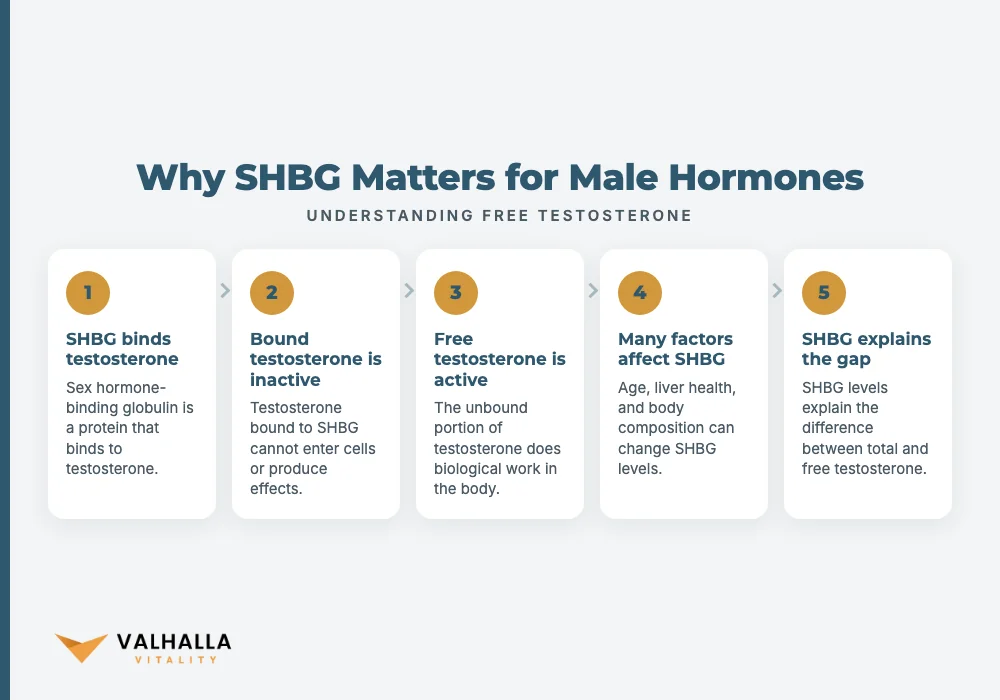
Sex hormone-binding globulin is a protein made in the liver. It circulates in the blood and binds tightly to sex hormones, including testosterone and estrogen. Testosterone bound to SHBG is biologically inactive. It cannot enter cells, activate androgen receptors, or produce any of the physiological effects associated with healthy testosterone levels.
This creates a real clinical problem. A man can have a total testosterone result squarely within the reference range and still experience every symptom of low T, if most of that testosterone is locked onto SHBG. The free testosterone ratio, the fraction not bound to SHBG or albumin, is the portion doing actual biological work. A 2020 meta-analysis in Experimental Gerontology identified free testosterone as one of the strongest circulating biomarkers of physical frailty in aging men, which underscores why SHBG levels in men carry independent clinical weight beyond the total testosterone number.
Several factors push SHBG higher or lower before any medication is considered. Age raises SHBG. Liver health affects how much the organ produces. Thyroid function, insulin sensitivity, and body composition all modulate output. A 2024 individual participant data meta-analysis published in the European Journal of Endocrinology found that higher BMI, alcohol intake, and physical inactivity were independently associated with lower calculated free testosterone concentrations in men, partly through effects on SHBG. A man starting enclomiphene therapy carries his own SHBG baseline, and that baseline shapes how his body responds.
Lab results reflect this complexity. Total testosterone reports what the body produces; free testosterone reports what is biologically available. SHBG levels in men explain the gap between the two. Understanding that gap is the starting point for interpreting any hormone lab on enclomiphene therapy. The relationship between enclomiphene SHBG binding and free testosterone availability is one of the first things a provider considers when evaluating where total T ends and bioavailable T begins.
How enclomiphene LH FSH stimulation connects to SHBG
Enclomiphene is a selective estrogen receptor modulator. It targets estrogen receptors in the hypothalamus and pituitary. Normally, estrogen feeds back onto those receptors and restrains LH and FSH output. Enclomiphene occupies the receptors without activating them, removing that restraint.
The pituitary then releases more LH and FSH. The testes respond to elevated LH by producing testosterone. This is endogenous testosterone production, meaning it comes from the body itself rather than from an external source. That distinction matters for fertility, because the testes remain active and sperm production is generally maintained. It also matters mechanistically for SHBG.
The SHBG connection runs through two channels. First, testosterone directly suppresses SHBG gene expression in liver cells. Higher testosterone translates to lower SHBG output. Second, enclomiphene reduces the functional effect of estrogen at the receptor level. Estrogen is a strong driver of SHBG synthesis in the liver, so blunting estrogen's receptor-mediated signaling may cut SHBG production further. Both pathways point in the same direction.
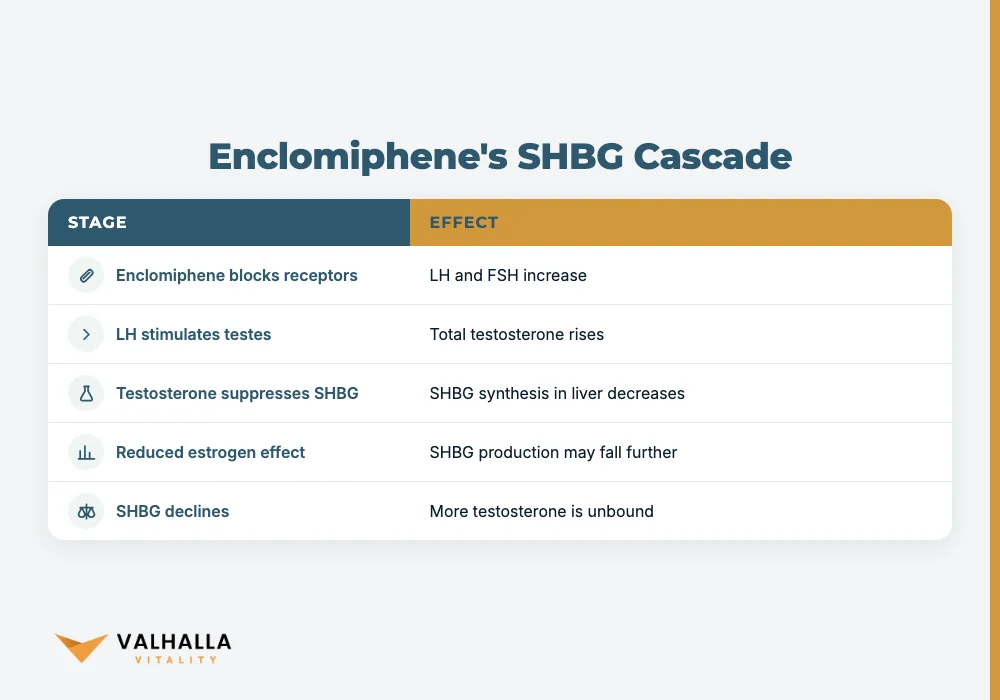
The table below summarizes the cascade.
| Stage | Hormone change | Effect on SHBG and free T |
|---|---|---|
| Enclomiphene blocks hypothalamic estrogen receptors | LH and FSH increase | Estrogen-driven SHBG signal removed |
| Elevated LH stimulates testicular testosterone | Total testosterone rises | Testosterone suppresses hepatic SHBG synthesis |
| Reduced estrogen receptor signaling | Estrogen effect on liver decreases | SHBG production may fall further |
| SHBG declines | More testosterone is unbound | Free testosterone ratio rises |
Understanding this cascade matters because it explains why total testosterone and free testosterone can diverge significantly on enclomiphene therapy. A man might see total T climb substantially while free T gains less than expected, if SHBG holds steady rather than declining. That difference is clinically meaningful. It determines whether the therapy is achieving the bioavailability goal, not just hitting a total testosterone number on a lab report. Recognizing this cascade is why enclomiphene SHBG tracking cannot be reduced to a single lab value, the full picture requires seeing how each hormone level is changing relative to the others.
Does enclomiphene increase or decrease SHBG?
Enclomiphene generally decreases SHBG or holds it flat, rather than raising it. That is the expected direction given the dual mechanism above. Clinical experience with enclomiphene testosterone production consistently shows this pattern across men with secondary hypogonadism.
The word "generally" carries real weight. Individual results vary, and several factors can interrupt the expected pattern. A man with undiagnosed hypothyroidism, significant liver dysfunction, or persistent estrogen elevation may see SHBG hold stubbornly high even as total testosterone rises. Some men show only modest SHBG reduction but still gain meaningfully in free testosterone, because any increase in total T improves the free testosterone ratio even when SHBG does not fall.
Conversely, SHBG can drop more sharply in men who begin therapy with elevated SHBG and a long-standing compensated LH pattern, because the estrogen-blocking effect amplifies the suppressive action of rising testosterone on the liver. This individual variability in the enclomiphene SHBG response is precisely why a provider-reviewed lab panel is more informative than total testosterone alone. The conclusion: total testosterone alone cannot confirm whether enclomiphene SHBG dynamics are trending correctly. A complete lab panel is the only way to see the full hormonal picture.
How does enclomiphene affect free testosterone levels?
Enclomiphene typically raises free testosterone through two compounding effects: more total testosterone entering circulation and less SHBG available to bind it. Both changes together expand the free testosterone ratio more than either would achieve separately.
A 2024 paper in Current Opinion in Endocrinology, Diabetes, and Obesity emphasized that calculated free testosterone captures a dimension of androgen status that total testosterone alone cannot reflect, especially in men where SHBG concentrations vary widely. When SHBG is high, total T overstates actual bioavailable hormone. When SHBG is declining on therapy, free T becomes the accurate signal of whether treatment is working.
Enclomiphene works upstream, at the hypothalamic-pituitary level, rather than supplying testosterone from an external source. By driving enclomiphene LH FSH stimulation and keeping the hypothalamic-pituitary-gonadal axis intact, it allows the body to regulate the process itself. This typically produces a proportionate change in the free testosterone ratio rather than a sudden spike. For a detailed look at how enclomiphene modulates estrogen during this process, the interplay between receptor blockade and SHBG synthesis is covered there.
Lifestyle factors do not stop influencing free testosterone once treatment begins. The same 2024 meta-analysis by Narinx et al. showed that BMI, alcohol consumption, and physical activity level independently affected free testosterone concentrations in men, even after accounting for total T. Men who address modifiable factors alongside therapy may see a more favorable enclomiphene SHBG outcome than those who do not.
What SHBG levels are normal during enclomiphene therapy?
There is no single target SHBG value on enclomiphene therapy. Reference ranges vary by laboratory, assay method, and age. What matters more than reaching a fixed number is the trajectory: is SHBG trending in the right direction relative to total T and free T?
Calculated free testosterone, derived from total T and SHBG using a validated formula, is often more practical than direct measurement because it integrates both variables in one number. A 2024 review in Current Opinion in Endocrinology, Diabetes, and Obesity noted that calculated free testosterone performs well in clinical settings where direct immunoassay measurement of free T is less reliable. Providers typically use calculated free T alongside SHBG and total T to evaluate the full hormonal response to enclomiphene.
Tracking enclomiphene SHBG trends across consecutive lab draws gives providers the context they need to distinguish a trajectory problem from normal early-treatment fluctuation. Providers flag two patterns during lab review. First, SHBG that stays elevated despite rising total testosterone suggests that free T may not be improving as much as the headline number implies. Second, SHBG that falls very low can shift the androgen-to-estrogen balance and may warrant a closer look at estradiol. Neither scenario calls for patient self-adjustment. A licensed provider determines whether any lab change requires a response after reviewing the full panel.
The broader relevance of SHBG extends beyond testosterone availability. A 2025 systematic review and dose-response meta-analysis in the Journal of Clinical Endocrinology and Metabolism found that both high and low SHBG concentrations were independently associated with all-cause mortality risk in prospective cohort data, reinforcing that SHBG is not simply a secondary variable in male hormone health. SHBG levels in men are always interpreted in context, not in isolation.
Can enclomiphene lower SHBG while raising total testosterone?
Yes. This is the expected outcome for most men responding to therapy. Enclomiphene testosterone production increases endogenous output, testosterone suppresses SHBG, and the combined effect expands the free testosterone ratio more than total T alone would suggest.
This is also what makes enclomiphene mechanistically distinct from exogenous testosterone protocols. Adding testosterone from outside the body suppresses the hypothalamic-pituitary-gonadal axis and changes how downstream signals behave, including SHBG. Enclomiphene preserves the axis, so SHBG changes occur within a more physiologically integrated hormonal response. For more on how enclomiphene compares with clomiphene and how each affects hormonal markers differently, that comparison is covered there.
Co-occurring conditions can complicate this pattern. Obesity influences SHBG in complex ways depending on insulin resistance, liver fat, and degree of metabolic dysfunction. A 2021 meta-analysis in the Surgery for Obesity and Related Diseases found that bariatric surgery substantially raised SHBG in men with obesity, illustrating how dramatically body composition affects this protein. Men who begin enclomiphene therapy with significant metabolic overlap may see a more variable enclomiphene SHBG response than men whose primary issue is isolated secondary hypogonadism. When co-occurring metabolic conditions are present, closer monitoring intervals are typically warranted because the enclomiphene SHBG interaction is less predictable.
Should I Monitor Enclomiphene SHBG While on This Therapy?
Yes, consistently. Monitoring SHBG during treatment is standard practice because total testosterone alone does not confirm that more bioavailable hormone is reaching target tissues.
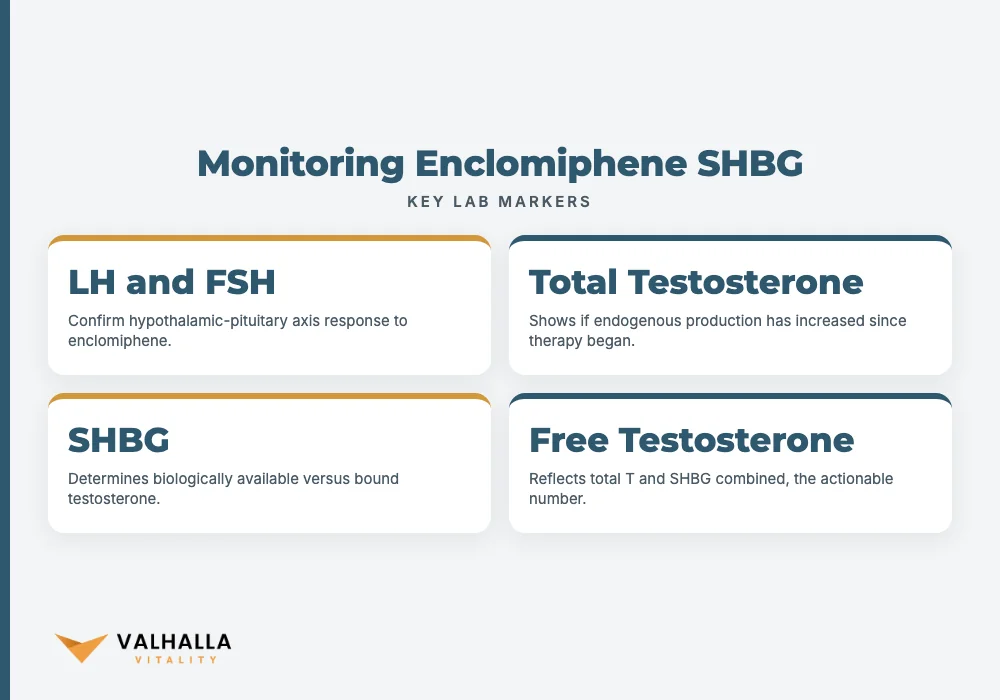
A complete lab panel for enclomiphene therapy typically includes total testosterone, free testosterone (calculated or direct), SHBG, estradiol, LH, and FSH. Each marker answers a distinct clinical question:
- LH and FSH confirm that the hypothalamic-pituitary axis is responding to enclomiphene's receptor-blocking effect.
- Total testosterone shows whether endogenous production has increased since therapy began.
- SHBG determines how much of that total testosterone is biologically available versus bound and inactive.
- Free testosterone reflects the net result of total T and SHBG combined, which is the clinically actionable number.
- Estradiol confirms that estrogen is not rising disproportionately to testosterone, which would drive SHBG higher and blunt the free testosterone benefit.
When providers review these markers together, they look for total testosterone rising as expected, SHBG stable or declining, free testosterone ratio improving, estradiol proportionate to testosterone, and LH and FSH elevated above the pre-treatment baseline, confirming enclomiphene LH FSH stimulation is active.
When the expected SHBG response does not occur
Some men see total testosterone climb while SHBG holds steady or even rises. This happens when estradiol increases significantly alongside testosterone. Aromatization converts a portion of newly produced testosterone into estrogen, and estrogen then stimulates SHBG production in the liver, partially blunting the free testosterone gain.
In these cases, estrogen management may become part of the treatment plan. Enclomiphene functions as an enclomiphene estrogen blocker at the receptor level in the hypothalamus, but it does not reduce circulating estrogen concentrations the way an aromatase inhibitor does. When aromatization runs high, receptor-level blockade alone may not prevent rising estradiol from driving SHBG upward. A licensed provider reviews the full lab panel to determine whether any adjustment is warranted.
Monitoring frequency follows individual lab results, not a fixed interval. A licensed provider sets the schedule based on where numbers land and how quickly the hormonal picture stabilizes. For more detail on what lab monitoring during enclomiphene treatment involves, the safety and tracking protocol is covered there alongside the full side-effect profile.
Ready to talk to a provider?
If your hormone labs are unclear or you want a structured evaluation of how enclomiphene SHBG dynamics may apply to your situation, a provider consultation is the right starting point. Book Your Consultation to connect with a licensed provider who can review your intake and determine whether this therapy may be appropriate for you.
FAQ
Does enclomiphene raise SHBG?
Enclomiphene generally does not raise SHBG. The therapy typically holds SHBG flat or lowers it, because rising testosterone suppresses SHBG production in the liver and blunted estrogen receptor signaling removes a key driver of SHBG synthesis. Individual responses vary based on baseline hormone levels, liver health, and metabolic status.
How is free testosterone different from total testosterone?
Total testosterone measures all testosterone in the blood, including the fraction bound to SHBG and albumin, which is biologically inactive. Free testosterone is the unbound portion that can enter cells and produce hormonal effects. When SHBG is elevated, total T can appear normal while free T is meaningfully low.
What happens if SHBG stays high during enclomiphene therapy?
If SHBG remains elevated despite rising total testosterone, gains in free testosterone may be limited. A provider will typically review estradiol, assess contributing factors such as thyroid function or body composition, and determine whether any change to the treatment plan is warranted. This pattern, a blunted enclomiphene SHBG response, is more common in men with significant metabolic comorbidities or unaddressed thyroid dysfunction.
Can lifestyle changes affect SHBG during treatment?
Yes. Body weight, alcohol consumption, and physical activity independently influence SHBG and free testosterone concentrations in men, according to a 2024 individual participant data meta-analysis in the European Journal of Endocrinology. Addressing modifiable factors alongside enclomiphene therapy may support a more favorable SHBG response.
Why do providers measure both SHBG and free testosterone?
Measuring both markers gives a more complete picture of androgen status. SHBG shows how much testosterone is biologically inactive, while free testosterone reflects what is actually available to tissues. Tracking both allows a provider to confirm whether a change in total testosterone has translated into a meaningful change in bioavailable hormone.
Sources
- Mailliez A et al. (2020). Circulating biomarkers characterizing physical frailty: CRP, hemoglobin, albumin, 25OHD and free testosterone as best biomarkers. Results of a meta-analysis. Experimental Gerontology. PubMed
- Narinx N et al. (2024). Sociodemographic, lifestyle, and medical factors associated with calculated free testosterone concentrations in men: individual participant data meta-analyses. European Journal of Endocrinology. PubMed
- Raeisi-Dehkordi H et al. (2025). Endogenous Sex Steroid Hormones, Sex Hormone-Binding Globulin, and Risk of All-Cause and Cause-Specific Mortality: A Systematic Review and Dose-Response Meta-Analysis of Prospective Cohort Studies. The Journal of Clinical Endocrinology and Metabolism. PubMed
- Nyamaah JA et al. (2024). Use of calculated free testosterone in men: advantages and limitations. Current Opinion in Endocrinology, Diabetes, and Obesity. PubMed
- Emami MR et al. (2021). Effect of bariatric surgery on endogenous sex hormones and sex hormone-binding globulin levels: a systematic review and meta-analysis. Surgery for Obesity and Related Diseases. PubMed
You May Also Like
 Enclomiphene
 Before and After: Physical Changes Explained
Enclomiphene before and after: what physical changes to expect, how the results timeline unfolds, and why provider monitoring matters for outcomes.
October 21, 2026 ETRead more → Enclomiphene
 Vision Side Effects: Eye Floaters & More
Enclomiphene vision side effects include eye floaters, blurry vision, and light sensitivity. Know the warning signs and when to contact your provider.
October 21, 2026 ETRead more → Enclomiphene
 Drug Test: Detection, WADA, and Disclosure
Enclomiphene drug test detection depends on the test type. Learn how workplace panels, military screening, and WADA rules treat this SERM.
October 21, 2026 ETRead more →