
The following blog post is for entertainment and informational purposes only. It is not intended to provide medical advice or diagnosis. Please consult your doctor before making any health-related decisions.
Enclomiphene shelf life is typically one to two years from the manufacturing date when the medication is stored under manufacturer-specified conditions. Solid forms hold up longer than liquid solutions. Capsules and tablets resist moisture and temperature shifts more reliably, which makes them the standard formulation at most compounding pharmacies. For broader context on what this compound does, see the role of enclomiphene citrate in men's hormone health, or Book Your Consultation to discuss your treatment timeline with a licensed provider.
What affects enclomiphene shelf life?
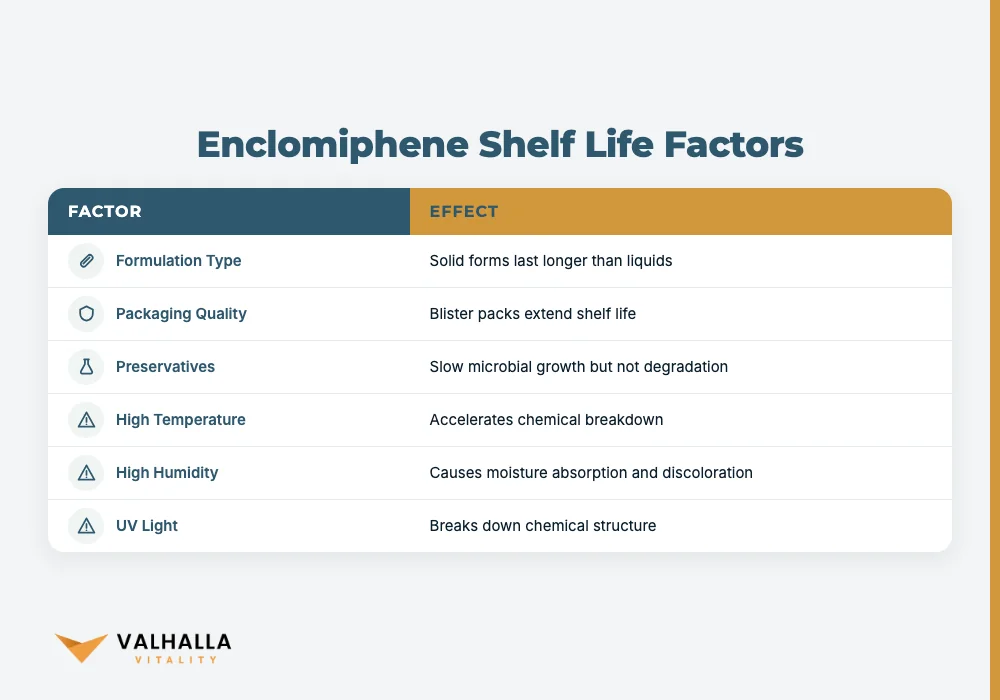
Enclomiphene shelf life is shaped by formulation type, packaging quality, and the storage environment. The table below summarizes the main variables and their effect on stability.
| Factor | Effect on stability |
|---|---|
| Formulation (tablets/capsules vs. liquid) | Solid forms last longer; liquid forms degrade more quickly |
| Packaging (blister pack vs. open bottle) | Blister packs extend shelf life by limiting light and moisture |
| Preservatives in liquid forms | May slow microbial growth; do not prevent eventual degradation |
| Temperature above 77°F (25°C) | Accelerates chemical breakdown of active ingredients |
| High humidity | Causes moisture absorption, softening, and discoloration in tablets |
| UV light exposure | Breaks down the compound's chemical structure over time |
Formulation
The physical form of a medication determines how well it resists environmental stress. Tablets and capsules create a barrier that limits contact between the active compound and air, moisture, and light. That barrier directly protects it.
Liquid enclomiphene is exposed to those stressors more directly. It degrades faster. Without adequate preservatives, liquid formulations may lose meaningful potency well before the labeled expiration date.
Packaging and preservatives
Sealed original packaging is the first line of defense for enclomiphene storage. Blister packs provide an individual barrier around each dose and extend usable life compared to open bottles. Accessing a container repeatedly introduces air and humidity with every opening.
Liquid vials should stay in their original container, sealed tightly and stored upright. Preservatives in liquid formulations can slow microbial growth but do not make unlimited enclomiphene shelf life possible.
Does enclomiphene need to be refrigerated?
No. Standard enclomiphene storage does not require refrigeration. Manufacturer guidelines typically specify room temperature between 68°F and 77°F (20°C to 25°C). Refrigerating capsules or tablets creates a condensation risk each time the container moves between cold and warm air, and repeated moisture exposure can degrade the tablet coating over time.
Freezing liquid solutions can damage formulation stability. Unless a dispensing pharmacy or licensed provider specifically recommends enclomiphene refrigeration for your formulation, a cool, dry, dark cabinet at room temperature is the appropriate enclomiphene storage location.
How long does enclomiphene last?
Enclomiphene shelf life runs approximately one to two years from the manufacturing date under optimal conditions. That window reflects confirmed potency and purity. Exact duration varies by formulation type, packaging, and whether liquid versions contain preservatives.
The expiration date on the packaging is the most reliable reference. Potency does not drop off overnight. It declines gradually, which means a compound approaching its enclomiphene expiration date may have already lost measurable activity, particularly when storage conditions have been inconsistent.
For men exploring how enclomiphene addresses testosterone concerns, the compound's stability window matters for supply planning within a provider-supervised treatment timeline.
Does enclomiphene expire?
Yes. Every supply of enclomiphene carries a manufacturer-stamped expiration date that marks the end of the confirmed potency and safety window. After that point, the manufacturer no longer confirms the compound meets labeled specifications. Managing enclomiphene shelf life means tracking this date and discarding any supply that has passed it.
Expired enclomiphene potency is lower and less predictable than fresh product. Do not continue using a supply past its enclomiphene expiration date.
What happens if you take expired enclomiphene?
Using expired enclomiphene introduces two practical concerns. First, reduced efficacy: degraded active ingredients may not produce the hormonal response a licensed provider expects when reviewing a treatment plan. The therapeutic response becomes unpredictable.
Second, some compounds break down into byproducts with unknown effects as they degrade. The evidence for specific harm from expired enclomiphene is limited, but using a compound with uncertain potency in a hormone-sensitive context carries real risk. Contact your dispensing pharmacy or licensed provider if you are uncertain whether your current supply is still within its usable period.
How to store enclomiphene properly
Proper enclomiphene storage is the most direct way to protect it. The right environment limits exposure to the main degradation drivers: heat, humidity, light, and air.
How should enclomiphene capsules be stored?
Store capsules at room temperature, between 68°F and 77°F (20°C to 25°C), in a dry location away from moisture. Bathrooms and kitchen surfaces near appliances are poor choices because heat and steam vary widely in those areas.
Keep the container sealed between uses and away from windowsills or any surface that receives direct sunlight. A bedroom drawer or medicine cabinet away from exterior walls typically provides a stable, low-humidity environment.
For liquid forms, keep the vial sealed, stored upright, and in its original packaging away from light. Always check the compounding pharmacy label for any formulation-specific enclomiphene storage instructions, since requirements can differ between preparations.
Recognizing an expired enclomiphene supply
Always check the enclomiphene expiration date on the packaging before each use. Physical signs of degradation include discoloration, changes in tablet or capsule texture, and any unfamiliar smell. Softened or crumbling tablets suggest moisture exposure. Liquid solutions that appear cloudy, separated, or off-color should not be used, regardless of the date on the label.
Do not estimate potency from appearance alone. Dispose of expired or compromised product through a licensed take-back program or pharmacy disposal service. Most localities have established rules on medication disposal; many pharmacies offer return programs. Do not flush unused medication or place it in household trash.
For a broader look at treatment monitoring and ongoing care in enclomiphene therapy, a licensed provider oversees the full process, including when a fresh supply is appropriate.
Ready to discuss enclomiphene with a licensed provider?
A licensed provider reviews your intake and lab results to determine whether enclomiphene therapy is appropriate for your situation. Availability varies by state.
FAQ
Does enclomiphene expire?
Yes. Every enclomiphene supply carries a manufacturer-stamped expiration date marking the end of the confirmed potency and safety window. After that date, the compound may have lost measurable activity and should not be used.
How long does enclomiphene last?
Enclomiphene shelf life is generally one to two years from the manufacturing date when stored at room temperature under manufacturer-specified conditions. The exact duration depends on formulation type and packaging.
Does enclomiphene need to be refrigerated?
Standard enclomiphene storage does not require refrigeration. Keeping capsules or tablets in a cool, dry, dark location between 68°F and 77°F (20°C to 25°C) is adequate for most formulations.
What happens if you take expired enclomiphene?
Expired enclomiphene potency is unreliable because active ingredients degrade after the expiration date. Using it may result in a weaker-than-expected hormonal response and potential exposure to degradation byproducts.
How should enclomiphene capsules be stored?
Keep capsules in their original, sealed container at room temperature, away from moisture, heat, and direct sunlight. Avoid bathrooms and kitchens, where temperature and humidity fluctuate most.
Sources
- International Council for Harmonisation (ICH). Q1A(R2): Stability Testing of New Drug Substances and Products. ICH Harmonised Guideline, 2003.
- U.S. Pharmacopeia (USP). General Chapter <659>: Packaging and Storage Requirements. USP-NF, current edition.
- U.S. Food and Drug Administration. Disposal of Unused Medicines: What You Should Know. FDA Consumer Update.
You May Also Like
 Enclomiphene
 Before and After: Physical Changes Explained
Enclomiphene before and after: what physical changes to expect, how the results timeline unfolds, and why provider monitoring matters for outcomes.
October 21, 2026 ETRead more → Enclomiphene
 Vision Side Effects: Eye Floaters & More
Enclomiphene vision side effects include eye floaters, blurry vision, and light sensitivity. Know the warning signs and when to contact your provider.
October 21, 2026 ETRead more → Enclomiphene
 Drug Test: Detection, WADA, and Disclosure
Enclomiphene drug test detection depends on the test type. Learn how workplace panels, military screening, and WADA rules treat this SERM.
October 21, 2026 ETRead more →