
The following blog post is for entertainment and informational purposes only. It is not intended to provide medical advice or diagnosis. Please consult your doctor before making any health-related decisions.
Cycloastragenol supplement is a bioactive compound extracted from the roots of Astragalus membranaceus, a plant central to traditional Chinese herbal medicine for centuries. Research suggests it may support healthy aging by activating telomerase, the enzyme associated with maintaining telomere length during cell division. Short telomeres are linked to accelerated biological aging. Research keeps advancing. If you are evaluating a telomere-lengthening supplement option, understanding what this compound does and what the evidence actually shows is the practical starting point.
What is cycloastragenol used for?
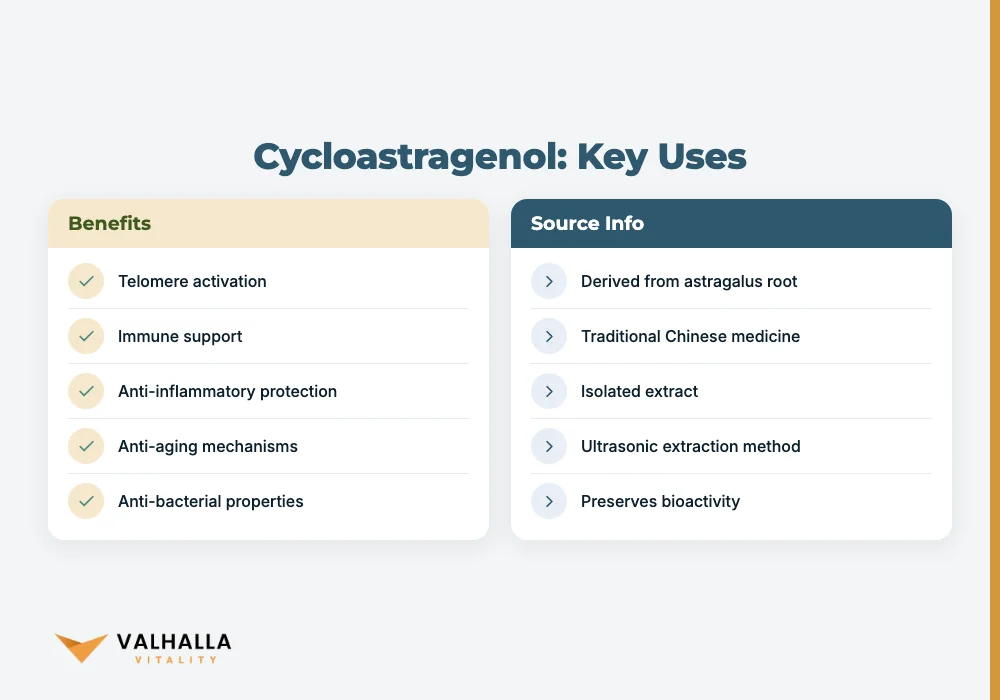
Cycloastragenol is used primarily for telomere activation, immune support, and anti-inflammatory protection. A 2017 review in the British Journal of Pharmacology by Shen et al. identified cycloastragenol among the active compounds from traditional Chinese herbal medicine with documented anti-ageing pharmacological mechanisms, including telomerase activation and anti-inflammatory action. The evidence holds up.
Beyond anti-aging, the original plant source carries a long record in traditional medicine for anti-bacterial, anti-hypersensitive, anti-stress, and diuretic properties. Cycloastragenol, as an isolated extract, concentrates these properties in a more measurable form. It is derived specifically from astragalus root extract (Astragalus membranaceus), a plant whose active compounds require careful extraction to preserve bioactivity.
| Property | What research suggests |
|---|---|
| Primary application | Telomerase activation |
| Botanical source | Astragalus membranaceus root |
| Traditional background | Chinese herbal medicine |
| Extraction method | Ultrasonic technique |
| Documented mechanisms | Anti-inflammatory, antioxidant, telomere support |
Extraction precision is not a minor detail. Astragalus root contains many active phytochemicals alongside cycloastragenol, and isolating the compound without degrading it requires controlled methodology. The ultrasonic extraction technique uses mechanical vibration rather than heat to cut through plant cell walls, producing faster processing, higher yield, and preserved bioactivity. For a closer look at how astragalus root compounds are extracted and isolated, that process is covered in a dedicated review.
Cycloastragenol benefits: what the research shows
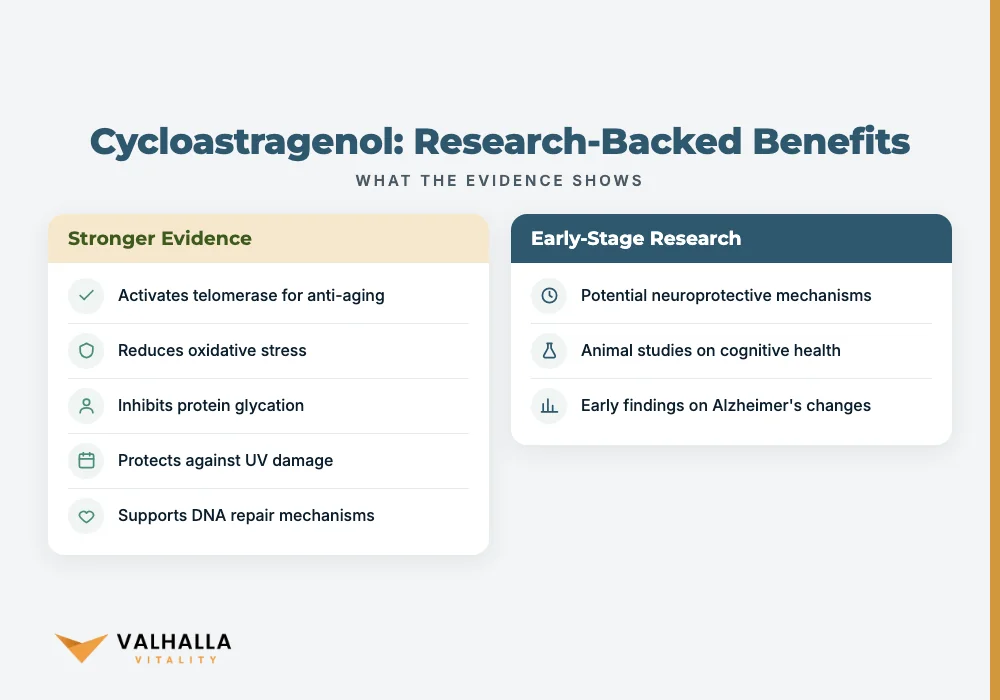
The cycloastragenol benefits recorded in preclinical research span several biological pathways. This is not a compound with a single narrow function. Anti-aging, immune support, and neuroprotective mechanisms all appear in the evidence base, though with varying levels of human data behind each.
Telomere activation and anti-aging
Cycloastragenol supplement appears to activate telomerase, which may slow the natural shortening of telomeres that occurs with each cell division. Telomeres are the protective caps at the ends of chromosomes, and their gradual erosion is one of the biological processes associated with aging. Preclinical studies show that cells treated with cycloastragenol demonstrated improved nutrient absorption and measurable changes in telomere-related markers.
The research also points to three additional anti-aging mechanisms beyond telomerase activation. These include reducing oxidative stress, inhibiting protein glycation, and protecting cells against UV-induced damage. That last point matters for people who spend significant time outdoors, since UV radiation accelerates cellular aging at a structural level. UV damage compounds fast.
Immune system support
Research links cycloastragenol to stimulation of DNA repair mechanisms, which may support broader immune function. When cells repair DNA damage efficiently, the immune system can operate from a healthier baseline. Repair efficiency counts. This connection extends the compound's relevance beyond anti-aging into general wellness for adults focused on long-term health maintenance.
Cognitive health
Animal studies have explored cycloastragenol's potential role in reducing neurodegenerative changes associated with Alzheimer's disease. These findings are early-stage. They do not support claims that cycloastragenol supplement prevents or treats Alzheimer's in people, but they point toward a biologically plausible neuroprotective direction worth further investigation.
Anti-inflammatory and antimicrobial properties
Astragalus membranaceus has a well-documented record in traditional Chinese herbal medicine for anti-inflammatory, anti-bacterial, and anti-stress activity. Shen et al. (2017) confirmed these mechanisms pharmacologically in their review of herbal anti-ageing compounds, providing modern scientific grounding for those traditional applications. As a refined extract, cycloastragenol concentrates these properties in a standardized, isolated form.
Preclinical cancer findings related to cycloastragenol are covered separately for those interested in that specific line of evidence.
Does cycloastragenol actually lengthen telomeres?
In cell-based studies, the answer is directionally yes. In broad human populations, the picture is more limited. Laboratory research shows that cells exposed to cycloastragenol supplement demonstrated telomere-related activity consistent with telomerase engagement. The mechanism is biologically plausible. It has been reproduced in multiple preclinical settings.
Human clinical trials are smaller and fewer. More studies are needed. No large randomized controlled study has confirmed sustained telomere lengthening across a general adult population. This distinction matters when evaluating any telomere lengthening supplement: preclinical evidence establishes biological plausibility, while human trials establish clinical relevance. Right now, the evidence base supports the former more strongly than the latter.
Telomerase activity also varies by cell type, age, and individual health. Two people taking the same cycloastragenol supplement may respond differently because of differences in their underlying biology. A licensed provider can run relevant labs before recommending a telomere-focused supplement approach, giving the decision clinical grounding rather than relying on general population averages.
What is the recommended cycloastragenol dosage?
A licensed provider determines the appropriate cycloastragenol dosage after reviewing your health history and relevant lab results. No universal amount applies across all adults. Age, existing health conditions, current medications, and individual metabolic response each influence what is appropriate for a specific person.
Preclinical research established dose parameters in cell-culture and animal models. Translating those parameters directly into human supplementation requires clinical judgment, not a formula. Dose recommendations found on product labels reflect manufacturing conventions. The gap between published research and a personalized protocol is where a provider review adds genuine value.
Needs may also shift over time. A dose appropriate at one stage of health may not remain the best choice as your health profile evolves. The right starting point is a direct clinical conversation, not a number from a label or a general website.
What are the side effects of cycloastragenol?
Cycloastragenol side effects were examined across a comprehensive set of endpoints in preclinical studies. Tracked measures included clinical observations, body weight, food intake, eye exams, urinalyses, hematology, clinical chemistry, pathology, gross organ weights, and histopathology. No adverse effects were detected across any of these measures. That is a meaningful safety baseline.
Preclinical safety data, however, does not capture every scenario in a diverse human population. Pregnant or nursing individuals should avoid cycloastragenol supplement use, as adequate safety data does not exist for those groups. Adults taking prescription medications should consult a provider before adding any new supplement to their regimen.
Published human studies have not flagged serious adverse reactions. Cycloastragenol reviews in the research literature describe the compound as well-tolerated across the populations studied. A clean preclinical safety record is reassuring, but it does not address every individual scenario, particularly for those with complex health histories.
For a thorough review of what clinical studies reveal about cycloastragenol tolerance, risks, and contraindications, the complete safety picture is covered in a dedicated article.
How does cycloastragenol compare to astragaloside IV?
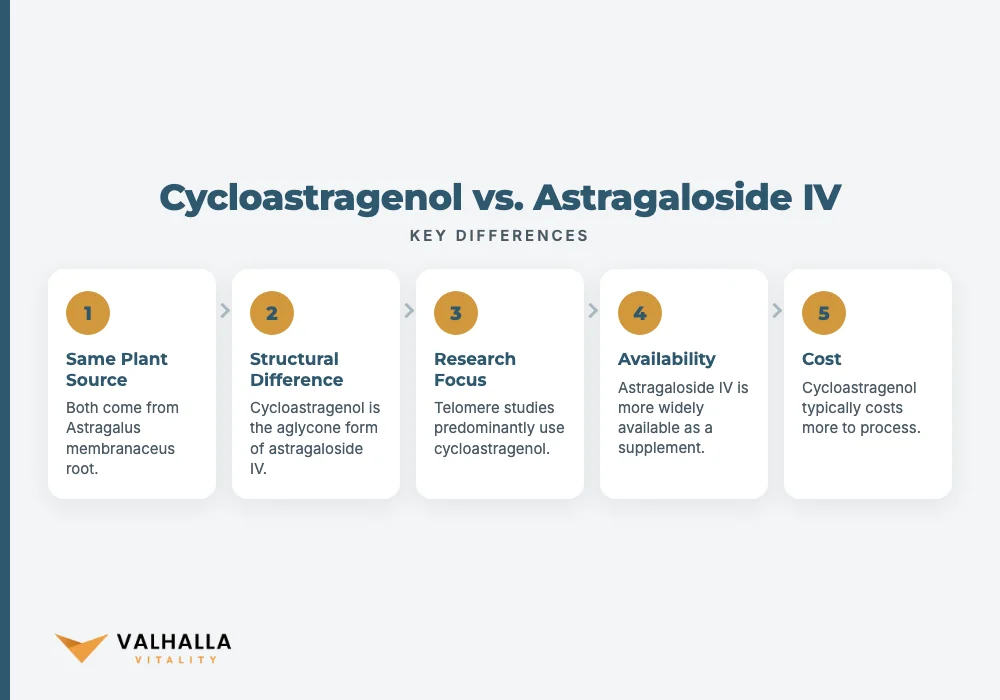
Both cycloastragenol and astragaloside IV come from Astragalus membranaceus root, and both appear in the anti-aging research literature. The key structural difference: cycloastragenol is the aglycone form of astragaloside IV, meaning the attached sugar molecule has been cleaved during processing, leaving the base compound behind. Structure shapes function.
Key differences between the two:
- Source: both derived from Astragalus membranaceus root extract
- Structure: cycloastragenol is the de-glycosylated (aglycone) form of astragaloside IV
- Availability: astragaloside IV is more widely available in supplement form
- Research focus: telomere and telomerase studies predominantly use cycloastragenol specifically
- Cost: cycloastragenol typically costs more due to additional isolation and processing steps
This distinction matters when evaluating cycloastragenol vs astragaloside IV for telomere applications. Most published research on telomerase activation has specifically used cycloastragenol, not astragaloside IV. The two are not interchangeable in that research context, and efficacy claims from one do not automatically transfer to the other. A provider familiar with both compounds can help you weigh the trade-offs based on your goals and current bloodwork.
Youthavar: cycloastragenol supplement from Valhalla Vitality
Youthavar is Valhalla Vitality's cycloastragenol supplement, formulated to deliver the compound in a quality-controlled format aligned with the anti-aging and telomere-support properties the research covers. All supporting ingredients are chosen with safety in mind alongside the primary active compound. The formulation targets adults looking to support long-term cellular health within a supervised context.
Youthavar is designed for adults who are not pregnant or nursing and who have reviewed its use with a licensed provider. Availability varies by state. A provider reviews your intake to confirm whether this supplement is appropriate for your individual health profile.
Ready to explore your options?
When you are ready to explore whether a cycloastragenol supplement fits your health and longevity goals, Book Your Consultation to connect with a licensed provider who can review your intake.
FAQ
What is cycloastragenol used for?
Cycloastragenol supplement is used for telomere activation, immune support, and anti-inflammatory protection. Research suggests it works through multiple pathways, including telomerase activation and oxidative stress reduction, with the strongest evidence coming from preclinical and cell-based studies.
What is the recommended cycloastragenol dosage?
No single dose applies across all adults. A licensed provider determines the appropriate cycloastragenol dosage after reviewing your health history and lab results, since individual factors such as age and existing health conditions influence what is appropriate.
Does cycloastragenol actually lengthen telomeres?
Cell-based studies show cycloastragenol can activate telomerase and influence telomere-related markers. Human clinical trials are limited in scale, so broad conclusions about telomere lengthening across general adult populations are not yet fully supported by the evidence base.
What are the side effects of cycloastragenol?
Preclinical safety studies tracked a wide range of endpoints and found no adverse effects. Human data is more limited, and pregnant or nursing individuals should not use cycloastragenol supplement without medical supervision.
How does cycloastragenol compare to astragaloside IV?
Both compounds come from Astragalus membranaceus root, but cycloastragenol is the aglycone form of astragaloside IV. Most telomere-focused research has specifically studied cycloastragenol, and the two are structurally distinct compounds that are not interchangeable based on current evidence.
Sources
- Shen CY et al. (2017). Anti-ageing active ingredients from herbs and nutraceuticals used in traditional Chinese medicine: pharmacological mechanisms and implications for drug discovery. British Journal of Pharmacology. PubMed
You May Also Like
 Cycloastragenol
 Side Effects: Safety, Risk, and Use
Cycloastragenol side effects are minimal in current research, but data is limited. Learn about TA-65 safety, benefits, and dosage guidance.
October 31, 2026 ETRead more → Cycloastragenol
 cancer research: what the evidence shows
Cycloastragenol cancer research explores how astragalus saponins may influence telomeres and immune function. Discover what current science shows.
October 30, 2026 ETRead more → Cycloastragenol
 Supplement: Benefits and How It Works
Cycloastragenol is an anti-aging telomere supplement that may activate telomerase and slow cellular aging. Discover how this astragalus extract works.
October 28, 2026 ETRead more →