
The following blog post is for entertainment and informational purposes only. It is not intended to provide medical advice or diagnosis. Please consult your doctor before making any health-related decisions.
Curcumin absorption is the defining variable in whether any turmeric supplement does anything measurable. Delivery is everything. Without an effective delivery system, the body clears curcumin so rapidly that almost none reaches the tissues where its anti-inflammatory effects are needed. If you are building a longevity supplement protocol, this is the problem to solve first, because every other decision about curcumin depends on it.
Why is curcumin poorly absorbed by the body?
Curcumin is fat-soluble and chemically unstable in the digestive environment. It breaks down in the gut. The liver then filters most of what survives before it can enter circulation.
A 2020 review in Molecules by Stohs et al. describes standard curcumin's oral bioavailability as exceptionally low, driven by rapid metabolism, poor water solubility, and fast biliary elimination. These are not minor pharmacokinetic hurdles. Standard capsules lose most of their active compound before it reaches any target tissue.
Curcumin absorption is further complicated by first-pass metabolism. After what little survives the gut enters the bloodstream, the liver rapidly converts most of it into inactive metabolites, primarily glucuronides and sulfates. This two-stage clearance process is why simply increasing the dose of a poorly formulated product cannot solve the underlying problem.
Traditional populations in South and Southeast Asia who consume turmeric as a daily food across full lifetimes show different outcomes than Western supplement users. The research-supported explanation is that decades of consistent low-level dietary exposure allow trace amounts to accumulate over time. That model does not translate to a supplement habit measured in weeks.
For context: berberine, another plant-derived compound with documented health potential, shows oral absorption as low as 0.3% in some research. Curcumin faces a comparable challenge. The question for any curcumin product is not just how much it contains, but how much actually makes it through.
Delivery systems and curcumin absorption: a practical comparison
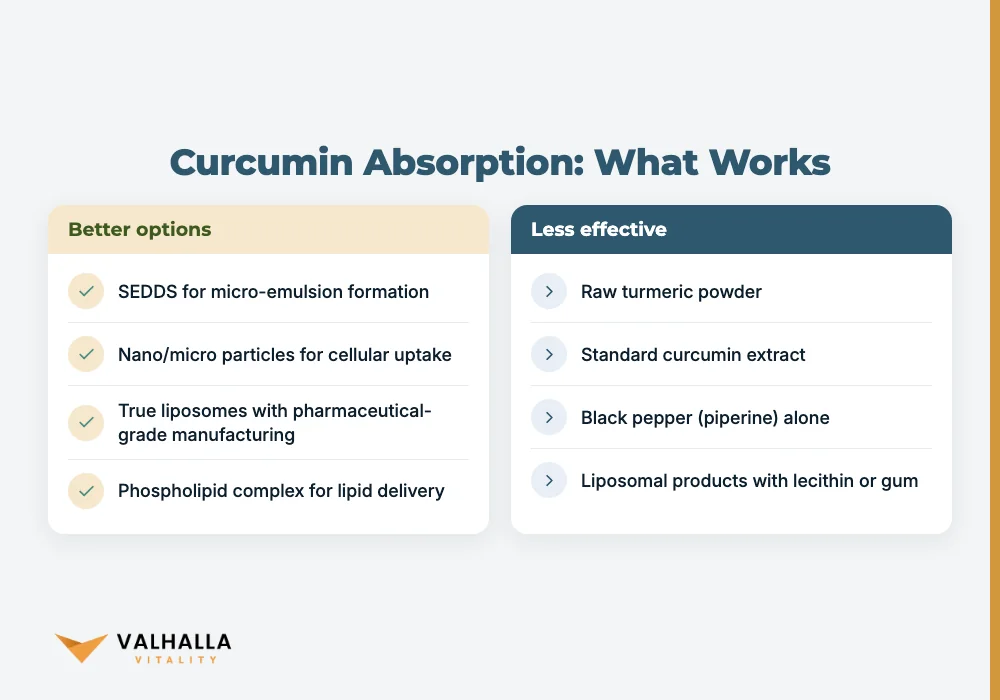
Standard capsules and raw turmeric powder sit at the bottom of the absorption hierarchy. Each delivery approach involves real tradeoffs between efficacy, cost, and manufacturing complexity.
| Delivery system | How it works | Key limitation |
|---|---|---|
| Raw turmeric powder | No enhancement | Decades of daily use required for any cumulative effect |
| Standard curcumin extract | Concentrates curcuminoids; no delivery aid | Rapidly cleared; minimal tissue penetration |
| Black pepper (piperine) | Increases intestinal permeability | Diminishing returns at higher doses; interacts with other compounds |
| Phospholipid complex | Binds curcumin for lipid-soluble delivery | Moderate improvement; variable quality across brands |
| Liposomal curcumin | Lipid bilayer encapsulation | Most commercial products are suspensions, not true liposomes |
| SEDDS (self-emulsifying) | Micro-emulsion formed on GI contact | Research shows up to 7.8x improvement over liposomes |
| Nano/micro particles | Particle size reduction for cellular uptake | Requires specialized manufacturing; hard to verify from a label |
The liposomal category requires scrutiny. True liposomes need pharmaceutical-grade manufacturing that most supplement companies cannot execute. If a product lists lecithin or any gum as the primary delivery ingredient, it is almost certainly a simple suspension. Only a small number of manufacturers in the dietary supplement market have the technical capacity to produce genuine liposomes. Even pharmaceutical manufacturers rarely use them due to stability challenges.
SEDDS technology is more practical at scale. Self-emulsifying drug delivery systems are already standard in pharmaceutical formulations for poorly water-soluble drugs. One study found a 7.8-fold curcumin absorption advantage over liposomal delivery for this approach. Nano and micro particle formulations reduce particle size until cells can interact directly with the compound. The evidence base for nanoparticle approaches is strong in pharmaceutical research, but verifying the technology from a consumer product label is difficult.
When evaluating bioavailability claims, context matters. Most comparative studies measure the area under the plasma concentration curve over time. A "7.8-fold improvement" means 7.8 times the total curcumin detected in blood over the measurement period compared to a stated reference. A credible claim names the comparator, the study design, and whether tissue levels were measured alongside plasma levels.
Unlike compounds such as creatine monohydrate, which absorbs reliably from standard formats without specialized delivery, curcumin requires formulation work to reach systemic levels. That difference matters when comparing supplement categories and evaluating product quality.
Turmeric vs curcumin: what is actually in the root?
Turmeric is the whole root. Curcumin is its most studied extract. But turmeric contains at least two biologically active constituents worth understanding separately.
The first is curcumin, which has generated thousands of peer-reviewed studies. A 2022 comprehensive review in Molecules by Liu et al. catalogued its mechanisms across inflammatory, metabolic, and neurological pathways, representing the breadth of documented turmeric health benefits. The second is 4-dihydrocurcumin, or 4DHC, a naturally occurring constituent of turmeric and a metabolic product when curcumin is processed in the body.
Curcumin blocks more than 30 pathways linked to inflammation and cellular aging. 4DHC acts on a different 20-plus pathways. Critically, 4DHC persists in tissues significantly longer. Some studies have recorded biological activity up to four weeks after ingestion. That pharmacokinetic profile is fundamentally different from curcumin, which clears within hours even with enhanced delivery.
Most curcumin products contain curcumin only. Most turmeric powders contain both naturally, but at concentrations that require decades of daily use to accumulate meaningful systemic effects. For supplement purposes, curcumin absorption challenges are the central formulation problem, since isolated curcumin, absent the rest of the root matrix, behaves differently than curcumin embedded in whole turmeric.
Does turmeric actually reduce inflammation?
Yes, when delivered in a bioavailable form. The clinical evidence for curcumin anti-inflammatory effects is substantial and consistent across independent research groups.
A 2024 quantitative analysis of randomized controlled trials by Mokgalaboni et al. in Nutrients found that curcumin supplementation significantly reduced fasting blood glucose and inflammatory markers, including CRP and IL-6, in participants with type 2 diabetes. These were real, measurable outcomes in clinical populations. The effect appeared specifically with bioavailable curcumin formulations.
The anti-inflammatory mechanism works through multiple pathways. The 2022 Liu et al. review identifies inhibition of NF-kB signaling, suppression of pro-inflammatory cytokines, and reduction of oxidative stress as primary mechanisms. Not speculative effects. Each has been replicated across multiple independent research groups.
A 2025 review in Nutrients by Cerullo et al. added a further dimension: curcumin's modulation of the gut-brain axis may influence neuroinflammation and metabolic dysfunction simultaneously. The gut microbiome appears to mediate part of this systemic effect, which explains why formulation decisions affect outcomes beyond basic blood-level absorption.
Beyond core inflammation, a 2016 systematic review by Vaughn et al. in Phytotherapy Research found positive clinical signals for turmeric in several inflammatory skin conditions. A 2021 systematic review by Cheraghipour et al. in Current Drug Discovery Technologies found consistent curcumin activity against Candida species across multiple studies. These applications work through different mechanisms, expanding the documented turmeric health benefits picture.
Curcumin for inflammation is a documented effect. Delivery determines whether it happens in any given supplement. Weak results in some older trials trace back directly to inadequate curcumin absorption, the compound was present on paper but never reached target tissues in meaningful amounts.
What is the most bioavailable form of curcumin?
No single winner. The 2020 Stohs et al. review in Molecules evaluated multiple formulation strategies and found that SEDDS, nanoparticle-based systems, and phospholipid complexes all show clinically meaningful improvement over standard curcumin extracts. No format dominated across all outcomes or study designs.
For evaluating the best curcumin supplement on the market, the practical implications are:
- Look for a named delivery technology, not generic "enhanced" or "advanced" language.
- Confirm the product separates curcuminoid percentage from delivery mechanism. High purity extract with no delivery system means poor curcumin absorption regardless of what the label says.
- Prefer products with a cited study for that specific formulation type, not a generic claim.
- Understand that "95% curcuminoid extract" describes the purity of the starting material, not whether delivery engineering was applied.
Bioavailable curcumin formulations cost more to produce. That is the unavoidable tradeoff. A low-cost grocery store capsule almost certainly lacks any meaningful delivery technology.
What is 4DHC and how does it differ from standard curcumin?
4DHC, or 4-dihydrocurcumin, is both a naturally occurring compound in turmeric and a metabolic byproduct when curcumin is processed in the body. It acts through mechanisms distinct from curcumin.
Where curcumin targets more than 30 inflammatory and aging-related pathways, 4DHC addresses a separate set of 20-plus pathways. The key difference is persistence. Curcumin clears quickly even with good formulations. 4DHC has been shown in some studies to remain biologically active in tissues for up to four weeks following ingestion. An activity window measured in weeks, not hours, is a meaningfully different tool for addressing chronic inflammation.
For the biology of aging specifically, this distinction has practical consequences. Chronic low-grade inflammation is a recognized driver of cellular aging. Compounds that modulate inflammatory signaling over extended periods may produce different sustained effects compared to those that peak and clear within a day.
4DHC is largely absent from standard curcumin products. It appears in some advanced formulations but remains unknown to most consumers and practitioners. The research base for 4DHC is smaller than for curcumin, but its distinct pathway profile and extended tissue persistence make it a meaningful addition to any formulation aimed at the full turmeric curcuminoid spectrum.
The conventional curcumin supplement market has overlooked 4DHC largely because of commercial inertia. Curcumin extraction is straightforward and well-established. 4DHC requires additional formulation steps, keeping it niche.
Curcumin within broader longevity protocols
Curcumin and 4DHC sit within a wider category of plant-derived compounds that address upstream biological drivers of aging, particularly chronic inflammation and oxidative stress. The curcumin anti-inflammatory mechanisms documented across hundreds of trials make it one of the most extensively studied compounds in this space, particularly for chronic low-grade inflammation. Cycloastragenol from astragalus root operates through different mechanisms but shares the same orientation toward cellular aging biology rather than downstream symptom management.
The curcumin absorption lesson applies across this entire category. A poorly formulated supplement, regardless of how well-studied the active ingredient, will not deliver its documented effects. The gap between a compound's documented effects in research settings and its real-world human impact is often explained by delivery. Curcumin is an unusually well-studied example of a challenge that appears throughout the longevity supplement category.
For a broader overview of provider-reviewed longevity approaches, Valhalla Vitality covers the full range of options available through telehealth.
How much curcumin should I take daily?
A licensed provider determines the appropriate amount after reviewing your health history, labs, and current medications. Curcumin at meaningful concentrations interacts with several metabolic pathways, which is why the dosing decision belongs in a clinical review process, not on a product label.
What the research does establish is that dose without delivery is largely irrelevant. A large amount of poorly absorbed curcumin will not outperform a smaller amount of a high-bioavailability formulation. The Liu et al. 2022 review notes that curcumin's dose-response relationship is nonlinear and heavily formulation-dependent.
For dietary context only: dried turmeric root contains roughly 2 to 5 percent curcumin by weight. Regular culinary use contributes some curcumin through food, though not in concentrations that approach what research trials use. Supplementation is designed to bridge that gap. It does so only when curcumin absorption is addressed at the formulation level.
Choosing the best curcumin supplement: a practical checklist
Most curcumin products fail on delivery. Before purchasing, look for:
- Named delivery system: SEDDS, phospholipid complex, nano-curcumin, or genuine liposomal formulation. Vague "enhanced bioavailability" claims without a named mechanism are insufficient.
- Curcuminoid content and delivery mechanism listed separately: high purity extract with no delivery system means poor curcumin absorption regardless of the milligram count on the label.
- 4DHC inclusion: present in advanced formulations; signals the manufacturer understands the full curcuminoid profile of turmeric.
- Third-party testing: a certificate of analysis from an independent lab confirms what is actually in the capsule.
- Clinical evidence for the specific formulation: a study citing the exact product or formulation type is far more credible than a generic "X times more bioavailable" claim without a stated comparator or methodology.
- Lecithin warning: if the primary delivery ingredient is lecithin or any gum, it is a suspension, not a genuine liposome.
Products that meet all these criteria cost more. That is the expected tradeoff when curcumin absorption is genuinely improved rather than only marketed as improved.
Ready to discuss your supplement approach?
A licensed provider can review your health history and help determine whether a curcumin formulation fits your goals. Book Your Consultation.
FAQ
Why is curcumin absorption so limited in standard supplements?
Curcumin is fat-soluble and breaks down quickly in the digestive environment, with the liver converting most of what remains into inactive metabolites before it reaches circulation. Standard capsules and powders show very low oral bioavailability, as described in the 2020 review by Stohs et al. in Molecules.
What is the most bioavailable form of curcumin?
SEDDS, nanoparticle-based systems, and phospholipid complexes all show meaningful improvement over standard curcumin extracts, according to the Stohs et al. 2020 review in Molecules. No single delivery method dominates every study design, but each outperforms basic unformulated extracts by measurable amounts.
Does turmeric actually reduce inflammation?
Yes, when the right formulation is used. Curcumin anti-inflammatory activity has been confirmed in multiple randomized controlled trials, including a 2024 meta-analysis by Mokgalaboni et al. that found significant reductions in inflammatory markers when participants received bioavailable curcumin. Standard turmeric powder shows minimal systemic effect.
What is 4DHC and how does it differ from standard curcumin?
4DHC (4-dihydrocurcumin) is a naturally occurring turmeric compound that targets different biological pathways than curcumin does. Unlike curcumin, which clears quickly, 4DHC has been shown in some studies to remain active in tissues for up to four weeks after ingestion.
How much curcumin should I take daily?
A licensed provider determines the appropriate amount after reviewing your health history, labs, and current medications. The dose-response relationship is nonlinear and heavily formulation-dependent, meaning amount alone does not determine effectiveness.
Sources
- Stohs SJ et al. (2020). Highly Bioavailable Forms of Curcumin and Promising Avenues for Curcumin-Based Research and Application: A Review. Molecules. PubMed
- Liu S et al. (2022). A Comprehensive Review on the Benefits and Problems of Curcumin with Respect to Human Health. Molecules. PubMed
- Mokgalaboni K et al. (2024). Curcumin Attenuates Hyperglycemia and Inflammation in Type 2 Diabetes Mellitus: Quantitative Analysis of Randomized Controlled Trial. Nutrients. PubMed
- Cerullo M et al. (2025). Curcumin Modulation of the Gut-Brain Axis for Neuroinflammation and Metabolic Disorders Prevention and Treatment. Nutrients. PubMed
- Vaughn AR et al. (2016). Effects of Turmeric (Curcuma longa) on Skin Health: A Systematic Review of the Clinical Evidence. Phytotherapy Research. PubMed
- Cheraghipour K et al. (2021). Anti-Candida Activity of Curcumin: A Systematic Review. Current Drug Discovery Technologies. PubMed
You May Also Like
 Semaglutide
 Sodium vs Semaglutide: Key Differences Explained
Semaglutide sodium vs semaglutide: how these GLP-1 formulations compare in structure, side effects, and what a provider weighs before prescribing.
November 5, 2026 ETRead more →
Wegovy Insurance Coverage: What Plans Actually Cover
Wegovy insurance coverage requires prior authorization and medical criteria. Learn how to qualify, appeal a denial, and what Medicare covers in 2025.
November 5, 2026 ETRead more → Featured
At Home STI Test: How It Works, Accuracy & Privacy
At home STI test kits let you screen for chlamydia, HIV, and more with private, rapid STI results. Learn how to use them and what to do next.
November 5, 2026 ETRead more →