
The following blog post is for entertainment and informational purposes only. It is not intended to provide medical advice or diagnosis. Please consult your doctor before making any health-related decisions.
Cycloastragenol side effects are minimal in current research. The compound, widely marketed as the TA-65 supplement, is a triterpenoid saponin isolated from astragalus root that activates telomerase to slow the progressive shortening of telomeres with each cell division. No serious adverse events have been documented in the available human trials. Before you start any telomere lengthening supplement, speaking with a licensed provider helps ensure the choice aligns with your individual health history.
What is cycloastragenol?
Cycloastragenol is a triterpenoid saponin compound isolated from the roots of Astragalus membranaceus. The plant has been used in traditional medicine for more than two centuries. Modern biochemistry identified cycloastragenol as the primary driver of the plant's most studied biological effect: stimulating telomerase, the enzyme that rebuilds the protective caps on chromosome ends. Those caps, called telomeres, shorten with each round of cell division. When they reach a critical minimum, the cell can no longer divide or function properly.
Understanding this mechanism is the starting point for any honest discussion of cycloastragenol benefits and risks alike. The compound does not act like a conventional nutritional supplement. It interacts with machinery that governs how cells age, which is both the source of its appeal and the reason cycloastragenol safety deserves careful attention.
Commercial products range widely in purity. The TA-65 supplement is the branded preparation that has been through the most human research. Other products based on astragalus root extract carry varying concentrations of the active compound, and dose comparisons across brands are unreliable without verified standardization data. Understanding how astragalus root is standardized and extracted for supplements puts that variability in context before you choose a product.
How does cycloastragenol work?
Cycloastragenol does not operate through a single target. Four interconnected mechanisms explain its proposed effects on cellular aging and broader health.
- Telomerase activation. A set of suppressor proteins normally keeps telomerase activity low in most somatic cells. Cycloastragenol appears to override this suppression, freeing the enzyme to rebuild shortened telomeres and extend the functional lifespan of dividing cells. This is the foundation of its anti-aging rationale and the core reason it is classified as a telomere lengthening supplement.
- Lipid metabolism support. Excess lipid accumulation damages cell membranes and organs over time. Cycloastragenol influences multiple lipid biomarkers and may reduce cytoplasmic lipid droplets, supporting healthier metabolic conditions within cells. At higher concentrations, it also engages calcium signaling pathways.
- Antioxidant activity. Reactive oxygen species damage DNA, proteins, and membranes. Cycloastragenol appears to increase antioxidant capacity, reducing the oxidative burden on tissues. This pathway contributes to its proposed protective effects on skin aging and cellular integrity.
- Anti-inflammatory action. Chronic low-grade inflammation accelerates cellular aging across every major organ system. Cycloastragenol has demonstrated anti-inflammatory properties in preclinical studies, connecting to its traditional use for immune resilience and its potential role in recovery and tissue repair.
These four mechanisms reinforce each other. That is why researchers study cycloastragenol as a systemic longevity compound rather than a narrow-target drug. The compound approaches aging from multiple directions simultaneously. This multi-pathway activity also means that evaluating cycloastragenol side effects requires considering each mechanism in context rather than applying a one-size-fits-all safety assumption.
Can cycloastragenol actually lengthen telomeres?
Yes, in preclinical models, it can. In cell culture and animal studies, cycloastragenol activates telomerase and produces measurable increases in telomere length. The more consequential question is whether this holds in humans at supplemental concentrations. The honest answer: promising, but not yet definitively proven.
Human data on cycloastragenol comes primarily from small, short-duration trials rather than large randomized controlled studies. Those trials show results consistent with preclinical findings: telomere length markers in blood cells move in the predicted direction after consistent use. But small sample sizes and limited follow-up periods constrain how much confidence those results justify.
A nuance worth holding: longer telomeres alone may not translate into slower aging. What matters biologically is keeping cells above the critical shortening threshold that triggers dysfunction. Cycloastragenol research, including work on the TA-65 supplement, suggests the compound may help cells maintain function longer by preventing premature entry into that dysfunctional state. Whether this translates into clinically measurable outcomes in healthy adults over a lifetime has not been established.
The published studies and forms of cycloastragenol in the current literature give a clearer picture of where the evidence is solid and where it remains incomplete. That context matters when calibrating expectations before committing to supplementation.
What are the side effects of cycloastragenol?
Cycloastragenol side effects reported in current literature are minimal. No serious adverse events have been documented in available human research. The honest framing: absence of documented harm reflects both a reassuring early safety signal and the limited scale of the research conducted so far.
Several concerns appear consistently in informed discussions of cycloastragenol safety.
Immune overstimulation. Cycloastragenol is an immunostimulant. For most healthy adults, that is a benefit. For people with autoimmune conditions, including rheumatoid arthritis, lupus, psoriasis, or inflammatory bowel disease, stimulating immune activity may worsen symptoms rather than help. No human trial has confirmed this specific harm, but the biological plausibility makes a provider conversation essential before starting.
The telomerase-cancer concern. Telomerase is abnormally active in many human cancers. This raises a legitimate question about any compound that activates this enzyme: could cycloastragenol inadvertently support cancer cell survival? Preclinical research shows a complicated picture. Some studies indicate anti-tumor properties, not pro-tumor effects, partly because the compound also engages immune surveillance mechanisms. The question is not settled. People with an active cancer diagnosis or a strong hereditary cancer risk should review what researchers have found in cancer models and discuss the specific implications with an oncologist before using any telomere-activating supplement.
Unknown long-term effects. Cycloastragenol supplements have been commercially available for roughly two decades. No 20-year safety dataset exists. The absence of known long-term harms is not the same as confirmed lifetime safety. Compounds that interact with fundamental cellular machinery at the level of telomere biology warrant ongoing scrutiny, particularly as cumulative use extends.
Medication interactions. No specific drug interactions with cycloastragenol have been established in human trials. Because the compound modulates immune function, people using immunosuppressant drugs for transplant maintenance or autoimmune disease management should exercise particular caution. A licensed provider can review your full medication list before you begin.
Populations that should avoid it. Pregnant and nursing women are excluded from the general safety recommendation because cycloastragenol has not been studied in those populations. The default for any immunomodulatory supplement during pregnancy is avoidance.
Cycloastragenol side effects: reading the full risk profile
For each concern listed above, no controlled human trial has confirmed the specific harm in people using standard supplemental doses. The research base is real but limited, and that limitation means both reassurance and caution are warranted depending on individual health status.
The overall assessment on cycloastragenol side effects: for healthy adults without autoimmune conditions or cancer history, the current evidence supports short-term use as well tolerated. The primary open questions involve long-term effects and safety in specific subpopulations, not documented acute harms.
Reported cycloastragenol benefits
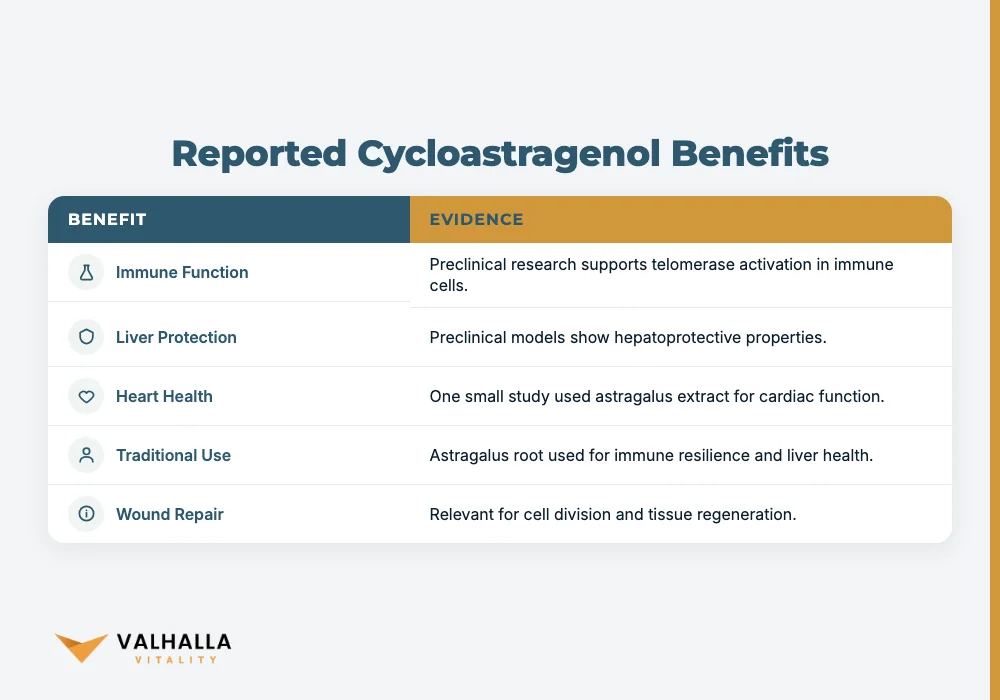
The benefits attributed to cycloastragenol span a wide range. Reviewing them alongside the established cycloastragenol side effects profile gives a more complete picture than evaluating either in isolation. Some are supported by preclinical research. Others come primarily from user reports. That distinction matters when setting realistic expectations.
Immune function. Activating telomerase in immune cells may extend their functional lifespan and improve their capacity for DNA repair. This is one of the most biologically plausible cycloastragenol benefits, directly tied to the compound's mechanism rather than inferred from secondary pathways. Traditional use of astragalus root for immune resilience across two centuries aligns with this preclinical picture.
Liver protection. The liver is highly sensitive to oxidative stress and lipid accumulation, two of the pathways cycloastragenol addresses through its antioxidant and lipid metabolism effects. Hepatoprotective properties have been observed in preclinical models. This application has deep roots in astragalus root extract aging research and in traditional use long before the active compound was isolated.
Heart health. One study examined 134 patients with congestive heart failure. Among the 19 who received an astragalus extract, researchers observed reduced chest distress and improvements in cardiac function. The treatment involved the full plant extract rather than isolated cycloastragenol, and the sample was small. It remains one of the few human data points available for the cardiovascular application.
Wound repair. Shortened telomeres impair the cell division required for tissue regeneration. This is particularly relevant for diabetic patients, whose wound repair is already compromised by other mechanisms. In preclinical models, cycloastragenol's activation of telomerase improved the efficiency of cellular repair in wound-repair contexts.
Skin and UV protection. Cycloastragenol's antioxidant activity may protect skin cells from UV-related damage that accelerates visible aging. Cell renewal supported by telomerase activation could also contribute to improvements in skin texture over time. No controlled human trial has confirmed this specifically for skin, but user reports of improved appearance are consistent with the mechanism.
Stress and cognitive health. Shortened telomeres appear in people with chronic stress and depression, and this cellular aging has been associated with neurodegenerative risk. Cycloastragenol's telomerase activation addresses this pathway at the cellular level. The connection to specific conditions like Alzheimer's disease remains theoretical at this stage and should not be read as a clinical claim.
Hair health. Some users report improvements in hair growth and color maintenance with regular cycloastragenol use. This is not supported by controlled trial data but fits with the compound's general role in supporting cell renewal in rapidly dividing cell populations.
Cancer research context. Preclinical work on cycloastragenol in cancer cell models has produced results more nuanced than a simple pro- or anti-cancer label allows. Some studies show inhibitory effects on cancer cell growth through pathways separate from telomere biology. This remains an active research area without settled clinical conclusions.
Is cycloastragenol safe to take daily?
For healthy adults without autoimmune conditions or active cancer history, current evidence suggests short-term daily use is well tolerated. That statement carries two qualifiers worth noting explicitly. "Short-term" reflects the actual duration of available human data. "Healthy adults without those conditions" reflects the populations to which general safety statements can reasonably apply.
The safety case for cycloastragenol rests on two foundations. First, the parent plant, Astragalus membranaceus, has two centuries of documented medicinal use without recorded serious harm. Second, the limited human research on isolated cycloastragenol has not produced documented toxicity or serious adverse events. Neither foundation is equivalent to long-term clinical trial data, but together they represent more than an untested compound. That baseline also shapes how cycloastragenol side effects are interpreted in a daily-use context: not as confirmed risks requiring avoidance, but as theoretical concerns warranting monitoring.
Daily use raises the question of cumulative effect. A supplement that continuously activates telomerase operates differently from a nutritional supplement that compensates for dietary gaps. Whether sustained telomerase activation over years is neutral, beneficial, or problematic in ways not yet apparent is genuinely unknown. That uncertainty is the most accurate position available with current data.
Provider monitoring makes daily use more defensible than self-managed supplementation. Valhalla Vitality's provider-reviewed intake process covers exactly this kind of situation, allowing baseline lab assessment before starting and tracking of relevant markers as use continues.
Three populations warrant specific caution with daily cycloastragenol use:
- People with autoimmune conditions should have an explicit conversation with their provider about their immune profile before starting.
- People on immunosuppressant therapy should not use cycloastragenol without direct provider guidance.
- Pregnant and nursing women should avoid it entirely until safety data exists for those populations.
How long does cycloastragenol take to work?
Most people need several months of consistent use before any measurable change appears. The outcomes most associated with cycloastragenol, including telomere length shifts, immune function improvements, and skin quality changes, develop slowly. That pace reflects the nature of the biological processes involved.
In available human research on cycloastragenol and the TA-65 supplement, researchers tracked participants over periods ranging from a few months to approximately one year. Measurable changes in telomere length biomarkers in blood cells, when observed, appeared after consistent use across those timeframes rather than early in the study period. Short-term inflammatory and antioxidant markers sometimes shifted sooner. The primary endpoint of this type of astragalus root extract aging research is inherently gradual.
Subjective reports tell a somewhat different story. Some users describe improvements in energy levels, sleep quality, and joint comfort within the first two to four months of use. These are self-reported outcomes rather than controlled data. Individual variation is large. Age, baseline telomere status, overall health, and product purity all influence the response timeline.
The practical takeaway: cycloastragenol is not a rapid-acting compound. Its mechanism operates at the level of cellular rebuilding, which is a slow biological process. Expecting results in days misunderstands how this type of intervention works. Consistent use over months, with provider-supported monitoring, gives the clearest picture of whether the compound is producing meaningful effects, and helps identify any cycloastragenol side effects that may develop gradually rather than acutely.
What is the recommended dosage of cycloastragenol?
A licensed provider determines cycloastragenol dosage after reviewing your labs and health history, because product purities and individual health needs vary substantially. There is no single universal dose that applies across all products and all people.
Two factors make standardized dosing guidance unreliable for this compound. Product purity varies considerably across commercial preparations. The TA-65 supplement and other astragalus root extract formulas differ in their actual cycloastragenol content even at identical listed amounts, making cross-product dose comparisons unreliable without verified standardization data. Individual health status also matters. Immune function, existing conditions, and current medications all factor into what starting point is appropriate for a given person.
The original research on cycloastragenol dosage is almost entirely preclinical or from small human pilot studies. Neither base translates cleanly into population-wide recommendations. Until larger trials establish a clear therapeutic range with safety data across different intake levels, provider-guided dosing is the defensible approach for anyone treating this as a serious health intervention rather than casual supplementation.
Ready to get personalized guidance?
A licensed provider can review your health history and determine whether cycloastragenol or another telomere lengthening supplement is appropriate for your situation. Book Your Consultation to connect with a provider who can assess your options and monitor your response over time.
FAQ
What are the side effects of cycloastragenol?
Current human research reports minimal cycloastragenol side effects, with no serious adverse events documented in available trials. The main theoretical concerns are immune overstimulation in people with autoimmune conditions and unresolved questions about long-term effects from sustained telomerase activation. The research base is promising but limited in scale.
Is cycloastragenol safe to take daily?
For healthy adults without autoimmune disease or active cancer history, available evidence suggests short-term daily use is well tolerated. The parent plant has centuries of documented safe medicinal use, and isolated cycloastragenol has not produced known toxicity in human trials. Long-term safety data extending beyond a few years does not yet exist.
How long does cycloastragenol take to work?
Most people need several months of consistent use before any measurable change becomes apparent. Some users report subjective improvements in energy and sleep within the first two to four months, though individual variation is considerable. The mechanism operates through gradual cellular rebuilding rather than rapid pharmacological effect.
What is the recommended dosage of cycloastragenol?
There is no single universally appropriate dose because product purity and individual health status vary significantly across users and products. A licensed provider determines the appropriate cycloastragenol dosage after reviewing your labs and health history, factoring in immune status and any medications you currently take.
Can cycloastragenol actually lengthen telomeres?
In cell culture and animal studies, cycloastragenol activates telomerase and produces measurable telomere lengthening. Small human studies, including trials using the TA-65 supplement, show results consistent with that finding. Large, long-term randomized controlled trials have not been conducted, so the human evidence is promising but not yet complete.
Sources
- Harley CB, Liu W, Blasco M, et al. A natural product telomerase activator as part of a health maintenance program. Rejuvenation Research. 2011;14(1):45–56.
- Fauce SR, Jamieson BD, Chin AC, et al. Telomerase-based pharmacological enhancement of antiviral function of human CD8+ T lymphocytes. Journal of Immunology. 2008;181(10):7400–7406.
- Epel ES, Blackburn EH, Lin J, et al. Accelerated telomere shortening in response to life stress. Proceedings of the National Academy of Sciences. 2004;101(49):17312–17315.
You May Also Like
 Cycloastragenol
 Supplement: Benefits, Dosage, Safety
Cycloastragenol supplement may support telomere health and healthy aging. Explore benefits, dosage, side effects, and the astragaloside IV comparison.
October 31, 2026 ETRead more → Cycloastragenol
 cancer research: what the evidence shows
Cycloastragenol cancer research explores how astragalus saponins may influence telomeres and immune function. Discover what current science shows.
October 30, 2026 ETRead more → Cycloastragenol
 Supplement: Benefits and How It Works
Cycloastragenol is an anti-aging telomere supplement that may activate telomerase and slow cellular aging. Discover how this astragalus extract works.
October 28, 2026 ETRead more →