
The following blog post is for entertainment and informational purposes only. It is not intended to provide medical advice or diagnosis. Please consult your doctor before making any health-related decisions.
When weighing tadalafil vs sildenafil, the most consequential difference is ED medication duration. Sildenafil typically takes effect within 30 to 60 minutes and stays active for four to six hours. Tadalafil takes roughly one to two hours to peak but can remain effective for up to 36 hours. Before deciding between them, reviewing your ED treatment options with a licensed provider is the clearest path to finding the right fit for your health profile.
| Feature | Sildenafil | Tadalafil |
|---|---|---|
| Onset | 30 to 60 minutes | 1 to 2 hours |
| Duration | 4 to 6 hours | Up to 36 hours |
| Affected by high-fat food | Yes | Minimal |
| Daily low-dose option | No | Yes |
| Also approved for | Pulmonary arterial hypertension | BPH, pulmonary arterial hypertension |
What is the difference between tadalafil and sildenafil?
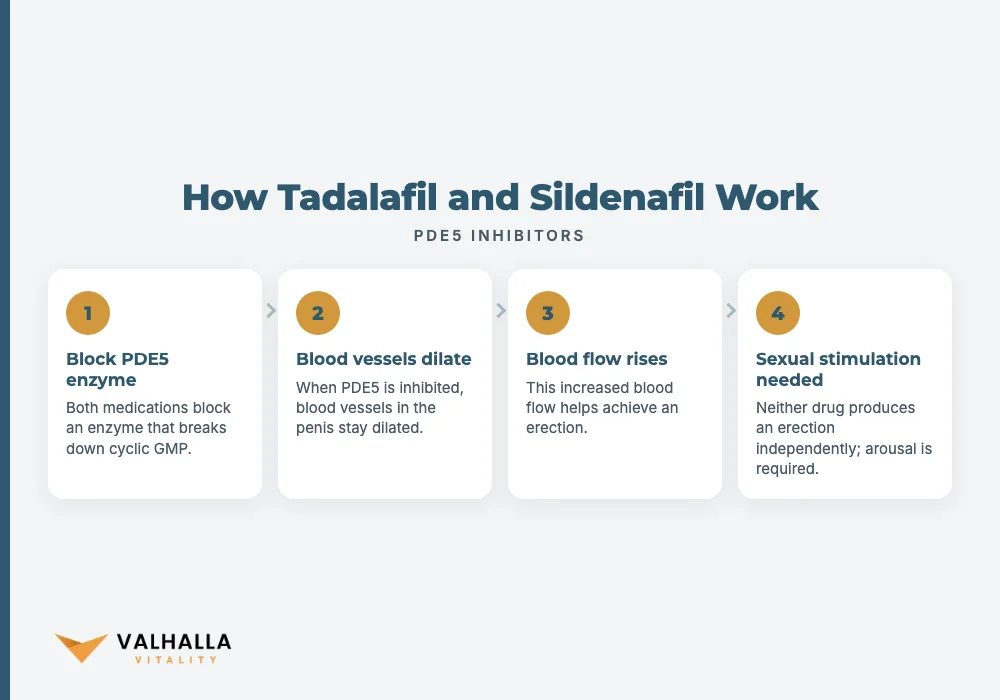
Both medications belong to the PDE5 inhibitor class. They work by blocking phosphodiesterase type 5, an enzyme that breaks down cyclic GMP in the smooth muscle of penile arteries. When PDE5 is inhibited, blood vessels in the penis stay dilated, blood flow rises, and an erection becomes achievable with sexual stimulation. Neither drug produces an erection independently. Arousal is still required.
The tadalafil vs sildenafil difference comes down to pharmacokinetics. Sildenafil has a half-life of approximately four hours, so therapeutic levels drop within four to six hours after ingestion. Tadalafil has a half-life of roughly 17.5 hours. That extended half-life is what gives it a 36-hour action window and what earned it the informal label "the weekend pill."
There are also selectivity differences. Tadalafil is less selective than sildenafil for PDE5 versus related phosphodiesterase subtypes. This selectivity gap has limited impact on the main therapeutic effect but does help explain why tadalafil-associated side effects differ from sildenafil's profile in a few specific ways.
The PDE5 inhibition mechanism also explains why both drugs require intact nerve pathways and functional vascular response to work effectively. ED with a predominantly neurogenic or severe vascular component may respond differently from ED that is primarily psychogenic or mild. A provider evaluates which factors are present during intake, which is why the initial consultation is a clinical step, not a formality.
Understanding that both drugs require sexual stimulation is clinically and psychologically important. Men who expect the medication to override low desire or high stress often find it less effective, not because the drug failed, but because a key part of the mechanism was misunderstood.
Which lasts longer, tadalafil or sildenafil?
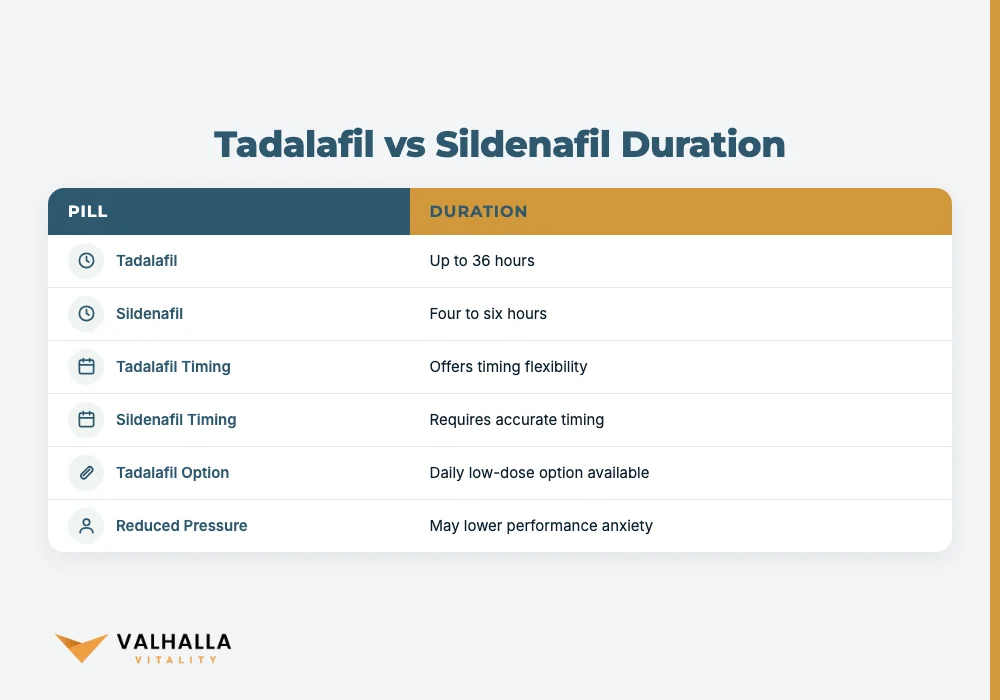
Tadalafil. The question of which ED pill lasts longer has a clear answer. How long does tadalafil last? In most men, the therapeutic window extends to 36 hours. Sildenafil's window runs four to six hours. That gap is not marginal; it changes how men think about and plan around the medication.
The practical implication is timing flexibility. Sildenafil requires accurate timing relative to intended activity. If a man takes it and plans are delayed, he may find himself outside the active window. In the tadalafil vs sildenafil comparison, tadalafil's 36-hour span removes most of that pressure. Many men report that reduced timing pressure also lowers performance anxiety, which often compounds ED independently of its physical causes.
Tadalafil also has a continuous daily low-dose option that removes on-demand timing entirely. With daily use, steady blood levels are maintained around the clock, and there is no timing calculation required before activity. This turns the medication from an event-based tool into a background treatment. Research on how daily tadalafil supports quality of life over time suggests benefits beyond isolated episodic use, including improvements in relationship dynamics and reduced anticipation anxiety. A licensed provider determines whether the daily approach is appropriate based on cardiovascular status, current medications, and overall health.
Which ED medication works faster?
Sildenafil. Sildenafil onset time is 30 to 60 minutes in most men, compared to tadalafil's one to two hours. When speed to effect is a priority, sildenafil has a clear advantage.
Actual onset varies individually. Metabolism, body composition, circulatory health, and food intake all influence how quickly either drug activates. Some men see sildenafil working in 15 to 20 minutes; others need closer to an hour. These are real-world ranges, not fixed timelines.
Speed and duration represent different priorities, and they point to different drugs. Fast onset matters for predictable, event-specific scenarios where the timing is relatively known in advance. Long duration matters for spontaneity and flexibility, particularly when schedules or relationship dynamics make precise planning difficult. Neither is objectively superior. The right choice depends on what a man values day to day, and that is a conversation worth having with a provider rather than resolving from a comparison chart alone.
How food affects tadalafil vs sildenafil
This is one of the more practical tadalafil vs sildenafil distinctions. Sildenafil food interactions are well documented. A high-fat meal taken shortly before the dose can delay absorption by roughly an hour, shifting the onset window in a way that is significant for a drug with only a four- to six-hour active period.
Tadalafil is not substantially affected by food. It can be taken with or without a meal, which removes one more variable from the planning equation. For men who eat late dinners or whose schedules are irregular, this difference has real day-to-day value.
Both drugs are absorbed faster on an empty stomach. For tadalafil, this point is minor. For sildenafil, it matters more. Men who notice inconsistent results with sildenafil often trace the variability to heavy meals taken close to the dose. That variability is not a failure of the medication; it is a food-drug interaction that is fully predictable once understood. It is worth raising with a provider before concluding the drug is not working as expected.
PDE5 inhibitor side effects: what to expect from each
The PDE5 inhibitor side effect profile is largely similar across both drugs. The most common reactions include headache, facial flushing, nasal congestion, indigestion, and mild transient vision changes. These effects occur because PDE5 is not exclusive to penile tissue; both drugs cause vasodilation in other areas of the body, which produces the flushing and headache. Sildenafil-specific vision effects, such as a bluish tint or increased light sensitivity, are temporary and typically self-limiting.
Some tadalafil users also report back pain and muscle aches, a pattern less commonly noted with sildenafil. This reaction tends to be mild and resolves within 12 to 24 hours without treatment.
Serious adverse events are rare with both drugs. These include priapism (an erection lasting more than four hours), sudden hearing loss, and sudden vision loss. Any of these warrant immediate medical attention. For a detailed review of which tadalafil side effects to monitor, including patterns that differ between on-demand and daily use, the linked overview covers both settings.
The most clinically important contraindication for both drugs is concurrent nitrate use. Nitrates combined with any PDE5 inhibitor can cause a sudden severe drop in blood pressure. This combination must be avoided entirely. Men on alpha-blockers also require careful evaluation before starting either drug.
Is tadalafil better than sildenafil for ED?
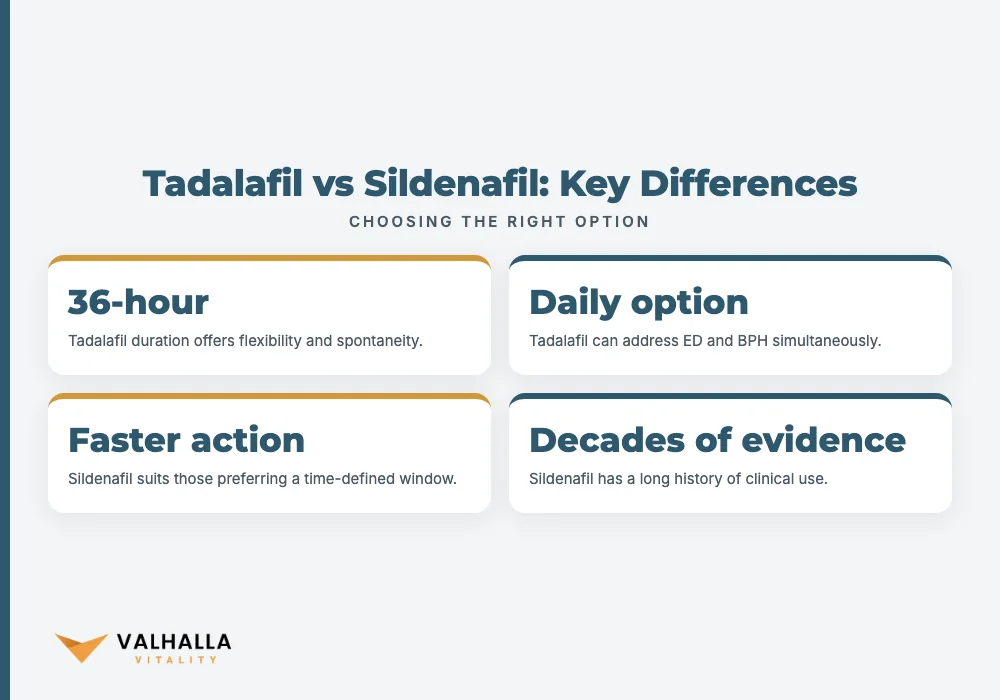
Neither drug is universally better. The right answer depends on priorities, lifestyle, and what a provider finds appropriate after reviewing health history.
Tadalafil generally suits men who value flexibility and spontaneity. Its 36-hour duration and daily option mean less planning, and reduced planning often reduces performance-related anxiety as well. For men dealing with both ED and benign prostatic hyperplasia (BPH), daily tadalafil, where a provider determines the protocol/dose after labs, includes the potential to address both conditions simultaneously. A 2023 systematic review and meta-analysis in the American Journal of Men's Health found that adding tadalafil to standard BPH therapy produced significantly better urinary symptom improvement compared to standard therapy alone, pointing to real dual-purpose benefit (Zhou R et al., 2023).
Sildenafil typically suits men who prefer a faster, more time-defined action window. It has decades of clinical evidence behind it. Both drugs achieve similar efficacy rates in published comparative trials.
Recent research is adding new dimensions to the tadalafil vs sildenafil conversation. A 2025 systematic review and meta-analysis published in Aging found an association between regular sildenafil use and lower Alzheimer's disease risk (Chua WY et al., 2025). This research is early and does not yet shift prescribing guidance for ED, but it reflects growing scientific interest in PDE5 inhibitors as a drug class with potentially wider health implications.
The psychological dimension also matters. Restoring reliable erectile function through whichever option fits best has documented effects on self-confidence and relationship quality. Feelings of frustration, anxiety, and inadequacy that accompany ED often ease when treatment is consistent and predictable. The best medication is frequently the one a man takes reliably, and that consistency can outweigh pharmacological differences in real-world use.
For men comparing options across the full PDE5 inhibitor class, a comparison of tadalafil and vardenafil adds useful framing when sildenafil is not the only alternative under consideration.
At Valhalla Vitality, a licensed provider reviews your intake, medical history, and current medications before determining which approach fits. That review is what makes the choice safe rather than a guess.
Can you take tadalafil and sildenafil together?
No. Combining them is dangerous and offers no benefit. Both drugs lower blood pressure through the same mechanism. Taking them together intensifies that effect and raises the risk of a sudden severe blood pressure drop, which can cause dizziness, fainting, or a serious cardiovascular event.
There is also no therapeutic logic to stacking them. Each drug already provides sufficient PDE5 inhibition at appropriate levels. Adding a second PDE5 inhibitor does not increase efficacy; it only multiplies risk.
If one medication is not producing the expected result, the right path is a provider consultation. Dose review, timing adjustments, switching to a different drug in the class, or addressing underlying health factors are all more appropriate responses than combining two PDE5 inhibitors.
Book your consultation
If the tadalafil vs sildenafil question is one you're working through, a licensed provider can review your intake and help you determine which fits your situation. Book Your Consultation to get started.
FAQ
What is the difference between tadalafil and sildenafil?
The core tadalafil vs sildenafil difference is duration: sildenafil works for four to six hours, while tadalafil can last up to 36 hours. Both are PDE5 inhibitors that treat erectile dysfunction by increasing blood flow to the penis when sexually stimulated. Tadalafil also has a daily low-dose option and is less affected by food intake than sildenafil.
Which lasts longer, tadalafil or sildenafil?
Tadalafil lasts significantly longer, with a window up to 36 hours compared to sildenafil's four to six hours. This difference is why tadalafil is called the "weekend pill" and why it suits men who prefer flexibility around timing. Sildenafil's shorter window requires more precise scheduling relative to anticipated activity.
Is tadalafil better than sildenafil for ED?
Neither is universally better; both achieve comparable efficacy in head-to-head trials. Tadalafil offers longer duration and may also benefit men dealing with both ED and BPH through daily use, as supported by a 2023 meta-analysis in the American Journal of Men's Health. A licensed provider reviews your health profile to determine which is appropriate.
Which ED medication works faster?
Sildenafil works faster, typically reaching effect within 30 to 60 minutes compared to tadalafil's one to two hours. If onset speed is the priority, sildenafil has the advantage. If duration matters more, tadalafil is the stronger fit.
Can you take tadalafil and sildenafil together?
No. Combining them intensifies the blood pressure-lowering effect of both drugs and can cause a dangerous cardiovascular event. There is no clinical benefit to taking them simultaneously. If one medication is not effective, consult a licensed provider to adjust the approach rather than combining both.
Sources
- Zhou R et al. (2023). A Systematic Review and Meta-Analysis of the Efficacy and Safety of Tamsulosin Plus Tadalafil Compared With Tamsulosin Alone in Treating Males With Lower Urinary Tract Symptoms Secondary to Benign Prostrate Hyperplasia. American journal of men's health. PubMed
- Chua WY et al. (2025). Sildenafil and risk of Alzheimer disease: a systematic review and meta-analysis. Aging. PubMed
You May Also Like
 Tadalafil
Avanafil vs Tadalafil: ED Medication Comparison Guide
Avanafil vs tadalafil compared: onset speed, duration, side effects, and when to choose each. See which ED medication fits your needs and lifestyle.
November 12, 2026 ETRead more → Tadalafil
 Drug Class: Mechanism, Uses, and Comparisons
Tadalafil drug class belongs to PDE5 inhibitors. Learn how tadalafil works in the body, what conditions it treats, and how it differs from sildenafil.
November 12, 2026 ETRead more → Tadalafil
 Weight Loss: What the Research Actually Shows
Tadalafil weight loss connections run through cGMP, fat cell biology, and insulin sensitivity. Here's what research shows and what it doesn't.
November 11, 2026 ETRead more →