
The following blog post is for entertainment and informational purposes only. It is not intended to provide medical advice or diagnosis. Please consult your doctor before making any health-related decisions.
Mic injection side effects are usually mild and temporary. The most common experience is brief soreness at the injection site, with more serious reactions being uncommon. Knowing the full range of what may happen, from minor local discomfort to rare systemic reactions, helps you tell normal from concerning from day one. A licensed provider reviews your medical intake and determines whether a MIC lipotropic injection is appropriate for your individual situation before prescribing.
What does MIC stand for in MIC B12 injections?
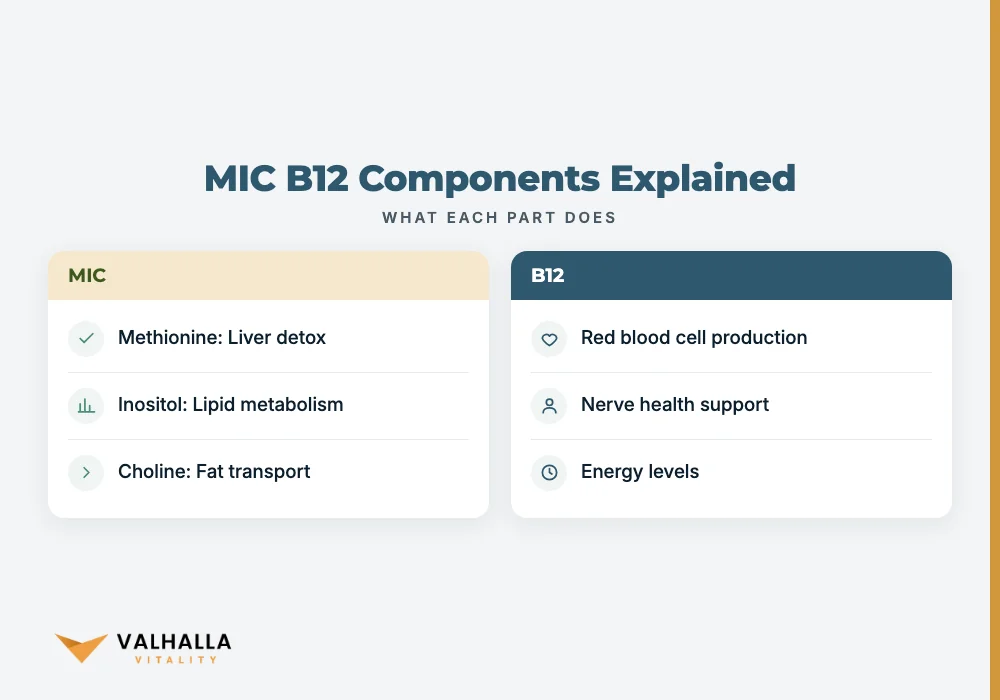
MIC stands for Methionine, Inositol, and Choline. These are lipotropic agents, compounds that support the body's ability to process and transport fat. Combined with vitamin B12, they form the core of what is often called a methionine inositol choline shot or lipotropic injection.
| Component | Category | Primary metabolic role |
|---|---|---|
| Methionine | Essential amino acid | Liver detoxification and protein synthesis |
| Inositol | B-vitamin family | Cell membrane function and lipid metabolism |
| Choline | Essential nutrient | Fat transport from the liver and nerve signaling |
| Vitamin B12 | Water-soluble vitamin | Red blood cell production, nerve health, energy |
Methionine is the only amino acid in this group the body cannot produce on its own, making dietary or supplemental sources necessary. Inositol helps regulate nerve impulse transmission and plays a role in insulin signaling. Choline works alongside both to prevent fat accumulation in liver cells. These functions together explain why the combination appears in metabolic support protocols and why the lipotropic injection benefits each component offers are distinct rather than overlapping.
What are the side effects of MIC B12 injections?
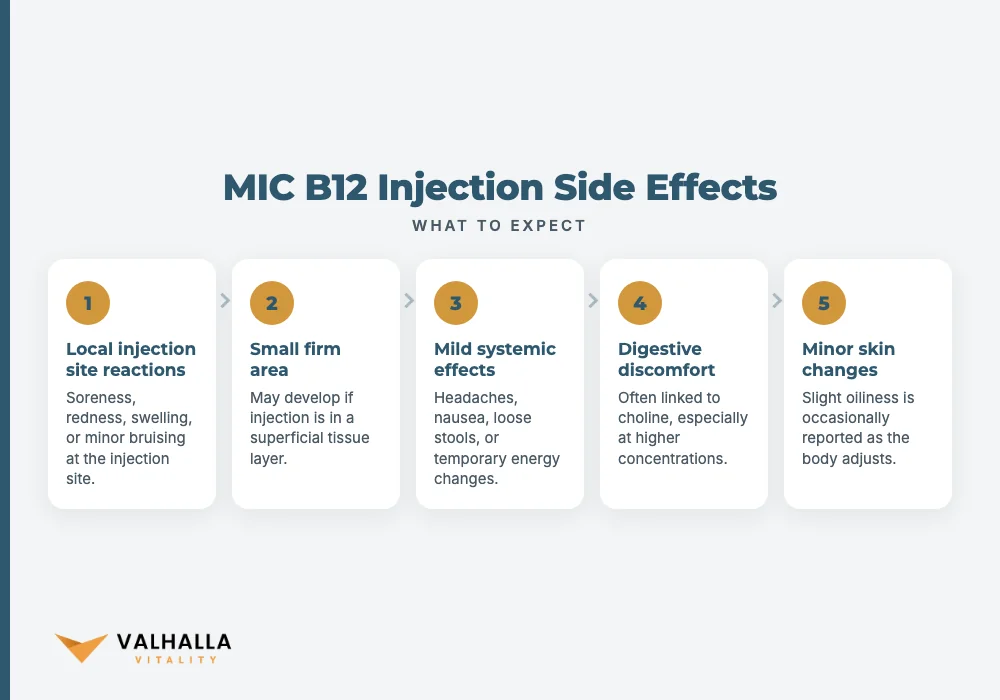
Mic injection side effects fall into three practical categories: local reactions at the injection site, mild systemic effects that some people notice in the first week or two, and rare serious reactions requiring prompt medical contact. Most people encounter only the first category, if anything at all.
Injection-site reactions
Soreness, mild redness, and slight swelling at the injection site are the most commonly reported reactions. They typically resolve within 24 to 48 hours. Minor bruising can occur, especially when injections consistently use the same spot. Rotating sites between sessions reduces this risk and prevents cumulative tissue irritation.
A small firm area may develop at the injection site occasionally. This usually happens when the injection lands in a superficial tissue layer rather than the intended muscle or subcutaneous fat. Proper technique prevents this. Your provider or pharmacist will walk through angle, depth, and site rotation before your first injection.
Mild systemic effects
A smaller group of people experience systemic effects during the first several sessions. These tend to be brief and manageable:
- Short-lived headaches that ease within a few hours of the injection
- Mild nausea, more likely when injecting on an empty stomach
- Loose stools or general digestive discomfort, most often linked to the choline component at higher concentrations
- Temporary changes in energy level as the body adjusts to the formula
These effects typically diminish within the first few sessions. Eating lightly before your injection and staying well-hydrated afterward reduces gastrointestinal symptoms in particular. Minor skin changes such as slight oiliness are occasionally reported and usually settle once the body adjusts, though any persistent skin reaction is worth mentioning to your provider.
Rare reactions that need attention
Allergic reactions to MIC B12 formulas are uncommon but do occur. Watch for hives, rash, swelling beyond the immediate injection site, or difficulty breathing after an injection. These require stopping the injection series and contacting your provider promptly.
An injection site that becomes increasingly warm, hard, or more inflamed after the first day, rather than improving, may signal a local infection. This is distinct from normal post-injection soreness and warrants a provider call rather than a watchful wait.
Tracking mic injection side effects between sessions
Keeping a brief log helps your provider fine-tune your treatment. Record the injection site, the date, and any reactions with their approximate duration. This is especially useful in the first month, when your provider may want to adjust technique guidance, injection frequency, or the formula itself. Brief, consistent notes make those follow-up conversations far more productive than relying on memory alone.
Are MIC injections safe for weight loss?
For most healthy adults, MIC injections are considered well-tolerated when prescribed and supervised by a licensed provider. Safety depends on individual health status, current medications, and whether any components interact with existing conditions. That evaluation happens before the prescription, not after.
The B12 component has a strong safety record. It is water-soluble, so the body excretes excess amounts rather than storing them. The lipotropic compounds, methionine, inositol, and choline, all occur naturally in everyday foods. Eggs, meat, legumes, and certain vegetables are common dietary sources. Injection concentrations exceed typical dietary intake, which is why provider oversight is part of responsible use.
Certain groups require closer evaluation. People with kidney or liver conditions, those taking medications that affect homocysteine metabolism, and anyone with known sensitivities to formula components need a thorough assessment before starting. Availability of this therapy also varies by state, as provider licensing and pharmacy networks differ across the country.
For a practical look at supporting MIC B12 weight loss goals alongside healthy habits, our dedicated guide covers what a structured program looks like in practice.
What providers check before prescribing MIC injections
Most consumer-facing guides stop at listing ingredients and side effects. Here is what a thorough provider evaluation actually involves, and why each step affects both safety and outcome.
Medical and medication history. Methionine interacts with certain antidepressants and medications affecting homocysteine pathways. The intake form surfaces this before any prescription moves forward. Choline in higher concentrations may not be appropriate for everyone, particularly those with certain metabolic or cardiovascular conditions.
Lab review. Reviewing B12 levels and basic metabolic markers gives the provider clinical context. Someone severely deficient responds differently from someone with normal levels. Lab values also inform how often injections make sense, since someone who normalizes quickly may not need the same frequency long-term.
Technique and site guidance. Many persistent mic injection side effects stem from technique rather than formula sensitivity. Providers walk through angle, injection depth, and site rotation in enough detail that patients who self-administer can do so correctly from the start.
Honest goal-setting. A provider-led conversation about realistic outcomes is part of responsible prescribing. MIC injections support metabolic processes. They work better within a structured program than as the entire plan. At Valhalla Vitality, the intake review includes this conversation before any treatment begins.
A licensed provider determines the appropriate dose and injection schedule after reviewing your intake and labs. No universal protocol fits every patient. Your schedule may be adjusted based on how your body responds.
Do MIC injections actually help you lose weight?
Mic b12 weight loss outcomes depend on what else is happening in your health program. The lipotropic components support fat metabolism at the cellular level. B12 contributes to energy production, which may support physical activity and program consistency over time.
Methionine helps the liver export fat rather than accumulate it, Inositol supports insulin signaling and lipid regulation, and Choline synthesizes the carrier molecules that actively transport fat out of liver cells. These are real metabolic functions, not marketing claims. They do not override energy balance. Fat loss still requires a caloric deficit.
The b12 shot energy effect is most pronounced for people who are B12-deficient at baseline. B12 deficiency causes fatigue and reduced motivation, both of which make it harder to stay consistent with any health program. Correcting a deficiency through injection, which bypasses the digestive absorption steps that limit oral supplement uptake, may meaningfully improve energy and adherence. For people with already-normal B12 levels, the energy benefit is more modest.
MIC injections function best as metabolic support within a supervised program. Used that way, they may make it easier to stay consistent, address metabolic inefficiencies tied to deficiency, and support the liver's fat-processing capacity during an active weight management phase.
MIC B12 benefits beyond weight loss
The mic shot benefits extend beyond fat metabolism, and many people starting these injections for weight reasons notice broader improvements.
Nerve and cognitive function. B12 is required for myelin production, the protective sheath around nerve fibers. Low B12 is associated with fatigue, numbness, and cognitive changes. Injections deliver B12 directly to the bloodstream, bypassing digestive absorption steps that limit oral supplement uptake in many people. Reviewing the full range of lipotropic injection benefits helps clarify what each component contributes individually.
Cardiovascular support. B12 helps break down homocysteine, a compound associated with blood vessel wall damage when elevated. Supporting healthy homocysteine levels may reduce cardiovascular risk over time. A provider interprets your specific lab values before connecting this pathway to any recommendation for your situation.
Mood and sleep. B12 contributes to neurotransmitter production, including pathways connected to serotonin. People with B12 deficiency frequently report mood changes alongside physical fatigue. B12 also plays a role in melatonin regulation, the hormone governing sleep-wake cycles. Those experiencing disrupted sleep due to B12 deficiency sometimes notice improved sleep patterns after starting injections.
Inflammation. B12 helps regulate inflammatory responses in nerve tissue. This is part of why it appears in research on neuropathy and neurological conditions. These mic b12 benefits are most relevant for people who are deficient at baseline, where correction produces the most noticeable changes.
How often should you get MIC B12 shots?
A licensed provider determines your injection frequency after reviewing your intake and labs. No single schedule fits everyone. Some initial programs run weekly during an active phase, with intervals adjusted based on response. Maintenance schedules involve longer gaps.
Bring this question to your first consultation. Your provider sets a cadence based on where you are starting from, your health goals, and how your body responds early on. The frequency may shift as treatment progresses. That adaptability is part of what distinguishes provider-led care from a fixed supplement schedule.
Find out if MIC injections are right for you
A licensed provider can review your intake and help you understand whether this therapy fits your health goals. Book Your Consultation to take the first step.
FAQ
What are the side effects of MIC B12 injections?
The most common mic injection side effects are brief soreness, mild redness, and slight swelling at the injection site, typically resolving within one to two days. Some people also report short-lived nausea or headaches, especially in the first few sessions. Serious reactions such as hives or difficulty breathing are rare but require prompt provider contact.
Are MIC injections safe for weight loss?
MIC injections are generally well-tolerated under licensed provider supervision for healthy adults without contraindications. The B12 component is water-soluble and low-risk; the lipotropic ingredients occur naturally in food. Individual health factors and current medications affect safety, so a provider evaluation comes before any prescription.
How often should you get MIC B12 shots?
Injection frequency is determined by a licensed provider based on your labs, goals, and response to treatment. Some programs begin on a weekly schedule and adjust over time. Bring this question to your consultation, where your provider can set an appropriate cadence for your situation.
What does MIC stand for in MIC B12 injections?
MIC stands for Methionine, Inositol, and Choline. These lipotropic compounds support fat metabolism, liver function, and cell signaling. Combined with vitamin B12, they form the standard methionine inositol choline shot used in lipotropic injection protocols.
Do MIC injections actually help you lose weight?
MIC injections may support fat metabolism and energy production as part of a broader program, but they are not a standalone weight loss solution. They work best alongside dietary changes and consistent physical activity. For people who are B12-deficient, correcting that deficiency through injections may meaningfully improve energy and adherence to a health routine.
You May Also Like
 MIC B12
 injection benefits: energy, fat & metabolism
MIC B12 injection benefits include energy support, fat metabolism, liver health, and mood. Find out how lipotropic shots work and who may benefit.
November 22, 2026 ETRead more → MIC B12
 Injections: Benefits, Weight Loss & How They Work
MIC B12 injections use methionine, inositol, choline, and B12 to support fat metabolism and energy. Learn what the evidence shows and who may benefit.
November 22, 2026 ETRead more → MIC B12
 Injection Benefits: Energy, Fat Loss & Mood
MIC B12 injection benefits include faster fat metabolism, higher energy, and improved mood. Learn how methionine, inositol, and choline work together.
November 21, 2026 ETRead more →