Testosterone Undecanoate vs Enanthate: TRT Comparison

The following blog post is for entertainment and informational purposes only. It is not intended to provide medical advice or diagnosis. Please consult your doctor before making any health-related decisions.
Testosterone undecanoate vs enanthate comes down to duration. Undecanoate is a long-acting ester that releases slowly from muscle tissue, sustaining stable serum testosterone for weeks without repeated injections. Enanthate clears faster. Both formulations restore testosterone to a normal physiological range in men with confirmed deficiency, but injection schedules, monitoring needs, and available routes differ substantially. A licensed provider uses your labs to determine which TRT injection options fit your clinical picture.
What is the difference between testosterone undecanoate and enanthate?
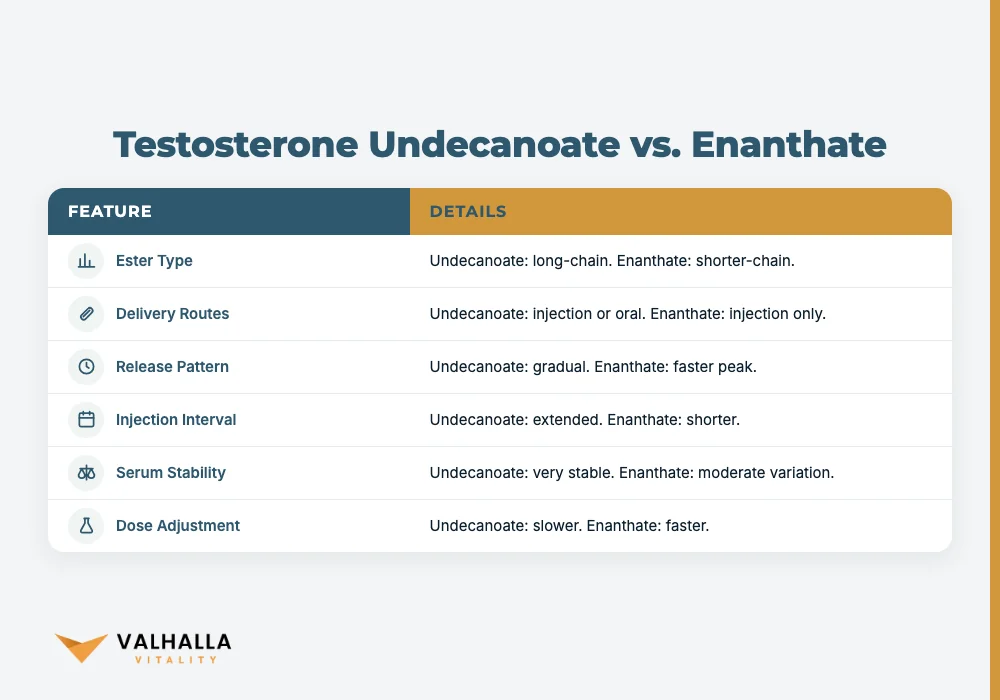
Undecanoate has a long-chain ester that creates a slow, sustained release from the injection site. Enanthate has a shorter ester, releases faster, and produces a more pronounced serum peak within days of injection. That single structural difference drives every practical tradeoff between the two. Ester length dictates everything.
Both compounds are esterified forms of testosterone. The ester molecule determines how quickly testosterone enters circulation after injection, which affects injection frequency, level stability, and how fast a provider can adjust your dose.
| Feature | Testosterone undecanoate | Testosterone enanthate |
|---|---|---|
| Ester type | Long-chain ester | Shorter-chain ester |
| Delivery routes | Injection or oral capsule | Injection only |
| Release pattern | Gradual, sustained depot | Faster peak, quicker clearance |
| Injection interval | Extended (provider-set) | Shorter (provider-set) |
| Serum level stability | Very stable | Moderate variation possible |
| Dose adjustment speed | Slower to reflect in labs | Faster to reflect in labs |
This testosterone ester comparison shows why neither formulation is universally preferred. The right choice depends on your schedule, clinical goals, and what a licensed provider finds in your labs.
How often do you inject testosterone undecanoate compared to enanthate?
Undecanoate requires far fewer injections. The long-chain ester holds testosterone in a slow-release depot within muscle tissue, allowing a licensed provider to schedule injections at extended intervals. Enanthate injection frequency is higher: faster clearance means levels decline sooner, requiring more regular dosing to sustain a stable serum range.
For men managing busy schedules, the reduced frequency matters day-to-day. Fewer visits add up. The undecanoate dosing schedule is extended by design; the enanthate schedule is shorter by necessity.
The tradeoff is response time. Because undecanoate stays active for weeks, a provider cannot adjust your dose and observe the result in labs quickly. With enanthate, lab feedback arrives faster, which may be useful when dialing in an initial dose. A licensed provider sets the exact interval after reviewing baseline labs and monitoring your response over time.
Can testosterone undecanoate be taken orally instead of by injection?
Yes. Testosterone undecanoate is the only commonly prescribed testosterone ester with an approved oral capsule form. Enanthate has no oral equivalent. The oral vs injectable testosterone question is therefore relevant only to undecanoate.
The oral capsule is absorbed through the lymphatic system, bypassing the liver's first-pass metabolism more effectively than older oral androgens. Hepatic exposure is reduced but not eliminated. That distinction matters clinically.
A 2025 review in Sexual Medicine Reviews (Goldstein et al.) examined newer oral undecanoate formulations and noted that liver side effects remain a monitoring consideration with long-term use. The oral form requires daily dosing because its effect duration is much shorter than the injectable version. For a detailed side-by-side of these two delivery approaches, see this guide on oral vs injectable testosterone methods.
Is testosterone undecanoate or enanthate better for TRT?
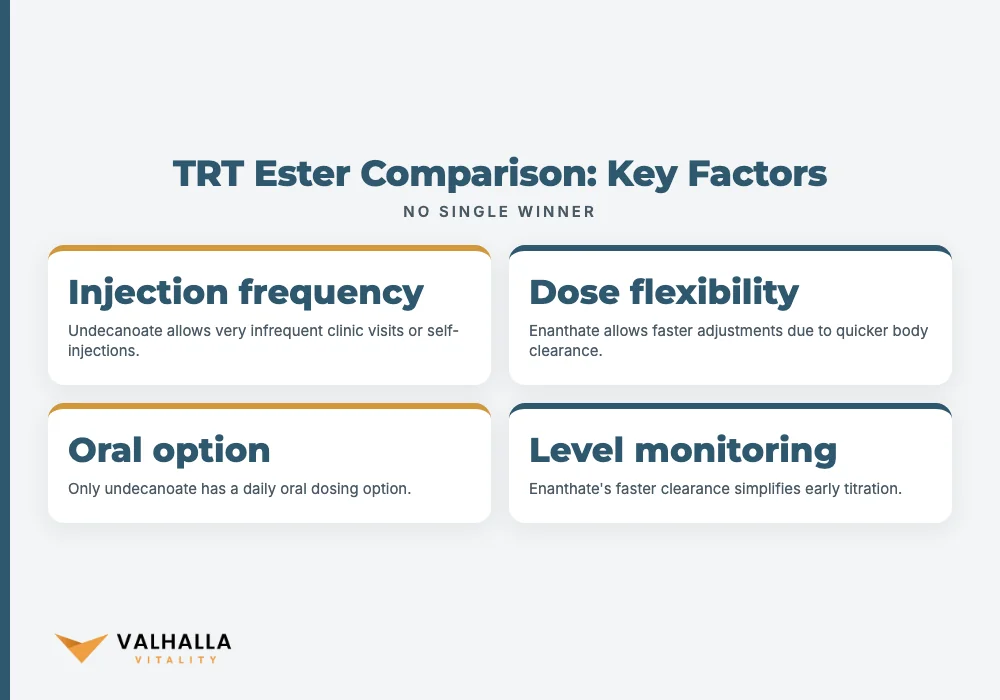
Neither is objectively better. The testosterone undecanoate vs enanthate decision depends on factors a licensed provider evaluates at intake:
- Injection frequency. Men who prefer very infrequent clinic visits or self-injections often find injectable undecanoate's extended interval practical.
- Dose flexibility. Enanthate allows faster adjustments because it clears the body sooner. When a provider needs to fine-tune levels more responsively, enanthate offers more leverage.
- Route preference. Only undecanoate has an oral option. Men who prefer to avoid testosterone replacement injections may opt for daily oral dosing instead.
- Level monitoring. Enanthate's faster clearance means lab results reflect dose changes more quickly, which can simplify early titration.
A 2024 systematic review in Frontiers in Endocrinology (Xu et al.) found that testosterone replacement therapy significantly supported erectile function across multiple formulations, with no single ester consistently outperforming others on that measure. No winner exists universally.
For men weighing additional TRT options, see how undecanoate compares to cypionate in terms of injection schedule and half-life.
Testosterone undecanoate vs enanthate: safety and monitoring
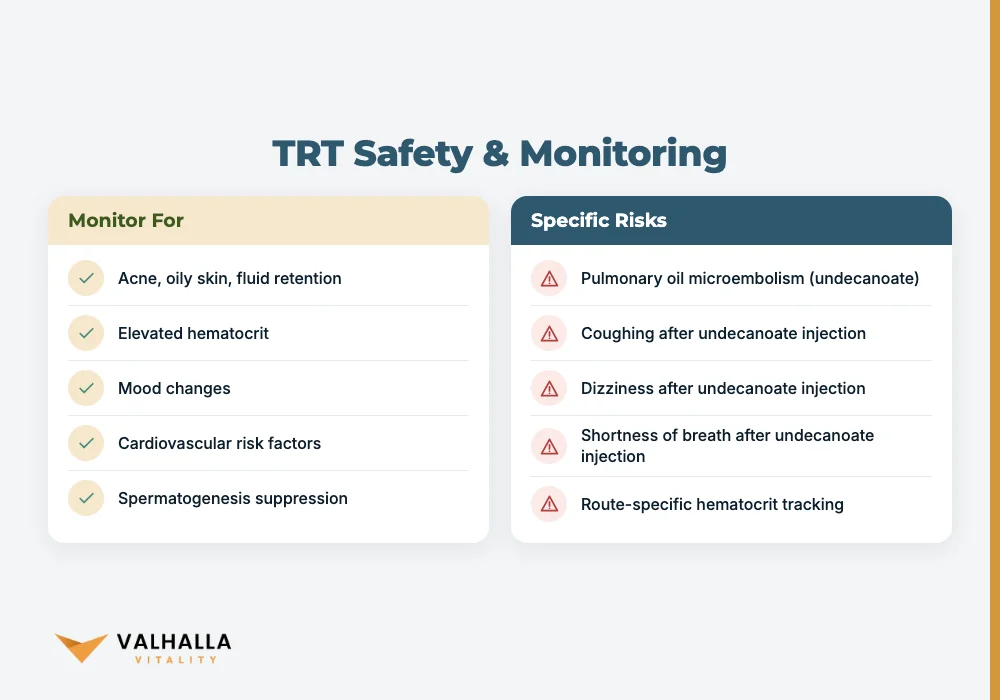
Both formulations share overlapping potential side effects. Acne, oily skin, fluid retention, elevated hematocrit, and mood changes are common to both testosterone undecanoate and enanthate. Men with pre-existing cardiovascular risk factors require regular monitoring throughout therapy, regardless of which ester they use.
One risk is specific to injectable undecanoate. A 2023 literature review in the International Journal of Impotence Research (Adam et al.) documented pulmonary oil microembolism (POME) following intramuscular testosterone undecanoate injection.
Symptoms include coughing, dizziness, and shortness of breath appearing shortly after injection. Observation saves lives here. This is why injectable undecanoate must be administered in a clinical setting with a mandatory post-injection observation period.
Hematocrit elevation is a key monitoring target for all testosterone replacement injections. A 2022 systematic review and meta-analysis in the Journal of Urology (Nackeeran et al.) found that the delivery route affects the degree of hematocrit increase, making route-specific lab tracking essential in long-acting testosterone therapy.
For men of reproductive age, a 2025 review in Nature Reviews Urology (Naelitz et al.) noted that exogenous testosterone, regardless of ester, may suppress spermatogenesis. A provider should discuss fertility implications before initiating any testosterone replacement therapy.
Which testosterone ester is better for bodybuilding?
Neither ester is prescribed for bodybuilding. Both are controlled substances in the US and require a licensed provider prescribing for a confirmed medical indication. No exceptions apply here.
From a pharmacological standpoint, enanthate produces a more pronounced serum peak shortly after injection, followed by a decline between doses. Undecanoate delivers stable levels with minimal fluctuation. For men already receiving medically supervised TRT, that stability may affect energy and day-to-day wellbeing. A licensed provider monitors labs and adjusts the protocol regardless of which ester is prescribed.
Talk with a licensed provider
If you are evaluating testosterone replacement therapy options, Book Your Consultation to have your labs reviewed and get a provider's assessment of which approach fits your clinical picture.
FAQ
What is the difference between testosterone undecanoate and enanthate?
Testosterone undecanoate has a long-chain ester that creates a slow-release depot in muscle tissue, requiring far less frequent injections than enanthate. Enanthate has a shorter ester, clears faster, and produces a more pronounced post-injection serum peak. A licensed provider reviews your labs to determine which formulation fits your needs.
How often do you inject testosterone undecanoate compared to enanthate?
Injectable undecanoate is administered far less often than enanthate, at an extended interval set by a licensed provider. Enanthate injection frequency is higher because its shorter ester causes testosterone levels to decline faster, requiring more regular dosing. Both schedules are determined by your provider based on labs and clinical response.
Is testosterone undecanoate or enanthate better for TRT?
Neither formulation is universally superior. Undecanoate suits men who prefer infrequent injections or an oral option; enanthate suits men who need faster dose adjustments or more responsive lab feedback. A licensed provider weighs your lifestyle, lab trends, and clinical goals before selecting a formulation.
Can testosterone undecanoate be taken orally instead of by injection?
Yes. Testosterone undecanoate is the only commonly prescribed testosterone ester with an approved oral capsule form, absorbed through the lymphatic system. The capsule requires daily dosing and carries liver monitoring considerations. Injectable undecanoate uses a very different, extended-interval schedule set by a provider.
Which testosterone ester is better for bodybuilding?
Neither ester is prescribed for bodybuilding; both require a licensed provider and a confirmed medical indication. Pharmacologically, enanthate produces a higher short-term serum peak while undecanoate provides more stable levels over time. Any use outside of diagnosed hormonal deficiency falls outside standard of care.
Sources
- Goldstein I et al. (2025). Newer formulations of oral testosterone undecanoate: development and liver side effects. Sexual medicine reviews. PubMed
- Xu Z et al. (2024). An updated systematic review and meta-analysis of the effects of testosterone replacement therapy on erectile function and prostate. Frontiers in endocrinology. PubMed
- Adam JA et al. (2023). Occurrence of pulmonary oil microembolism (POME) with intramuscular testosterone undecanoate injection: literature review. International journal of impotence research. PubMed
- Nackeeran S et al. (2022). The Effect of Route of Testosterone on Changes in Hematocrit: A Systematic Review and Bayesian Network Meta-Analysis of Randomized Trials. The Journal of urology. PubMed
- Naelitz BD et al. (2025). Testosterone replacement therapy and spermatogenesis in reproductive age men. Nature reviews. Urology. PubMed
You May Also Like
 Oral Testosterone Undecanoate
Testosterone Decanoate vs Undecanoate: Key Differences
Testosterone decanoate vs undecanoate: compare half-life, injection frequency, and oral absorption to choose the right TRT ester for your needs.
October 7, 2026 ETRead more → Oral Testosterone Undecanoate
Testosterone Undecanoate Oral Dosage: Complete TRT Guide
Testosterone undecanoate oral dosage is set by a licensed provider after lab review. Understand oral TRT protocol, Kyzatrex dosage, and key dosing factors.
October 7, 2026 ETRead more → Oral Testosterone Undecanoate
Testosterone Undecanoate vs Cypionate: Full TRT Guide
Testosterone undecanoate vs cypionate: compare esters, injection frequency, side effects, and oral TRT options to discuss with your provider.
October 6, 2026 ETRead more →