
The following blog post is for entertainment and informational purposes only. It is not intended to provide medical advice or diagnosis. Please consult your doctor before making any health-related decisions.
Oral testosterone fertility is a real clinical concern, not a minor side note, and the broader subject of testosterone therapy, male fertility, and reproductive planning deserves the same clinical attention as symptom management. When the body receives exogenous testosterone, it signals the hypothalamus and pituitary to stop producing the hormones that drive sperm formation, so testosterone and sperm count tend to move in opposite directions during treatment. A 2025 review in Nature Reviews Urology confirmed that testosterone replacement therapy reduces spermatogenesis in reproductive-age men, though recovery after stopping is possible in many cases. Men exploring oral hormone treatment often ask providers about Kyzatrex oral testosterone replacement therapy, which a licensed provider prescribes only after reviewing labs and health history.
What happens to sperm production on testosterone replacement?
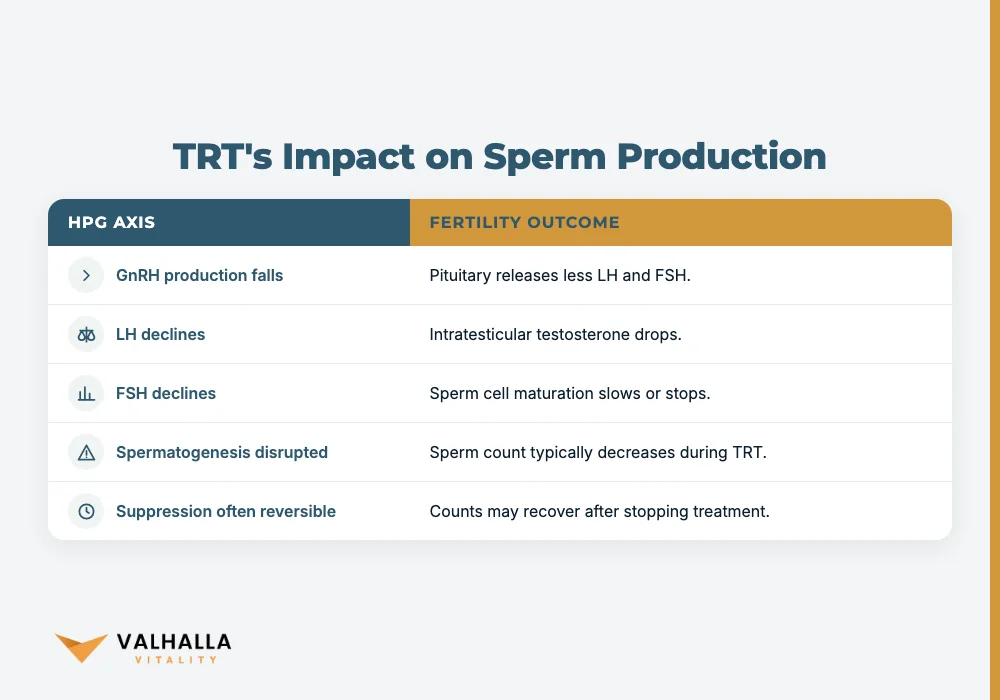
Testosterone replacement therapy suppresses the hormonal signals that drive sperm production. The hypothalamus releases GnRH, prompting the pituitary to produce LH and FSH. These two hormones activate the testes. LH drives testosterone synthesis; FSH drives sperm cell maturation directly.
Exogenous testosterone disrupts this chain. The testes receive minimal stimulation. LH and FSH fall. The result is reduced TRT sperm production, sometimes reaching very low counts, as Ohlander et al. documented in their 2016 Urologic Clinics of North America review on testosterone and male infertility.
This suppression operates regardless of how testosterone is delivered. Injections, gels, and oral capsules all raise systemic testosterone and activate the same negative feedback loop. TRT and sperm count are pharmacologically linked across every delivery route.
| HPG axis effect | Outcome for fertility |
|---|---|
| GnRH production falls | Pituitary releases less LH and FSH |
| LH declines | Intratesticular testosterone drops |
| FSH declines | Sperm cell maturation slows or stops |
| Spermatogenesis disrupted | Sperm count typically decreases during TRT |
| Suppression is often reversible | Counts may recover after stopping treatment |
Does oral testosterone therapy affect fertility?
Yes. Oral testosterone therapy affects fertility through the same HPG-axis suppression as injectable or topical routes. Testosterone replacement infertility is a predictable pharmacological effect, not a rare outlier, as Ohlander et al. (2016) note.
Oral testosterone undecanoate undergoes hepatic first-pass metabolism before reaching full systemic circulation. This lowers bioavailability compared to injected testosterone. Some researchers have proposed that lower peak levels may produce modestly weaker HPG suppression. In practice, however, no oral formulation has been shown to preserve fertility at therapeutic doses, according to the 2025 review by Naelitz et al.
Men managing low testosterone sperm count face a genuine choice between treating hypogonadism symptoms and protecting spermatogenesis. For a broader look at the clinical risk profile of oral testosterone for men beyond fertility, the available evidence adds useful context to that decision.
Does oral testosterone affect sperm differently than injections?
Possibly less suppressive, but not reliably different enough to treat as fertility-safe. Hepatic metabolism reduces systemic exposure with oral testosterone undecanoate relative to intramuscular routes, which in theory produces a weaker negative feedback signal on the HPG axis.
In practice, Naelitz et al. (2025) found that no TRT formulation currently preserves fertility at therapeutic doses in reproductive-age men. Route choice shapes pharmacokinetics; it does not change the underlying mechanism. Men comparing how oral TRT and injectable testosterone differ across clinical outcomes should still account for the fertility trade-off regardless of which route they consider.
Is sperm count loss from TRT reversible?
For most men, yes. After stopping testosterone therapy, the HPG axis typically resumes normal signaling. LH and FSH rise. Spermatogenesis restarts, and sperm counts often return to measurable levels within weeks to several months.
Recovery is not always complete. Naelitz et al. (2025) note that older men and those with pre-existing testicular concerns may have incomplete or delayed recovery. Duration of TRT also influences outcomes. A semen analysis before starting treatment creates a baseline that both provider and patient can compare against if recovery becomes a question later. That baseline matters.
Managing oral testosterone fertility concerns
A semen analysis before treatment begins is the most practical step a man can take when oral testosterone fertility questions are on the table. It records baseline sperm count, motility, and morphology. Periodic testing during treatment shows how much suppression has occurred and whether it is deepening over time.
Labs including LH, FSH, total testosterone, and estradiol fill out the hormonal picture. Individual responses vary significantly. Some men maintain measurable sperm counts throughout TRT; others drop to very low levels within a few months. Age, starting testicular function, and genetics all influence how strongly the HPG axis suppresses. A licensed provider monitors these markers over time and adjusts the treatment approach based on results, not assumptions.
Alternatives for men where fertility is the priority
When preserving fertility is the primary goal, treatments that stimulate the body's own testosterone production may be more appropriate than replacement therapy.
Enclomiphene and clomiphene citrate block estrogen receptors at the hypothalamus, increasing GnRH output and raising LH and FSH naturally. Testosterone rises without suppressing spermatogenesis. A 2018 study in European Urology Focus (Scovell et al.) found clomiphene achieved comparable testosterone recovery to TRT in young hypogonadal men while preserving the HPG axis. Men interested in that option can review how enclomiphene supports testosterone and fertility simultaneously before discussing it with a provider.
Sperm cryopreservation is worth considering before starting TRT. Banking a sample beforehand preserves options for assisted reproduction methods such as IUI or IVF, regardless of what happens to sperm count during treatment.
At Valhalla Vitality, a licensed provider reviews intake, lab results, and reproductive goals before determining whether any therapy is appropriate, because oral testosterone fertility questions are part of the clinical picture, not an afterthought.
Talk to a licensed provider
A licensed provider can review your labs, health history, and reproductive goals to help clarify your options: Book Your Consultation.
FAQ
Can you have children while on testosterone therapy?
It is possible but more difficult. TRT typically suppresses sperm production, making natural conception harder during treatment. Men who want to father children while managing low testosterone should discuss sperm banking or alternatives that preserve HPG function with a licensed provider before starting any testosterone therapy.
Is sperm count loss from TRT reversible?
In most men, yes. After stopping TRT, the HPG axis typically resumes normal function and sperm counts often recover within weeks to several months. Recovery is not certain, and the timeline depends on age, treatment duration, and pre-existing testicular health.
Does oral testosterone affect sperm differently than injections?
Oral testosterone undergoes hepatic first-pass metabolism, reducing systemic bioavailability compared to injections. This may result in slightly less HPG suppression in theory. However, no oral TRT formulation has been shown to reliably preserve fertility at therapeutic doses.
What should I do before starting TRT if I want to father children?
Have a baseline semen analysis before beginning any testosterone therapy. If fertility matters now or in the future, a licensed provider may recommend sperm banking or an alternative treatment that stimulates natural testosterone production without suppressing the HPG axis.
How long does sperm recovery take after stopping testosterone therapy?
Recovery timelines vary widely between men. Many see improvements within weeks to several months of stopping TRT. Men who were on therapy for extended periods or had pre-existing testicular concerns may take longer or have incomplete recovery.
Sources
- Naelitz BD et al. (2025). Testosterone replacement therapy and spermatogenesis in reproductive age men. Nature Reviews Urology. PubMed
- Ohlander SJ et al. (2016). Testosterone and Male Infertility. The Urologic Clinics of North America. PubMed
- Scovell JM et al. (2018). Testosterone Replacement Therapy Versus Clomiphene Citrate in the Young Hypogonadal Male. European Urology Focus. PubMed
You May Also Like
 Oral testosterone
Oral Testosterone Therapy: Energy, Side Effects & Results
Oral testosterone therapy may improve energy and ease fatigue in men with low T. Learn how it works, what side effects to expect from treatment.
October 7, 2026 ETRead more → Oral testosterone
Oral Testosterone Therapy: Options, Benefits, and Risks
Oral testosterone therapy delivers TRT in pill form. Learn how testosterone undecanoate capsules work, who qualifies, and key side effects to watch.
October 6, 2026 ETRead more → Oral testosterone
Oral Testosterone vs Injection: Choosing Your TRT Method
Oral testosterone vs injection explained: compare bioavailability, liver impact, and convenience to find the TRT method that fits your lifestyle.
October 4, 2026 ETRead more →