
The following blog post is for entertainment and informational purposes only. It is not intended to provide medical advice or diagnosis. Please consult your doctor before making any health-related decisions.
Enclomiphene benefits men with secondary hypogonadism by stimulating the body's own testosterone production rather than replacing it from an external source. The compound blocks estrogen receptors in the hypothalamus and pituitary, prompting the brain to release more LH and FSH, which in turn raises testosterone from the testes. If symptoms of low testosterone affect daily life, book your consultation with a licensed provider to review your labs.
What is secondary hypogonadism treatment with enclomiphene?
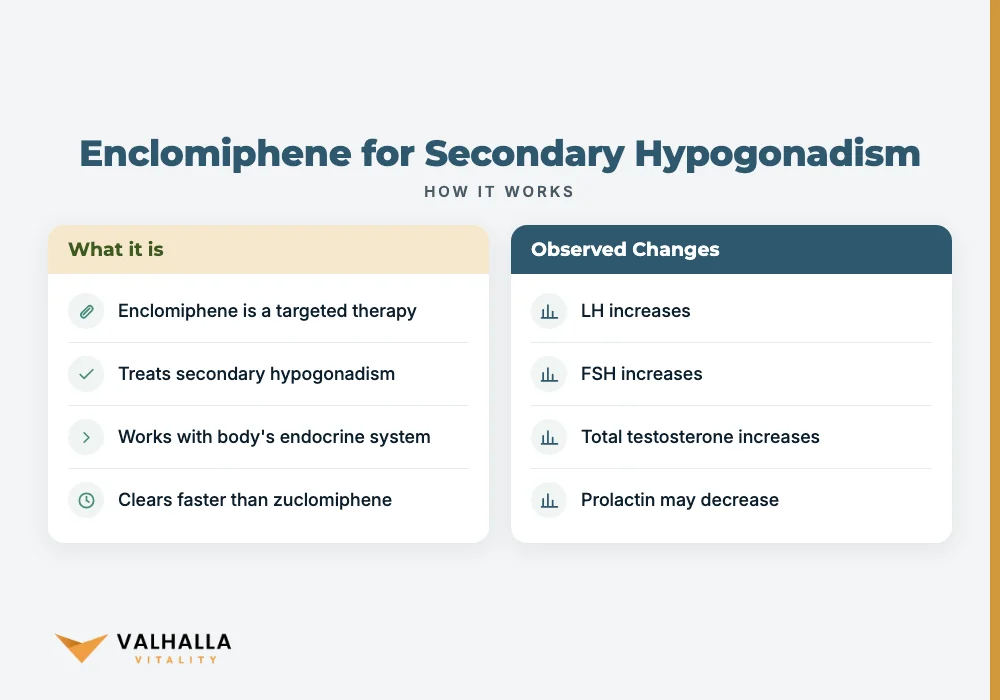
Secondary hypogonadism means the testes are functional, but the hypothalamic-pituitary axis is not sending the right signals. That distinction matters. Rodriguez et al. (2016) in Expert Opinion on Pharmacotherapy described enclomiphene citrate as a targeted secondary hypogonadism treatment, distinguishing it from primary hypogonadism where testicular function itself is impaired.
Enclomiphene is the trans-isomer of clomiphene. It clears the body faster than its cis-isomer, zuclomiphene. Faster clearance reduces cumulative estrogen-like effects over time. A 2022 systematic review by Huijben et al. in Andrology found consistent LH, FSH, and testosterone improvements across clomiphene-family trials in men.
The European Academy of Andrology guidelines (Corona et al., 2020) note that functional hypogonadism in men often links to obesity, metabolic syndrome, and aging. These conditions disrupt the signaling pathway rather than the testes directly.
In this context, enclomiphene benefits men by working with the body's existing endocrine system rather than overriding it.
Hormonal changes observed in men treated with enclomiphene:
| Hormone | Typical direction |
|---|---|
| LH | Increases |
| FSH | Increases |
| Total testosterone | Increases |
| Prolactin | May decrease |
Enclomiphene benefits men: what the clinical trials show
The clearest evidence covers secondary hypogonadism. A 2025 meta-analysis by Hohl et al. in Archives of Endocrinology and Metabolism reviewed randomized controlled trials on enclomiphene and clomiphene in men and found both compounds raised testosterone in eligible patients. This is currently the most comprehensive review of the RCT evidence.
Response varies by individual. Providers monitor lab values at regular intervals to confirm the testosterone response and catch any adverse effects early. A licensed provider determines the enclomiphene dosage after labs, not before.
Does enclomiphene work for low testosterone?
Yes, but patient selection matters. Enclomiphene works when the testes are intact and the upstream signal is deficient. It will not restore testosterone in primary hypogonadism, where the testes themselves are impaired.
For men whose low testosterone stems from a disrupted hypothalamic-pituitary signal, evidence from Hohl et al. (2025) and Rodriguez et al. (2016) supports the approach. A licensed provider confirms eligibility through blood work, not symptom reports alone.
Enclomiphene vs testosterone therapy
Both approaches raise circulating testosterone. The mechanisms differ fundamentally.
Testosterone replacement therapy delivers testosterone directly and suppresses LH and FSH in the process. The Endocrine Society clinical practice guideline (Bhasin et al., 2018) explicitly warns against TRT in men who wish to father children in the near term, because LH and FSH suppression reduces sperm production.
Enclomiphene works upstream. It raises LH and FSH. The testes then produce testosterone naturally. Testicular function is maintained, not bypassed. A detailed look at how enclomiphene citrate is used clinically covers the prescribing criteria and monitoring approach in more depth.
Neither option is universally superior. Provider and patient must weigh goals, reproductive plans, and lab values together before choosing a path.
Enclomiphene and fertility
Because enclomiphene raises FSH alongside LH, it may support sperm production. This contrasts directly with TRT. Rodriguez et al. (2016) highlighted this as a key advantage for men with secondary hypogonadism who want to preserve fertility while addressing low testosterone.
Anawalt et al. (2026) in JAMA confirm that hypogonadotropic hypogonadism, defined as low LH, FSH, and testosterone together, is a recognized form of adult male hypogonadism with established treatment pathways. Enclomiphene addresses this hormonal pattern by restoring the upstream signal. Men interested in what physical changes may follow treatment can find a detailed breakdown in the linked resource.
What are the side effects of enclomiphene?
Enclomiphene side effects reported in clinical studies include mood and energy changes, mild vision disturbances, alterations in libido, and hair thinning in men predisposed to male-pattern alopecia. Most are dose-related and tend to resolve when the dose is adjusted or stopped.
Providers track lab values throughout treatment, including hematocrit and liver enzymes. The monitoring guidance during enclomiphene treatment details what labs providers follow and what changes to report. The Hohl meta-analysis (2025) noted that safety data from available RCTs are present, though long-term follow-up data remain limited.
Can enclomiphene cause blood clots?
Blood clot risk has not been identified as a primary enclomiphene-specific concern in published clinical reviews. Any therapy that raises testosterone can increase red blood cell production and hematocrit. Elevated hematocrit raises blood viscosity and cardiovascular risk. Routine monitoring includes hematocrit checks to catch this early.
Enclomiphene blood pressure risk
Clinical literature noted that enclomiphene increased hemoglobin in patients with chronic kidney disease and elevated blood pressure. Elevated hemoglobin and hematocrit are relevant cardiovascular markers. Providers screen for pre-existing cardiovascular conditions before prescribing and monitor blood pressure alongside hormone levels throughout treatment.
How long does enclomiphene take to work?
Testosterone levels may begin rising within the first few weeks, as LH and FSH respond to receptor blockade. That is the hormonal shift. Symptom changes, including improvements in energy, mood, and libido, typically lag behind lab results by several weeks to a few months.
Lab values at regular intervals confirm whether the response is adequate. A licensed provider determines the dose after labs and adjusts based on follow-up results. The full range of enclomiphene benefits men may notice unfolds over months, not days. Individual timelines depend on baseline hormone levels and metabolic factors.
Can a doctor prescribe enclomiphene?
Yes. A licensed provider can prescribe enclomiphene when labs and clinical findings support it. It is dispensed through compounding pharmacies, not sold as an approved branded drug. Availability varies by state.
The process begins with a medical intake and blood work: total testosterone, LH, FSH, and a full metabolic panel. The provider reviews these results before recommending treatment. Anawalt et al. (2026) in JAMA confirm that adult male hypogonadism is a recognized clinical condition with established evaluation pathways. Valhalla Vitality walks through the full telehealth process, from intake to prescription delivery.
Ready to talk to a licensed provider?
Book Your Consultation with a licensed provider who reviews your labs and guides the next steps.
FAQ
Does enclomiphene increase testosterone levels?
Enclomiphene may raise LH and FSH, which signal the testes to produce more testosterone in men with secondary hypogonadism. A 2025 meta-analysis by Hohl et al. found consistent testosterone increases across randomized controlled trials. A licensed provider confirms eligibility through blood work before prescribing.
What are the most common enclomiphene side effects?
The most reported side effects are mood and energy changes, mild vision disturbances, and libido alterations. Hair thinning can occur in men with a genetic predisposition. Most effects are dose-related and tend to resolve when treatment is adjusted or stopped.
Can enclomiphene preserve fertility while treating low testosterone?
Unlike testosterone replacement therapy, enclomiphene raises FSH alongside testosterone, which may support sperm production. Rodriguez et al. (2016) identified this as a key clinical advantage for men with fertility concerns. A provider evaluates fertility-specific lab work before recommending any hormone therapy.
How does enclomiphene dosage get determined?
A licensed provider determines the dose after reviewing labs and monitoring the response at follow-up visits. No patient-selected dosing applies; dose adjustments depend on blood work and symptom reports. Regular lab monitoring is standard throughout the treatment process.
Is enclomiphene available without a prescription?
No. Enclomiphene requires a prescription from a licensed provider. It is dispensed through compounding pharmacies, and availability varies by state. A full medical intake and lab review are required before any prescription is issued.
Sources
- Hohl A et al. (2025). Clomiphene or enclomiphene citrate for the treatment of male hypogonadism: a systematic review and meta-analysis of randomized controlled trials. Archives of endocrinology and metabolism. PubMed
- Rodriguez KM et al. (2016). Enclomiphene citrate for the treatment of secondary male hypogonadism. Expert opinion on pharmacotherapy. PubMed
- Huijben M et al. (2022). Clomiphene citrate for men with hypogonadism: a systematic review and meta-analysis. Andrology. PubMed
- Corona G et al. (2020). European Academy of Andrology (EAA) guidelines on investigation, treatment and monitoring of functional hypogonadism in males: Endorsing organization: European Society of Endocrinology. Andrology. PubMed
- Bhasin S et al. (2018). Testosterone Therapy in Men With Hypogonadism: An Endocrine Society Clinical Practice Guideline. The Journal of clinical endocrinology and metabolism. PubMed
- Anawalt BD et al. (2026). Adult Male Hypogonadism: A Review. JAMA. PubMed
You May Also Like
 Enclomiphene
Enclomiphene vs Nolvadex: PCT and Low Testosterone Guide
Enclomiphene vs nolvadex: compare how each SERM restores testosterone after a cycle, which is safer for PCT, and how a provider decides between them.
October 16, 2026 ETRead more → Enclomiphene
Enclomiphene and Alcohol: What Men on Therapy Need to Know
Enclomiphene and alcohol may reduce therapy effectiveness. Learn how drinking affects testosterone, estrogen, and liver metabolism on therapy.
October 16, 2026 ETRead more → Enclomiphene
Enclomiphene Acne: Causes, Treatment and Prevention
Enclomiphene acne develops when rising testosterone overstimulates oil glands. Learn which men face the highest risk and how to manage breakouts.
October 16, 2026 ETRead more →