
The following blog post is for entertainment and informational purposes only. It is not intended to provide medical advice or diagnosis. Please consult your doctor before making any health-related decisions.
Tirzepatide cost monthly falls into a wide range, driven by formulation type, insurance coverage, and the dose a provider determines you need. For people paying out of pocket, compounded tirzepatide is typically the more accessible option. That gap can be significant. Understanding those variables before you start is the clearest path to planning your tirzepatide weight loss treatment budget.
How does tirzepatide work?
Tirzepatide is a dual receptor agonist. It activates both the GIP receptor and the GLP-1 receptor simultaneously, which distinguishes it from earlier GLP-1-only therapies. That dual action may reduce appetite more effectively, slow gastric emptying, and improve insulin sensitivity, according to a 2025 systematic review in Frontiers in Endocrinology (Tian Q et al.).
The FDA has approved tirzepatide for adults with type 2 diabetes and, separately, for chronic weight management. A licensed provider determines whether the therapy is appropriate after reviewing your intake and labs. If you are researching a tirzepatide dosage guide, the right starting point is a clinical evaluation, not a self-selected protocol. For more on how the therapy supports metabolic health, see tirzepatide metabolic benefits.
Key factors in tirzepatide cost monthly
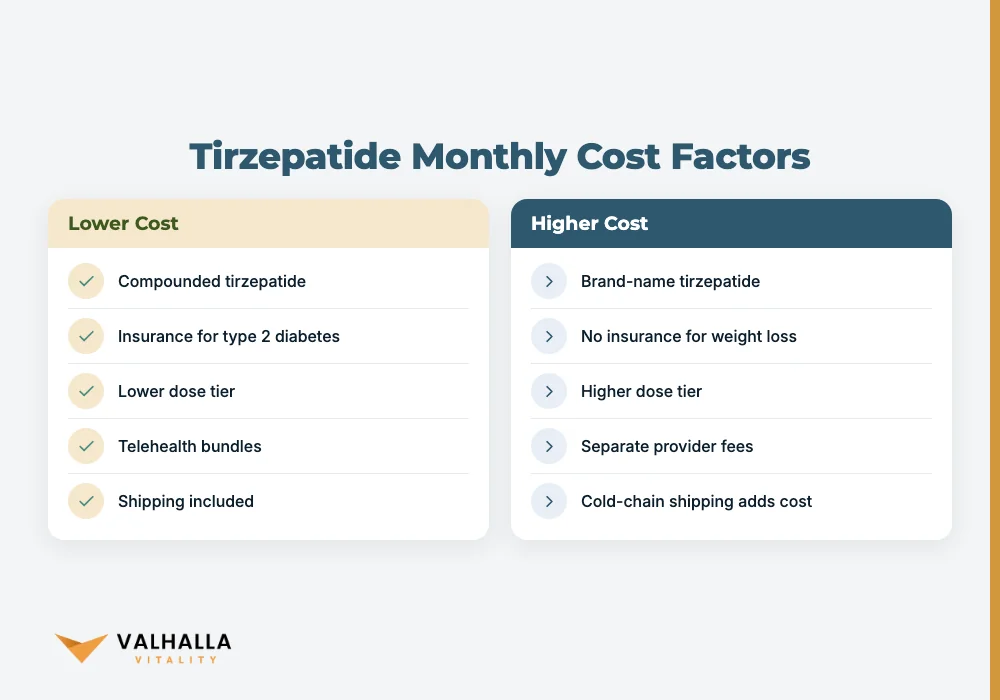
| Factor | What it means for your monthly total |
|---|---|
| Brand vs. compounded | Brand-name carries a higher list price; compounded from a licensed pharmacy typically costs less |
| Insurance coverage | May offset brand costs for type 2 diabetes; rarely covers weight-loss use without a qualifying diagnosis |
| Dose tier | Higher dose tiers cost more; a provider determines the appropriate level |
| Provider and monitoring fees | Telehealth bundles often include consultation in the monthly cost |
| Delivery | Cold-chain shipping may add to the total; some telehealth programs include it |
How much does tirzepatide cost per month without insurance?
Without insurance, tirzepatide cost monthly depends primarily on formulation type. Brand-name tirzepatide carries one of the higher list prices among injectable weight-loss therapies. That matters for direct-pay patients. Compounded tirzepatide price, set by the compounding pharmacy, is typically a fraction of the brand figure, making it the more common path for people paying out of pocket.
The total monthly spend also covers consultation, provider oversight, and delivery. At Valhalla Vitality, those elements are bundled into a single service, with provider approval typically delivered within 24 business hours of order placement and medication shipped in approximately 3 to 7 business days from the time the prescription is transferred to the pharmacy. Availability varies by state.
Is tirzepatide covered by insurance for weight loss?
It depends on your plan and your diagnosis. Most commercial insurance plans will cover tirzepatide when prescribed for type 2 diabetes. For weight management alone, coverage is inconsistent. Many plans require prior authorization with documented medical necessity, and some exclude anti-obesity medications altogether.
Medicare and Medicaid coverage has expanded in recent years for some GLP-1-based therapies, but specific formulary inclusions vary by plan year and state. If your insurer declines coverage, compounded tirzepatide through a direct-pay telehealth program is typically the most cost-accessible route. Availability varies by state.
How much weight can you lose on tirzepatide?
Tirzepatide weight loss results depend on the individual. Outcomes vary based on dose level, adherence, diet, activity, and baseline metabolic profile. Clinical evidence supports meaningful body weight reductions. A 2025 systematic review in Frontiers in Endocrinology (Tian Q et al.) confirmed tirzepatide's efficacy for weight loss in people with obesity or type 2 diabetes. A 2023 systematic review in the International Journal of Obesity (Tan B et al.) found consistent reductions in body weight and waist circumference across Phase 3 trials.
Tirzepatide may also support improvements in blood pressure, lipid levels, and systemic inflammation. A 2026 meta-analysis in Reviews in Endocrine & Metabolic Disorders (Masson W et al.) documented anti-inflammatory effects associated with the therapy. Those broader metabolic changes are part of why providers consider tirzepatide in patients with elevated cardiovascular risk, not only those focused on weight.
What are the most common tirzepatide side effects?
The most common tirzepatide side effects are gastrointestinal. Nausea, diarrhea, and vomiting are reported most frequently, particularly in the early weeks of treatment or after a dose increase. These effects typically ease as the body adjusts. Injection site reactions are mild and common.
Rarer but more serious risks include pancreatitis, hypoglycemia (particularly when combined with insulin or other glucose-lowering agents), and allergic reactions. For a comprehensive breakdown of what to monitor across treatment, see our tirzepatide side effects overview. A provider reviews your complete medical history before prescribing to screen for contraindications.
How does tirzepatide compare to semaglutide for weight loss?
In Phase 3 trial analyses, tirzepatide showed greater body weight reduction than semaglutide at the highest studied doses. The tirzepatide vs semaglutide comparison matters because the two therapies take different mechanistic paths. Semaglutide targets only the GLP-1 receptor. Tirzepatide adds GIP receptor activation. That second pathway appears to drive the stronger outcomes seen in comparative data.
A 2025 systematic review in Diabetes & Metabolic Syndrome (Singh A et al.) compared Phase 3 data for both therapies and placed tirzepatide ahead on weight endpoints. A 2024 network meta-analysis in the BMJ (Yao H et al.) similarly ranked tirzepatide above GLP-1-only therapies on glycemic control and weight outcomes. The pattern holds across multiple analyses. For a detailed side-by-side review, see our tirzepatide and semaglutide clinical comparison. Our semaglutide cost breakdown covers how the same cost factors apply to semaglutide.
Review your tirzepatide cost monthly options
A licensed provider reviews your intake and determines whether tirzepatide is appropriate for you, including what your personal monthly cost would look like. Book Your Consultation to take the first step.
FAQ
How is tirzepatide cost monthly calculated?
Tirzepatide cost monthly reflects the formulation type, the dose level a provider determines, consultation fees, and delivery. Compounded tirzepatide typically costs less than the brand version, particularly for self-pay patients.
Does compounded tirzepatide work the same way as the brand version?
Compounded tirzepatide uses the same active molecule but has not been evaluated by the FDA for safety, effectiveness, or quality. A licensed provider reviews your intake to determine whether this option is appropriate for you.
What should I know before looking for a tirzepatide dosage guide?
There is no universal starting protocol. A licensed provider determines the appropriate dose after reviewing your labs and health history, then increases it gradually under clinical supervision.
Is compounded tirzepatide price worth it compared to brand?
For many self-pay patients, compounded tirzepatide price is significantly lower than the brand-name alternative. Clinical suitability is determined by a licensed provider based on your individual health profile.
Can insurance reduce tirzepatide cost monthly?
Insurance may cover tirzepatide for type 2 diabetes management, but coverage for weight loss alone is inconsistent and often requires prior authorization. A provider can help document medical necessity to support a coverage request.
Sources
- Tian Q et al. (2025). Efficacy and safety of tirzepatide for weight loss in patients with obesity or type 2 diabetes: a systematic review and meta-analysis. Frontiers in Endocrinology. PubMed
- Tan B et al. (2023). Efficacy and safety of tirzepatide for treatment of overweight or obesity. A systematic review and meta-analysis. International Journal of Obesity. PubMed
- Masson W et al. (2026). Anti-inflammatory effects of tirzepatide: a systematic review and meta-analysis. Reviews in Endocrine & Metabolic Disorders. PubMed
- Singh A et al. (2025). Comparative efficacy and safety of semaglutide 2.4 mg and tirzepatide 5-15 mg in obesity with or without type 2 diabetes: a systematic review of Phase 3 clinical trials. Diabetes & Metabolic Syndrome. PubMed
- Yao H et al. (2024). Comparative effectiveness of GLP-1 receptor agonists on glycaemic control, body weight, and lipid profile for type 2 diabetes: systematic review and network meta-analysis. BMJ. PubMed
You May Also Like
 Tirzepatide
 benefits: weight loss and metabolic health
Tirzepatide benefits include weight loss, better blood sugar control, and cardiovascular improvements. Learn how this GLP-1 GIP dual agonist works.
November 4, 2026 ETRead more → Tirzepatide
 Weight Loss: How It Works and What to Expect
Tirzepatide weight loss treatment targets GLP-1 and GIP receptors to curb appetite. Learn side effects, cost, and how a provider prescribes this therapy.
November 4, 2026 ETRead more → Tadalafil
Buy Tadalafil Online: A Safe Guide to ED Treatment
Buy tadalafil online safely with a valid prescription. Learn how it works, what side effects to expect, and how provider-guided ordering works.
November 7, 2026 ETRead more →