
The following blog post is for entertainment and informational purposes only. It is not intended to provide medical advice or diagnosis. Please consult your doctor before making any health-related decisions.
Tirzepatide vs semaglutide is one of the most common weight loss medication comparisons that patients bring to telehealth providers today. Both are weekly GLP-1 weight loss injections, both reduce appetite and improve insulin sensitivity, and both require a licensed provider's review before use. The critical difference is mechanism: tirzepatide is a GIP GLP-1 dual agonist that engages two hormone receptors, while semaglutide targets only the GLP-1 receptor, and clinical research consistently links that second receptor to greater average weight reductions. To discuss whether either option may be appropriate for your health profile, speaking with a licensed provider is the right first step.
At a glance: tirzepatide vs semaglutide
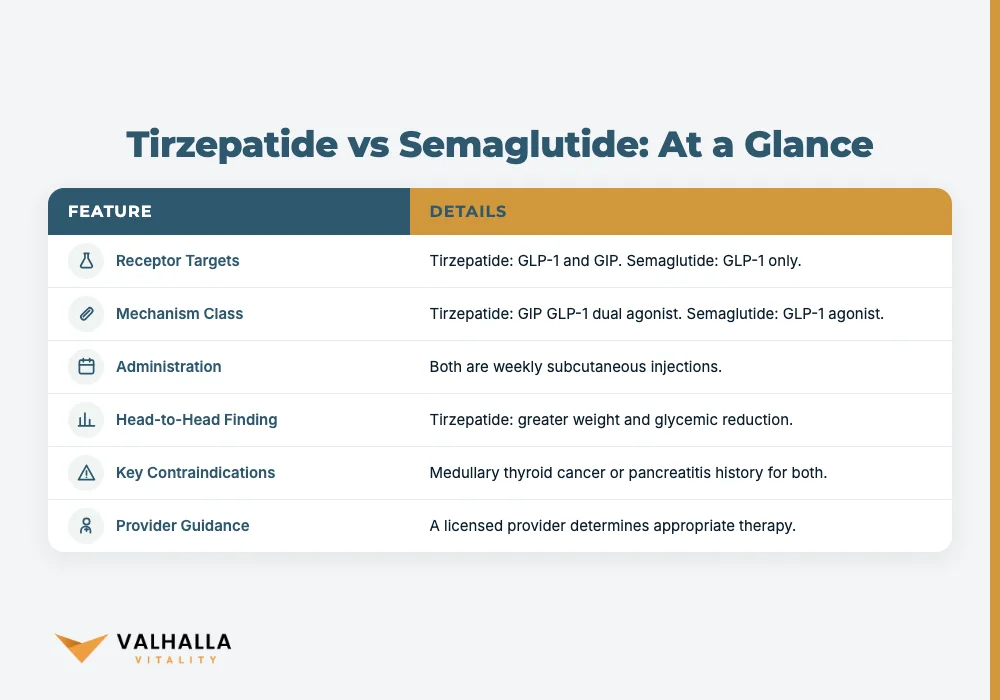
The table below captures the core structural differences. Individual outcomes vary based on health history and a licensed provider's clinical judgment.
| Tirzepatide | Semaglutide | |
|---|---|---|
| Receptor targets | GLP-1 and GIP | GLP-1 only |
| Mechanism class | GIP GLP-1 dual agonist | GLP-1 agonist |
| Administration | Weekly subcutaneous injection | Weekly subcutaneous injection |
| Regulatory status | Type 2 diabetes (2022); weight management | Type 2 diabetes; weight management |
| Head-to-head finding | Consistently greater weight and glycemic reduction | Meaningful weight and glycemic reduction; longer post-market history |
| Key contraindications | Medullary thyroid cancer history; pancreatitis history | Medullary thyroid cancer history; pancreatitis history |
A licensed provider determines whether either therapy is appropriate after reviewing your intake.
Patients familiar with brand names often encounter this comparison framed as a search for "Mounjaro vs Ozempic." Mounjaro is the branded tirzepatide formulation currently indicated for type 2 diabetes; Ozempic and Wegovy are semaglutide's brand names for type 2 diabetes and weight management respectively. The clinical data reviewed in this article applies to the underlying compounds rather than any single branded product.
How does tirzepatide work differently than semaglutide?
Tirzepatide works differently than semaglutide because it activates a second hormone receptor, the GIP receptor, alongside the GLP-1 receptor that semaglutide targets. That dual receptor mechanism is the defining structural difference between the two drugs. Semaglutide is a GLP-1 receptor agonist only. Tirzepatide is a GIP GLP-1 dual agonist that operates across both pathways.
GLP-1 stands for glucagon-like peptide-1. It is a gut hormone released after meals that slows gastric emptying, reduces appetite, and stimulates insulin secretion in a glucose-dependent manner. GIP stands for glucose-dependent insulinotropic polypeptide, a second incretin hormone released from the gut in response to food. GIP activity increases insulin sensitivity, promotes triglyceride clearance from the bloodstream, and influences how the body manages fat storage. The tirzepatide mechanism of action therefore engages these two overlapping but distinct metabolic pathways.
What the GIP receptor adds
Evidence suggests that GLP-1 and GIP signals may amplify each other when engaged together, rather than simply adding up. Rizvi and Rizzo noted in a 2022 review in Diabetes, Metabolic Syndrome and Obesity that dual GLP-1 and GIP receptor agonism produces complementary improvements in glycemic management and cardiovascular risk factors that neither pathway fully achieves on its own. That dual synergy is why researchers consistently frame the tirzepatide mechanism of action as structurally distinct from a standard GLP-1-only approach.
Semaglutide carries no GIP activity. That is the precise structural reason the tirzepatide vs semaglutide comparison in clinical trials consistently favors tirzepatide on weight-related endpoints.
Which is more effective for weight loss, tirzepatide or semaglutide?
Tirzepatide outperforms semaglutide on weight reduction in clinical data. A 2024 systematic review and network meta-analysis in Diabetologia by Karagiannis et al. analyzed randomized controlled trial data from adults with type 2 diabetes and found that subcutaneously administered tirzepatide produced significantly greater reductions in body weight and HbA1c compared with semaglutide. The advantage was consistent across the comparisons examined.
For weight management in adults with obesity, the SURMOUNT-1 trial (Jastreboff et al., 2022, New England Journal of Medicine) established that tirzepatide produces meaningful and sustained reductions in body weight. Separately, Ghusn et al. published a 2022 observational analysis in JAMA Network Open examining semaglutide weight loss results in real-world populations with overweight or obesity, confirming that semaglutide produces clinically significant outcomes outside of controlled trial settings.
Both drugs are effective as GLP-1 weight loss injections. Tirzepatide's additional GIP receptor mechanism consistently drives greater average reductions. Whether that gap is clinically meaningful for any individual patient is a question a licensed provider answers through direct evaluation.
How much weight can you lose on tirzepatide vs semaglutide?
Clinical trials demonstrate that both tirzepatide and semaglutide produce substantial reductions in body weight. Tirzepatide consistently shows greater average reductions than semaglutide across head-to-head analyses. That directional advantage is well-established across multiple independent studies.
Trial results reflect specific populations under controlled conditions. Individual responses depend on starting body weight, baseline metabolic health, comorbidities, adherence, and the clinical decisions a licensed provider makes over time. No single study predicts what any individual will experience. The evidence tells us which drug class works and which version of that comparison tends to come out ahead; it does not substitute for a personalized clinical evaluation.
For a closer look at the trial findings behind this weight loss medication comparison, our review of tirzepatide and semaglutide weight loss outcomes covers the key studies in detail. Individual questions about expected outcomes belong in a conversation with a licensed provider.
What are the side effects of tirzepatide vs semaglutide?
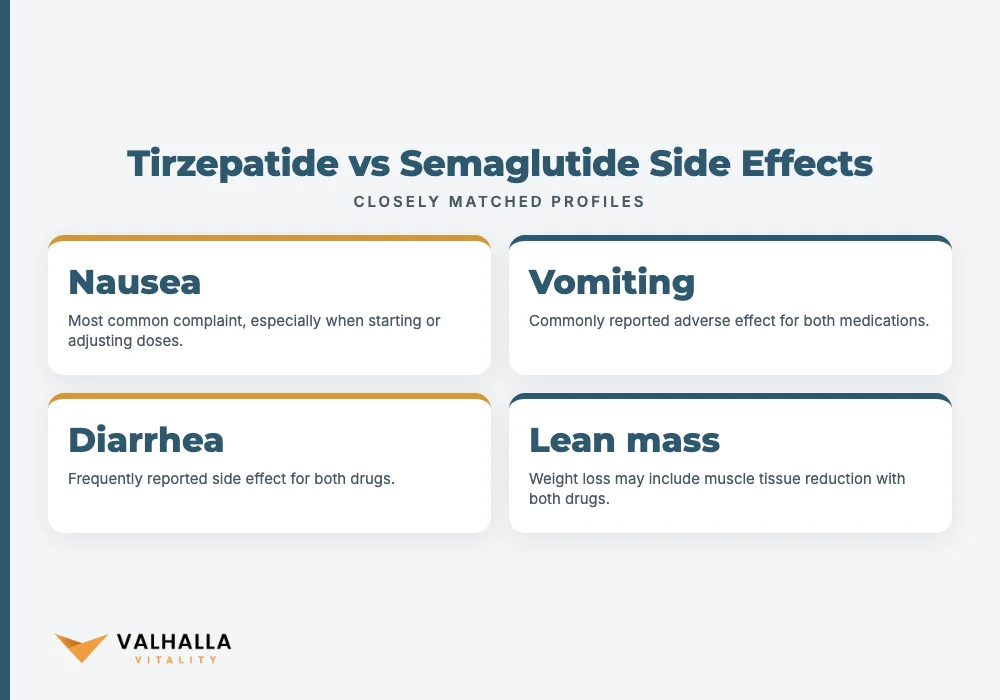
The side effect profiles of tirzepatide and semaglutide are closely matched. Reviewing tirzepatide side effects alongside semaglutide tolerability, this overlap follows directly from the fact that both engage the GLP-1 receptor. The most commonly reported adverse effects for both include:
- Nausea, particularly when starting or adjusting dosing
- Vomiting
- Diarrhea
- Headache
- Injection site reactions, including localized redness or mild swelling
Nausea is the most frequently reported complaint with both options. It tends to be most prominent early in treatment and typically diminishes as the body adjusts. Neither drug should be initiated in anyone with a personal or family history of medullary thyroid carcinoma, and both carry a warning for individuals with a history of pancreatitis.
Lean mass is an emerging concern with both drugs. A 2024 systematic review in Expert Opinion on Pharmacotherapy by Bikou et al. examined clinical trial data on semaglutide's effect on lean body mass and found that weight loss with semaglutide includes a component of muscle tissue reduction, consistent with patterns seen across calorie-restricting interventions more broadly. Research on tirzepatide's lean mass effects continues to accumulate. For patients concerned about muscle preservation, resistance training and adequate dietary protein are strategies worth discussing with a provider, alongside monitoring during treatment.
The shared side effect profile is also relevant for anyone wondering whether switching from one drug to the other will resolve tolerability issues. Switching is clinically possible, but it is a provider-directed decision, not a self-directed one.
Is tirzepatide authorized for weight loss management?
Yes. Tirzepatide has received regulatory authorization to address chronic weight management in adults with obesity or overweight with at least one weight-related condition. It received initial FDA approval for type 2 diabetes in 2022. Semaglutide holds equivalent regulatory authorization, with a longer post-market history that includes more accumulated real-world safety data.
FDA approval establishes that a drug meets safety and efficacy standards in controlled trial populations. That is a meaningful threshold. It is not, however, the same as individual eligibility. Whether you are an appropriate candidate for either option depends on a licensed provider's review of your health history, current medications, and labs.
For compounded formulations, the regulatory context differs from brand-approved drugs. Providers who prescribe through licensed 503A/503B compounding pharmacies operate under a separate set of federal standards that govern the compounding process. A licensed provider working within that framework still determines clinical appropriateness for each individual patient.
The regulatory authorization of both tirzepatide and semaglutide for weight management means the evidence base supporting their use in the right clinical context is solid. The question is whether that context applies to your specific health profile.
What emerging research shows beyond the scale
The tirzepatide vs semaglutide comparison now extends well beyond weight loss and glycemic control. Several newer research directions are drawing serious attention.
Anti-inflammatory effects
A 2026 systematic review and meta-analysis published in Reviews in Endocrine and Metabolic Disorders by Masson et al. examined tirzepatide's effect on inflammatory markers and found statistically significant reductions in CRP and IL-6 across the included trials. Chronic low-grade inflammation underlies a wide range of conditions beyond metabolic disease, from cardiovascular risk to joint pathology. The authors concluded that tirzepatide's anti-inflammatory activity may represent a clinically meaningful benefit independent of its effects on weight and blood sugar. Head-to-head comparisons between tirzepatide and semaglutide on inflammatory markers remain an active research question.
Early cognitive and neurological research
Researchers are beginning to examine whether GLP-1-targeting drugs may produce direct effects in the central nervous system. A 2025 study in Metabolic Brain Disease by Alshehri et al. explored tirzepatide's potential role in Alzheimer's disease, identifying mechanisms that include reduced neuroinflammation and improved insulin signaling in the brain. These are early-stage findings; the authors frame them as investigational pathways, not established therapeutic effects. For anyone following how the brain's immune cells respond to inflammation and metabolic signals, the convergence of metabolic medicine and neuroscience here is becoming a substantive field of inquiry.
Perioperative and surgical considerations
A 2026 paper in Frontiers in Endocrinology by Chaturvedi et al. examined GLP-1 receptor agonists in the context of surgical procedures, addressing perioperative timing, body composition changes following significant weight loss on these drugs, and anesthetic safety considerations related to gastric emptying. For patients planning surgical procedures after a period of GLP-1 therapy, the timing and management of treatment is increasingly a discussion among the patient, their prescribing provider, and the surgical team.
This expanding body of research suggests that the clinical significance of tirzepatide and semaglutide may extend beyond weight management and metabolic health, with implications for inflammation, cognitive health, and surgical medicine. None of these findings change the current prescribing framework. They do indicate that the long-term profile of these drug classes is still being established.
What a licensed provider evaluates before prescribing
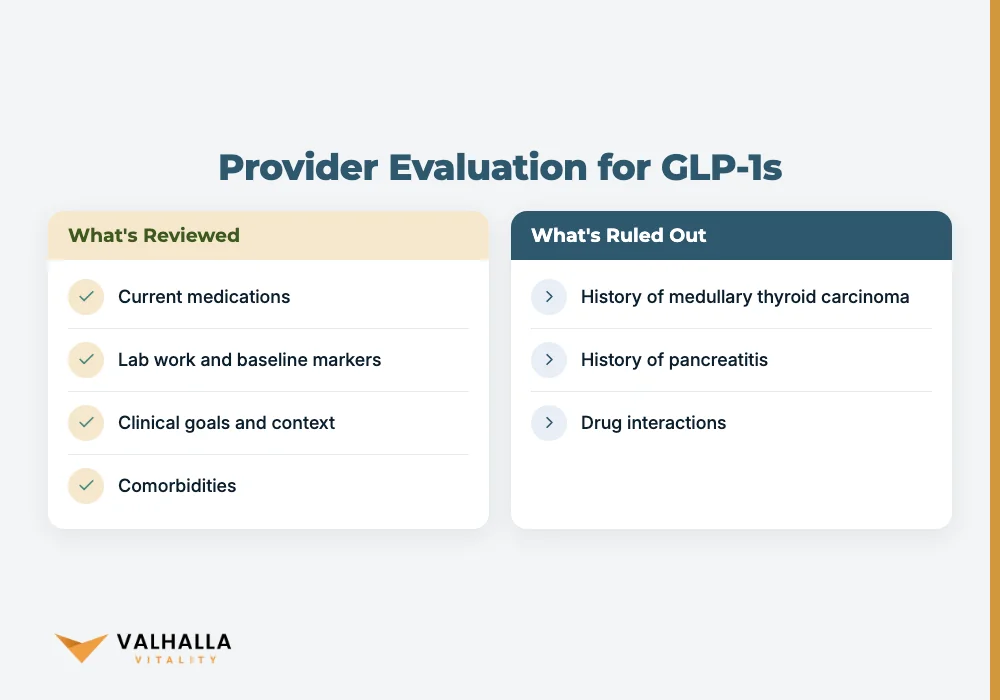
The tirzepatide vs semaglutide decision is a clinical one. A licensed provider considers several factors before recommending either option:
- Contraindications: Both drugs require ruling out a personal or family history of medullary thyroid carcinoma and a history of pancreatitis before prescribing begins.
- Current medications: Blood glucose agents, thyroid medications, and others can interact with GLP-1 receptor agonists. A full medication review is standard.
- Lab work and baseline markers: Metabolic panels, thyroid function tests, and other relevant labs help establish a clinical baseline, confirm eligibility, and create a monitoring framework for ongoing treatment.
- Clinical goals and context: Whether the primary goal is type 2 diabetes management, weight reduction, or cardiovascular risk reduction shapes the recommendation. Comorbidities matter.
A licensed provider determines whether a therapy is appropriate after reviewing your intake. This is not a formality; it is the process that makes either option safe for the person receiving it.
At Valhalla Vitality, provider review happens within 24 business hours of order placement. Once a prescription is transferred to an FDA-inspected U.S. compounding pharmacy, delivery takes approximately 3 to 7 business days. Availability varies by state.
For a detailed look at how semaglutide is used in a provider-guided setting, the clinical overview of how semaglutide works for weight loss covers the evaluation process in depth. For tirzepatide specifically, how tirzepatide is structured as a weight loss therapy in practice explains the treatment pathway from initial review to ongoing care.
Ready to explore your options?
If the tirzepatide vs semaglutide comparison has raised questions about which direction may make sense for your health, a licensed provider can help clarify the path forward. Book Your Consultation to start the review process.
FAQ
Which is more effective for weight loss, tirzepatide or semaglutide?
Clinical trial data and head-to-head meta-analyses consistently show tirzepatide producing greater average weight reductions than semaglutide. The difference is attributed to tirzepatide's dual GLP-1 and GIP receptor mechanism, which semaglutide's single-receptor approach does not replicate. Individual outcomes depend on health factors a licensed provider evaluates through a formal clinical review.
How does tirzepatide work differently than semaglutide?
Tirzepatide activates both the GLP-1 receptor and the GIP receptor, making it a GIP GLP-1 dual agonist. Semaglutide activates only the GLP-1 receptor. The addition of GIP receptor activation in tirzepatide is linked in clinical research to stronger effects on insulin sensitivity, triglyceride clearance, and body weight reduction.
What are the side effects of tirzepatide vs semaglutide?
Both drugs share a closely matched side effect profile: nausea, vomiting, diarrhea, headache, and injection site reactions are the most commonly reported. Nausea is most prominent early in treatment and typically decreases as the body adjusts. Neither drug should be used by anyone with a history of medullary thyroid cancer or pancreatitis.
Can you switch from semaglutide to tirzepatide?
Switching between these drugs is clinically possible, but the appropriateness and timing are decisions a licensed provider makes based on your current health status and treatment response. It is not a transition patients manage independently.
Has tirzepatide received regulatory authorization for weight loss management?
Yes. Tirzepatide holds regulatory authorization to address chronic weight management in adults with obesity or overweight with a weight-related condition, in addition to its 2022 indication for type 2 diabetes. Semaglutide holds equivalent authorization with a longer post-market safety record.
Sources
- Rizvi AA, Rizzo M. (2022). The Emerging Role of Dual GLP-1 and GIP Receptor Agonists in Glycemic Management and Cardiovascular Risk Reduction. Diabetes, Metabolic Syndrome and Obesity. PubMed
- Jastreboff AM et al. (2022). Tirzepatide Once Weekly for the Treatment of Obesity. New England Journal of Medicine. PubMed
- Ghusn W et al. (2022). Weight Loss Outcomes Associated With Semaglutide Treatment for Patients With Overweight or Obesity. JAMA Network Open. doi:10.1001/jamanetworkopen.2022.31982
- Karagiannis T et al. (2024). Subcutaneously administered tirzepatide vs semaglutide for adults with type 2 diabetes: a systematic review and network meta-analysis of randomised controlled trials. Diabetologia. PubMed
- Bikou A et al. (2024). A systematic review of the effect of semaglutide on lean mass: insights from clinical trials. Expert Opinion on Pharmacotherapy. PubMed
- Masson W et al. (2026). Anti-inflammatory effects of tirzepatide: a systematic review and meta-analysis. Reviews in Endocrine and Metabolic Disorders. PubMed
- Alshehri GH et al. (2025). Tirzepatide: a novel therapeutic approach for Alzheimer's disease. Metabolic Brain Disease. PubMed
- Chaturvedi R et al. (2026). Glucagon-like peptide-1 receptor agonists and aesthetic surgery: perioperative safety, timing, durability and body composition. Frontiers in Endocrinology. PubMed
You May Also Like
 Featured
At Home STI Test: How It Works, Accuracy & Privacy
At home STI test kits let you screen for chlamydia, HIV, and more with private, rapid STI results. Learn how to use them and what to do next.
November 5, 2026 ETRead more → Featured
What Are Endorphins? Benefits, Signs, and How to Boost Them
What are endorphins? Learn how these brain chemicals affect pain relief, mood, and energy, plus signs of low endorphins and how to boost them.
October 25, 2026 ETRead more → Featured
Microglia Function: How Your Brain's Immune Cells Work
Microglia function as the brain's primary immune defense. Learn how these cells clear debris, regulate inflammation, and what happens when they malfunction.
October 24, 2026 ETRead more →