
The following blog post is for entertainment and informational purposes only. It is not intended to provide medical advice or diagnosis. Please consult your doctor before making any health-related decisions.
Enclomiphene vs nolvadex is a comparison that comes up regularly in post cycle therapy planning and among men evaluating testosterone restoration options for secondary hypogonadism. Both belong to the selective estrogen receptor modulator (SERM) class, but they act on different tissues and serve different clinical goals. Enclomiphene blocks estrogen receptors in the hypothalamus and pituitary, driving the body's own LH and FSH production and restoring endogenous testosterone; nolvadex (tamoxifen) works primarily in breast tissue, controlling estrogen-driven effects there without the same direct upstream signal. A licensed provider reviews your labs and history before recommending either compound.
What is the difference between enclomiphene and nolvadex?
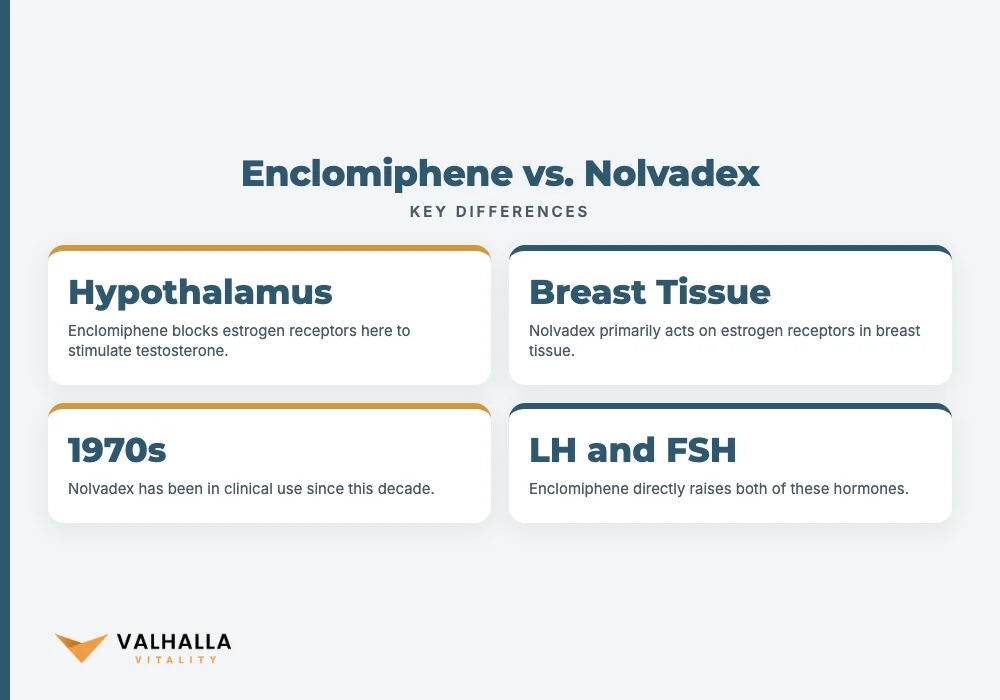
Enclomiphene and nolvadex are both SERMs. That similarity is where easy comparisons end. Enclomiphene is the trans-isomer of clomiphene, engineered to block estrogen receptors in the hypothalamus and anterior pituitary. Nolvadex, the brand name for tamoxifen, was developed for breast cancer treatment and acts primarily on estrogen receptors in breast tissue.
The development timelines reflect those different purposes. Nolvadex has been in clinical use since the 1970s, built on oncology trials that confirmed its anti-estrogenic properties in peripheral tissue. Enclomiphene emerged as the isolated trans-isomer of clomiphene, designed to retain the testosterone-stimulating mechanism of the parent compound while avoiding the effects linked to its cis-isomer counterpart, zuclomiphene.
The practical implication for men comparing enclomiphene vs nolvadex for a SERM for low testosterone or post cycle therapy purpose is direct: enclomiphene works upstream, removing the brake on LH and FSH release so the testes resume testosterone production on their own; nolvadex works downstream, managing estrogen effects in peripheral tissues without the same upstream hormonal push.
| Feature | Enclomiphene | Nolvadex (tamoxifen) |
|---|---|---|
| Drug class | SERM, trans-isomer of clomiphene | SERM |
| Primary target tissue | Hypothalamus and pituitary | Breast tissue |
| Main clinical use | Secondary hypogonadism, PCT | Breast cancer, gynecomastia prevention |
| Effect on LH and FSH | Raises both directly | Indirect, variable |
| Effect on testosterone | Direct increase | Indirect, limited |
| Fertility preservation | Preserves or may support | Variable |
| Peripheral estrogenic activity | Minimal | Partial agonist in some tissues |
| Administration | Oral | Oral |
Both drugs are taken orally, which keeps compliance manageable in outpatient and telehealth settings. A licensed provider determines the dose after reviewing labs, not a protocol found elsewhere.
How each SERM works on the HPG axis
The hypothalamic-pituitary-gonadal (HPG) axis is the control chain for testosterone production. The hypothalamus releases gonadotropin-releasing hormone (GnRH), which signals the pituitary to release luteinizing hormone (LH) and follicle-stimulating hormone (FSH). LH drives Leydig cells in the testes to produce testosterone. Estrogen then feeds back to slow this chain at the hypothalamus and pituitary, completing a regulatory loop. Understanding where each drug intervenes clarifies the enclomiphene vs nolvadex distinction.
Enclomiphene: clearing the feedback brake
Enclomiphene binds to estrogen receptors in the hypothalamus and pituitary, blocking estrogen's negative feedback on GnRH and LH/FSH release. The pituitary responds by releasing more LH and FSH. More LH signals Leydig cells to produce more testosterone. The testes stay active throughout treatment, keeping spermatogenesis intact, a consideration that matters for men concerned about fertility alongside testosterone levels.
A 2016 review in Expert Opinion on Pharmacotherapy (Rodriguez KM et al.) described enclomiphene citrate as addressing secondary male hypogonadism by restoring the HPG axis signal rather than replacing testosterone from outside. That distinction is clinically significant. Testosterone replacement therapy suppresses LH and FSH and shuts down testicular output; enclomiphene does the opposite.
Nolvadex: blocking peripheral estrogen
Nolvadex blocks estrogen receptors in breast tissue with high potency. This is why it has been a cornerstone of breast cancer therapy for decades and why it functions as a nolvadex estrogen blocker for steroid-associated gynecomastia. In post cycle therapy contexts, tamoxifen may also reduce estrogen feedback partially at the pituitary, allowing some HPG axis recovery.
The complication: nolvadex is a mixed agonist-antagonist. It blocks estrogen in breast tissue but acts as a partial agonist in other tissues, including bone and the liver. This partial agonism accounts for side effects associated with nolvadex PCT, including hot flashes and mood changes. The nolvadex PCT use case leans on its well-established anti-estrogenic strength and its indirect, modest stimulation of the HPG axis.
Enclomiphene vs nolvadex for PCT: which is better?
Enclomiphene targets the HPG axis more directly than nolvadex for the purpose of restoring endogenous testosterone. Whether it is the right choice for any individual depends on lab results, medical history, and the specific clinical problem the provider is solving.
Post cycle therapy uses SERMs to restart the HPG axis after anabolic steroids suppress it. The nolvadex PCT protocol has decades of real-world use behind it, with a well-documented risk profile across diverse patient populations. Enclomiphene for PCT is a more targeted option, developed specifically to stimulate LH and FSH through the hypothalamic-pituitary route.
A 2025 systematic review and meta-analysis in Archives of Endocrinology and Metabolism (Hohl A et al.) analyzed randomized controlled trials comparing clomiphene and enclomiphene for male hypogonadism, contributing comparative data directly relevant to the SERM class used in testosterone restoration contexts.
Some men evaluate clomid vs nolvadex PCT as an alternative framework. Clomid (mixed clomiphene) sits between the two: it contains both the active trans-isomer and the cis-isomer (zuclomiphene), producing a mixed receptor profile. Enclomiphene isolates the effective isomer, potentially reducing some unwanted effects. Nolvadex takes a different approach entirely, managing estrogen peripherally rather than stimulating testosterone centrally.
Rodriguez KM et al. (2016) noted that the pure trans-isomer formulation of enclomiphene addresses one of the longstanding criticisms of standard clomiphene PCT: the presence of zuclomiphene, which has a longer half-life and may exert prolonged estrogenic effects that partially counteract the testosterone-stimulating benefit.
Consider what each compound brings to a post cycle therapy SERM protocol:
- Enclomiphene raises LH and FSH through a direct hypothalamic-pituitary receptor-blocking mechanism.
- Nolvadex has decades of documented safety data and proven effectiveness at peripheral estrogen control.
- Enclomiphene's cleaner isomer profile avoids effects associated with the zuclomiphene component in standard clomiphene preparations.
- Nolvadex's anti-estrogenic effect in breast tissue makes it the better option when gynecomastia prevention is the primary PCT goal rather than testosterone axis restoration.
Our detailed breakdown of enclomiphene as a PCT option covers the protocol structure and what follow-up lab work looks like in practice.
Does enclomiphene raise testosterone more than nolvadex?
Yes. In clinical research on male hypogonadism, enclomiphene raises LH, FSH, and testosterone more consistently and directly than nolvadex, because its mechanism targets the specific receptors that govern testosterone output from the top of the axis.
Nolvadex can raise testosterone as a secondary effect. By partially blocking estrogen feedback at the pituitary, tamoxifen may allow modest LH and FSH recovery. That effect is indirect and variable. Nolvadex is not indicated as a primary therapy for low testosterone under clinical guidelines; enclomiphene was specifically developed for secondary male hypogonadism, a condition where the testes can produce testosterone but the HPG axis signal is insufficient.
Rodriguez KM et al. (2016) described enclomiphene's targeted hypothalamic-pituitary action as the mechanism that sets it apart from earlier SERMs for testosterone restoration in men with secondary hypogonadism. Hohl A et al. (2025) included both compounds in a meta-analysis examining testosterone outcomes across SERM-based RCTs in male hypogonadism, providing a current comparative evidence base.
Testosterone response is not linear. Some men with secondary hypogonadism see meaningful LH and FSH recovery on enclomiphene; others show a slower or more partial response based on receptor sensitivity and the duration of prior HPG axis suppression. A provider monitors lab trends, not just a single post-treatment value, to judge whether to continue, adjust, or reconsider. That monitoring process is where the enclomiphene vs nolvadex choice gets refined over time.
Key factors in testosterone outcomes with each compound:
- Enclomiphene raises LH and FSH first, then testosterone, through a well-defined receptor-blocking pathway.
- Nolvadex may raise testosterone indirectly, but this is a secondary effect rather than the drug's clinical purpose.
- Individual testosterone response to enclomiphene varies with baseline LH/FSH levels, receptor sensitivity, and the underlying cause of low testosterone.
- Lab monitoring during treatment is how a provider tracks whether the response is adequate.
For more on how enclomiphene compares to clomiphene-based approaches in mechanism and testosterone response, the enclomiphene and clomid side-by-side for men's hormonal health covers the isomeric distinctions and their clinical relevance.
Which is safer for PCT: enclomiphene or nolvadex?
Both have documented safety profiles. Neither is risk-free. The better question is which side effect profile fits an individual's health situation, and that is a clinical judgment based on lab results and medical history, not a general ranking.
Nolvadex has the longer safety record, accumulated through decades of use in large oncology patient populations. Its risks in short PCT applications are generally limited, but include:
- Hot flashes in some users
- Mood changes and irritability
- Rare cases of increased clotting risk with prolonged use
- Potential effects on bone density and lipid profiles with extended administration
Enclomiphene's cleaner isomer profile may reduce some effects linked to the zuclomiphene component present in standard clomiphene. Rodriguez KM et al. (2016) highlighted this pharmacological distinction in their review of enclomiphene for secondary hypogonadism. Reported side effects with enclomiphene include:
- Hot flashes (shared with tamoxifen)
- Headaches
- Nausea in some individuals
- Mood fluctuations
Both drugs can interact with other medications and may be contraindicated in certain health conditions. The enclomiphene vs nolvadex safety question does not have a single universal answer. A licensed provider determines whether a therapy is appropriate after reviewing your full intake, not based on general compound reputation alone.
For a more detailed safety review across the clinical literature, comparing tamoxifen and enclomiphene in hormone therapy reviews the evidence on both compounds side by side.
Can you take enclomiphene and nolvadex together?
Combining them is not standard practice and should only happen under direct provider supervision with a specific clinical reason.
Both drugs act on estrogen receptors. Stacking two SERMs introduces overlapping receptor competition that may add side effects without adding proportional benefit. Controlled trial data on the enclomiphene plus nolvadex combination in male hormone contexts is limited. Some PCT frameworks have historically combined nolvadex with clomid, but the clomid vs nolvadex PCT combination evidence base is not built on high-quality controlled trials.
If both gynecomastia prevention and testosterone restoration are goals, a provider will typically identify the single SERM best suited to address both rather than combining two drugs with overlapping mechanisms. More receptor competition is not automatically better. It adds complexity and potential side effects without a clear evidence-based rationale in most individual cases. The enclomiphene vs nolvadex combination question, in other words, is usually resolved by choosing one compound with the right tissue profile rather than using both.
Making the decision: practical criteria
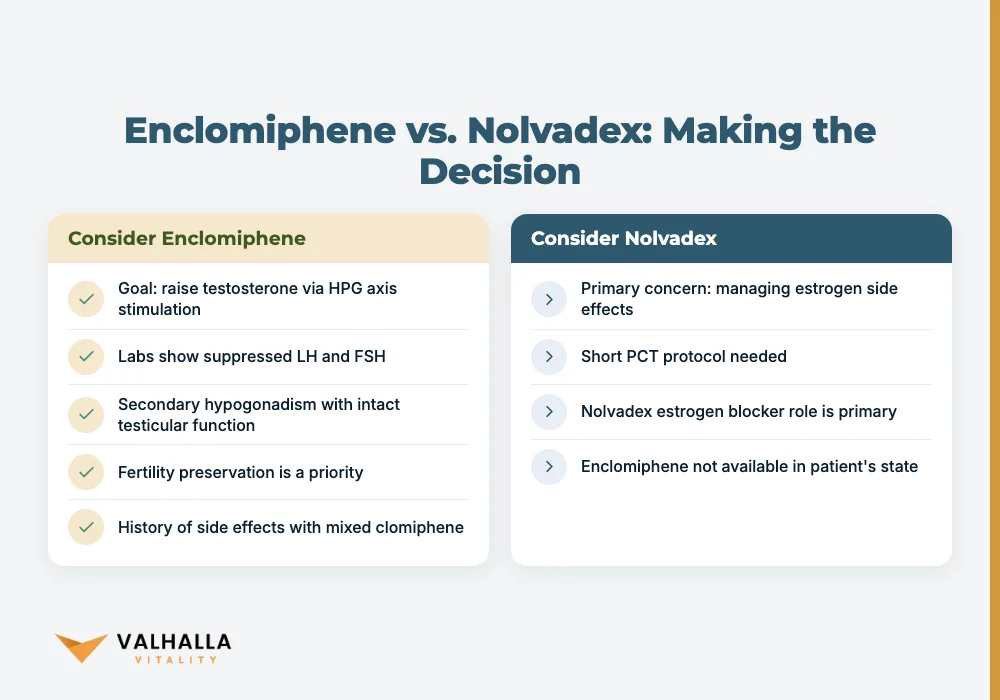
The enclomiphene vs nolvadex decision depends on what clinical problem is being solved and what the lab values show. These are not interchangeable compounds with the same use case.
A provider may lean toward enclomiphene when:
- The goal is raising testosterone through direct HPG axis stimulation
- Labs show suppressed LH and FSH as the primary driver of low testosterone
- The patient has secondary hypogonadism with intact testicular function
- Fertility preservation alongside testosterone restoration is a priority
- There is a prior history of side effects with mixed clomiphene preparations
A provider may consider nolvadex when:
- The primary concern is managing estrogen-driven side effects, particularly gynecomastia
- A short PCT protocol calls for a SERM with a long documented safety record
- The nolvadex estrogen blocker role is the primary therapeutic objective
- Enclomiphene is not available in the patient's state at the time of prescribing
What both pathways share:
- Oral dosing keeps compliance practical for outpatient and telehealth settings
- Baseline labs are required before either drug begins
- Neither drug addresses primary hypogonadism, where the testes cannot respond to LH signals
- Neither is a substitute for a complete hormonal evaluation
A point that often gets missed: using a SERM without knowing whether hypogonadism is primary or secondary can mean treatment that has no effect. Enclomiphene for PCT and nolvadex PCT both rely on functional testes capable of responding to LH. In primary hypogonadism, where testicular function is impaired, neither compound restores testosterone output meaningfully.
A provider running a complete lab panel, including total testosterone, free testosterone, LH, FSH, and estradiol, can map the hormonal pattern and choose the right tool. That diagnostic step is what separates targeted hormone management from guesswork. Availability is also a practical factor: enclomiphene is prescribed through licensed telehealth providers in states where it is currently available, but prescribing regulations vary. Availability varies by state.
The Valhalla Vitality men's hormone health overview covers the broader range of testosterone restoration options alongside SERM therapy for men who want to understand the full picture before a consultation.
Talk to a provider about your options
A licensed provider can review your hormone panel, walk through the differences between enclomiphene and nolvadex, and help determine which direction fits your specific situation. Book Your Consultation when you are ready.
FAQ
How long does enclomiphene take to raise testosterone?
Response timelines differ between individuals based on baseline hormone levels and how well the HPG axis responds to treatment. A provider orders follow-up labs at set intervals to monitor LH, FSH, and testosterone and adjusts the approach based on those results. There is no universal timeline; treatment length follows the lab response, not a fixed schedule.
What is the difference between clomid and nolvadex for PCT?
Clomid (clomiphene) contains two isomers that act on estrogen receptors with different potencies, while nolvadex (tamoxifen) is a structurally distinct compound that blocks estrogen receptors more strongly in peripheral tissues such as breast. Both are post cycle therapy SERMs used to support HPG axis recovery after anabolic cycles end. The clomid vs nolvadex PCT decision typically turns on whether the priority is direct testosterone restoration through HPG stimulation or estrogen management in peripheral tissue.
Is enclomiphene available through a telehealth provider?
Availability depends on state regulations, as prescribing rules vary across jurisdictions. A licensed provider can review your intake and determine whether enclomiphene therapy is appropriate for your situation. Availability varies by state.
Does nolvadex raise testosterone levels in men?
Nolvadex can indirectly raise testosterone in men by partially blocking estrogen's negative feedback at the pituitary, which may allow modest increases in LH and FSH output. This effect is indirect and less consistent than enclomiphene's direct hypothalamic-pituitary action. Nolvadex is not indicated as a primary treatment for low testosterone under standard clinical guidelines.
Sources
- Rodriguez KM et al. (2016). Enclomiphene citrate for the treatment of secondary male hypogonadism. Expert opinion on pharmacotherapy. PubMed
- Hohl A et al. (2025). Clomiphene or enclomiphene citrate for the treatment of male hypogonadism: a systematic review and meta-analysis of randomized controlled trials. Archives of endocrinology and metabolism. PubMed
You May Also Like
 Enclomiphene
Enclomiphene and Alcohol: What Men on Therapy Need to Know
Enclomiphene and alcohol may reduce therapy effectiveness. Learn how drinking affects testosterone, estrogen, and liver metabolism on therapy.
October 16, 2026 ETRead more → Enclomiphene
Enclomiphene Acne: Causes, Treatment and Prevention
Enclomiphene acne develops when rising testosterone overstimulates oil glands. Learn which men face the highest risk and how to manage breakouts.
October 16, 2026 ETRead more → Enclomiphene
Buy Enclomiphene Citrate: Safe & Legal Access Guide
Buy enclomiphene citrate through a licensed provider. Learn how it treats low testosterone, what labs you need, and how to get a prescription online.
October 16, 2026 ETRead more →