
The following blog post is for entertainment and informational purposes only. It is not intended to provide medical advice or diagnosis. Please consult your doctor before making any health-related decisions.
Tadalafil tablets are a prescription PDE5 inhibitor approved for erectile dysfunction (ED), benign prostatic hyperplasia (BPH), and pulmonary arterial hypertension (PAH). A single dose stays active for up to 36 hours. That window is longer than most other medications in the same class. Because tadalafil affects blood pressure and interacts with several drug categories, every prescription requires a licensed provider review of your health history before treatment starts.
What is tadalafil used for?
Tadalafil tablets address three distinct conditions, all connected by one mechanism: relaxing smooth muscle in blood vessel walls to increase blood flow.
- Tadalafil for ED: Increased blood flow to penile tissue during sexual stimulation helps men achieve and sustain an erection.
- Benign prostatic hyperplasia (BPH): Relaxing muscles in the prostate and bladder eases urinary symptoms linked to prostate enlargement.
- Pulmonary arterial hypertension (PAH): Widening blood vessels in the lungs reduces the heart's workload and may support improved exercise capacity in affected individuals.
Sexual health and urological conditions often coexist. A licensed provider determines whether a therapy is appropriate after reviewing your intake, and may treat more than one condition simultaneously with tadalafil tablets.
How does tadalafil work for erectile dysfunction?
The mechanism behind how tadalafil works centers on phosphodiesterase type 5 (PDE5), an enzyme that breaks down cGMP, a signaling molecule responsible for relaxing smooth muscle in penile blood vessels. Block PDE5, and cGMP accumulates. Smooth muscle relaxes. Blood flow to the penis increases during arousal.
One point matters: tadalafil does not trigger spontaneous erections. Sexual stimulation is still required. Without arousal, the drug produces no erectile effect.
A 2021 meta-analysis in JAMA Network Open found that combination approaches to erectile dysfunction showed greater clinical benefit than monotherapy in several patient groups, which reinforces why individualized provider assessment matters (Mykoniatis et al., 2021).
How long does tadalafil last?
Up to 36 hours. That extended duration is why tadalafil tablets earned the informal label "the weekend pill." Other PDE5 inhibitors typically remain active for four to six hours, so the difference is substantial. The longer window removes the need to time a dose immediately before sexual activity.
A common misconception: lasting 36 hours does not mean a continuous erection. It means effective drug levels remain in the body for that period. An erection still requires sexual stimulation to occur.
Can you take tadalafil daily?
Yes. A low-dose daily regimen exists for men who prefer a steady drug level over on-demand dosing. With tadalafil daily use, planning around a dose window is unnecessary. This regimen also addresses BPH symptoms alongside ED when both are present, treating them through a single approach.
A licensed provider determines the appropriate dose and regimen after reviewing labs and health history. The on-demand and daily options are not interchangeable for all patients. For what research shows about daily tadalafil, including longer-term outcomes data, that evidence is covered in a separate guide.
Tadalafil vs sildenafil
Both are PDE5 inhibitors that treat ED through the same underlying mechanism. The key practical differences:
- Duration: Sildenafil lasts four to six hours; tadalafil tablets last up to 36.
- Food interaction: Sildenafil absorbs more slowly after a heavy meal; tadalafil can be taken with or without food.
- Dosing style: Sildenafil is typically on-demand only; tadalafil is available in both on-demand and daily formulations.
Neither drug is universally better. The right choice depends on frequency of use, lifestyle habits, and drug interactions. A provider weighs both options during evaluation. For a full look at comparing tadalafil and sildenafil, including onset data and clinical context, the detailed breakdown is available here.
Tadalafil side effects: what to watch for
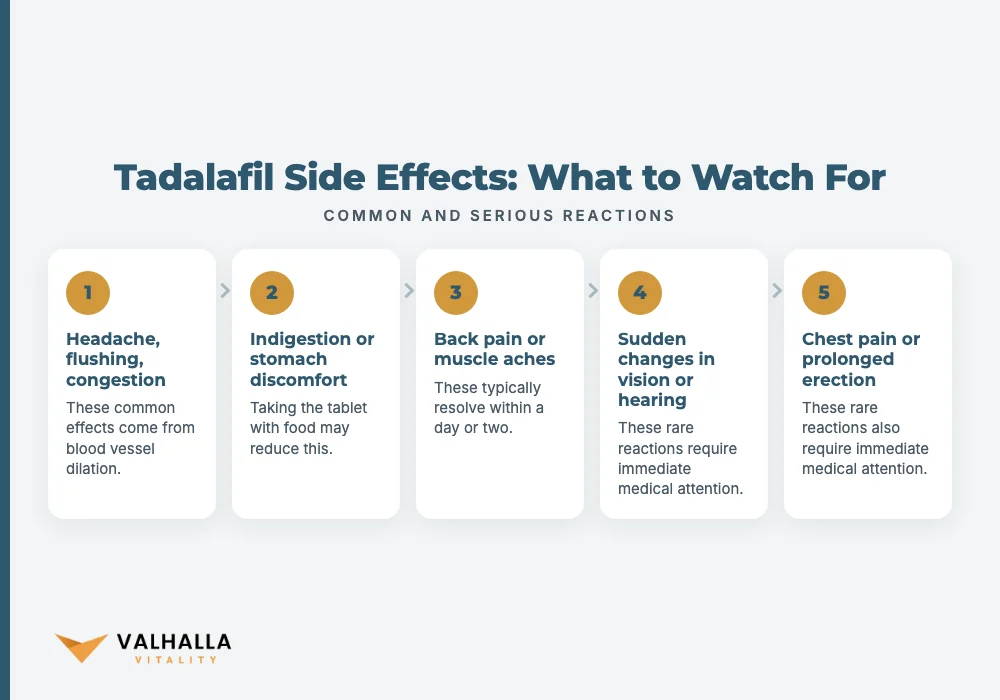
Most side effects of tadalafil tablets trace back to its vasodilatory mechanism. Widening blood vessels produces predictable systemic effects.
Common effects include:
- Headache, from blood vessel dilation throughout the body
- Facial flushing or warmth
- Nasal congestion
- Indigestion or stomach discomfort (taking the tablet with food may reduce this)
- Back pain or muscle aches, which typically resolve within a day or two
Rare but serious reactions require immediate medical attention: sudden changes in vision or hearing, chest pain, or an erection lasting more than four hours. For a detailed look at side effect patterns to watch for and when to seek provider guidance, that review is covered separately.
Safety considerations for tadalafil tablets
Tadalafil dosage is determined individually. A licensed provider determines the dose after labs and a full medication review, since tadalafil interacts with several drug classes.
The most significant interaction involves nitrates, used in certain chest pain medications. Combining them causes a sharp, potentially dangerous drop in blood pressure. Alpha-blockers carry a similar risk. Disclose every prescription drug, supplement, and herbal product before starting.
Additional points to review with your provider:
- Alcohol increases the risk of blood pressure side effects. Limit intake during treatment.
- Grapefruit juice affects how the body processes tadalafil. Avoid it.
- Severe liver or kidney impairment may require dose adjustment or rule out tadalafil entirely.
- Pregnant or breastfeeding individuals are not candidates for this drug.
Tadalafil tablets are widely prescribed and well-studied for ED and BPH globally. Most users in clinical populations report improved erectile function and quality of life. Provider-guided treatment ensures the right dose, the right regimen, and appropriate monitoring over time.
Ready to take the next step?
If tadalafil tablets may address your concerns, a licensed provider review is where to start. Book Your Consultation to have your intake reviewed and your options explained.
FAQ
What is tadalafil used for?
Tadalafil tablets are approved to treat erectile dysfunction, benign prostatic hyperplasia (BPH), and pulmonary arterial hypertension (PAH). All three indications involve relaxing smooth muscle in blood vessels to improve blood flow. A licensed provider determines which condition applies and whether treatment is appropriate for your situation.
How long does tadalafil last?
A single dose of tadalafil can remain at effective levels in the body for up to 36 hours, longer than other PDE5 inhibitors. This does not mean a continuous erection; sexual stimulation is still required for one to occur. The extended window offers flexibility around the timing of sexual activity.
Can you take tadalafil daily?
Yes, a low-dose daily regimen is available as an alternative to on-demand dosing. It maintains a steady drug level and also addresses BPH symptoms when both conditions are present. A licensed provider reviews labs and health history before recommending daily use.
How does tadalafil work for erectile dysfunction?
Tadalafil blocks the PDE5 enzyme, allowing the signaling molecule cGMP to accumulate in penile blood vessels. This relaxes smooth muscle and increases blood flow during sexual stimulation. The result is improved ability to achieve and maintain an erection.
What are the common side effects of tadalafil?
The most commonly reported side effects are headache, facial flushing, nasal congestion, indigestion, and temporary back or muscle aches. These reflect the drug's vasodilatory mechanism and typically resolve on their own. Persistent or severe symptoms should be reported to a provider.
Sources
- Mykoniatis I et al. (2021). Assessment of Combination Therapies vs Monotherapy for Erectile Dysfunction: A Systematic Review and Meta-analysis. JAMA network open. PubMed
You May Also Like
 Tadalafil
 Half Life: Duration, Dosing, and What to Expect
Tadalafil half life averages 17.5 hours, keeping one dose active for up to 36 hours. See how this shapes daily vs on-demand dosing schedules.
November 24, 2026 ETRead more → Tadalafil
 Pill: How It Works, Duration, and Daily Use
Tadalafil pill treats erectile dysfunction with up to 36-hour effect. Learn how it works, daily use, side effects, and how it compares to sildenafil.
November 22, 2026 ETRead more → Tadalafil
 Erectile Dysfunction: What You Need to Know
Tadalafil erectile dysfunction treatment: how PDE5 inhibition works, daily vs as-needed dosing, side effects, and how it compares with sildenafil.
November 18, 2026 ETRead more →