
The following blog post is for entertainment and informational purposes only. It is not intended to provide medical advice or diagnosis. Please consult your doctor before making any health-related decisions.
Several testosterone therapy types exist. Injections, transdermal gels, pellets, skin patches, and oral capsules can all raise testosterone in men with clinically confirmed hypogonadism, but the right choice depends on lab values, lifestyle, and a licensed provider's assessment. Learn more about the testosterone therapy service before speaking with a provider.
What are the different types of testosterone therapy?
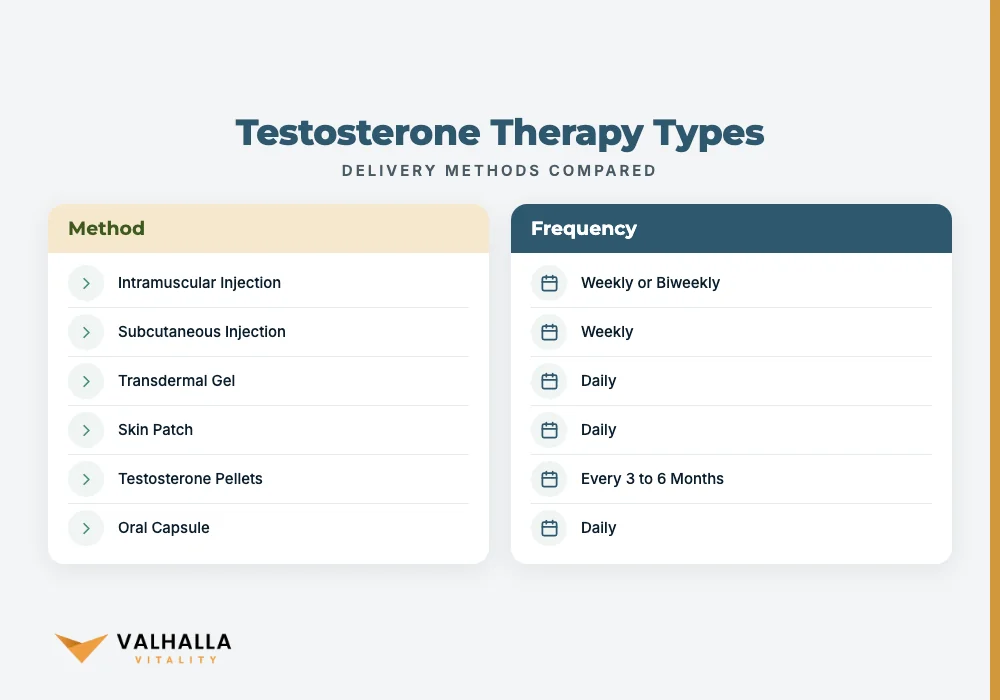
The main testosterone therapy types fall into five categories based on how testosterone enters the body.
| Delivery type | Route | Administration interval |
|---|---|---|
| Intramuscular injection (testosterone cypionate) | Muscle tissue | Weekly or biweekly |
| Subcutaneous injection | Fat beneath skin | Weekly |
| Transdermal gel / topical testosterone | Skin absorption | Daily |
| Skin patch | Skin absorption | Daily |
| Testosterone pellets (subdermal) | Implanted under skin | Every 3 to 6 months |
| Oral capsule | GI tract | Daily |
A licensed provider determines the appropriate form and schedule after reviewing bloodwork and a full medical history. No delivery method is universally superior.
Injections: intramuscular and subcutaneous TRT
Testosterone cypionate is among the most commonly prescribed injectable forms in the United States. Providers administer it into muscle tissue or, increasingly, into subcutaneous fat positioned just beneath the skin, where it tends to produce a steadier hormonal release. A 2022 study in the Journal of Clinical Endocrinology and Metabolism by Figueiredo et al. found subcutaneous TRT to be a safe, practical option that produces stable testosterone levels with good tolerability.
Levels fluctuate between doses. Testosterone peaks shortly after injection and declines before the next cycle. Dose adjustments are straightforward because providers can change the schedule based on follow-up labs, without waiting for an implant to dissolve.
Topical testosterone: gels and patches
Topical testosterone products absorb through the skin on a daily basis, avoiding the peaks and troughs associated with less frequent injection cycles. Wang et al. (2022) in Endocrinology and Metabolism Clinics of North America reviewed TRT methods and noted that transdermal forms maintain consistent daily testosterone exposure when applied as directed. Consistent daily use is what holds those levels steady.
Gels carry a skin-transfer risk. Direct contact with a partner or child shortly after application can transfer testosterone unintentionally. Patches reduce that risk but may cause local irritation at the application site.
Testosterone pellets
Testosterone pellets are small, solid cylinders implanted under the skin, typically near the hip or flank. They dissolve over three to six months, releasing testosterone into surrounding tissue throughout that window. A 2021 review in Current Drug Targets by Handattu et al. described pellet-based delivery as providing prolonged, stable hormone release compared with daily or weekly administration formats.
The key limitation is irreversibility once implanted. If levels run high or side effects develop, removal requires a clinical procedure rather than simply stopping use. For patients who prefer not to manage weekly or daily self-administration, that extended interval is a genuine advantage.
Is testosterone injection better than a gel?
Neither is universally better. The choice between testosterone gel vs injection comes down to clinical goals, lifestyle, and how readily a patient manages a daily or weekly routine.
Injections, particularly testosterone cypionate, are well-studied and carry no skin-transfer risk. Gels provide daily hormonal stability without needles but require care around contact exposure. When weighing TRT injections vs pellets, the key distinction is flexibility: injections allow dose changes between cycles, while pellets offer a hands-off approach for months but cannot be adjusted once in place.
A licensed provider reviews the full clinical picture before recommending any specific form. For a deeper look at comparing testosterone replacement therapy options for men, that article covers provider considerations by delivery method.
How long do testosterone pellets last?
Testosterone pellets typically remain active for three to six months. Individual metabolism, activity level, and body composition all affect absorption rate, so the actual interval varies. Levels stay relatively stable throughout that window, avoiding the peaks and drops common to shorter-cycle therapies.
As pellets near full absorption, a provider orders follow-up labs to evaluate current levels and decide whether reimplantation is clinically appropriate. The timeline is not fixed; monitoring drives it.
What is the safest form of TRT?
No testosterone therapy type is categorically safest for all patients. Safety depends on individual health status, lab results, and ongoing monitoring rather than delivery route alone.
Risks shared across all delivery methods include worsening of sleep apnea, elevated red blood cell production (erythrocytosis), and effects on prostate health. Men with existing cardiovascular disease, congestive heart failure, or a history of prostate cancer require careful clinical evaluation before any form of TRT is considered. Wang et al. (2022) noted that risk stratification before initiating therapy is standard clinical practice.
Benefits are documented too. A 2022 systematic review and meta-analysis in Urologia Internationalis by Taniguchi et al. found that testosterone therapy improved erectile function in men with late-onset hypogonadism, but only when properly indicated following lab confirmation and provider review.
Can you take testosterone orally?
Yes. Oral testosterone is a recognized testosterone therapy type. Modern formulations absorb through the gastrointestinal lymphatic system rather than direct portal circulation, which reduces the first-pass liver metabolism concern associated with older oral androgen compounds. Oral routes are less frequently prescribed than injections or gels but remain a clinically valid option for appropriate patients.
The oral testosterone and injection comparison covers how the two delivery routes differ in absorption, tolerability, and clinical use.
Who should consider an evaluation
Symptoms that may signal low testosterone include persistent fatigue, reduced sex drive, difficulty maintaining muscle mass, poor concentration, mood changes, and erectile dysfunction. Symptoms alone are not a diagnosis. Blood tests confirming low testosterone, combined with a full clinical evaluation, are required before a provider considers any form of TRT.
TRT is generally a long-term commitment. Most providers order labs every six months. Valhalla Vitality supports this through an online intake process in which a licensed provider reviews results within 24 business hours of submission, with ongoing monitoring built into the care cycle for the duration of treatment. Availability varies by state.
A 2018 analysis in the Asian Journal of Andrology by Meyer et al. examined the relationship between endogenous testosterone and mortality risk, finding that chronically low testosterone may carry implications for metabolic and cardiovascular health beyond the commonly cited effects on libido and muscle.
For patients interested in how TRT fits alongside other hormonal support, the article on how TRT and DHEA work together covers how those protocols are sometimes combined.
Ready to discuss your options?
Book Your Consultation with a licensed provider who reviews your intake and labs before recommending any specific testosterone therapy type.
FAQ
What are the main testosterone therapy types?
The main testosterone therapy types are intramuscular injections, subcutaneous injections, transdermal gels, skin patches, subdermal pellets, and oral capsules. Each delivers testosterone through a different route and at a different frequency. A licensed provider selects the appropriate form based on lab results and medical history.
How is testosterone cypionate different from other injectable forms?
Testosterone cypionate is an oil-based injectable ester that providers administer into muscle tissue or subcutaneous fat on a weekly or biweekly schedule. It is among the most widely prescribed injectable forms in the United States. A provider determines the schedule and adjusts it based on follow-up bloodwork.
Can testosterone pellets be removed if problems arise?
Pellets can be removed, but doing so requires a minor clinical procedure rather than simply stopping use. Unlike gels or injections, pellets cannot be discontinued at home after implantation. This factor should be discussed with a provider before choosing this form.
What risks are shared across testosterone therapy types?
Known risks across delivery methods include worsening sleep apnea, elevated red blood cell counts, and effects on prostate health. Existing cardiovascular conditions and other medical factors are assessed before therapy begins. A licensed provider evaluates individual risk and monitors levels throughout treatment.
Sources
- Meyer EJ et al. (2018). Endogenous testosterone and mortality risk. Asian journal of andrology. PubMed
- Figueiredo MG et al. (2022). Testosterone Therapy With Subcutaneous Injections: A Safe, Practical, and Reasonable Option. The Journal of clinical endocrinology and metabolism. PubMed
- Handattu MS et al. (2021). A Comprehensive Review on Pellets as a Dosage Form in Pharmaceuticals. Current drug targets. PubMed
- Taniguchi H et al. (2022). Testosterone Therapy for Late-Onset Hypogonadism Improves Erectile Function: A Systematic Review and Meta-Analysis. Urologia internationalis. PubMed
- Wang C et al. (2022). Testosterone Replacement Therapy in Hypogonadal Men. Endocrinology and metabolism clinics of North America. PubMed