
The following blog post is for entertainment and informational purposes only. It is not intended to provide medical advice or diagnosis. Please consult your doctor before making any health-related decisions.
Testosterone replacement therapy comes in several forms, including injections, gels, pellets, and oral options, and the best TRT for men depends on individual lab results, symptoms, and a licensed provider's clinical assessment. No single method is universally best. Different delivery methods suit different patients based on lifestyle, health history, and how levels respond to treatment. If you are unsure where to start, Book Your Consultation to get a licensed provider's review of your intake.
Signs you need TRT
Fatigue that sleep does not fix. A steady drop in sex drive. Mood changes, reduced muscle mass, and unexplained weight gain can all point toward low testosterone. These symptoms overlap with many other conditions, which is why diagnosis always comes from a blood test, not a symptom checklist. For a detailed breakdown of how these changes present across different decades, low testosterone signs and symptoms by age covers the clinical picture in depth.
Low testosterone has several causes. These include age-related decline, testicular injury or infection, genetic conditions, pituitary gland disorders, certain medications, and chronic alcohol or substance use. Diagnosis cannot be made from symptoms alone. A blood test measuring total and free testosterone is required before any provider considers this or any other hormone therapy.
How TRT works
Testosterone replacement therapy introduces exogenous testosterone to compensate for inadequate natural production. A licensed provider determines whether therapy is appropriate after reviewing labs and medical history. The goal is a clinically healthy range, not a maximum.
A 2024 evidence synthesis in Health Technology Assessment reviewed the effects and safety of TRT for hypogonadism across multiple randomized trials and found that testosterone replacement may support improvements in sexual function, mood, and body composition in appropriately selected patients [S1].
Testosterone therapy options: what to compare
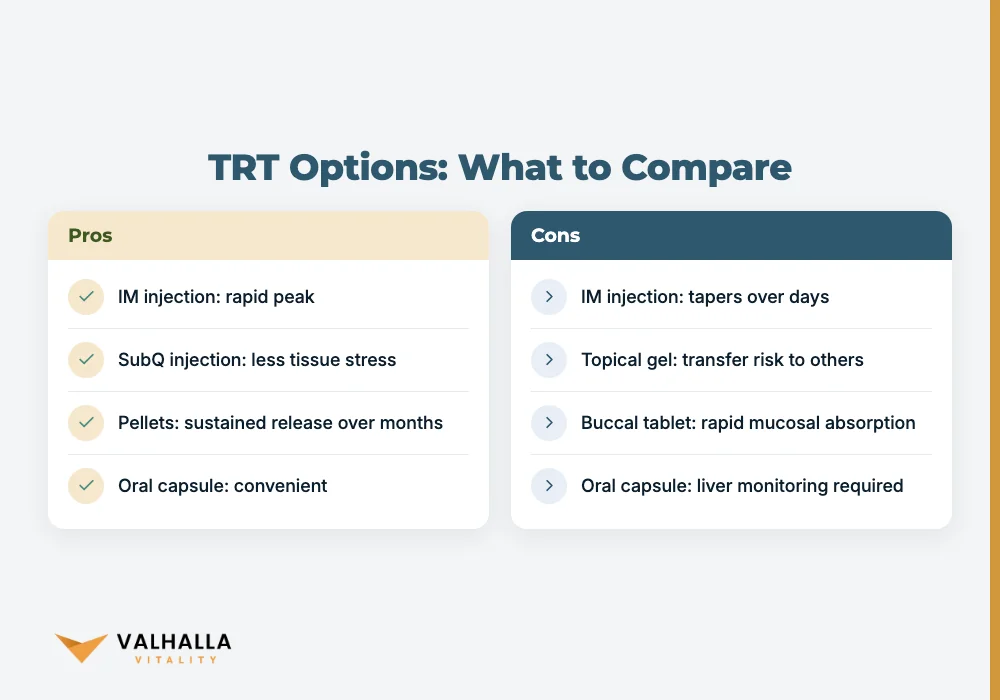
Choosing the best TRT for men starts with understanding how delivery methods differ. A provider considers your lifestyle, adherence patterns, and clinical picture before recommending any specific form. The table below outlines the main testosterone therapy options:
| Delivery method | How it's administered | Release profile |
|---|---|---|
| Intramuscular injection | Injected into muscle | Rapid peak that tapers over days |
| Subcutaneous injection | Shallow injection under skin | Comparable to IM, less tissue stress |
| Topical gel | Applied to skin daily | Steady absorption; transfer risk to others |
| Skin patch | Applied to upper body | Stable daily absorption |
| Testosterone pellets | Minor in-office insertion | Slow sustained release over months |
| Buccal tablet | Held against gum | Rapid mucosal absorption |
| Oral capsule | Taken with food | Convenient; liver monitoring required |
What is the most effective form of testosterone replacement therapy?
No single method is universally superior. Intramuscular injections have been a clinical standard for decades. A 2022 study in the Journal of Clinical Endocrinology and Metabolism found subcutaneous injections to be a safe and practical alternative with comparable hormone delivery and fewer adverse injection-site effects [S2]. Pellets offer a sustained release window after a single insertion; a 2021 review in Current Drug Targets confirmed that implanted pellets maintain consistent hormone levels over their absorption period [S3]. For a side-by-side breakdown of all testosterone delivery formats including injections, gels, and more, the key differences come down to scheduling, flexibility, and personal preference.
TRT injections vs pellets: the practical difference
TRT injections and pellets differ most in how quickly a provider can respond to lab results. Injections allow protocol adjustments after each follow-up panel. Pellets, once inserted, release hormone at a fixed rate until fully absorbed, so corrections take longer to take effect. Men who prefer not to manage a weekly injection schedule often favor pellets. Men who are new to therapy, or whose levels need frequent adjustment, typically benefit from injections at the outset.
What are the benefits of TRT for men?
Testosterone replacement benefits, when therapy is clinically indicated, may include improvements in libido, energy, mood, and lean body mass. The 2024 evidence synthesis [S1] found that men with confirmed hypogonadism who received TRT reported meaningful improvements in sexual function and quality of life compared with placebo.
Some evidence also points to potential support for bone mineral density and insulin sensitivity. These outcomes depend on baseline levels, overall health, and consistent monitoring throughout treatment. No provider can promise a specific result.
What are the risks of testosterone replacement therapy for men?
TRT carries real risks that require ongoing lab monitoring. TRT side effects to discuss with a provider before starting include:
- Erythrocytosis, an elevated red blood cell count, is an established risk on TRT and is caught early through routine hematocrit panels.
- The body typically reduces its own testosterone output when exogenous testosterone is introduced, which matters if therapy is ever paused or stopped.
- A 2025 review in Nature Reviews Urology confirmed that TRT suppresses spermatogenesis in reproductive-age men; men who want to preserve fertility should discuss alternatives with a provider before starting [S5].
- Providers track hematocrit and lipid panels throughout treatment to watch cardiovascular markers.
- Skin reactions and injection-site responses occur at different rates depending on the delivery method chosen.
Availability varies by state.
How long does it take for TRT to work?
Most men report noticing initial changes within four to six weeks, though the timeline varies by delivery method and individual physiology. Some effects, such as changes in bone density, take longer to measure. A provider schedules follow-up labs to confirm levels are in a therapeutic range and adjusts the protocol if needed. For context on what those numbers should look like, ideal testosterone levels on TRT for men and women walks through what providers look for at follow-up panels.
Choosing the best TRT for men
How do I know which TRT option is right for me?
The right testosterone therapy option depends on your labs, medical history, lifestyle, and a direct conversation with a licensed provider. No article can make that determination. Some men with secondary hypogonadism may also be candidates for approaches that support the body's own hormone production rather than supplementing from outside. How enclomiphene may enhance TRT outcomes covers one such alternative in detail.
At Valhalla Vitality, a licensed provider reviews your intake within 24 business hours of submission. The best TRT for men is the one that follows a proper clinical evaluation, matches your physiology, and is adjusted regularly based on lab follow-up.
Ready to explore your options?
Book Your Consultation to speak with a licensed provider about your symptoms, lab results, and the testosterone therapy options available to you.
FAQ
What is TRT and who needs it?
Testosterone replacement therapy is a medically supervised treatment for men with clinically confirmed low testosterone. A blood test confirming hypogonadism and a full provider review are required before therapy begins.
Does TRT affect sperm count?
Yes. A 2025 review confirmed that testosterone replacement therapy suppresses spermatogenesis in reproductive-age men. Men who want to preserve fertility should discuss alternatives with a licensed provider before starting TRT.
How is the best TRT for men determined?
A licensed provider evaluates lab results, symptoms, delivery-method preferences, and overall health before recommending a testosterone therapy option. There is no single method that works best for every patient.
How much does testosterone therapy cost?
Testosterone therapy cost depends on the delivery method, monitoring labs, and provider fees. Specific pricing is available once you complete the medical intake process and a provider has reviewed your case.
Are there natural ways to support testosterone levels?
Regular exercise, body fat reduction, and a diet that includes zinc and omega-3 fatty acids may support healthy testosterone production. A provider can advise whether lifestyle changes alone are sufficient or whether testosterone replacement therapy is clinically warranted.
Sources
- Cruickshank M et al. (2024). The effects and safety of testosterone replacement therapy for men with hypogonadism: the TestES evidence synthesis and economic evaluation. Health Technology Assessment. PubMed
- Figueiredo MG et al. (2022). Testosterone Therapy With Subcutaneous Injections: A Safe, Practical, and Reasonable Option. The Journal of Clinical Endocrinology and Metabolism. PubMed
- Handattu MS et al. (2021). A Comprehensive Review on Pellets as a Dosage Form in Pharmaceuticals. Current Drug Targets. PubMed
- Naelitz BD et al. (2025). Testosterone replacement therapy and spermatogenesis in reproductive age men. Nature Reviews Urology. PubMed