
The following blog post is for entertainment and informational purposes only. It is not intended to provide medical advice or diagnosis. Please consult your doctor before making any health-related decisions.
A tirzepatide research peptide carries a "research use only" label saying it is not intended for human use, and as of November 2026 such products are not FDA-approved drugs. An FDA-approved prescription medicine containing tirzepatide exists for specific conditions. A label such as "tirz research peptide" cannot confirm purity, dose or sterility.
Valhalla Vitality does not sell research-use-only products. Discussion of a substance in this article does not mean it is available through Valhalla Vitality.
What Is Tirzepatide?
Tirzepatide is a peptide that acts as a dual GIP (glucose-dependent insulinotropic polypeptide) and GLP-1 (glucagon-like peptide-1) receptor agonist, which means it activates both receptor types. Our overview of GLP-1 research peptides explains the wider receptor class and the "GLP" names that appear on labels. Whatever name a listing uses, such as "tirz" or "tirzepatide GLP-1 research peptide," a molecule name on a label is only the seller's claim. FDA describes tirzepatide products sold labeled "for research purposes" as being of unknown quality.
What Has Science Studied About Tirzepatide?
Tirzepatide has been studied in randomized clinical trials in humans, and a 2026 systematic review and meta-analysis pooled several of those trials. Those studies examined the regulated medicine, not products sold as research peptides.
What a Published Review Has Examined
That 2026 review examined two inflammatory markers, high-sensitivity C-reactive protein and interleukin-6, in studies of tirzepatide. It included seven randomized clinical trials and one observational study.
Why These Studies Don't Describe Research-Labeled Products
Published human studies of tirzepatide were not studies of research-labeled products, so they cannot tell a reader what such a product contains. The existence of human trials says nothing about the purity, dose or sterility of a research-labeled product.
Are Tirzepatide Research Peptides FDA-Approved? (as of November 2026)
As of November 2026, tirzepatide products sold as research peptides are not FDA-approved drugs. An FDA-approved prescription medicine containing tirzepatide exists for specific conditions.
The approved uses come from two FDA labels for tirzepatide:
- As an adjunct to diet and exercise, to improve glycemic control in adults and pediatric patients 10 years and older with type 2 diabetes.
- To reduce the risk of major adverse cardiovascular events (cardiovascular death, non-fatal heart attack or non-fatal stroke) in adults with type 2 diabetes at high risk for these events.
- With a reduced-calorie diet and increased physical activity, to reduce excess body weight and maintain weight reduction long term in adults with obesity, or in adults with overweight who have at least one weight-related comorbid condition.
- To treat moderate to severe obstructive sleep apnea in adults with obesity.
Products sold as research peptides are not any of these approved products.
FDA says it has warned companies that sold unapproved drugs containing tirzepatide that were falsely labeled "for research purposes" or "not for human consumption" and were sold directly to consumers for human use with dosing instructions. The same FDA statement names other molecules too, including semaglutide; our article on the semaglutide research peptide covers that molecule.
In warning letters to sellers of research-labeled peptides, FDA has found that despite "research use only" or "not for human consumption" statements, evidence such as the seller's website showed the products were intended as drugs for human use, making them unapproved new drugs. The regulatory situation is complex and changes over time, so FDA's own pages are the place to check current status.
Risks of Research-Use-Only Tirzepatide Products
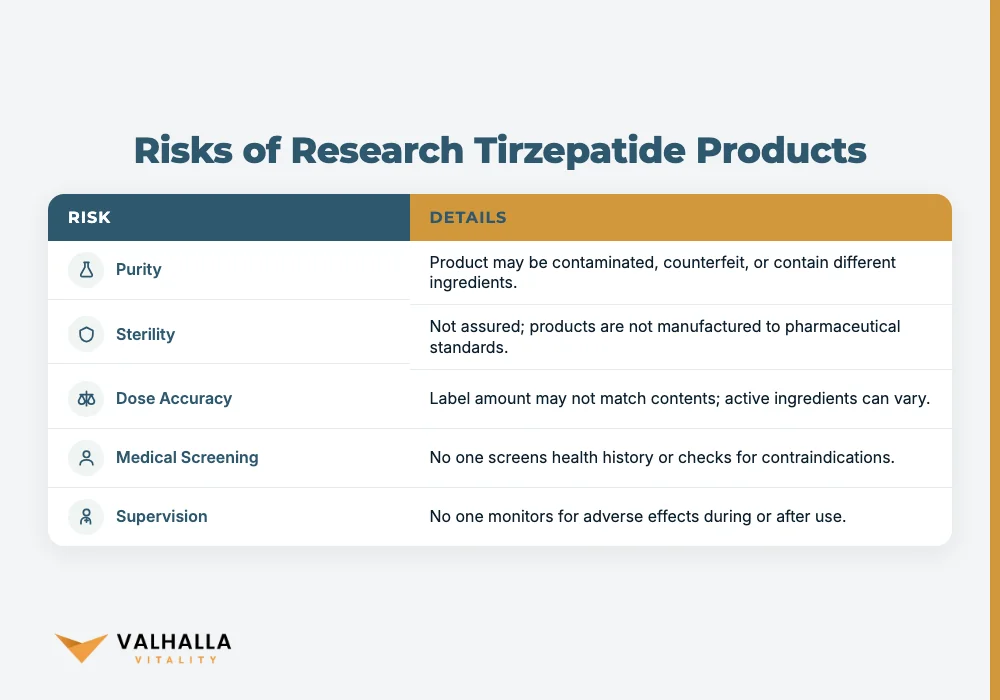
A tirzepatide research peptide is not manufactured or tested to pharmaceutical standards, so its purity, sterility, dose accuracy and actual composition can differ from what the label states. A label reading "tirzepatide research peptide 30mg" tells you nothing about what is actually inside the vial.
- Purity cannot be confirmed, and the product may be contaminated or counterfeit.
- Sterility is not assured.
- The amount on the label may not match the contents, and the product may contain different ingredients altogether.
- No one screens your health history, current medications or possible contraindications before use.
- No one monitors for adverse effects during or after use.
Purity, Sterility, and Dose Accuracy
FDA has warned that drugs that have circumvented regulatory safeguards may be contaminated or counterfeit, may contain varying amounts of active ingredients, or may contain different ingredients altogether. FDA states that injectable drug products can pose risks of serious harm because they are delivered directly into the body, sometimes directly into the bloodstream, and bypass some of the body's key defenses against toxins and microorganisms. Both warnings apply regardless of what a product's label states.
No Medical Screening or Supervision
Using a research-labeled product on your own means no one reviews your health history before use, and no one checks for contraindications or interactions with medicines you already take. There is also no follow-up: no one watches for adverse effects, and no one is in place to assess a problem if one appears.
Key Points on Tirzepatide Research Peptides (as of November 2026)
- As of November 2026, tirzepatide products sold as research peptides are not FDA-approved drugs.
- An FDA-approved prescription medicine containing tirzepatide exists for specific conditions. Products sold as research peptides are not that medicine.
- FDA has warned companies that sold tirzepatide falsely labeled "for research purposes" or "not for human consumption" directly to consumers, and it urges consumers not to buy these products.
- A "research use only" label cannot confirm purity, sterility or dose, and self-use means no medical screening or supervision.
Questions about any medication or supplement are best discussed with a licensed healthcare professional.
Frequently Asked Questions
What does "research use only" mean on a tirzepatide product?
"Research use only" is a labeling statement that the product is not intended for human use. In warning letters to sellers of research-labeled peptides, FDA has found that this label does not stop a product from being an unapproved new drug when evidence, such as the seller's website, shows it is meant for human use. The label also cannot confirm what a tirzepatide product actually contains.
Is there an FDA-approved medicine containing tirzepatide?
Yes. As of November 2026, an FDA-approved prescription medicine containing tirzepatide exists for specific conditions. Two approved tirzepatide labels cover only certain patients with type 2 diabetes, obesity or overweight, or obstructive sleep apnea, alongside diet and physical activity where a label specifies them. Research-labeled products are not those approved products and are not FDA-approved drugs.
What has FDA said about tirzepatide sold "for research purposes"?
FDA says it has warned companies that sold such tirzepatide products, and it urges consumers not to buy them. In FDA's description, the companies sold unapproved drugs falsely labeled "for research purposes" or "not for human consumption" directly to consumers, with dosing instructions. FDA says these products may be harmful to health, and as of November 2026 they are not FDA-approved drugs.
Does a "30mg" label tell you what is in a tirzepatide research peptide?
No. A label reading "tirzepatide research peptide 30mg," or a listing for a "tirz research peptide," is only the seller's claim and tells you nothing about what is actually inside the vial. According to FDA, drugs that bypass regulatory safeguards may be contaminated or counterfeit, and the amount or even the identity of the active ingredient may differ from what the label states.
Sources
- Masson W et al. (2026). Anti-inflammatory effects of tirzepatide: a systematic review and meta-analysis. Reviews in Endocrine and Metabolic Disorders. PMID 41032183. PubMed
- U.S. Food and Drug Administration. FDA's Concerns with Unapproved GLP-1 Drugs Used for Weight Loss. Content current as of 10/01/2026. FDA.gov
- U.S. Food and Drug Administration. Warning letters database (letters to online peptide sellers), letters dated 02/26/2025 to 08/24/2026. FDA.gov
- DailyMed, U.S. National Library of Medicine. Tirzepatide prescribing label (type 2 diabetes and cardiovascular risk), Section 1. Label revised 8/2026; DailyMed updated August 27, 2026. DailyMed
- DailyMed, U.S. National Library of Medicine. Tirzepatide prescribing label (weight management and obstructive sleep apnea), Section 1. Label revised 8/2026; DailyMed updated August 28, 2026. DailyMed
This article is for educational purposes only and is not medical advice. Valhalla Vitality does not sell research-use-only products, and discussion of a substance in this article does not mean it is available through Valhalla Vitality. Availability of any compounded therapy depends on the specific product, formulation, current regulatory requirements, pharmacy eligibility and provider evaluation. Compounded medications are not FDA-approved and have not been evaluated by the FDA for safety, effectiveness, or quality.
You May Also Like
 Tirzepatide
 side effects: what to expect and manage
Tirzepatide side effects range from common nausea to rare pancreatitis. Learn how long they last, what to watch for, and how to manage each one.
November 17, 2026 ETRead more → Tirzepatide
 Near Me: How to Get a GLP-1 Prescription Online
Find tirzepatide near me through a telehealth provider. Get your prescription reviewed and shipped within days. Availability varies by state.
November 17, 2026 ETRead more → Tadalafil
 vs Vardenafil: Onset, Duration, and Side Effects
Tadalafil vs vardenafil: compare onset time, duration, side effects, and food interactions to understand which PDE5 inhibitor fits your lifestyle.
November 17, 2026 ETRead more →