
The following blog post is for entertainment and informational purposes only. It is not intended to provide medical advice or diagnosis. Please consult your doctor before making any health-related decisions.
As of November 2026, retatrutide is not FDA-approved for any use: it is an investigational molecule, and clinical trials are ongoing. A retatrutide research peptide is a product sold online with a "research use only" label, a labeling statement indicating the product is not intended for human use. Retatrutide targets three hormone receptors: the GLP-1 receptor, the GIP receptor, and the glucagon receptor, which is why it is called a triple agonist.
Valhalla Vitality does not sell research-use-only products. Discussion of a substance in this article does not mean it is available through Valhalla Vitality.
How retatrutide works: three receptors, one molecule
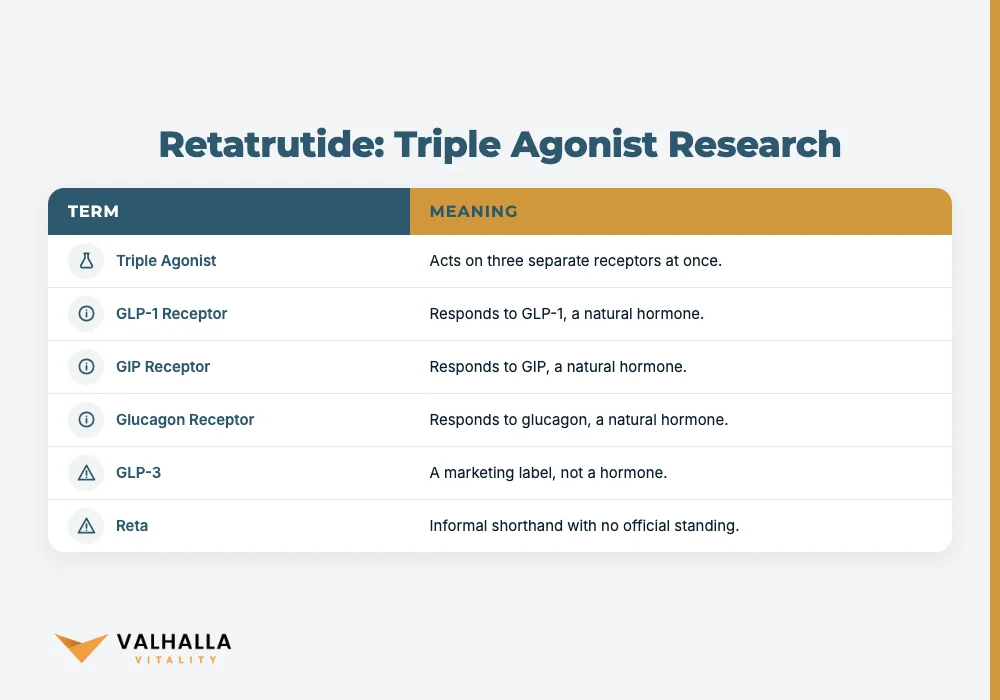
An agonist is a molecule that binds to a receptor and activates it, the way a natural hormone does. Retatrutide is a single molecule designed to act on three separate receptors at once. That is what makes it a triple agonist in laboratory research. Each receptor responds to a different natural hormone.
- The GLP-1 receptor responds to GLP-1 (glucagon-like peptide-1), a natural hormone.
- The GIP receptor responds to GIP (glucose-dependent insulinotropic polypeptide), another natural hormone.
- The glucagon receptor responds to glucagon, a natural hormone.
Retatrutide has been studied in clinical trials, and FDA addresses the molecule on its page about unapproved GLP-1 drugs. Our guide to GLP-1 research peptides explains what GLP-1 receptor agonists are and the regulatory status of related molecules.
Why "GLP-3" is a marketing label, not a hormone
There is no hormone called GLP-3. A retatrutide research peptide listing may carry names like "retatrutide glp-3 research peptide" and "glp 3 research peptide." Retatrutide's actual targets are the GLP-1 receptor, the GIP receptor, and the glucagon receptor. Those are three distinct receptor systems, none of which is called GLP-3.
"Reta," as in "reta research peptide," is informal shorthand with no official standing. A label like "GLP-3" tells a buyer nothing about what a product contains, how pure it is, or whether it is sterile. It is a marketing term applied to a molecule with a specific triple-receptor profile.
What research has studied: retatrutide clinical trials
Retatrutide's research program has reached human clinical trials. The ClinicalTrials.gov listings cited here describe which studies exist and which conditions they cover, not their results. FDA states that retatrutide has not been found safe and effective for any condition, so its safety in humans has not been established.
Phase 3 trials listed as of October 2026
As of October 20, 2026, ClinicalTrials.gov lists 14 Phase 3 studies of retatrutide. They cover obesity or overweight, type 2 diabetes, knee osteoarthritis, chronic low back pain, fatty liver disease (MASLD), and cardiovascular and kidney outcomes. These are conditions under study, not approved uses.
What the trial listings do not show
"Investigational" means a molecule is still being studied in clinical trials and has not been approved for any use. A registry listing describes a study. It is not a result, and it is not an approval. Trial listings also say nothing about what is inside a vial sold online under a research label.
Retatrutide FDA approval status as of November 2026
As of November 2026, retatrutide is not approved by the FDA for any use. FDA states that it is not a component of any FDA-approved drug and has not been found safe and effective for any condition. FDA also states that retatrutide cannot be used in compounding under federal law.
The interim HHS enforcement-discretion policy for 503A compounding with certain peptides, published in the Federal Register on October 30, 2026, does not apply to retatrutide: it is not one of the six peptides listed in the policy's Appendix A.
Retatrutide is investigational, and clinical trials are ongoing. Products sold as retatrutide research peptides are not FDA-approved drugs. A "research use only" label is a labeling statement that a product is not intended for human use. In August 2026 warning letters to online peptide sellers, however, FDA found that despite such labeling, evidence from the sellers' websites showed the products were intended as drugs for human use. FDA concluded they were unapproved new drugs.
FDA says it has warned companies that illegally sold unapproved drugs containing retatrutide, falsely labeled "for research purposes" or "not for human consumption." The regulatory situation is complex and changing; for legal questions, rely on official sources such as fda.gov.
Risks of buying retatrutide labeled "for research use only"
Products labeled "research use only," including RUO peptides sold as retatrutide, are not manufactured or tested to pharmaceutical standards. Purity, dose accuracy, sterility, and composition may all differ from what the label claims. No number on a vial changes that.
A listing for a "retatrutide research peptide vial" or a product with a "GLP-3" label tells a buyer nothing about purity, actual content, or sterility. As of November 2026, retatrutide is not approved by the FDA for any use, and any retatrutide product offered online is therefore an unapproved product. FDA urges consumers not to buy these products, which it says are of unknown quality and may be harmful to their health.
- Purity is unverified. FDA has warned that drugs that have circumvented regulatory safeguards may be contaminated.
- Dose accuracy is unverified. FDA has warned that such drugs may contain varying amounts of active ingredients.
- Sterility is unverified. FDA states that injectable drug products bypass some of the body's key defenses against toxins and microorganisms, which can lead to serious and life-threatening conditions.
- Composition is unconfirmed. FDA has warned that such products may be counterfeit or may contain different ingredients altogether.
- No medical screening happens. No one checks for possible contraindications before use.
- No one supervises use. With self-use, no one follows up if problems occur.
Key points as of November 2026
- Retatrutide is not FDA-approved for any use. It is investigational, and clinical trials are ongoing.
- FDA states that retatrutide cannot be used in compounding under federal law, and the interim HHS enforcement-discretion policy for 503A compounding with certain peptides, published October 30, 2026, does not apply to it.
- Products sold online as retatrutide research peptides are not FDA-approved drugs. FDA says it has warned companies that sold them and urges consumers not to buy these products.
- "GLP-3" is a marketing label, not a hormone.
Questions about any medication or supplement are best discussed with a licensed healthcare professional.
Frequently asked questions
What is a retatrutide research peptide?
A retatrutide research peptide is a product sold online with a "research use only" label, which states that it is not intended for human use. Retatrutide is an investigational molecule that targets the GLP-1, GIP, and glucagon receptors. As of November 2026, it is not approved by the FDA for any use, and clinical trials are ongoing. These products are not manufactured or tested to pharmaceutical standards.
Is retatrutide FDA approved?
No. As of November 2026, retatrutide is not approved by the FDA for any use. FDA states that it is not a component of any FDA-approved drug and has not been found safe and effective for any condition. Retatrutide is investigational, and clinical trials are ongoing. Retatrutide products sold online are not FDA-approved drugs.
Is GLP-3 a real hormone?
No. There is no hormone called GLP-3. The term is a marketing label sometimes attached to retatrutide in online product listings. Retatrutide's actual targets are three receptors: the GLP-1 receptor, the GIP receptor, and the glucagon receptor. A label like "GLP-3" or "glp 3 research peptide" tells a buyer nothing about what a product contains.
Is retatrutide a GLP-1 agonist?
Retatrutide acts on the GLP-1 receptor, but not only on it. It targets three receptors: the GLP-1, GIP, and glucagon receptors, which is why it is called a triple agonist. This describes how the molecule is built, not what it does in people. As of November 2026, retatrutide is not approved by the FDA for any use, and clinical trials are ongoing.
What are the risks of buying retatrutide online labeled "for research use only"?
Unapproved products like these do not go through FDA review for safety, effectiveness, or quality. FDA has warned that such drugs may be contaminated or counterfeit, may contain varying amounts of active ingredients, or may contain different ingredients altogether. Self-use means no medical screening and no supervision. FDA urges consumers not to buy these products, which it says are of unknown quality.
Is there an FDA approval date for retatrutide?
The official sources cited here give no FDA approval date for retatrutide. As of November 2026, it is investigational: it is still being studied in clinical trials and has not been approved for any use. ClinicalTrials.gov lists Phase 3 studies of retatrutide, but a trial listing is not a result and not an approval. FDA states that retatrutide is not a component of any FDA-approved drug.
Sources
- U.S. Food and Drug Administration. FDA's Concerns with Unapproved GLP-1 Drugs Used for Weight Loss. Content current as of 10/01/2026. https://www.fda.gov/drugs/drug-alerts-and-statements/fdas-concerns-unapproved-glp-1-drugs-used-weight-loss
- U.S. Food and Drug Administration. Warning Letters database (letters to online peptide sellers, 2025 and 2026). https://www.fda.gov/inspections-compliance-enforcement-and-criminal-investigations/compliance-actions-and-activities/warning-letters
- ClinicalTrials.gov, U.S. National Library of Medicine. Studies with intervention "retatrutide". Queried October 20, 2026. https://clinicaltrials.gov/api/v2/studies?query.intr=retatrutide&fields=NCTId,Phase,OverallStatus,BriefTitle&pageSize=100
- Federal Register. Enforcement Discretion Policy Regarding 503A Compounding Using Certain Peptide Bulk Drug Substances (HHS notice, 91 FR 68526). Published October 30, 2026. https://www.federalregister.gov/documents/2026/10/30/2026-22192/enforcement-discretion-policy-regarding-503a-compounding-using-certain-peptide-bulk-drug-substances
- U.S. Department of Health and Human Services. Enforcement Discretion Policy Regarding 503A Compounding Using Certain Peptide Bulk Drug Substances (interim policy, Appendix A). Announced October 30, 2026. https://www.hhs.gov/sites/default/files/hhs-503a-peptide-enforcement-discretion-policy-appendix-b.pdf
This article is for educational purposes only and is not medical advice. Valhalla Vitality does not sell research-use-only products, and discussion of a substance in this article does not mean it is available through Valhalla Vitality. Availability of any compounded therapy depends on the specific product, formulation, current regulatory requirements, pharmacy eligibility and provider evaluation. Compounded medications are not FDA-approved and have not been evaluated by the FDA for safety, effectiveness, or quality.
You May Also Like
 Tirzepatide
 side effects: what to expect and manage
Tirzepatide side effects range from common nausea to rare pancreatitis. Learn how long they last, what to watch for, and how to manage each one.
November 17, 2026 ETRead more → Tirzepatide
 Near Me: How to Get a GLP-1 Prescription Online
Find tirzepatide near me through a telehealth provider. Get your prescription reviewed and shipped within days. Availability varies by state.
November 17, 2026 ETRead more → Tadalafil
 vs Vardenafil: Onset, Duration, and Side Effects
Tadalafil vs vardenafil: compare onset time, duration, side effects, and food interactions to understand which PDE5 inhibitor fits your lifestyle.
November 17, 2026 ETRead more →