
The following blog post is for entertainment and informational purposes only. It is not intended to provide medical advice or diagnosis. Please consult your doctor before making any health-related decisions.
Semaglutide is a GLP-1 receptor agonist. As of October 2026, products sold as a semaglutide research peptide are not FDA-approved drugs. They carry a "research use only" label, a labeling statement that the product is not intended for human use. If you're considering one, talk with a licensed provider about your health history and goals instead of buying it.
What is semaglutide?
Semaglutide belongs to a drug class called GLP-1 receptor agonists. As of October 2026, the conditions in its approved labels differ by label and by form.
One FDA label covers a semaglutide injection for adults with type 2 diabetes. Used with diet and exercise, it is approved to improve blood sugar control.
In adults with type 2 diabetes and established cardiovascular disease, the injection is also approved to reduce the risk of major adverse cardiovascular events. In adults with type 2 diabetes and chronic kidney disease, it is approved to reduce the risk of sustained eGFR decline, end-stage kidney disease and cardiovascular death.
A separate weight-management label covers a semaglutide injection and tablets. With a reduced-calorie diet and increased physical activity, they are approved to reduce excess body weight and maintain weight reduction long term.
The injection is approved for adults and pediatric patients 12 and older with obesity, and for adults with overweight who have at least one weight-related condition. The tablets are approved for adults with obesity, or adults with overweight who have at least one weight-related condition.
Both forms are also approved to reduce the risk of major adverse cardiovascular events in adults with established cardiovascular disease and either obesity or overweight. Under accelerated approval, the injection, not the tablets, is also approved for adults with noncirrhotic MASH, a liver condition, with moderate to advanced liver fibrosis (stages F2 to F3).
What research has studied
Semaglutide has been studied in human clinical trials of its regulated formulations, and published reviews of those human studies have summarized that work. Products sold as research peptides were not part of those trials. That gap matters.
What human data exists and what it does not show
Published reviews have examined how the body absorbs and clears semaglutide, lean mass in clinical trial participants, and psychiatric outcomes. That research studied regulated formulations and does not describe products sold with research-use-only labels.
Semaglutide in combination trials
As of October 20, 2026, ClinicalTrials.gov lists 22 Phase 3 studies of cagrilintide, an investigational molecule, most of them testing it in combination with semaglutide for weight management and type 2 diabetes. Phase 3 is not approval.
FDA states that, as of October 2026, cagrilintide is not a component of any FDA-approved drug and has not been found safe and effective for any condition. A trial listing is not an approval, and products sold as research peptides are not part of these studies.
Regulatory status as of October 2026
As of October 2026, products sold as a semaglutide research peptide are not FDA-approved drugs. An FDA-approved prescription medicine containing semaglutide exists for specific conditions and is prescribed only after a licensed provider's evaluation.
That medicine comes as an injection and as tablets, and a research-labeled vial is neither of those approved products. FDA notes that unapproved versions do not undergo its review for safety, effectiveness and quality before they are marketed. The regulatory situation is complex and changing, and FDA's own pages are the official source.
What has FDA said about semaglutide labeled "for research purposes"?
FDA says it has warned companies that sold unapproved drugs containing semaglutide that were falsely labeled "for research purposes" or "not for human consumption" and were sold directly to consumers for human use, and it urges consumers not to buy these products.
The phrase "research use only" is a labeling statement that a product is not intended for human use. In warning letters to sellers of research-labeled peptides, FDA has found that evidence from the sellers' websites showed the products were intended as drugs for human use and were unapproved new drugs despite that label.
Risks of buying research-labeled semaglutide
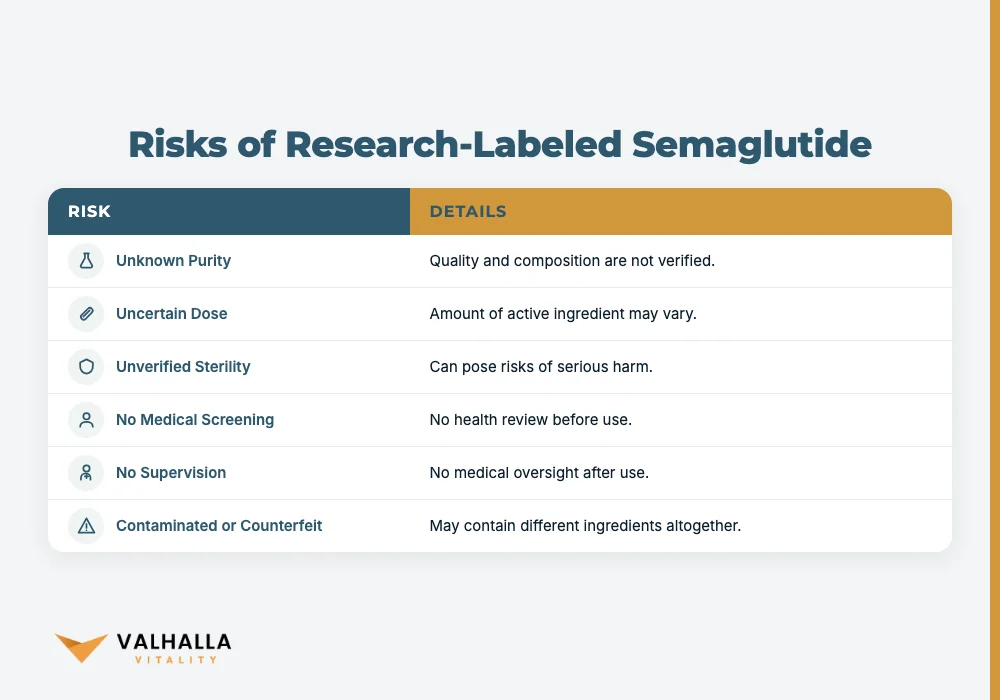
FDA has stated that the research-labeled semaglutide products it warned about are of unknown quality and may be harmful. For anyone considering a semaglutide research peptide, the main risks are unknown purity and composition, uncertain dose, unverified sterility, and no medical screening or supervision.
In warning letters to peptide sellers, FDA has noted that injectable drug products bypass some of the body's key defenses against toxins and microorganisms and can pose risks of serious harm, which is why unverified sterility matters. Self-use means no medical screening beforehand and no supervision afterward. The stakes are real.
Why can't a research peptide seller confirm what is in the vial?
Research-labeled products are not manufactured or tested to pharmaceutical standards, so what is in a vial may differ from what its label says. FDA has warned that drugs that bypass regulatory safeguards may be contaminated or counterfeit, or may contain varying amounts of the active ingredient or different ingredients altogether.
If a research-use-only product has caught your attention, start with a conversation instead of a purchase. When you talk with a licensed Valhalla Vitality provider, they can review your health history and goals and discuss whether any treatment option may be appropriate for you.
What a licensed provider evaluation looks like
A licensed provider reviews your health history and goals in an online evaluation and decides whether any treatment option is clinically appropriate. Not everyone will qualify, and a consultation may not result in a prescription. Availability varies by state.
Talk to a licensed provider before you make a decision
Research-labeled products carry risks that a label alone cannot resolve. A licensed provider consultation is the appropriate starting point for anyone weighing such a product.
Book Your Consultation to speak with a licensed Valhalla Vitality provider about your health history and goals.
Frequently asked questions
Is a semaglutide research peptide the same as the approved injection or tablets?
No. As of October 2026, an FDA-approved prescription medicine containing semaglutide exists for specific conditions and is prescribed only after a licensed provider's evaluation. It comes as an injection and as tablets; a research-labeled vial is neither, and FDA notes that unapproved versions do not undergo its review for safety, effectiveness and quality before they are marketed.
What is the FDA-approved semaglutide medicine approved for?
As of October 2026, one FDA label covers a semaglutide injection for adults with type 2 diabetes: blood sugar control and, in some, cardiovascular and kidney risk reduction. A separate label covers a semaglutide injection and tablets for weight reduction and cardiovascular risk reduction in certain adults. Only that injection also covers pediatric patients 12 and older with obesity and, under accelerated approval, certain adults with MASH.
Is semaglutide being studied in combination with other molecules?
Yes: semaglutide is being tested alongside cagrilintide, an investigational molecule. As of October 20, 2026, most of the 22 Phase 3 cagrilintide studies listed on ClinicalTrials.gov pair it with semaglutide for weight management and type 2 diabetes. FDA says cagrilintide is not approved for any use, and products sold with research-use-only labels are not part of these trials.
Why can't a seller confirm what is in a semaglutide research peptide vial?
A seller's certificate of analysis is not independent regulatory verification and cannot confirm what is in a vial. Research-labeled products are not made or tested to pharmaceutical standards, so their purity, dose, sterility and composition may not match the label. In a 2025 warning letter to a peptide seller, FDA also said that drugs bypassing regulatory safeguards may be contaminated or counterfeit.
What are the risks of self-using a semaglutide research peptide?
Self-use means no medical screening beforehand and no supervision afterward, and research-labeled products also carry quality risks, including uncertain sterility. In warning letters to peptide sellers, FDA has noted that injectable drug products bypass some of the body's key defenses against toxins and microorganisms and can pose risks of serious harm. A licensed provider can review your health history and decide whether any treatment option is appropriate.
Sources
PubMed
- Carminati M et al. (2026). Glucagon-like peptide-1 receptor agonist semaglutide through the lens of psychiatry: a systematic review of potential benefits and risks. International Clinical Psychopharmacology. PubMed
- Bikou A et al. (2024). A systematic review of the effect of semaglutide on lean mass: insights from clinical trials. Expert Opinion on Pharmacotherapy. PubMed
- Yang XD et al. (2024). Clinical Pharmacokinetics of Semaglutide: A Systematic Review. Drug Design, Development and Therapy. PubMed
- Jamialahmadi T et al. (2025). Beyond fat: Does semaglutide affect lean mass? Clinical Nutrition. PubMed
Regulatory
- DailyMed (NLM/NIH): semaglutide injection (diabetes) label, Section 1. Label revised 5/2026; updated June 1, 2026. DailyMed
- DailyMed (NLM/NIH): semaglutide injection and tablets (weight management) label, Section 1. Label revised 6/2026; updated June 18, 2026. DailyMed
- FDA: FDA's Concerns with Unapproved GLP-1 Drugs Used for Weight Loss. Content current as of 10/01/2026. FDA
- FDA: Warning letters database (letters to online peptide sellers; letters dated February 2025 to August 2026). FDA
- ClinicalTrials.gov (NLM/NIH): studies with intervention "cagrilintide," queried October 20, 2026. ClinicalTrials.gov
This article is for educational purposes only and is not medical advice. Prescription treatments are available only after evaluation by a licensed provider, and not everyone will qualify. Compounded medications are not FDA-approved and have not been evaluated by the FDA for safety, effectiveness, or quality.
You May Also Like
 Semaglutide
 Sodium vs Semaglutide: Key Differences Explained
Semaglutide sodium vs semaglutide: how these GLP-1 formulations compare in structure, side effects, and what a provider weighs before prescribing.
November 5, 2026 ETRead more →
Wegovy Insurance Coverage: What Plans Actually Cover
Wegovy insurance coverage requires prior authorization and medical criteria. Learn how to qualify, appeal a denial, and what Medicare covers in 2025.
November 5, 2026 ETRead more → Featured
At Home STI Test: How It Works, Accuracy & Privacy
At home STI test kits let you screen for chlamydia, HIV, and more with private, rapid STI results. Learn how to use them and what to do next.
November 5, 2026 ETRead more →