
The following blog post is for entertainment and informational purposes only. It is not intended to provide medical advice or diagnosis. Please consult your doctor before making any health-related decisions.
Rapamycin weight loss research points to a real but layered relationship between this drug and body composition. Known clinically as sirolimus, rapamycin works by blocking a cellular hub called mTOR, which regulates energy use, protein synthesis, and fat storage throughout the body. Animal studies consistently show reductions in fat mass after treatment, and a 2024 systematic review by Lee et al. in The Lancet Healthy Longevity found promising metabolic signals in early human trials. For anyone evaluating this drug, understanding how rapamycin inhibits mTOR pathways lays the groundwork for weighing both the potential and the trade-offs.
Does rapamycin help with weight loss?
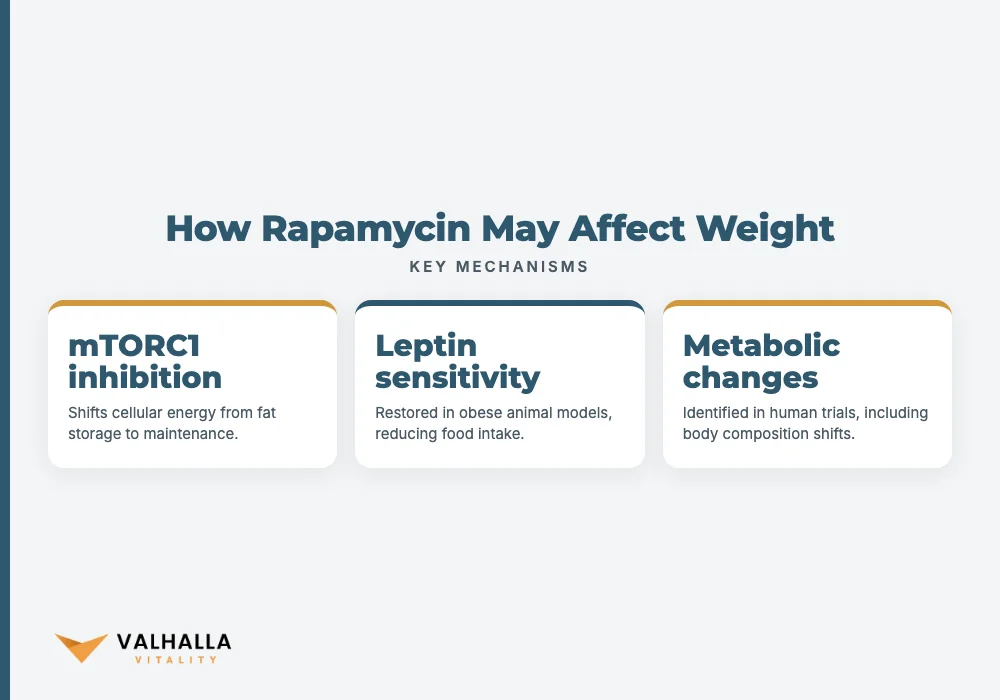
Rapamycin does influence body weight. The effect is mechanism-dependent, though, and context-specific. It does not suppress appetite the way a GLP-1 therapy does. Instead, it reshapes how cells handle energy at a biochemical level, with downstream effects on fat accumulation, insulin signaling, and the hormonal systems that govern hunger.
The key driver is mTOR inhibition. When rapamycin suppresses mTOR complex 1 (mTORC1), the body shifts from storage and growth mode toward maintenance and cellular repair. That shift can lower fat accumulation over time.
In animal models, obese rodents treated with rapamycin lost body weight, reduced fat mass, and in several studies regained leptin sensitivity, the hormonal signal that tells the brain it has had enough to eat.
Leptin resistance is a central driver of persistent obesity. When fat cells release leptin, it normally signals the hypothalamus to reduce hunger and increase energy expenditure. In leptin-resistant states, that signal goes unanswered. Rapamycin's ability to restore this feedback loop in obese animal models is one of the more striking findings in rapamycin weight loss research and has shaped much of the subsequent interest in this area.
The human data is earlier-stage. The 2024 Lancet systematic review by Lee et al. identified metabolic changes across rapamycin trials, including body composition shifts, but the authors called for larger, longer-term controlled studies before firm clinical recommendations can be made.
| Mechanism | How it may affect body weight | Evidence level |
|---|---|---|
| mTORC1 inhibition | Shifts cellular energy from fat storage to maintenance | Strong (animal); emerging (human) |
| Leptin sensitivity restoration | Reduces food intake in obese models | Rodent studies |
| Insulin sensitivity improvement | Lowers blood sugar swings, reduces fat storage | Animal and early human |
| Dietary restriction mimicry | Triggers metabolic changes similar to caloric restriction | Proposed (Unnikrishnan et al., 2020) |
| Autophagy activation | Increases fat utilization for cellular energy | Animal studies |
A 2020 paper by Unnikrishnan et al. in the Journals of Gerontology proposed that rapamycin functions as a dietary restriction mimetic. The idea: rapamycin triggers some of the same metabolic signals produced by caloric restriction without requiring the person to eat less. That framing has shaped a significant strand of sirolimus weight management research because it suggests the drug operates on the same cellular machinery that makes caloric restriction effective.
How does rapamycin affect metabolism and fat burning?
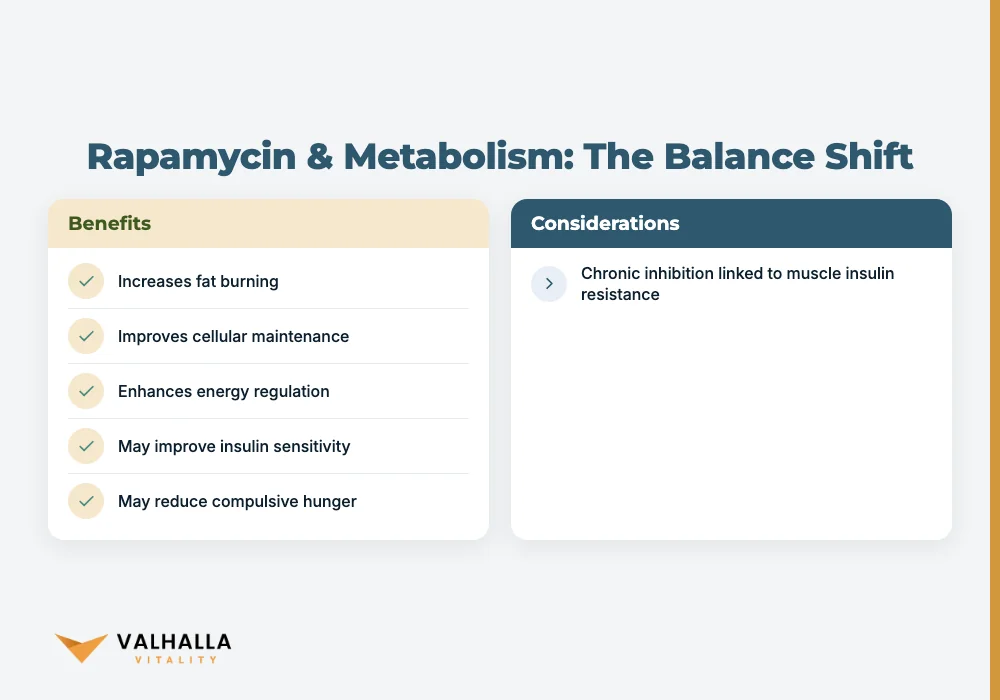
Rapamycin affects metabolism by suppressing mTORC1, a molecular switch that regulates protein synthesis, fat storage, and energy use across nearly every cell type. When mTORC1 is active, the body builds and stores. When rapamycin blocks it, the balance shifts: fat burning increases, cellular maintenance takes priority, and energy regulation improves.
This mTOR inhibitor fat loss mechanism is what gives rapamycin a distinct profile compared to appetite-suppressing therapies. Liu et al. (2025) in Signal Transduction and Targeted Therapy identify mTOR as a central integrator of nutrient and energy signals whose dysregulation underlies multiple metabolic diseases.
Taken together, these mechanisms form the biochemical foundation of the rapamycin weight loss effect documented across animal studies and emerging in human trials.
Rapamycin insulin sensitivity and glucose control
Insulin sensitivity describes how efficiently cells respond to insulin's signal to absorb glucose from the blood. Poor sensitivity, known as insulin resistance, links tightly to weight gain, elevated blood sugar, and increased fat storage. Animal studies have shown that rapamycin can improve insulin sensitivity, allowing cells to process glucose more effectively.
Stable blood glucose means fewer spikes. Spikes drive cravings, particularly for high-carbohydrate and high-fat foods. When rapamycin insulin sensitivity improvements reduce this cycle, the result may be less compulsive hunger and better dietary control. That is a practically significant rapamycin metabolism benefit for anyone managing body weight alongside underlying metabolic dysfunction.
There is a complication worth noting. Chronic, continuous mTOR inhibition has been associated with muscle insulin resistance in some animal studies, a potentially counterproductive effect. This is one reason dosing strategy matters as much as the drug itself. A licensed provider determines the dose after reviewing labs, not based on a fixed number. The balance between beneficial and adverse metabolic effects is an active area of investigation.
Rapamycin body composition and fat mobilization
Rapamycin influences how fat tissue behaves at the cellular level. By suppressing mTORC1, the drug may encourage adipocytes to release stored triglycerides for use as energy rather than accumulating further. Over time, this cellular shift can alter rapamycin body composition outcomes, reducing fat percentage relative to lean mass.
The 2024 Lancet systematic review by Lee et al. found that human participants in rapamycin trials showed changes in metabolic markers, including body composition shifts. While the review's primary focus was aging endpoints, the metabolic data provides early human-level support for the fat-mobilization mechanism. It is the strongest available human evidence for rapamycin metabolism benefits in this context. For a broader range of rapamycin's clinical research, the picture extends well beyond weight into immune function and tissue repair.
BCAA metabolism and muscle preservation
Branched-chain amino acids (BCAAs) play a central role in muscle protein synthesis and energy metabolism. Choi et al. (2024) in Experimental & Molecular Medicine show that disrupted BCAA metabolism contributes to metabolic disease states, including obesity-related conditions. mTOR signaling sits directly upstream of BCAA metabolism regulation.
By modulating mTOR, rapamycin may influence how the body handles BCAAs, with downstream effects on the muscle-to-fat ratio. This distinction matters for body composition because weight loss that includes substantial muscle loss is metabolically counterproductive. Lab monitoring during any rapamycin protocol helps track whether body composition is shifting in a beneficial direction, not just downward on a scale.
What the evidence shows: from animal studies to human trials
The animal evidence for rapamycin weight loss is extensive and consistent. Studies show that rapamycin-treated rodents lose body weight, reduce fat mass, and shift their defended body weight setpoint downward. A single administration has produced a persistent downward shift in the body weight level animals actively defend, a pattern that differs from most dietary interventions. Rebound doesn't happen the same way.
In obese animal models, rapamycin has also restored leptin sensitivity and reduced food intake without requiring any dietary change.
The human evidence is earlier in development. The Lancet systematic review by Lee et al. (2024) examined multiple human trials of rapamycin and its derivatives, identifying promising metabolic changes but noting significant variation in dose levels and schedules across trials. That variability makes direct cross-study comparison difficult and reflects how early-stage the clinical evidence remains for rapamycin weight loss specifically.
Phillips et al. (2023) in GeroScience found that rapamycin outperformed dietary restriction in improving resilience against pathogens in a meta-analysis. The finding is relevant because it shows rapamycin operates through its own distinct mechanisms, not simply by mimicking starvation.
The overlap with caloric restriction pathways is real, but rapamycin's pharmacological footprint extends further. This is part of why rapamycin's aging research consistently intersects with metabolic health findings: the two areas are not separate.
Rapamycin as a longevity drug: the metabolic connection
Rapamycin's most prominent role in current research is as a rapamycin longevity drug candidate. It has extended lifespan in multiple species, including mice, and is under active investigation in humans through ongoing trials.
The metabolic changes it produces, including improved insulin signaling, reduced fat accumulation, and enhanced autophagy, are not incidental to that longevity research. They are central to it.
For those new to this compound, rapamycin's pharmacological background covers its evolution from transplant immunosuppressant to longevity research candidate. That history matters for understanding why its metabolic effects are taken seriously by clinicians and researchers alike.
Metabolic health and biological aging are deeply intertwined. Chronic elevated insulin, excess visceral fat, and mTOR hyperactivation are common threads connecting obesity, type 2 diabetes, and accelerated cellular aging.
mTOR hyperactivation is also associated with cellular senescence, a state in which cells stop dividing but remain metabolically active and produce inflammatory signals. Accumulation of senescent cells is a recognized driver of tissue aging and metabolic dysfunction. By suppressing mTOR, rapamycin may slow this process, contributing to metabolic improvements that extend well beyond fat loss alone.
Rapamycin weight loss should not be evaluated in isolation from this longevity context. The drug affects multiple systems simultaneously. Someone seeking a medically supervised approach to metabolic optimization, with appropriate monitoring and realistic expectations, is the right candidate. Someone interested only in losing weight without engaging with the full pharmacological profile is not.
What are the side effects of rapamycin for weight loss?
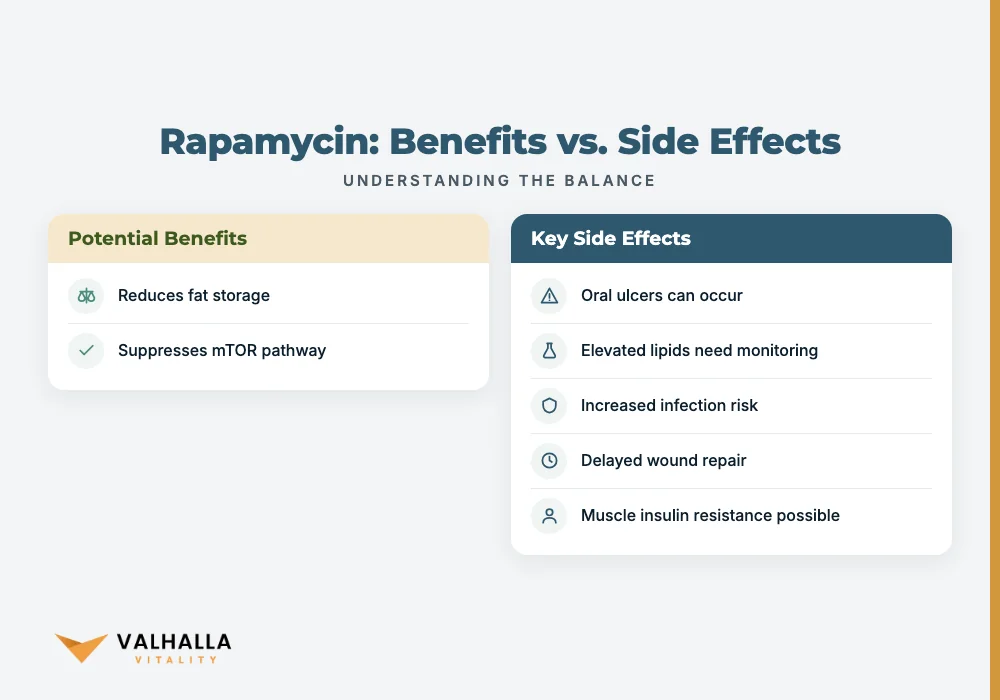
The most common side effects of rapamycin include oral ulcers, elevated triglycerides and cholesterol, increased susceptibility to infection, delayed wound repair, and potential muscle insulin resistance with prolonged continuous use. These effects are dose-dependent and vary considerably by individual health status.
Rapamycin is not a supplement. It is a prescription drug whose mechanism, suppressing mTOR across cell types, affects immune function, wound repair, lipid metabolism, and muscle physiology simultaneously. The same pathway that reduces fat storage also regulates immune defense. Suppressing it broadly produces beneficial and adverse effects simultaneously, which is why the structure of any protocol matters as much as the drug itself.
The key side effects in more detail:
- Oral ulcers tend to occur at higher doses and often improve with dose reduction or formulation changes
- Elevated lipids (triglycerides and LDL cholesterol) require periodic lipid panel monitoring during any protocol
- Infection risk is real; mTOR plays a role in immune cell activation, and its suppression can reduce immune vigilance
- Wound repair delays are relevant for anyone anticipating surgery or managing an active injury
- Muscle insulin resistance is a concern with long-term continuous use; intermittent protocols may reduce this risk
Monitoring during a rapamycin protocol typically includes periodic lipid panels, kidney function tests, and complete blood counts to assess immune health. Providers also check for oral ulcer indicators and signs of infection at follow-up visits. This monitoring cadence is what distinguishes a medically supervised rapamycin protocol from self-administration, where these signals can go undetected until they become significant problems.
For individuals managing cardiovascular risk factors, the potential for elevated lipids is a particular concern. It is not a contraindication, but it is a monitoring requirement that should inform the protocol design from the start.
Dosing and safety: what providers assess before prescribing
How much rapamycin should you take for weight management?
There is no established standard dose for rapamycin weight loss. Use in this context is off-label, and the research literature reflects widely varying dose levels and schedules across trials. The 2024 Lancet systematic review by Lee et al. cited this variability directly as a limitation in drawing cross-study conclusions.
What the evidence does suggest is that intermittent dosing may preserve metabolic benefits while reducing the adverse effect burden compared to continuous daily administration. The muscle insulin resistance concern associated with chronic use is one reason clinicians have experimented with less frequent schedules.
A licensed provider determines the dose after reviewing labs, taking into account kidney function, baseline lipid levels, immune status, and concurrent medications.
For context on how providers approach rapamycin protocols in clinical practice, reviewing the dosing considerations before any consultation is worthwhile.
Is rapamycin safe to use for losing weight?
Whether rapamycin is safe for weight management depends on the individual, the dosing protocol, and the quality of medical monitoring. The drug is a prescription immunosuppressant authorized for transplant recipients. Its use for weight loss or body composition management is off-label, and the safety profile at lower, intermittent doses differs meaningfully from transplant-level continuous use.
The 2024 Lancet systematic review by Lee et al. found that lower-dose intermittent protocols in otherwise healthy adults showed a more favorable safety profile than the chronic high-dose regimens used in transplant medicine. The authors still called for longer-term controlled trials. That is the honest state of the evidence.
Someone with an underlying immune condition faces a different risk calculation than a metabolically healthy adult. Someone taking medications that interact with mTOR pathways faces additional considerations.
These variables make self-administration inadvisable. At Valhalla Vitality, licensed providers review intake forms and labs before any protocol is considered, with approval typically within 24 business hours. Availability varies by state.
Take the next step with a licensed provider
Book Your Consultation to discuss with a licensed provider whether rapamycin is an appropriate option given your health history and goals.
FAQ
Does rapamycin cause weight loss?
Rapamycin has been shown to reduce fat mass and body weight consistently in animal studies, with early human trials showing promising metabolic changes. The mechanism involves mTOR inhibition, which shifts cellular priorities away from fat storage and toward maintenance. Human evidence for rapamycin weight loss is still developing, and use in this context is off-label.
How does rapamycin affect fat metabolism?
Rapamycin suppresses mTORC1, a central regulator of fat storage, protein synthesis, and energy use. This may encourage fat cells to release stored triglycerides for energy, improve insulin sensitivity, and activate autophagy. Liu et al. (2025) identify mTOR as a key integrator of metabolic signals across cell types, and its dysregulation underlies multiple metabolic diseases.
Does rapamycin improve insulin sensitivity?
Animal studies show that rapamycin can improve insulin sensitivity, helping cells process glucose more efficiently and reducing the blood sugar swings that drive cravings. However, chronic continuous use has also been associated with muscle insulin resistance in some models, which is why dosing schedule and regular lab monitoring are essential components of any protocol.
What is the difference between rapamycin and sirolimus?
Rapamycin and sirolimus are the same compound. Sirolimus is the generic clinical name used in prescribing and pharmaceutical contexts; rapamycin is the original research name from the discovery literature. Both refer to the same mTOR-inhibiting drug with applications in transplant medicine, oncology, and longevity research, including sirolimus weight management investigation.
Who should not use rapamycin for weight management?
Rapamycin is not appropriate for people with active infections, uncontrolled immune conditions, or significant kidney or liver dysfunction without specialist oversight. People taking medications that interact with mTOR pathways require careful evaluation before any protocol begins. A licensed provider reviews health history and labs to determine candidacy; self-administration is not advisable.
Sources
- Unnikrishnan A et al. (2020). Is Rapamycin a Dietary Restriction Mimetic?. The journals of gerontology. Series A, Biological sciences and medical sciences. PubMed
- Liu H et al. (2025). Energy metabolism in health and diseases. Signal transduction and targeted therapy. PubMed
- Lee DJW et al. (2024). Targeting ageing with rapamycin and its derivatives in humans: a systematic review. The lancet. Healthy longevity. PubMed
- Choi BH et al. (2024). The role of BCAA metabolism in metabolic health and disease. Experimental & molecular medicine. PubMed
- Phillips EJ et al. (2023). Rapamycin not dietary restriction improves resilience against pathogens: a meta-analysis. GeroScience. PubMed
You May Also Like
 Rapamycin
 for Longevity: Science, Evidence and Safety
Rapamycin for longevity blocks mTOR, activates autophagy, and may slow cellular aging. Explore the clinical evidence on lifespan extension and safety.
November 25, 2026 ETRead more → Rapamycin
 Side Effects: Risks, Safety, and What to Know
Rapamycin side effects include immune suppression, metabolic changes, and kidney risks. Learn what research shows and how a provider monitors safety.
November 24, 2026 ETRead more → Rapamycin
 Benefits: What the Science Actually Shows
Rapamycin benefits span longevity, immune health, cancer prevention, and neuroprotection. See what the evidence shows and why provider review matters.
November 17, 2026 ETRead more →