
The following blog post is for entertainment and informational purposes only. It is not intended to provide medical advice or diagnosis. Please consult your doctor before making any health-related decisions.
Rapamycin longevity research has arrived in clinical practice. Originally developed to prevent organ transplant rejection, rapamycin blocks mTOR, a cellular growth sensor that drives many of the biological processes underlying aging. A 2026 review in Clinical Medicine & Research by Rezkalla et al. identified it among the most rigorously studied compounds in modern geroscience. If you're exploring a provider-guided approach to healthspan, our anti-aging longevity support page covers what a formal evaluation involves.
What is rapamycin?
Rapamycin is a natural compound first isolated from a bacterium called Streptomyces hygroscopicus, discovered in soil samples from Easter Island, locally known as Rapa Nui. The name reflects its geographical origin. Researchers initially studied it as an antifungal agent, but its potent immunosuppressive properties redirected development toward transplant medicine, where it goes by the generic name sirolimus. Sirolimus received regulatory authorization to prevent kidney transplant rejection, and that clinical history has produced decades of detailed safety observation.
Its relevance to longevity comes from a different mechanism. At lower, intermittent levels, rapamycin appears to shift cellular behavior toward maintenance rather than growth. These are fundamentally different cellular states, with different long-term consequences for tissue health and biological aging.
Key facts about rapamycin:
- Origin: soil bacteria from Easter Island, isolated in the 1970s
- Generic name: sirolimus
- Regulatory indication: prevention of organ rejection in kidney transplant patients
- Primary molecular target: mTOR, a central cellular growth and metabolism regulator
- Longevity use: off-label, provider-supervised, with active clinical investigation underway
How does rapamycin slow the aging process?
The mTOR inhibitor aging hypothesis centers on one idea: chronic mTOR activity drives aging faster than biology requires. mTOR functions as an intracellular nutrient and energy sensor. When resources are plentiful, mTOR accelerates cell growth, protein synthesis, and replication. When resources tighten, mTOR quiets down and cells shift toward maintenance.
This balance suited most of human evolutionary history. In a modern environment of continuous caloric abundance, mTOR rarely rests.
A 2024 paper in Biogerontology by Keizer et al. described how chronic mTOR activity contributes to cellular senescence, reduced autophagy, and accumulated protein aggregates that drive tissue dysfunction over time. Intermittent mTOR inhibition may address those accumulations by signaling cells to clean house.
Key cellular processes activated when mTOR is inhibited:
- Autophagy: cells recycle damaged proteins and organelles rather than accumulating them
- Mitophagy: a targeted form of autophagy that removes dysfunctional mitochondria specifically
- Reduced cellular senescence: fewer "zombie cells" that linger, releasing pro-inflammatory signals
- Improved proteostasis: better regulation of protein folding and clearance of misfolded proteins
- Attenuation of inflammaging: chronic low-grade inflammation is partly mTOR-dependent
A 2024 study in Autophagy by Di Rienzo et al. examined AMBRA1, a protein that regulates mitophagy, and its decline with age. When AMBRA1 activity drops, damaged mitochondria accumulate and amplify cellular stress.
Rapamycin-driven mTOR inhibition may partially restore mitophagy flux through pathways involving AMBRA1 and related regulators. Dysfunctional mitochondria are upstream of many age-related disease processes. This makes the AMBRA1-mitophagy connection more than a mechanistic footnote.
Cognitive aging is another dimension where mTOR activity matters. A 2024 review in CNS Neuroscience & Therapeutics by Davoody et al. found that overactive mTOR signaling appears consistently in Alzheimer's disease models, and that rapamycin-based inhibition reduced pathological markers in animal studies. Human data at this stage remains preliminary. For a step-by-step breakdown of the biochemical cascade, how rapamycin inhibits mTOR pathways covers each downstream effect in detail.
Can rapamycin extend human lifespan?
Animal evidence is consistent. Rapamycin extended median lifespan in mice in multiple controlled studies, including when treatment began in midlife rather than early life. Similar longevity effects appeared across other organisms, including yeast. That consistency across different species and life stages strengthened early confidence that the mTOR pathway is a genuine longevity target.
Human data is accumulating but incomplete. Lifespan studies in humans require decades of follow-up, and that data doesn't exist yet for rapamycin in healthy populations. Researchers measure biological aging surrogates instead: epigenetic aging clocks, immune biomarkers, organ function tests, and functional capacity. These markers can shift meaningfully within trial timeframes, even when definitive lifespan endpoints cannot be collected.
A 2026 review by Rezkalla et al. in Clinical Medicine & Research characterized rapamycin as among the leading geroprotector candidates under active investigation, while noting that rigorous endpoint data in healthy adults is still accumulating. The gap between strong animal evidence and human proof reflects the design limits of longevity trials. It is not evidence against the drug.
The more achievable near-term goal is healthspan: more years of functional health, fewer years burdened by age-related disease. That framing is what current rapamycin longevity research most plausibly supports.
What is the recommended rapamycin dose for longevity?
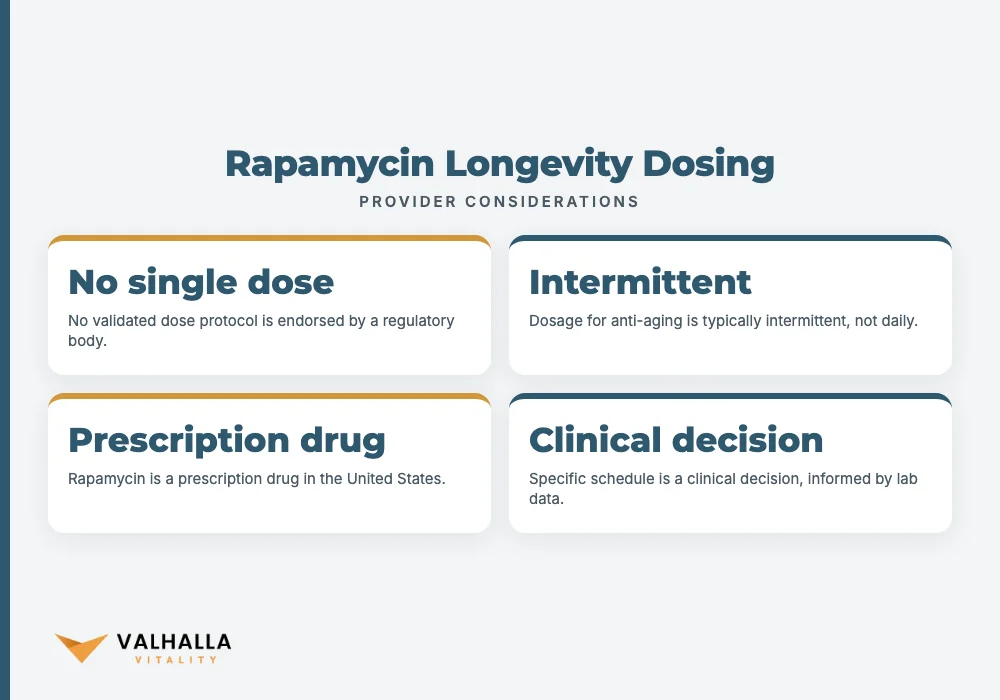
No single validated sirolimus dose protocol for healthy aging has been endorsed by a regulatory body. This is a genuine limitation of the field. A licensed provider determines the dose after reviewing labs, health history, and current medications. Blood levels, kidney and liver function, lipid status, and immune markers all affect how the drug behaves in an individual patient.
Questions a provider typically works through before determining a rapamycin protocol:
- What are the patient's current lipid levels and metabolic markers?
- Is the patient on medications that share the CYP3A4 metabolic pathway?
- What is the patient's infection history and current immune status?
- Are there upcoming surgical or dental procedures that could affect wound recovery?
- What is the patient's current exercise and nutrition regimen?
- What specific longevity goals are driving interest in therapy?
The rapamycin dosage for anti-aging used in clinical practice is typically intermittent rather than daily. Cycling appears to separate the longevity-relevant cellular effects, autophagy activation and potential immune rejuvenation, from the deeper immunosuppression observed at continuous high transplant doses. But the specific schedule is a clinical decision, informed by individual lab data and response monitoring.
Rapamycin is a prescription drug in the United States. Getting a proper rapamycin longevity protocol right requires a provider, not a dosing guide found online. The complexity reflects genuine pharmacological individualization.
Rapamycin immune function: navigating the trade-offs
Rapamycin's reputation as an immunosuppressant creates understandable hesitation when it is considered for healthy people. The nuance is specific and consequential. High, continuous doses suppress immune function broadly. That is exactly what transplant patients need: reduced immune attack on a donor organ. For healthy aging, this effect would be counterproductive.
The more interesting finding is that at lower, intermittent levels, rapamycin may partially improve immune aging markers rather than suppress it. Older immune systems often exhibit immunosenescence: T cells become exhausted, the immune repertoire narrows, and the system loses its capacity to mount effective responses to new threats.
Some data suggests intermittent mTOR inhibition may refresh markers of immune aging in ways that conventional transplant-dose immunosuppression does not. That distinction, suppression at transplant doses versus potential rejuvenation at longevity doses, sits at the center of current rapamycin immune function research.
It is also dose-sensitive in ways that underscore why lab monitoring matters. What is beneficial at one level may be immunosuppressive at another. Provider oversight is not a formality here. It is the mechanism by which individual dosing decisions stay defensible as evidence evolves.
The decades-long transplant safety record gives providers a detailed adverse event reference. Infections, lipid changes, and metabolic effects are all documented. That background informs how rapamycin longevity protocols are constructed and monitored.
What are the long-term side effects of rapamycin?
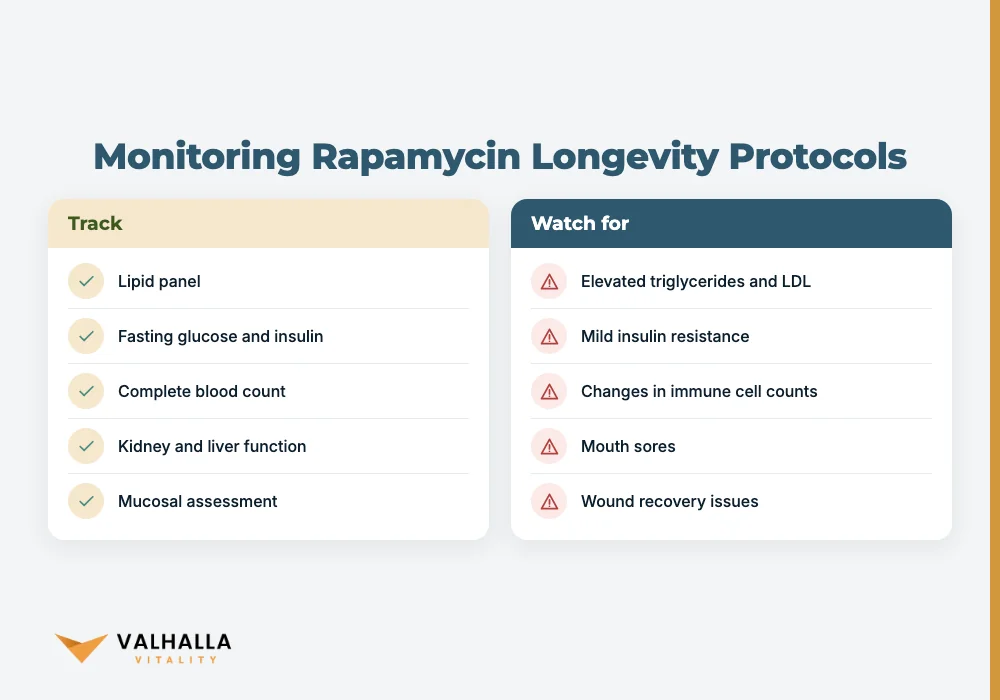
Known rapamycin side effects include changes in lipid metabolism, glucose regulation, wound recovery, and mucosal health. A 2018 paper in American Journal of Clinical Dermatology by Lacouture et al. described skin-related adverse events including oral mucositis, acne-like eruptions, and nail changes in patients receiving mTOR inhibitor therapies. These effects occur more frequently and severely at higher doses.
At the lower, intermittent levels explored in rapamycin longevity protocols, documented side effect frequency appears reduced. Long-term safety data for healthy adults using intermittent low-dose rapamycin is still being collected. Transplant population data provides relevant background safety context, but it does not directly map onto sporadic low-dose use in metabolically healthy people.
Parameters commonly monitored during rapamycin longevity protocols:
- Lipid panel: rapamycin may elevate triglycerides and LDL cholesterol
- Fasting glucose and insulin markers: some users experience dose-dependent mild insulin resistance
- Complete blood count: to track immune cell counts and rule out infection risk
- Kidney and liver function: baseline metabolism of the drug depends on both
- Mucosal assessment: mouth sores are a known dose-dependent effect worth catching early
- Wound recovery history: patients with planned procedures should discuss timing with their provider
For a broader look at how the cellular benefits weigh against these metabolic concerns, rapamycin's role in autophagy activation covers both sides in detail.
The absence of randomized controlled trial data in healthy humans beyond a few years is the most significant data gap. Clinicians working in rapamycin longevity monitor patients carefully and adjust protocols based on individual response.
Is rapamycin safe for healthy people to take?
No drug taken long-term is without risk. The honest answer: rapamycin is potentially appropriate for selected individuals, under provider oversight, with regular monitoring, and with informed consent about what is and is not yet known. It is not a supplement with a benign safety profile. It is a prescription drug with a real pharmacological effect that requires medical management.
What providers typically evaluate before initiating rapamycin therapy in a healthy adult:
- Baseline immune health, infection history, and any autoimmune conditions
- Metabolic markers: lipids, fasting glucose, and insulin sensitivity
- Liver and kidney function panels
- Current medications, especially those metabolized by CYP3A4
- Reproductive status and contraception plans, since rapamycin affects fetal development
- Upcoming surgeries or dental procedures
The clinical profile that tends to be considered in observational practice includes adults in their mid-40s or older, without active infection, with metabolically normal labs, not planning surgery in the near term, and prepared to monitor labs at regular intervals. That is a starting frame, not an assurance of appropriateness. Individual assessment carries more weight than any general profile.
Availability varies by state, since licensed providers must be authorized to practice in the patient's state of residence.
Rapamycin, exercise, and geroprotection
An underappreciated dimension of rapamycin longevity research involves its interaction with physical training. mTOR drives muscle protein synthesis after resistance exercise. Blocking mTOR for longevity purposes may therefore dampen the adaptation response to training. This creates a real tension for active patients.
A 2023 paper in BMC Biology by Elliehausen et al. examined geroprotector drugs alongside exercise in the context of healthy aging. The findings showed that the rapamycin-exercise interaction is timing-dependent. Taking rapamycin on the same day as a resistance training session appears to attenuate training adaptations more than spacing the drug on separate days between workouts.
Exercise is independently the strongest evidence-based intervention for healthspan extension. Any rapamycin longevity protocol that compromises exercise adaptations needs careful construction. Providers familiar with both the rapamycin pharmacology and exercise physiology can structure a schedule that separates the drug from training windows rather than stacking them.
This interaction illustrates why protocol design is not a one-size assignment. The timing of rapamycin relative to physical activity affects outcomes. That variable requires clinical judgment.
Rapamycin longevity trials: current endpoints and open questions
Formal rapamycin clinical trials are actively enrolling and publishing. Research groups are investigating rapamycin in healthy older adults across multiple biological aging endpoints. This represents a meaningful advance over the earlier phase of research, which relied primarily on animal studies and observational reports from anti-aging clinics.
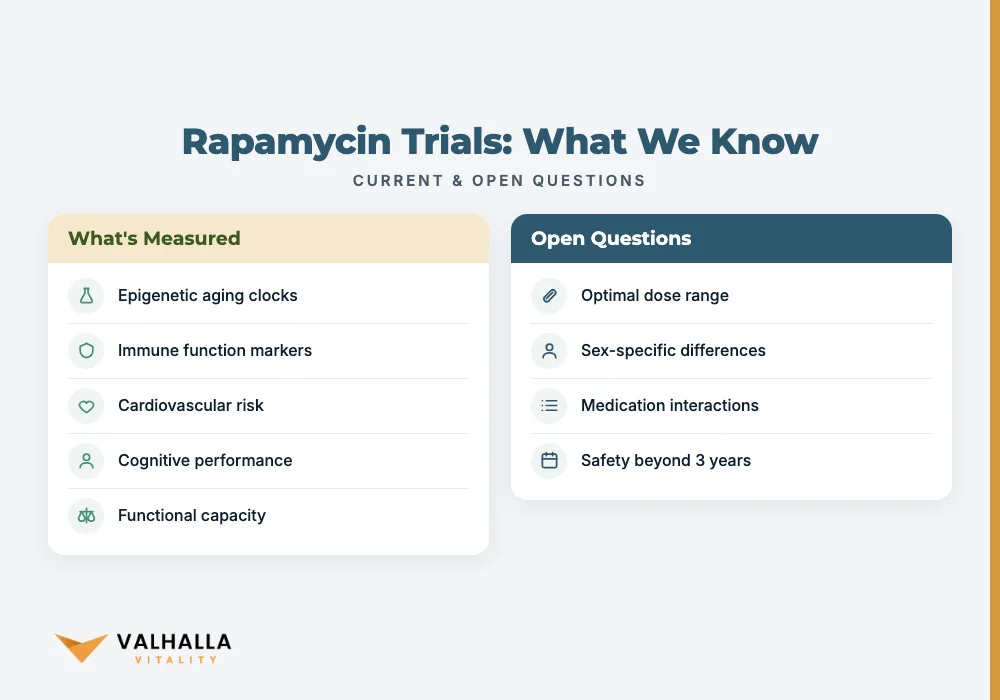
What current rapamycin clinical trials are measuring:
- Epigenetic aging clocks: biological age estimates derived from DNA methylation patterns
- Immune biomarkers, including T-cell function markers and vaccine response efficacy
- Cardiovascular risk markers and arterial stiffness
- Cognitive performance and brain-related biomarkers
- Functional capacity and muscle mass preservation
- Safety signals specific to intermittent low-dose protocols in healthy populations
What these trials have not yet resolved: the optimal dose range for healthy adults, sex-specific differences in response, interaction effects with common medications, and safety beyond two to three years of continuous use. The 2026 review by Rezkalla et al. in Clinical Medicine & Research noted the rapid acceleration of publications in this area and characterized the near-term period as a critical data-gathering window.
Patients beginning provider-supervised rapamycin longevity protocols today are, in a practical sense, contributing to the evidence base that will inform future clinical practice. That comes with a responsibility to monitor carefully and report changes to their provider. For an overview of enrollment status and primary endpoints, rapamycin clinical trials tracks the most recent publications.
What to expect from a rapamycin longevity evaluation
The process at Valhalla Vitality begins with an online medical intake covering current medications, health history, recent lab results, and goals. A licensed provider reviews the intake and determines whether rapamycin therapy is appropriate and, if so, what protocol to begin. Provider review happens within 24 business hours of order placement.
Labs are ordered before the first prescription. These cover lipid panels, fasting glucose, complete blood count, liver and kidney function, and additional markers depending on health history. Some patients arrive with recent bloodwork; others complete an at-home lab test as part of the intake process.
If therapy begins, the provider sets an initial monitoring schedule. Lipid levels and metabolic markers are rechecked at intervals the provider determines based on individual response.
Some patients show changes in cholesterol after starting rapamycin; others show minimal metabolic shifts. Adjusting the protocol based on actual lab data is what distinguishes a supervised rapamycin longevity program from self-administration.
Prescription medication is delivered approximately 3 to 7 business days from when the prescription is transmitted to a partner compounding pharmacy, which processes rapamycin under 503A/503B compounding standards. Availability varies by state.
Ready to explore rapamycin longevity?
If the evidence aligns with your health goals, the next step is a conversation with a licensed provider. Book Your Consultation to begin a provider-led evaluation.
FAQ
What is the recommended rapamycin dose for longevity?
There is no single regulatory-approved dose for longevity use. A licensed provider determines the appropriate dose after reviewing your labs, health history, and current medications, with ongoing monitoring adjusting the protocol over time. The clinical approach is typically intermittent rather than daily.
Is rapamycin safe for healthy people to take?
Rapamycin may be appropriate for selected healthy adults under provider supervision, but it is not risk-free. Known effects on lipid metabolism, glucose regulation, and wound recovery require regular monitoring, and long-term safety data in healthy populations is still accumulating. Provider oversight is essential, not optional.
How does rapamycin slow the aging process?
Rapamycin inhibits mTOR, a protein that drives cellular growth and suppresses the cleanup processes that aging cells need. By blocking mTOR intermittently, the drug activates autophagy, reduces cellular senescence, and may restore mitophagy flux. These mechanisms correspond to several established hallmarks of biological aging.
What are the long-term side effects of rapamycin?
Documented rapamycin side effects include elevated triglycerides and LDL cholesterol, mild insulin resistance, and mucosal effects such as mouth sores. Skin-related effects have been observed at higher doses. Long-term safety data specific to low-dose intermittent use in healthy adults remains incomplete.
Can rapamycin extend human lifespan?
No human lifespan study has confirmed this, since such trials require decades to complete. Animal studies show consistent lifespan extension across multiple species, and human biological aging markers can shift with rapamycin use. Whether those changes translate to longer human lives remains an open research question.
Sources
- Rezkalla SH et al. (2026). Longevity. Clinical Medicine & Research. PubMed
- Lacouture M et al. (2018). Toxic Side Effects of Targeted Therapies and Immunotherapies Affecting the Skin, Oral Mucosa, Hair, and Nails. American Journal of Clinical Dermatology. PubMed
- Di Rienzo M et al. (2024). Role of AMBRA1 in mitophagy regulation: emerging evidence in aging-related diseases. Autophagy. PubMed
- Keizer HG et al. (2024). A comprehensive model for the biochemistry of ageing, senescence and longevity. Biogerontology. PubMed
- Davoody S et al. (2024). mTOR signaling and Alzheimer's disease: What we know and where we are?. CNS Neuroscience & Therapeutics. PubMed
- Elliehausen CJ et al. (2023). Geroprotector drugs and exercise: friends or foes on healthy longevity?. BMC Biology. PubMed
You May Also Like
 Rapamycin
 Benefits: What the Science Actually Shows
Rapamycin benefits span longevity, immune health, cancer prevention, and neuroprotection. See what the evidence shows and why provider review matters.
November 17, 2026 ETRead more → Rapamycin
 Weight Loss: Metabolism, Fat, and Safety
Rapamycin weight loss research links mTOR inhibition to fat metabolism and insulin sensitivity. See how this longevity drug may reshape body composition.
November 15, 2026 ETRead more → Rapamycin
 Dosage for Anti-Aging: What You Need to Know
Rapamycin dosage for anti-aging is set by a licensed provider after labs. Discover how sirolimus protocols work and what the latest research shows.
November 14, 2026 ETRead more →