
The following blog post is for entertainment and informational purposes only. It is not intended to provide medical advice or diagnosis. Please consult your doctor before making any health-related decisions.
Men with low testosterone often ask what enclomiphene before and after looks like in practice. Physical changes are real. They are gradual, and proportional to how far testosterone was from a healthy range before treatment. For men being evaluated for low testosterone, this SERM prompts the body to raise its own testosterone production, and it is that hormonal shift, not the drug itself, that drives changes in energy, body composition, and strength.
Enclomiphene does not add testosterone from an external source. It encourages the body's own axis to produce more. That distinction shapes every realistic expectation that follows.
How enclomiphene works
Enclomiphene blocks estrogen receptors in the hypothalamus. This removes the negative feedback signal that normally suppresses gonadotropin-releasing hormone (GnRH) release. With that suppression lifted, the pituitary releases more LH and FSH, which signal the testes to produce more testosterone.
The result is a testosterone rise within the physiologic range. No testosterone enters from an external source. The body's own axis does the work. Understanding how enclomiphene functions as a hormone support option clarifies why its physical effects are both real and bounded.
What physical changes can men expect from enclomiphene?
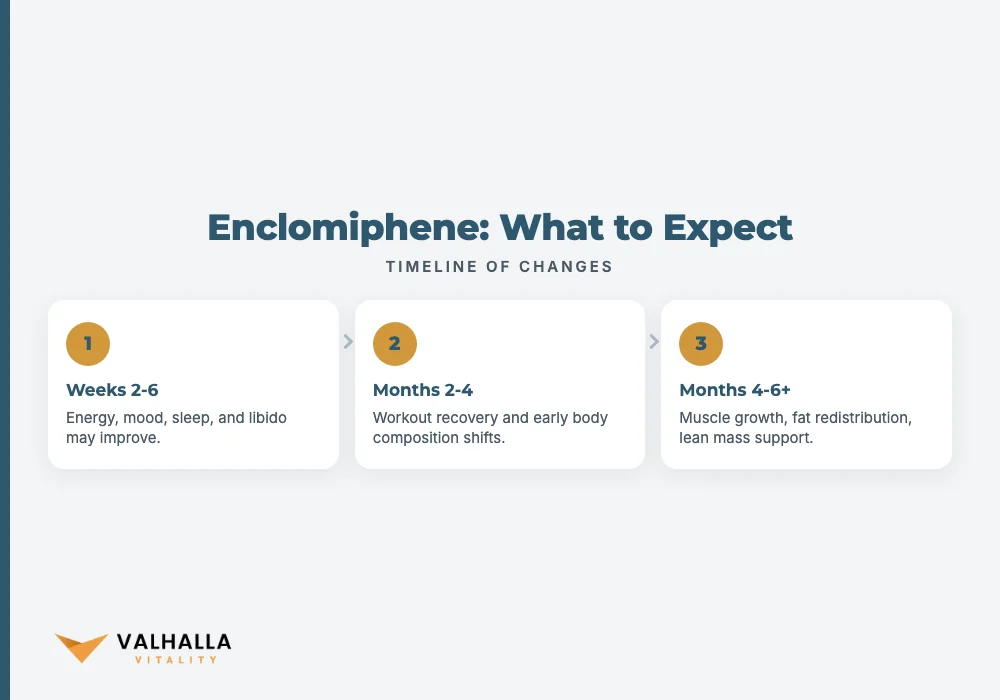
Most men notice changes in stages. Functional improvements tend to appear first. Visible changes take longer and depend on whether training, sleep, and nutrition are supporting the hormonal shift.
General enclomiphene results timeline observed clinically:
| Timeframe | What may change |
|---|---|
| Weeks 2-6 | Energy levels, mood, sleep quality, libido |
| Months 2-4 | Workout recovery, early shifts in body composition |
| Months 4-6+ | Enclomiphene muscle growth, fat redistribution, lean mass support |
Age, baseline testosterone, testicular sensitivity, and lifestyle variables all shape individual response. These windows are a guide, not a fixed outcome.
Does enclomiphene build muscle?
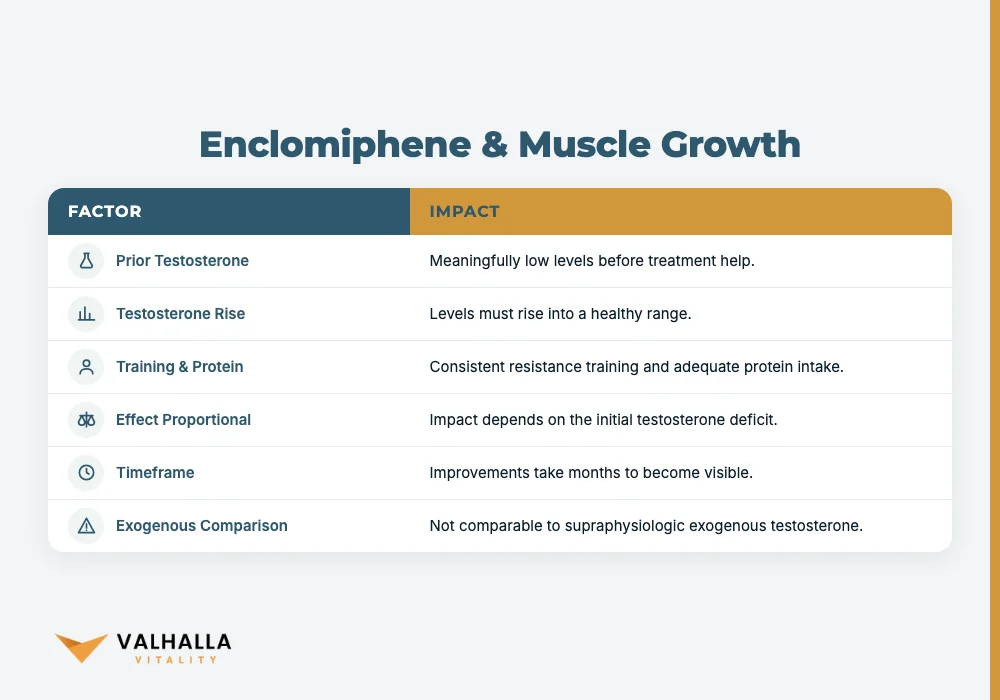
Yes, but the degree matters. Testosterone plays a well-established role in protein synthesis, muscle fiber repair, and recovery between training sessions. When testosterone is below a healthy range, men commonly struggle to maintain or build lean mass despite consistent effort.
Enclomiphene muscle growth becomes more plausible when all of these conditions apply:
- Testosterone levels were meaningfully low before starting treatment.
- The hypothalamic-pituitary-gonadal axis responds and testosterone rises into a healthy range.
- Resistance training and adequate protein intake are consistent throughout treatment.
The effect is proportional to the deficit. Men without significant low testosterone before treatment are unlikely to notice visible lean mass changes. Enclomiphene body composition improvements take months and are not comparable to exogenous testosterone at supraphysiologic doses.
Does enclomiphene burn fat?
Enclomiphene fat loss is not a direct pharmacological effect. The drug does not act on fat tissue.
Low testosterone is associated with visceral fat accumulation, particularly in the abdominal region. As testosterone rises in response to treatment, some men may notice gradual shifts in body composition over several months. Those shifts require a caloric deficit and consistent physical activity to become meaningful. For a closer look at what the evidence shows, the article on enclomiphene and weight management covers this in depth.
Can enclomiphene cause weight gain?
Enclomiphene weight gain is unlikely as a direct effect of the medication. The concern worth monitoring is estradiol.
If estrogen rises without appropriate oversight, some men may experience water retention. This is why estradiol is tracked alongside testosterone throughout treatment. A licensed provider determines the dose after labs and adjusts the protocol if estradiol trends in the wrong direction. Regular monitoring prevents temporary retention from being mistaken for something else.
How long does enclomiphene take to show results?
The enclomiphene results timeline varies considerably between individuals. Testosterone levels typically begin rising within the first few weeks of treatment. Energy, mood, and libido often improve before anything visible changes.
Most men who notice meaningful enclomiphene physical changes report them over a three-to-six-month window. Continued progress is possible beyond that point when lifestyle factors remain consistent. The process reflects what a gradual hormonal correction produces over time. Men expecting fast, dramatic changes are likely to be disappointed.
Enclomiphene before and after: what lab results reveal
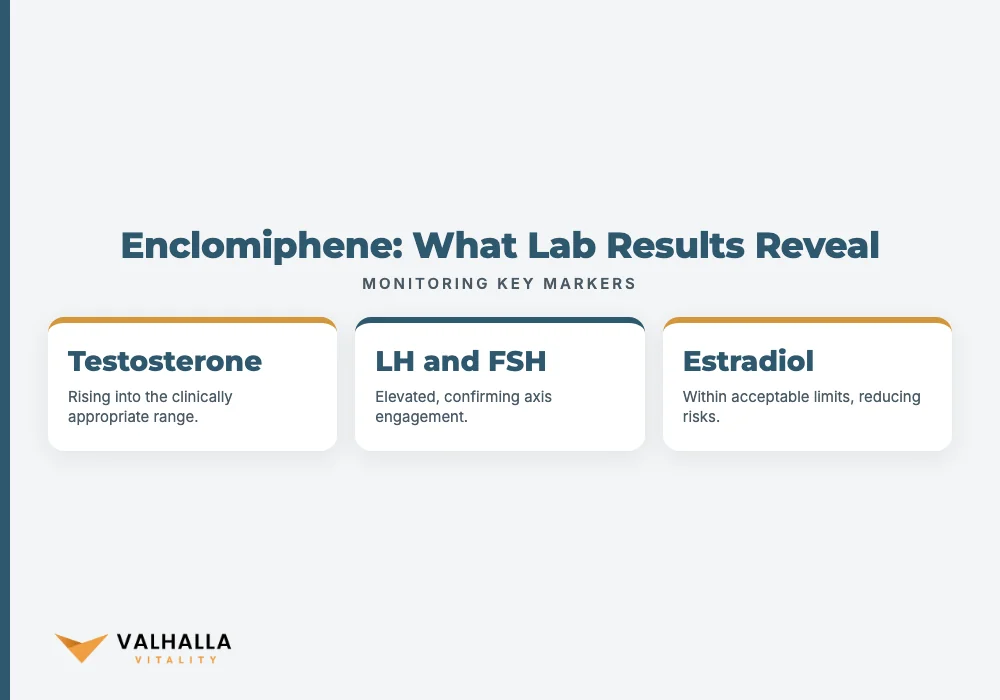
Visible changes tell only part of the story. Labs tell the rest.
Regular panels track testosterone, LH, FSH, and estradiol. They confirm that the axis is responding, that testosterone has reached a therapeutic range, and that estradiol is not climbing to a problematic level. Without this data, there is no way to know whether a protocol is working correctly or needs adjustment.
What a well-run monitoring panel confirms:
- Testosterone is rising into the clinically appropriate range.
- LH and FSH are elevated, confirming axis engagement.
- Estradiol is within acceptable limits, reducing water retention and mood risks.
A licensed provider interprets these results and adjusts the protocol if needed. At Valhalla Vitality, monitoring is built into every enclomiphene protocol from the start, not added later when something goes wrong.
Why individual response varies
The same protocol will not produce the same testosterone response in every man. Testicular sensitivity, baseline LH and FSH levels, and the overall health of the hypothalamic-pituitary-gonadal axis all influence how strongly the body responds.
This is why comparing outcomes across forum posts rarely leads to useful expectations. A man's enclomiphene physical changes are shaped by his own hormonal picture, not someone else's experience. Provider-led care means protocols are adjusted to individual lab results, not to generalized timelines or anecdotal benchmarks.
Men weighing their options will find the guide to enclomiphene versus Clomid useful for understanding how these two approaches differ mechanistically.
When enclomiphene is unlikely to change body composition
This point is often overlooked. Men whose testosterone levels were already within a healthy range before starting treatment are unlikely to notice enclomiphene body composition changes. The realistic enclomiphene before and after picture for men without a hormonal deficit is minimal change, because there is no deficit to correct.
Enclomiphene is a clinical tool for men with low or suboptimal testosterone. Its effects are real for that population. For men without a hormonal issue, meaningful physical changes are not expected.
Ready to explore your options?
Book Your Consultation to review your labs with a licensed provider and find out whether enclomiphene may be appropriate for your situation.
FAQ
What does the enclomiphene before and after experience typically look like?
Most men notice improvements in energy, mood, and libido within the first few weeks. Visible changes in body composition and lean mass generally take three to six months with consistent training and nutrition. The degree of change reflects how low testosterone was before starting treatment.
Does enclomiphene build muscle without exercise?
Enclomiphene may support the hormonal conditions that make muscle development more achievable, but it does not build muscle independently. Resistance training and adequate protein intake remain necessary for any meaningful change in lean mass.
Can enclomiphene cause weight gain?
Enclomiphene is not directly associated with fat gain. Some men experience temporary water retention if estradiol rises without appropriate monitoring. A licensed provider tracks estradiol alongside testosterone and adjusts the protocol when needed.
How do I know if enclomiphene is working?
Lab results are the most reliable indicator. Rising testosterone within a healthy range, combined with improvements in energy, mood, and workout recovery, indicates a good clinical response. A provider reviews this data and determines whether the protocol needs adjustment.
You May Also Like
 Enclomiphene
 Vision Side Effects: Eye Floaters & More
Enclomiphene vision side effects include eye floaters, blurry vision, and light sensitivity. Know the warning signs and when to contact your provider.
October 21, 2026 ETRead more → Enclomiphene
 Drug Test: Detection, WADA, and Disclosure
Enclomiphene drug test detection depends on the test type. Learn how workplace panels, military screening, and WADA rules treat this SERM.
October 21, 2026 ETRead more → Enclomiphene
 Mood Swings: Causes and What to Expect
Enclomiphene mood swings, depression, anxiety, and sleep issues explained. Learn what causes mood changes and how provider oversight helps.
October 20, 2026 ETRead more →