
The following blog post is for entertainment and informational purposes only. It is not intended to provide medical advice or diagnosis. Please consult your doctor before making any health-related decisions.
Enclomiphene does not increase penis size. Adult penile dimensions are fixed by genetics and pubertal development, and no hormone therapy changes them afterward. What men asking about enclomiphene penis size are often tracking, though, is something more functional: how low testosterone affects erections, libido, and sexual confidence. Those are valid concerns, and how enclomiphene works as a testosterone therapy is worth understanding clearly before drawing conclusions about its sexual effects.
How does enclomiphene boost testosterone naturally?
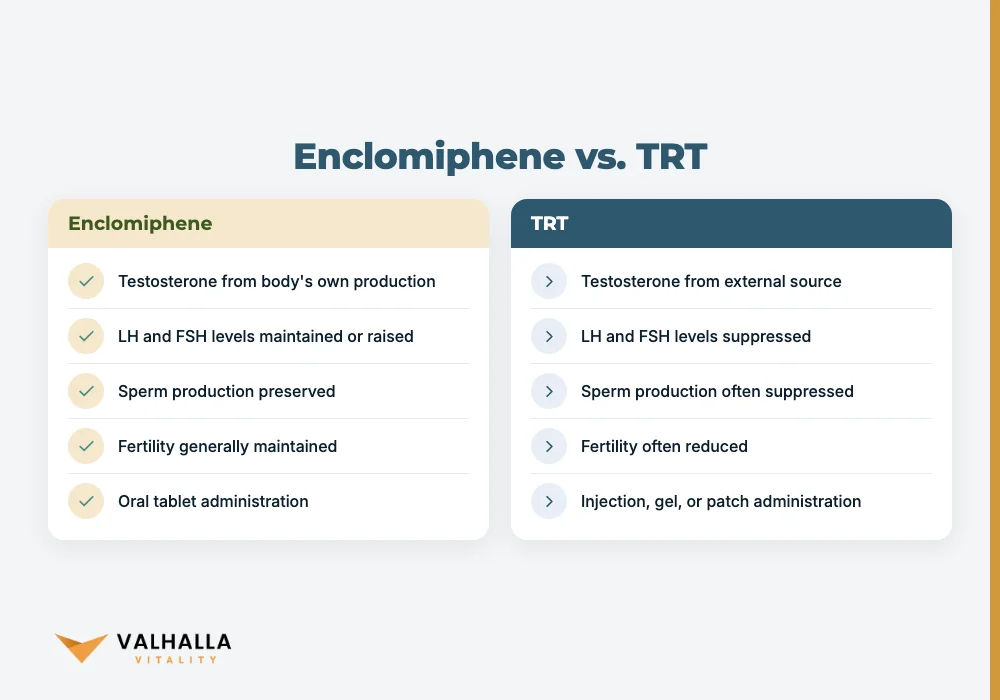
Enclomiphene is the trans-isomer of clomiphene. Traditional clomiphene contains two isomers; enclomiphene isolates only the trans-form, which sidesteps the side effects associated with the cis-isomer. As a selective estrogen receptor modulator (SERM), it blocks estrogen receptors in the hypothalamus. The brain reads this block as a deficit and responds by releasing more gonadotropin-releasing hormone (GnRH). GnRH then signals the pituitary gland to secrete luteinizing hormone (LH) and follicle-stimulating hormone (FSH). LH tells the testes to produce testosterone; FSH supports sperm generation.
The result is testosterone produced by the body itself. That distinguishes enclomiphene from testosterone replacement therapy (TRT), which supplies testosterone from an external source. A licensed provider determines whether enclomiphene therapy is appropriate and sets the dose after reviewing labs.
Enclomiphene vs. TRT at a glance
| Feature | Enclomiphene | TRT (exogenous) |
|---|---|---|
| Testosterone source | Endogenous (body's own) | Exogenous (external) |
| LH and FSH levels | Maintained or raised | Suppressed |
| Sperm production | Preserved | Often suppressed |
| Fertility impact | Generally maintained | Often reduced |
| Administration | Oral tablet | Injection, gel, patch |
For men comparing these pathways, the fertility difference is the most clinically significant. The enclomiphene vs TRT fertility distinction carries real consequences for men in their reproductive years, covered in detail in the fertility section below.
Does enclomiphene increase penis size?
No. Enclomiphene does not increase penis size in adults, and there is no clinical evidence suggesting it can. The enclomiphene penis size question surfaces frequently in men's health discussions, and the direct answer is that penile anatomy is not what changes through hormone therapy.
Penile dimensions are set primarily by genetics and the hormonal conditions during fetal development and puberty. A global meta-analysis published in Andrology found that penile dimensions vary substantially across populations, underscoring the dominant role of genetic and developmental factors rather than adult hormone fluctuations (Wang C et al., 2025). Once puberty ends, adult penile tissue does not respond to testosterone by growing. The genes that shaped those dimensions during development do not re-engage because a SERM raised circulating testosterone.
Enclomiphene penis size: separating function from anatomy
What enclomiphene can affect is the hormonal environment that governs sexual function. Low testosterone impairs erections, reduces libido, and makes sexual performance feel weaker. Correcting a testosterone deficiency may restore those functions. When erections improve and arousal strengthens, some men perceive their anatomy differently. That perception shift reflects improved blood flow and function, not structural growth.
A 2024 European Association of Urology guideline on penile size noted that concerns about dimensions are common and frequently disconnected from objective measurements (Falcone M et al., 2024). The guideline recommends addressing those concerns in a structured clinical setting rather than through unsupervised hormone use. Keeping the enclomiphene penis size question grounded in evidence protects men from pursuing outcomes the therapy cannot deliver.
Supplements marketed for penile enlargement often leverage the association between testosterone and masculinity to imply a link that the research does not support. The clinical reality is more specific: testosterone levels influence how the penis functions, not how large it grows. Men who understand that distinction can focus their healthcare decisions on what actually changes with treatment.
Does testosterone affect penile size in adults?
No, not in a measurable way. Testosterone drives penile growth during fetal development and throughout puberty by activating androgen receptors in developing tissue. Once those developmental windows close, adult penile tissue does not grow in response to testosterone. The 2024 EAU guidelines confirm that penile anatomy is structurally fixed after puberty and that hormone therapies do not alter it (Falcone M et al., 2024).
What testosterone does affect in adults is penile function. The Endocrine Society's 2018 clinical practice guideline for testosterone therapy in men with hypogonadism identifies reduced libido, erectile dysfunction, and decreased sexual satisfaction as symptoms of deficiency that may improve with treatment (Bhasin S et al., 2018). These are functional effects. The testosterone and penile size relationship in adults is about how well things work, not how large they are.
Testosterone influences nitric oxide production in endothelial cells, which affects the vasodilation that erections require. It also interacts with dopaminergic pathways in the brain to sustain sexual motivation. These chemical connections between hormone levels and sexual performance explain why testosterone evaluation is central to diagnosing erectile concerns. The AUA's 2018 guideline on testosterone deficiency reinforces this: evaluating sexual symptoms is a central step in diagnosing hypogonadism, and restoring testosterone to a healthy range may address those symptoms (Mulhall JP et al., 2018).
Low testosterone and its effects on sexual function
Low testosterone does not shrink adult penile anatomy. It does meaningfully affect how the penis functions and how men experience their sexuality. Men with clinically low testosterone frequently report weaker erections, reduced frequency of morning erections, longer time to arousal, and lower sexual interest. These are among the most common reasons men seek hormone evaluation.
The low testosterone penis effects on sexual function are well documented across clinical guidelines. The Endocrine Society identifies erectile dysfunction, reduced libido, and impaired sexual satisfaction as core symptoms of hypogonadism (Bhasin S et al., 2018). When testosterone falls below the normal range, the biological signals that initiate and sustain arousal lose strength. Erections become less firm. They may be harder to maintain during activity. Spontaneous arousal may decline over months without a clear single cause.
Not every man experiences all of these symptoms, and severity varies with how far testosterone falls and with individual sensitivity. Some men notice changes gradually over years; others see a more sudden shift after an illness or a stressful period. The overlap with general aging symptoms makes self-diagnosis unreliable. Blood tests are the only way to confirm whether a testosterone deficiency is present and clinically significant.
These functional deficits are consistent with a hormonal problem rather than a structural one. That distinction matters clinically: the fix is different. Correcting the hormone level may restore function without any change to anatomy. For a fuller review of how low testosterone is identified and what evaluation involves, evaluating low testosterone symptoms and treatment options covers the process from intake through provider review. Availability varies by state.
Can enclomiphene improve erectile function?
Yes, indirectly. Enclomiphene does not act on penile tissue directly. It raises testosterone, and higher testosterone supports the vascular and neurological signals that erectile function depends on. The mechanism is hormonal, not mechanical.
The enclomiphene penis size question most often stems from erection quality concerns, not from curiosity about anatomy. Men notice erections feel different and wonder if something physical changed. Improved testosterone levels may increase libido, raise morning erection frequency, and support stronger erections by enhancing the vascular signals that sustain them. When erections improve, they produce more physical fullness, which some men interpret as an enclomiphene penile growth effect. That is not growth. It is improved blood flow.
A 2026 structured review on penile size anxiety found that self-perception of genital dimensions is heavily shaped by psychological factors, including performance anxiety, body image, and sexual confidence (Broul M et al., 2026). When enclomiphene raises testosterone and enclomiphene erectile function improves, men often report a shifted relationship with their bodies. That shift has real value, even when no anatomy has changed.
What changes and what doesn't
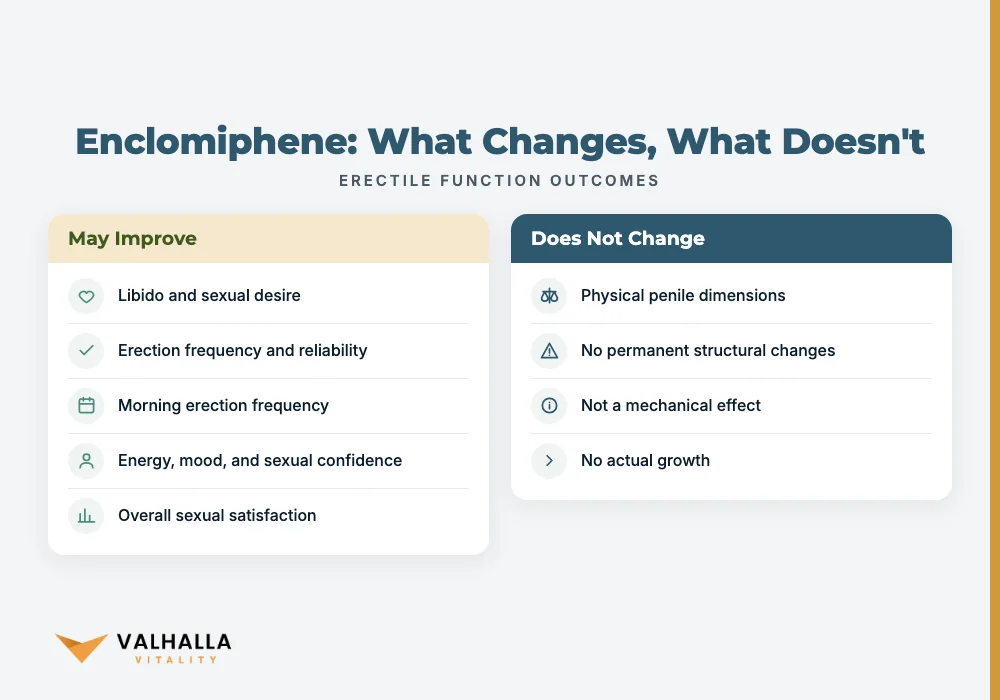
These enclomiphene erectile function outcomes are supported by clinical evidence.
Outcomes that may improve when low testosterone is corrected:
- Libido and sexual desire may increase noticeably.
- Erection frequency and reliability often improve.
- Morning erection frequency commonly rises.
- Energy and mood improve, both of which support sexual confidence as hormone levels normalize.
- Overall sexual satisfaction may increase.
Outcomes that enclomiphene does not change:
- Physical penile dimensions remain the same.
- No permanent structural changes to penile anatomy occur through enclomiphene therapy.
- Erectile dysfunction from vascular disease, nerve damage, or causes independent of testosterone is not resolved by enclomiphene alone.
If erection problems stem from cardiovascular disease, nerve damage, or other factors beyond low testosterone, enclomiphene will not address them. A provider identifies whether low testosterone is a contributing factor before recommending treatment.
What are the sexual benefits of enclomiphene?
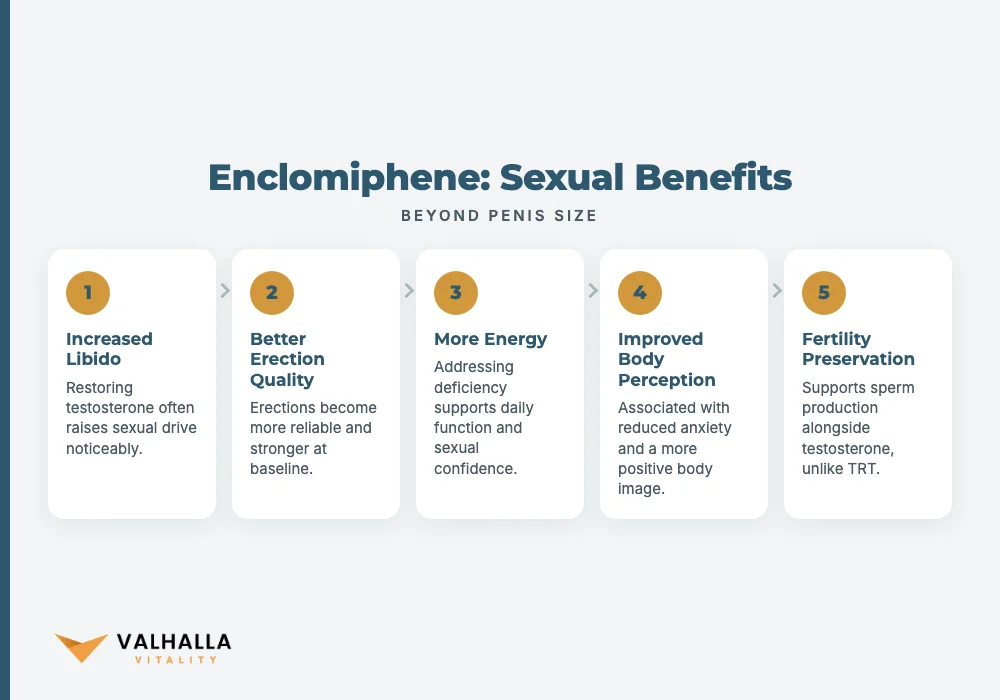
The sexual benefits of enclomiphene flow directly from its effect on testosterone. The enclomiphene penis size discussion sometimes obscures these real functional gains. Men who have low testosterone and restore it to a healthy range commonly describe meaningful improvements in how they feel and how sex feels.
The enclomiphene testosterone benefits that hold up under clinical review:
- Libido: testosterone is the primary driver of sexual desire in men; restoring it from a deficient state often raises drive noticeably.
- Erection quality: erections become more reliable, better maintained during activity, and stronger at baseline.
- Energy: fatigue is a core symptom of low testosterone; addressing the deficiency supports daily function and sexual confidence.
- Body perception: balanced testosterone is associated with reduced anxiety and a more positive body image, both of which shape how men experience intimacy.
- Fertility preservation: unlike TRT, enclomiphene maintains the body's own LH and FSH signals, supporting sperm production alongside testosterone.
None of these benefits involve enclomiphene penis size change. The gains are hormonal and functional. That distinction directs men toward realistic goals and away from treatments that promise anatomical change but deliver nothing measurable.
Psychological effects and self-perception
Testosterone affects mood and self-confidence in ways that feed directly back into sexual experience. Men with low testosterone often report elevated anxiety, reduced motivation, and a more negative body image. When testosterone is restored, those symptoms may ease.
Men sometimes underestimate how much hormonal balance shapes everyday mental state. When testosterone is chronically low, the brain adapts to lower dopaminergic activity and higher anxiety signaling. Restoring hormone levels does not produce an overnight change, but men often describe a gradual return to feeling more like themselves over weeks of treatment. That shift, while incremental, has a meaningful downstream effect on how sexual experiences feel.
A 2026 review on penile size anxiety found that body dysmorphic patterns and performance anxiety frequently amplify size concerns well beyond any objective basis (Broul M et al., 2026). When enclomiphene improves testosterone and reduces anxiety, men may find their perception of their own bodies shifts in a positive direction. That shift is real and has genuine value. It is not the same as physical growth, but it matters to quality of life and sexual confidence.
Enclomiphene vs. TRT: fertility and the sexual health trade-off
For men who want to address low testosterone without reducing their fertility, the enclomiphene vs TRT fertility comparison is a practical necessity. TRT suppresses LH and FSH. That suppression shuts down the testes' own production of both testosterone and sperm. Men on TRT who want to conceive typically need to stop therapy or add medications to restore sperm production.
Enclomiphene works in the opposite direction. It raises LH and FSH, stimulating the testes to produce both testosterone and sperm simultaneously. This is why enclomiphene is frequently considered for men with secondary hypogonadism who need to maintain fertility during treatment. From a sexual health standpoint, both pathways aim to normalize testosterone and may support libido, erection quality, and energy. The substantive difference is reproductive.
For a direct comparison of how these therapies differ mechanically and clinically, which testosterone therapy suits your goals lays out the key decision factors. Availability varies by state.
Preserving fertility alongside hormone treatment
The fertility advantage enclomiphene holds over TRT is not a secondary consideration for men in their reproductive years. For a couple trying to conceive, maintaining sperm production during hormone therapy is clinically significant. It shapes which treatment pathway makes sense before the first prescription is written.
For a closer look at how enclomiphene affects testicular function and sperm parameters specifically, how enclomiphene affects testicular function covers the research in detail.
Marketing claims and what the evidence actually covers
The supplement and men's health industries frequently attach penile enlargement claims to testosterone-related products. Those claims deserve skepticism. There is no credible clinical evidence that enclomiphene, or any testosterone therapy, changes adult penile dimensions. Anecdotal reports circulate online, but they consistently conflate improved erectile function with physical growth.
Enclomiphene has no published trials supporting penile enlargement as an outcome and is not marketed for that purpose by any credible clinical source. The 2024 EAU guidelines recommend that men with persistent concerns about penile dimensions seek a structured clinical assessment that includes objective measurement and psychological evaluation where appropriate (Falcone M et al., 2024). That process is separate from testosterone evaluation, though the two sometimes overlap for the same patient.
Being precise about which enclomiphene penis size claims are unsupported, and which enclomiphene testosterone benefits are documented, gives men the footing to make grounded decisions. The documented benefits are worth pursuing if deficiency is confirmed. They are not the same as anatomical change. Clarity on that point is more useful than optimistic framing that sets men up for disappointment.
If you want to explore whether hormone evaluation fits your situation, Valhalla Vitality connects men with licensed providers who review labs and intake before any prescription is written.
Take the next step
If you want to find out whether enclomiphene therapy is appropriate for your situation, Book Your Consultation connects you with a licensed provider who reviews your intake and labs before any prescription is written.
FAQ
Does enclomiphene increase penis size?
No. Enclomiphene does not increase penis size in adults. Penile dimensions are determined by genetics and pubertal development and do not change through testosterone therapy of any kind.
Can enclomiphene improve erectile function?
Yes, indirectly. Enclomiphene raises testosterone, which may support stronger and more reliable erections by improving the hormonal signals that sustain them. If low testosterone contributes to erectile difficulties, correcting it may help.
How is enclomiphene different from TRT for fertility?
Enclomiphene stimulates the body to raise its own LH and FSH, which preserves sperm production alongside testosterone. TRT supplies testosterone externally and suppresses LH and FSH, which typically reduces sperm counts. This makes enclomiphene a common option for men who want to maintain fertility during hormone therapy.
Does testosterone affect penile size in adults?
No. Testosterone drives penile development during fetal growth and puberty, but adult penile tissue does not grow in response to testosterone changes. In adults, testosterone affects sexual function, not anatomy.
What are the realistic sexual benefits of enclomiphene?
Men who correct low testosterone with enclomiphene may experience improved libido, more reliable erections, better energy, and a more positive sense of body confidence. These are hormonal and functional improvements, not changes to penile dimensions.
Sources
- Wang C et al. (2025). A meta-analysis of Chinese men's penile size in a global context. Andrology. PubMed
- Falcone M et al. (2024). European Association of Urology Guidelines on Penile Size Abnormalities and Dysmorphophobia: Summary of the 2023 Guidelines. European urology focus. PubMed
- Bhasin S et al. (2018). Testosterone Therapy in Men With Hypogonadism: An Endocrine Society Clinical Practice Guideline. The Journal of clinical endocrinology and metabolism. PubMed
- Mulhall JP et al. (2018). Evaluation and Management of Testosterone Deficiency: AUA Guideline. The Journal of urology. PubMed
- Broul M et al. (2026). Penile size anxiety, body dysmorphic disorder, and cosmetic penile enhancement requests: a structured narrative review and expert-derived assessment framework. Sexual medicine reviews. PubMed
You May Also Like
 Enclomiphene
 Before and After: Physical Changes Explained
Enclomiphene before and after: what physical changes to expect, how the results timeline unfolds, and why provider monitoring matters for outcomes.
October 21, 2026 ETRead more → Enclomiphene
 Vision Side Effects: Eye Floaters & More
Enclomiphene vision side effects include eye floaters, blurry vision, and light sensitivity. Know the warning signs and when to contact your provider.
October 21, 2026 ETRead more → Enclomiphene
 Drug Test: Detection, WADA, and Disclosure
Enclomiphene drug test detection depends on the test type. Learn how workplace panels, military screening, and WADA rules treat this SERM.
October 21, 2026 ETRead more →