Tadalafil and Testosterone: Effects, TRT, and Combined Use

The following blog post is for entertainment and informational purposes only. It is not intended to provide medical advice or diagnosis. Please consult your doctor before making any health-related decisions.
Tadalafil and testosterone address two distinct problems that often appear together in the same man. Tadalafil improves penile blood flow during arousal; testosterone therapy corrects hormonal deficiency. A provider who manages testosterone replacement therapy for men may add tadalafil when ED persists after hormone levels are optimized.
A 2020 review in Current Urology Reports confirmed tadalafil is effective for managing erectile dysfunction in multi-condition settings. A licensed provider reviews labs before recommending either therapy or both.
How tadalafil and testosterone therapy work
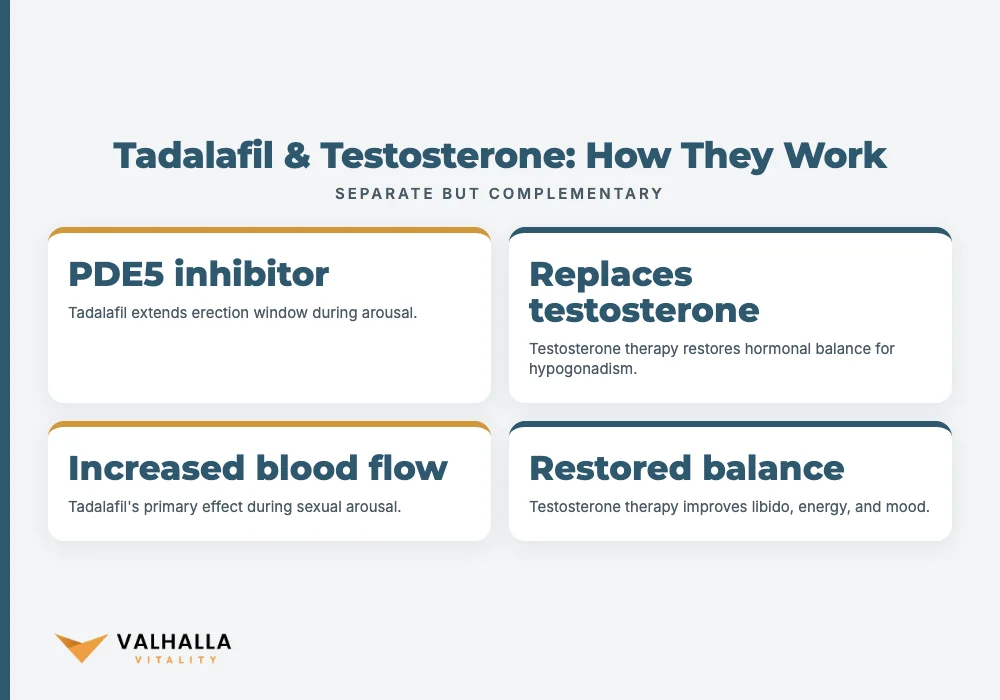
Tadalafil is a PDE5 inhibitor. During sexual arousal, the body releases nitric oxide, which triggers cyclic GMP production and relaxes smooth muscle cells in penile arteries. Blood fills the erectile chambers. Tadalafil blocks the enzyme that would otherwise cut this signal short, extending the window for an erection. It does not create arousal; it amplifies what the nervous system initiates.
Testosterone therapy works through a different pathway. The 2018 Endocrine Society Clinical Practice Guideline on testosterone therapy in men with hypogonadism defines the condition as inadequate testosterone production combined with symptoms including reduced libido, fatigue, and impaired sexual function. Therapy replaces what the testes are not producing in sufficient quantities.
Available forms include intramuscular injections, topical gels, transdermal patches, and implantable pellets. A licensed provider determines the appropriate form and dose after reviewing labs and health history.
The two treatments target separate layers of the same problem.
| Tadalafil | Testosterone therapy | |
|---|---|---|
| Mechanism | PDE5 inhibitor; prolongs nitric oxide signaling | Replaces or supplements circulating testosterone |
| Primary effect | Increased penile blood flow during arousal | Restored hormonal balance; improved libido, energy, mood |
| Main indication | Erectile dysfunction; also LUTS/BPH | Confirmed hypogonadism |
| Effect on the other | May indirectly influence testosterone via NO signaling | Restoring T may improve penile tissue response to PDE5 inhibitors |
| Requires provider review | Yes | Yes, with lab confirmation |
Understanding both mechanisms clarifies why they are sometimes prescribed together when ED and low T coexist.
Does tadalafil increase testosterone levels?
No. Tadalafil does not directly increase testosterone. Its mechanism targets blood flow, not hormone synthesis. That is the short, clinically relevant answer.
The longer picture requires nuance. Nitric oxide, which tadalafil amplifies, participates in regulating the hypothalamic-pituitary-gonadal (HPG) axis, the feedback loop that governs testosterone production in the testes. Some research suggests tadalafil's effect on nitric oxide signaling could exert a modest indirect influence on this axis. Any such effect is small and variable across individuals, and it is not consistent enough to substitute for testosterone therapy in a man with confirmed low levels.
Cialis effects on testosterone levels, in clinical terms, are not a treatment target. Men who ask "does Cialis increase testosterone" often do so because fatigue, reduced libido, and mood changes accompany their ED. The right response to those symptoms is lab testing, not a higher tadalafil dose.
Low T and erectile dysfunction frequently co-occur, particularly in men with metabolic conditions such as diabetes or obesity. Each problem typically requires its own treatment approach.
The 2018 Endocrine Society guideline recommends confirming low testosterone on at least two separate morning measurements before initiating therapy, because levels fluctuate and a single result can mislead. Men experiencing these overlapping symptoms can review the signs of low testosterone by age to help determine whether a provider evaluation makes sense.
Does Cialis boost testosterone naturally?
No. Tadalafil is not a testosterone booster. Any indirect effect on testosterone production through nitric oxide signaling is too small and too inconsistent to produce a meaningful clinical change in men with genuinely low levels. Men with confirmed hypogonadism need testosterone therapy to address the hormonal deficit, not a PDE5 inhibitor.
Can you take Cialis while on TRT?
"Can you take Cialis with TRT?", yes. Combining tadalafil with TRT is a well-established clinical approach, and many providers prescribe both when separate evaluations confirm a need for each.
TRT and erectile dysfunction are distinct problems that share surface-level symptoms. Restoring testosterone may improve libido and sexual motivation, but it does not always resolve vascular ED. The penile vascular response depends on blood flow mechanisms that testosterone does not directly control.
A 2020 review in Current Urology Reports documented tadalafil's use alongside other therapies in men managing both erectile dysfunction and lower urinary tract symptoms, supporting its role in multi-condition protocols. Combining tadalafil and testosterone in this context reflects established practice, not experimental use.
Combining Cialis and TRT does not mean taking both indefinitely. Some men find that testosterone optimization resolves their ED entirely. Others find tadalafil remains useful long-term. A provider tracks both and adjusts accordingly.
For men comparing PDE5 inhibitor options, a comparative analysis of tadalafil vs. vardenafil covers key differences for ED treatment. Availability of any combined protocol varies by state.
What happens when you take tadalafil on testosterone replacement therapy?
Sexual function often responds better when tadalafil and testosterone replacement therapy are combined than when either is used alone. Both the vascular and hormonal contributors to sexual dysfunction are addressed at once.
Testosterone influences penile tissue at a biological level. Adequate testosterone helps maintain the sensitivity of the vascular and neural systems that respond to nitric oxide during arousal. When testosterone is low, the efficiency of the pathway tadalafil relies on may be reduced.
Restoring testosterone may therefore improve how well tadalafil works. This makes TRT and erectile dysfunction treatment a genuinely complementary combination in men who are hormonally deficient.
The 2018 Endocrine Society guideline documents that adequately treated hypogonadism independently reduces fatigue, low libido, and mood symptoms, regardless of what happens with erectile function specifically. Men on TRT often report improvements in energy and overall well-being before they see changes in erectile performance. These are separate effects of the same therapy.
What to expect in practice varies. Some men respond quickly; others need several months for testosterone levels to stabilize before the full benefit becomes apparent. A provider monitors labs and symptom response throughout, adjusting the protocol based on results.
Is it safe to combine tadalafil with testosterone therapy?
For most men, yes. Tadalafil and testosterone therapy each carry individual safety considerations, but neither directly amplifies the other's mechanism. The practical concern is managing each therapy's effects within the same plan.
Tadalafil lowers blood pressure modestly during its active window. Taken alongside nitrates or certain alpha-blockers, this drop can become clinically significant. Men with existing cardiovascular disease should discuss this with a provider before starting.
Testosterone therapy can raise hematocrit and influence lipid profiles. Both changes are manageable with monitoring, but both need to be tracked.
Key safety steps for combined treatment:
- Cardiovascular screening before initiating either therapy, particularly for men with heart disease, uncontrolled hypertension, or recent cardiac events.
- Baseline lab panel before TRT: total and free testosterone, hematocrit, lipid panel, and prostate-specific antigen.
- Complete medication disclosure, including over-the-counter drugs and supplements, to screen for interactions.
- Prostate health monitoring throughout testosterone therapy, with closer evaluation for men with prior prostate history.
- Regular follow-up labs to verify hormone levels are within range and that hematocrit has not risen to a level requiring adjustment.
These are standard protocols for managed hormone therapy, not exceptional precautions.
What a provider evaluates before prescribing both
Most discussions of tadalafil and testosterone skip the clinical evaluation step. Understanding it sets realistic expectations and explains why there is no shortcut to a prescription.
Symptom review. A provider wants to know when ED began, whether fatigue and low libido are present, and whether cardiovascular risk factors such as hypertension, diabetes, or elevated cholesterol exist. Low T and erectile dysfunction share symptom overlap with conditions including sleep apnea and thyroid dysfunction. A structured intake, not self-diagnosis, sorts this out.
Laboratory panel. Testosterone levels are measured on at least two separate mornings before therapy begins, as the Endocrine Society guideline specifies. Additional markers, including LH, FSH, estradiol, complete blood count, and a metabolic panel, identify whether the deficit is primary (testicular) or secondary (signaling from the brain).
These results also establish a monitoring baseline. For context on what hormone values typically look like during ongoing treatment, how testosterone is monitored on TRT provides a useful reference.
Medication review. Tadalafil has documented interactions with nitrates and some antihypertensives. Testosterone therapy may interact with anticoagulants. A full medication list is standard before any new prescription.
Cardiovascular and prostate assessment. Both therapies carry cardiovascular considerations. Prior prostate history does not automatically exclude a man from testosterone therapy, but it requires more careful monitoring and a fuller provider discussion before proceeding.
The evaluation exists because testosterone therapy for ED, or any combined protocol, is not appropriate for every man who asks. A licensed provider determines what is appropriate after reviewing your intake.
Take the next step
A licensed provider can evaluate your symptoms and labs to determine whether tadalafil, testosterone therapy, or both fit your situation. Book Your Consultation to get started.
FAQ
Does tadalafil increase testosterone levels?
Tadalafil does not directly raise testosterone. It may have a small indirect effect through nitric oxide signaling pathways that influence the HPG axis, but this effect is inconsistent and clinically minor. Men with confirmed low testosterone need testosterone therapy, not a PDE5 inhibitor, to restore normal hormonal function.
Can you take Cialis while on TRT?
Yes. Combining Cialis with TRT is a recognized clinical protocol for men who have both confirmed hypogonadism and ED that persists after hormonal optimization. The two therapies work through separate mechanisms and are routinely co-prescribed when evaluations support both.
Is it safe to combine tadalafil with testosterone therapy?
For most men, yes, when both are managed by a licensed provider. Each therapy has standard monitoring requirements: cardiovascular screening for tadalafil, and regular hormone and hematocrit labs for TRT. Ongoing follow-up keeps the protocol within safe parameters.
What happens to erectile function when tadalafil and TRT are combined?
The combination may improve erectile function more than either therapy alone because they address different components of the problem. TRT corrects the hormonal environment; tadalafil supports the vascular response during arousal. Individual response varies, and outcomes become clearer once hormone levels stabilize.
Does low testosterone cause erectile dysfunction?
Low testosterone can contribute to ED by reducing libido and impairing the hormonal environment that supports sexual function. It is one of several potential causes, and ED can occur even with normal testosterone levels. A provider confirms the cause through labs and medical history, not symptoms alone.
Sources
- Sebastianelli A et al. (2020). Tadalafil Alone or in Combination with Tamsulosin for the Management for LUTS/BPH and ED. Current Urology Reports. PubMed
- Bhasin S et al. (2018). Testosterone Therapy in Men With Hypogonadism: An Endocrine Society Clinical Practice Guideline. The Journal of Clinical Endocrinology and Metabolism. PubMed
You May Also Like
 Oral testosterone
Oral Testosterone Therapy: Energy, Side Effects & Results
Oral testosterone therapy may improve energy and ease fatigue in men with low T. Learn how it works, what side effects to expect from treatment.
October 7, 2026 ETRead more → Oral testosterone
Oral Testosterone Fertility: How TRT Affects Sperm
Oral testosterone fertility: TRT typically reduces sperm production. Learn what the research shows and how to protect your reproductive options.
October 7, 2026 ETRead more → Enclomiphene
Enclomiphene vs Clomiphene: Key Differences for Men
Enclomiphene vs clomiphene for men: how they differ in structure, side effects, and testosterone outcomes, plus what current research shows for each.
October 7, 2026 ETRead more →