Enclomiphene Alternatives for Low T: Gonadorelin and Clomid

The following blog post is for entertainment and informational purposes only. It is not intended to provide medical advice or diagnosis. Please consult your doctor before making any health-related decisions.
Men evaluating enclomiphene alternatives for low testosterone typically encounter two practical options: sublingual gonadorelin combined with a microdose of clomiphene citrate, or low-dose clomiphene citrate on its own. Both pathways stimulate natural hormone production through the body's own signaling axis rather than replacing testosterone from outside. A licensed provider determines which approach fits after reviewing labs, and you can discuss your options with a licensed provider before committing to any change.
What are the best alternatives to enclomiphene citrate?
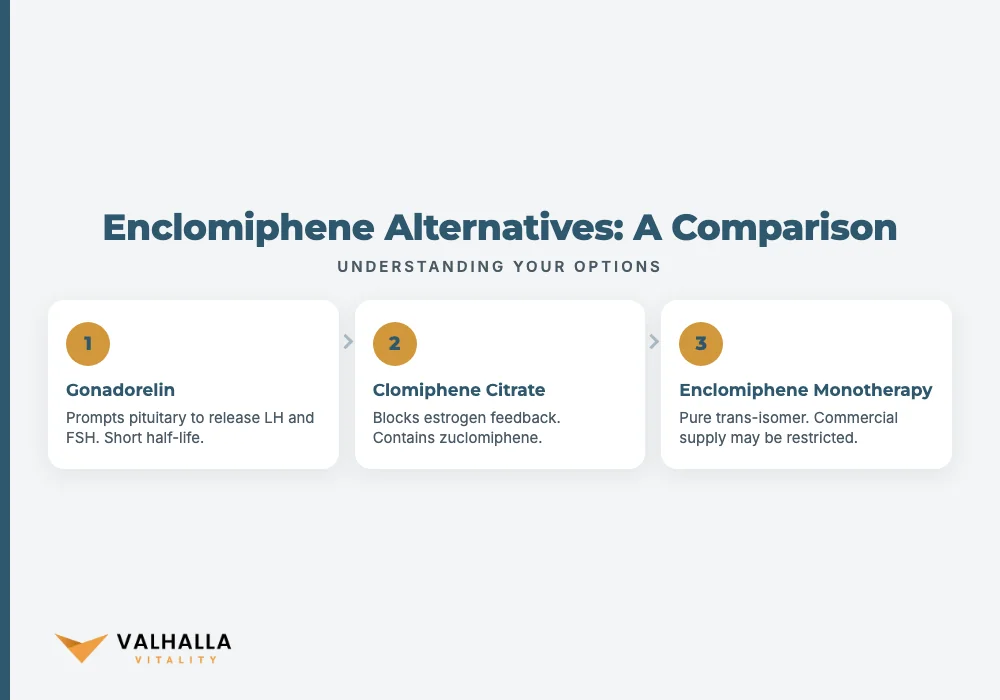
The most relevant enclomiphene alternatives all act on the hypothalamic-pituitary-gonadal (HPG) axis. Gonadorelin and clomiphene citrate are the two compounds most commonly used for this purpose. Here is how they compare.
| Compound | Mechanism | Key consideration |
|---|---|---|
| Gonadorelin | GnRH analog; prompts the pituitary to release LH and FSH | Half-life of ~4 minutes; needs pairing to sustain effect |
| Clomiphene citrate (low dose) | Blocks estrogen feedback; raises LH and FSH | Contains zuclomiphene; side-effect risk drops at lower doses |
| Enclomiphene monotherapy | Pure trans-isomer; raises LH and FSH | Commercial supply may become restricted |
These options all sit within a broader set of low testosterone treatment options, from gonadotropin-stimulating agents to full testosterone replacement. A licensed provider determines which category fits based on symptoms, labs, and whether fertility preservation is a factor.
Is gonadorelin a good replacement for hCG therapy?
The gonadorelin vs hCG comparison centers on where in the hormonal axis the intervention is placed. Gonadorelin is a credible alternative to human chorionic gonadotropin (hCG), though the two compounds target different levels of the same axis. HCG acts directly on testicular Leydig cells, mimicking LH to stimulate local testosterone production. Gonadorelin, a gonadotropin-releasing hormone (GnRH) analog, acts upstream by prompting the pituitary to release both LH and FSH.
The pharmacological constraint is half-life. Short. A 2023 analysis published in the Journal of Pharmaceutical and Biomedical Analysis confirms gonadorelin's plasma half-life at approximately four minutes, with the compound clearing the body within roughly twenty minutes of subcutaneous administration (Torrini et al., 2023). That brevity limits what sublingual gonadorelin achieves as a standalone monotherapy.
Twice-weekly subcutaneous injections have produced modest results when gonadorelin is used alone. That limitation is why many providers pair it with low-dose clomiphene citrate. For men weighing the clinical case for HCG alternatives in men's hormone therapy, the combination approach addresses the half-life constraint directly: clomiphene sustains the pituitary stimulus between gonadorelin doses.
What is the difference between clomid and enclomiphene?
Clomiphene citrate (Clomid) is not a single compound. It is a racemic mixture: roughly 60% enclomiphene (the trans-isomer) and 40% zuclomiphene (the cis-isomer). That split defines the clomid vs enclomiphene comparison for men considering low-dose therapy.
Enclomiphene is the active driver. It blocks estrogen receptors at the pituitary, which releases the negative-feedback brake on gonadotropin production and raises LH and FSH output. Testosterone follows. Zuclomiphene carries mild estrogenic activity and has a longer half-life that leads to accumulation with repeated use. In men, zuclomiphene is associated with hot flashes and headaches, side effects that appear rarely when enclomiphene is used as a pure compound.
The 2025 EAU guidelines on male sexual and reproductive health recognize gonadotropin-stimulating agents, including clomiphene citrate, as an established treatment category for secondary hypogonadism in men who wish to preserve fertility (Salonia et al., 2025). That guideline-level recognition reinforces clomiphene's continued place among low testosterone treatment options even as the future of pure enclomiphene monotherapy remains uncertain. Research on clomiphene citrate for men with secondary hypogonadism consistently points to the enclomiphene isomer as the active driver of the LH response, which informs the conversation about clomid alternatives for men who want to preserve fertility while managing low testosterone.
For a full side-by-side breakdown of these two hormone therapies, the isomeric difference explains most of the divergence in side-effect profiles between clomid and enclomiphene citrate.
Can sublingual clomiphene replace enclomiphene monotherapy?
A sublingual microdose of clomiphene citrate combined with gonadorelin is among the most practical enclomiphene alternatives for men transitioning off monotherapy. At a low dose, the zuclomiphene fraction is reduced enough to limit its associated side effects. Enough enclomiphene remains to prime the pituitary response to gonadorelin. The two compounds reinforce each other.
Compounded sublingual troches can be produced at a cost comparable to enclomiphene capsules, which reduces the financial barrier to switching. The troche form can also be split, allowing the dose to be distributed across morning and evening to maintain more consistent hormone signaling throughout the day.
This option is particularly relevant for men who experienced side effects on full-dose clomiphene in the past or who want a formulation with more dosing flexibility than a standard capsule. A licensed provider determines the dose after reviewing labs and confirms the therapy is appropriate for the patient's state and clinical profile.
What happens to my treatment if enclomiphene is discontinued?
Discussions about ending commercial production of pure enclomiphene citrate as a standalone compound have circulated among practitioners. No definitive regulatory action had been confirmed as of this writing. Enclomiphene is a clinically established constituent of clomiphene citrate, which gives the compound a recognized regulatory footing even if standalone enclomiphene products face supply constraints.
Men on enclomiphene monotherapy have two clear options if supply becomes restricted. Transitioning to a compounded sublingual gonadorelin-clomiphene combination through a licensed US compounding pharmacy preserves the core hormonal stimulus at a similar price. For men further along in treatment whose response to monotherapy has diminished, a broader conversation about low testosterone treatment options, including testosterone replacement, may be warranted.
Treatment continuity is achievable. Understanding the clinical case for enclomiphene in secondary hypogonadism before a supply disruption occurs gives men a clearer starting point for that conversation.
Availability varies by state. The team at Valhalla Vitality works within a provider-led telehealth model to support men navigating these transitions.
Ready to explore your options?
When you are ready to understand which enclomiphene alternatives or hormone management approaches fit your situation, Book Your Consultation to start a licensed provider review of your intake and labs.
FAQ
What are the main enclomiphene alternatives for low testosterone?
The two most clinically used enclomiphene alternatives are low-dose clomiphene citrate and sublingual gonadorelin, often combined in a compounded troche. Both stimulate the body's own LH and FSH production rather than replacing testosterone directly. A licensed provider determines which fits your labs and goals.
What is the difference between clomid and enclomiphene?
Clomiphene citrate is roughly 60% enclomiphene and 40% zuclomiphene. Enclomiphene raises LH and FSH with fewer side effects in men; zuclomiphene has mild estrogenic activity and is associated with hot flashes and headaches at standard doses. Low-dose clomiphene reduces zuclomiphene exposure while retaining the testosterone-stimulating effect.
Is gonadorelin a good alternative to hCG?
Gonadorelin stimulates the pituitary to release LH and FSH, while hCG acts directly on the testes. Its half-life of roughly four minutes means it clears the body quickly, so it works better when paired with a complementary compound. A licensed provider can assess which option fits your fertility and testosterone goals.
Can sublingual clomiphene replace enclomiphene monotherapy?
A sublingual microdose of clomiphene citrate combined with gonadorelin may support a smooth transition for men coming off enclomiphene monotherapy. The compounded troche can be split for morning and evening use to maintain more consistent hormone signaling. A licensed provider determines the dose after reviewing labs.
What happens if enclomiphene production is discontinued?
Men can transition to low-dose clomiphene citrate with or without gonadorelin through a licensed US compounding pharmacy. The goal of stimulating natural testosterone production remains achievable through these alternatives. Providers who prescribe enclomiphene are familiar with these transition paths.
Sources
- Torrini F et al. (2023). Advances and perspectives in the analytical technology for small peptide hormones analysis: A glimpse to gonadorelin. Journal of Pharmaceutical and Biomedical Analysis. PubMed
- Salonia A et al. (2025). European Association of Urology Guidelines on Male Sexual and Reproductive Health: 2025 Update on Male Hypogonadism, Erectile Dysfunction, Premature Ejaculation, and Peyronie's Disease. European Urology. PubMed
You May Also Like
 Enclomiphene, Featured
Enclomiphene Boost Testosterone: What Men Should Know
Enclomiphene boost testosterone by stimulating your body's own HPG axis. Learn how it affects free T, libido, sperm count, and how it compares to TRT.
October 1, 2026 ETRead more → Enclomiphene, Featured
Enclomiphene and DHEA Together: How This Combo Works
Enclomiphene and DHEA together may support testosterone levels naturally. Learn how enclomiphene SERM therapy works with DHEA supplementation.
September 24, 2026 ETRead more →
Enclomiphene Prostate Cancer: PSA, BPH & Safety Guide
Enclomiphene prostate cancer risk explained: how PSA monitoring works, how it compares to TRT, and what men with BPH need to know before starting.
October 21, 2026 ETRead more →