
The following blog post is for entertainment and informational purposes only. It is not intended to provide medical advice or diagnosis. Please consult your doctor before making any health-related decisions.
Men who train seriously and search for trt bodybuilding dosage answers are usually looking for a specific number. That number does not exist in any clinically responsible form. Testosterone replacement therapy is a medically supervised process built around individual lab results, health history, and symptoms reviewed by a licensed provider, and a licensed provider determines the dose after reviewing bloodwork rather than applying a generic figure from a forum post.
!TRT bodybuilding dosage: provider-guided testosterone therapy vs self-directed use-01M0YAFDS9AVW6YFVGS2639DXS.webp)
Why men chasing muscle goals look into TRT dosing
Testosterone directly influences muscle protein synthesis, recovery capacity, and energy during intense training. It is not surprising that men who hit persistent plateaus or notice unusual fatigue start researching trt bodybuilding dosage guidance. The instinct is logical. The information they typically find, however, often isn't.
Most dosage figures circulating online were never reviewed by a licensed provider. Numbers get repeated across forums and social media with no connection to the underlying lab work or individual health context that makes them clinically meaningful. Testosterone naturally declines as men age, which creates a legitimate medical question for many men in their late thirties and beyond, and that question is fundamentally different from the performance-first framing that dominates most online dosage discussions.
A 2024 review by Van Every et al. in Exercise and Sport Sciences Reviews examined how endogenous hormones affect exercise-induced muscle hypertrophy. Their analysis found the relationship between testosterone and muscle gain is real, but more nuanced than a simple dose-response model. Individual biology, training load, and recovery quality all shape the outcome. No dosage figure captures that complexity.
Standard TRT vs bodybuilding-style dosing: what separates them
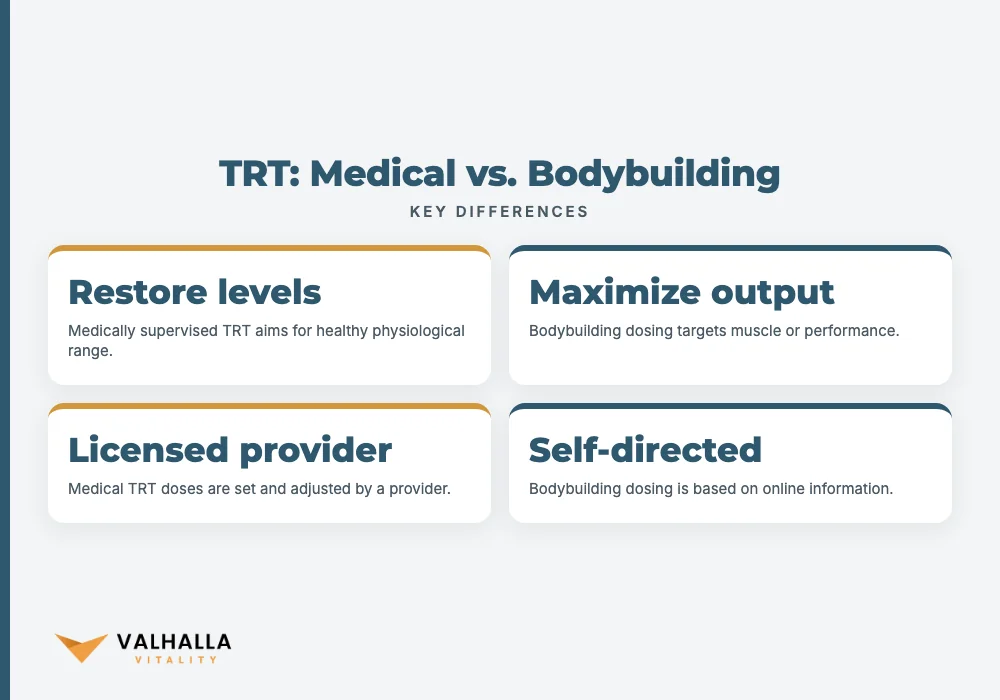
Any serious discussion of trt bodybuilding dosage starts with recognizing that two fundamentally different systems are involved.
| Feature | Medically supervised TRT | Bodybuilding-style dosing |
|---|---|---|
| Primary goal | Restore levels to a healthy physiological range | Maximize muscle or performance output |
| Starting point | Comprehensive baseline labs reviewed by a licensed provider | Typically no baseline labs |
| Dose decisions | Set and adjusted by a licensed provider based on results | Self-directed, based on anecdotal online information |
| Ongoing monitoring | Structured follow-up labs: CBC, estradiol, lipids | Usually absent |
| Safety response | Adjustments triggered by out-of-range lab findings | No structured mechanism to identify changes |
These two approaches are not variations on the same theme. One is a clinical therapy with defined safety infrastructure. The other removes that infrastructure by design, which is precisely where the risk originates.
Men who notice persistent fatigue, reduced drive, or slower recovery are better served by recognizing the early symptoms that lead men to ask about TRT than by jumping straight to dosage questions. Knowing whether symptoms connect to measurable hormonal changes is where that conversation should start.
How much testosterone do bodybuilders actually take?
Bodybuilder testosterone levels in performance-focused contexts typically run well above what any licensed provider would prescribe for replacement therapy alone. The 2018 Endocrine Society Clinical Practice Guideline, authored by Bhasin et al. and published in the Journal of Clinical Endocrinology and Metabolism, defines the goal of TRT as restoring testosterone to the mid-normal physiological range for that individual. Not exceeding it.
That boundary is not arbitrary. It reflects where therapeutic benefit and cardiovascular safety converge in the published evidence. Elevated red blood cell counts, shifts in lipid markers, and suppression of natural testosterone production all become more likely as levels are pushed above the physiological range. Without structured lab monitoring, those changes develop without early detection.
A licensed provider determines the dose after labs. That principle separates safe testosterone levels for men in a clinical setting from the numbers that circulate in performance communities, and it is the most important element missing from most online trt bodybuilding dosage discussions.
What is the difference between TRT and steroid use?
TRT vs steroids comparisons come up constantly, and the clinical distinction deserves a plain answer.
TRT is a medical therapy. A licensed provider prescribes it to men whose lab work confirms low testosterone. The 2018 Endocrine Society guidelines by Bhasin et al. specify that TRT should be offered to men with both clinical symptoms and repeat lab confirmation of low testosterone levels. The therapy uses physiological replacement doses, requires structured monitoring, and is adjusted based on how each individual responds over time.
Anabolic steroid use for performance enhancement occupies a separate clinical category. It typically involves doses well above replacement levels, pursued without a diagnosis, without a provider, and without lab monitoring. A peer-reviewed review of anabolic-androgenic steroid misuse published in the Journal of Sports Medicine documented that misuse patterns differ substantially from supervised replacement protocols in dose magnitude, cycling behavior, and associated health risks.
The confusion between TRT and steroids is understandable. Both involve exogenous testosterone. But the goals, dose levels, clinical oversight, and intended populations differ in ways that make conflating them a meaningful clinical problem. That distinction also explains why a credible discussion of trt bodybuilding dosage cannot simply offer a number: what is appropriate depends entirely on whether someone has confirmed low testosterone, which only lab work and a licensed provider can determine.
Can TRT help with muscle building and strength?
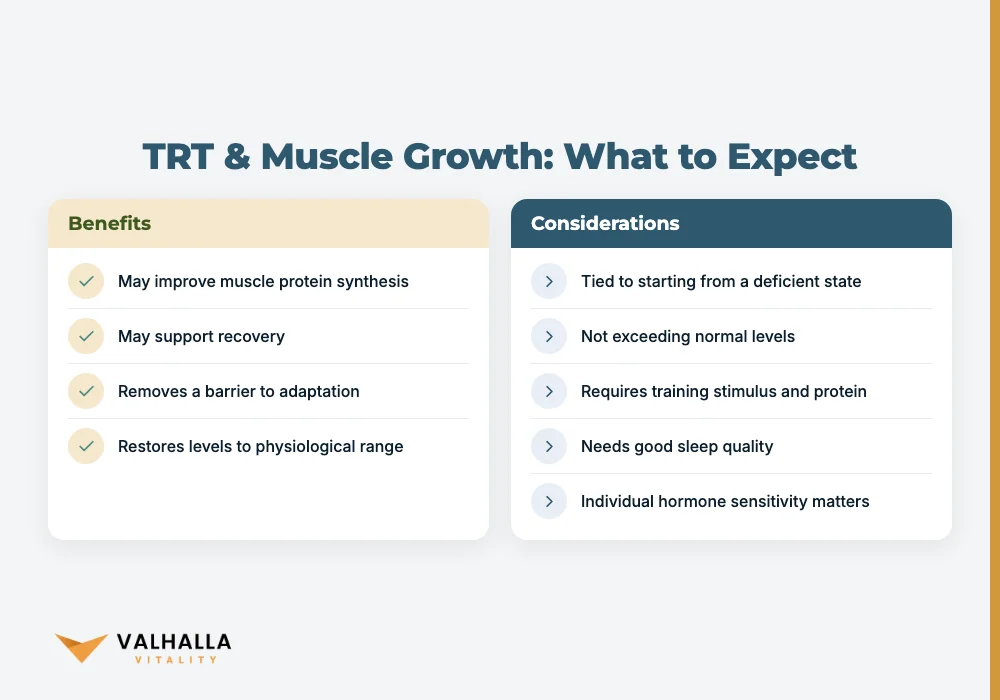
Yes, for men with confirmed low testosterone, testosterone replacement muscle gain is a documented effect. Restoring levels that have declined below the physiological range may support improvements in muscle protein synthesis and recovery as a natural consequence of normalizing the hormonal environment. The effect is tied to starting from a deficient state, not to exceeding normal levels.
A 2024 systematic review and meta-analysis by Corona et al. in Expert Opinion on Drug Safety reviewed the cardiovascular safety of testosterone replacement therapy across a broad body of published literature. Their findings indicated that, in men with confirmed low testosterone receiving guideline-appropriate care, TRT carries a different risk and benefit profile than the supraphysiological dosing associated with anabolic steroid misuse. Properly monitored therapeutic doses do not carry the cardiovascular concerns sometimes attributed to performance-level use.
What the research says about testosterone and hypertrophy
Van Every et al. (2024), reviewing hormonal influences on exercise-induced hypertrophy in Exercise and Sport Sciences Reviews, found that testosterone for muscle growth contributes to adaptation but does not operate as an isolated lever. Training stimulus, protein availability, sleep quality, and individual hormone sensitivity all interact. Optimizing testosterone in someone who is genuinely deficient removes a barrier to adaptation. It does not override the need for every other variable to function well.
This framing matters for anyone thinking about provider-guided TRT with muscle or strength goals in mind. Medically supervised testosterone brings levels back to the physiological range. For men with confirmed low testosterone, that restoration may translate into real changes in body composition and training recovery over time. For men already within the normal range, replacement dosing is unlikely to produce dramatic gains on its own.
Understanding what healthy testosterone levels look like during active TRT helps calibrate those expectations accurately. A licensed provider tracks progress against a target range rather than chasing a peak number.
!Testosterone for muscle growth: what safe testosterone levels look like under medically supervised TRT-01M0YAFVA2KFW2AQCJYDEE3Z99.webp)
What are the risks of unsupervised testosterone dosing?
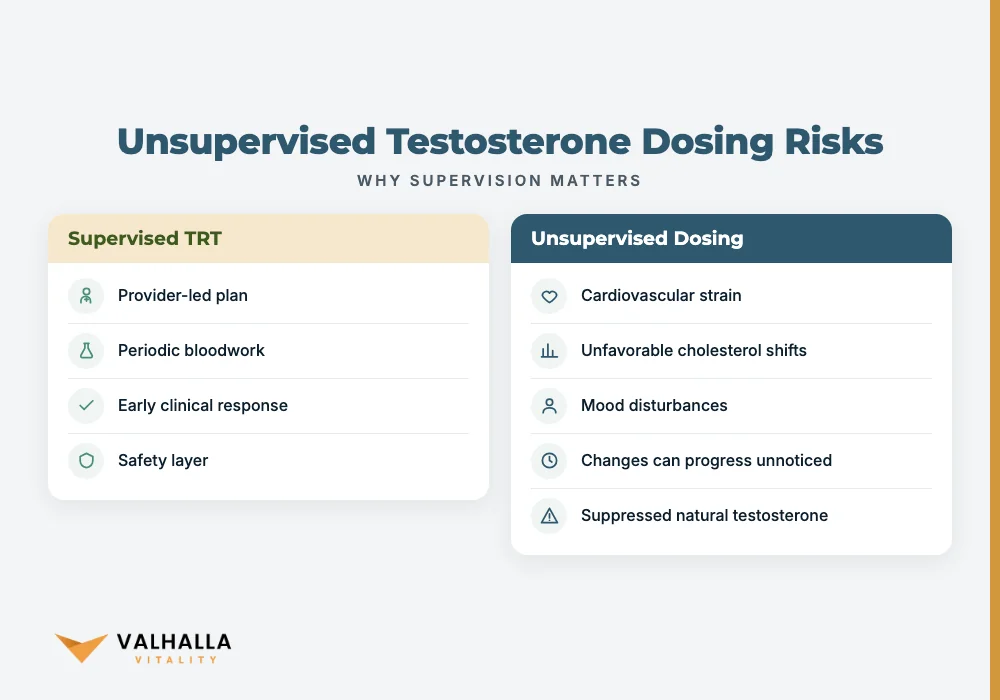
Pursuing trt bodybuilding dosage approaches outside a clinical framework removes the safety layer that makes testosterone therapy manageable. According to the National Institute on Drug Abuse, nonmedical use of anabolic steroids and related performance-enhancing substances has been associated with cardiovascular strain, unfavorable cholesterol shifts, and mood disturbances.
The Cleveland Clinic's overview of anabolic steroid risks and a peer-reviewed review published in the Journal of Sports Medicine identify the following concerns that become more likely without structured lab monitoring:
- Elevated red blood cell counts that can increase cardiovascular strain over time. In a supervised setting, a provider catches this through periodic bloodwork and responds before it compounds.
- Suppressed natural testosterone production. The Journal of Sports Medicine review found that sperm production can take months to recover in some cases after cessation of above-therapeutic dosing.
- Lipid and cholesterol markers can shift in an unfavorable direction during sustained above-range exposure, a pattern documented in the Cleveland Clinic's overview of anabolic steroid risks.
- Mood, sleep quality, and skin health may change. Irritability and acne are among the commonly reported effects in published literature.
- Without lab monitoring, none of these changes triggers an early clinical response, and they can progress before the person notices anything measurable.
These findings describe higher-dose, non-medical steroid use rather than supervised replacement therapy at physiological levels. They do not automatically define the risk profile of medically supervised TRT. What they illustrate clearly is why self-directed performance dosing carries risks that a structured, provider-led approach is specifically designed to detect and address early.
Why TRT bodybuilding dosage cannot be a universal number
There is no dosage that produces identical results in every man. Testosterone metabolism, receptor sensitivity, baseline lab values, and overall health status vary substantially between individuals. A dose that brings one person's levels into the healthy physiological range may push another's above it, or fall short entirely. That variation is why a credible provider-guided TRT evaluation relies on individual lab data rather than population averages or community norms.
A provider-led evaluation typically starts with comprehensive baseline bloodwork: total testosterone, free testosterone, a complete blood count, and a lipid panel. A licensed clinician reviews those results alongside reported symptoms and health history before recommending any treatment direction. Follow-up labs at structured intervals allow the provider to make data-driven adjustments as the individual's response becomes clear.
How testosterone naturally changes across the decades is part of that evaluation context as well. A provider who sees where someone is starting from, relative to what is typical for their age and health profile, makes better-calibrated decisions than any generic dosage recommendation could.
How do I get TRT if my goal is muscle gain?
The first step is confirming whether testosterone levels are actually below the healthy range, which requires baseline lab work reviewed by a licensed provider. TRT is a medical treatment for confirmed low testosterone, not a standalone performance protocol.
The evaluation involves more than a single consultation. It starts with a medical intake form and baseline lab panel. A licensed provider reviews both before recommending any treatment direction. Medically supervised testosterone is not dispensed based on a stated gym goal alone. The labs and the clinical picture together drive every decision.
If testosterone is confirmed low and relevant symptoms are present, therapy may be an appropriate option. If levels are within the normal range, TRT is unlikely to be the clinical recommendation regardless of muscle or fitness objectives.
Telehealth platforms like Valhalla Vitality that offer provider-guided TRT allow men to complete the intake and lab review process without an in-person clinic visit. Availability varies by state. A licensed provider reviews all intake information and determines whether therapy is clinically appropriate before any prescription is issued.
For men who want to understand all available options before their first provider conversation, comparing the distinctions between testosterone injections and alternatives like enclomiphene can help frame a more focused discussion with a licensed clinician.
Talk to a provider about your TRT goals
For anyone ready to discuss their trt bodybuilding dosage questions with a licensed provider who can review individual labs, Book Your Consultation is the right first step.
FAQ
Is TRT bodybuilding dosage the same as standard testosterone replacement dosing?
No. Standard testosterone replacement therapy restores levels to a healthy physiological range based on confirmed low testosterone and individual lab results, while bodybuilding-style dosing typically targets supraphysiological levels without a clinical indication, provider oversight, or structured monitoring. These two approaches carry different risk profiles and are not interchangeable.
Can TRT help with muscle building and strength?
Testosterone replacement muscle gain is a documented effect in men with confirmed low testosterone, as restoring hormonal levels to the physiological range may support improvements in muscle protein synthesis and recovery capacity. For men whose testosterone is already within the normal range, replacement dosing is unlikely to produce dramatic strength gains on its own. A licensed provider can assess individual lab results and set accurate expectations.
What are the risks of unsupervised testosterone dosing?
Unsupervised use at above-therapeutic levels has been linked to elevated red blood cell counts, suppressed natural testosterone production, and unfavorable lipid changes, according to the National Institute on Drug Abuse and a peer-reviewed review published in the Journal of Sports Medicine. Without lab monitoring, these changes can progress undetected. A licensed provider running periodic labs is positioned to catch early warning signs before they compound.
How does a provider decide on the right TRT dosing approach?
A licensed provider reviews baseline labs including total and free testosterone, a complete blood count, and lipids before recommending a starting approach. The 2018 Endocrine Society guidelines by Bhasin et al. specify that TRT should be offered only to men with both clinical symptoms and confirmed low testosterone on repeat testing. Follow-up labs at structured intervals drive all subsequent adjustments.
How is TRT different from anabolic steroid use?
TRT is a medical therapy prescribed at physiological replacement doses to men with confirmed low testosterone, with structured lab monitoring built into the protocol. Anabolic steroid use for performance typically involves supraphysiological doses without a medical indication, a licensed provider, or lab oversight. The dose level, clinical rationale, and risk profile differ substantially, as documented in a peer-reviewed review of steroid misuse published in the Journal of Sports Medicine.
Sources
- Van Every DW et al. (2024). Hormones, Hypertrophy, and Hype: An Evidence-Guided Primer on Endogenous Endocrine Influences on Exercise-Induced Muscle Hypertrophy. Exercise and Sport sciences reviews. PubMed
- Corona G et al. (2024). Cardiovascular safety of testosterone replacement therapy in men: an updated systematic review and meta-analysis. Expert opinion on drug safety. PubMed
- Bhasin S et al. (2018). Testosterone Therapy in Men With Hypogonadism: An Endocrine Society Clinical Practice Guideline. The Journal of clinical endocrinology and metabolism. PubMed
- National Institute on Drug Abuse. Anabolic Steroids and Other Appearance and Performance Enhancing Drugs (APEDs). NIDA
- Cleveland Clinic. Anabolic Steroids. Cleveland Clinic
- Anabolic-Androgenic Steroid Misuse: Mechanisms, Patterns of Misuse, User Typology, and Adverse Effects. Journal of Sports Medicine. PMC
You May Also Like

What Are Research Peptides? Definition, Uses and Labeling
Research peptides are sold 'for research use only' but are not approved by the FDA for human use. This guide explains the label, risks, and the safer path.
October 26, 2026 ETRead more → Spermidine
 Anti Aging: Mechanisms, Benefits & Science
Spermidine anti aging: discover how this polyamine activates autophagy, supports mitochondrial health, and may slow cellular aging processes.
October 25, 2026 ETRead more → Semaglutide
Tirzepatide vs Semaglutide: Weight Loss Results Compared
Tirzepatide vs semaglutide compared: mechanisms, real-world weight loss data, side effects, and cost. Find which GLP-1 therapy fits your needs.
October 25, 2026 ETRead more →